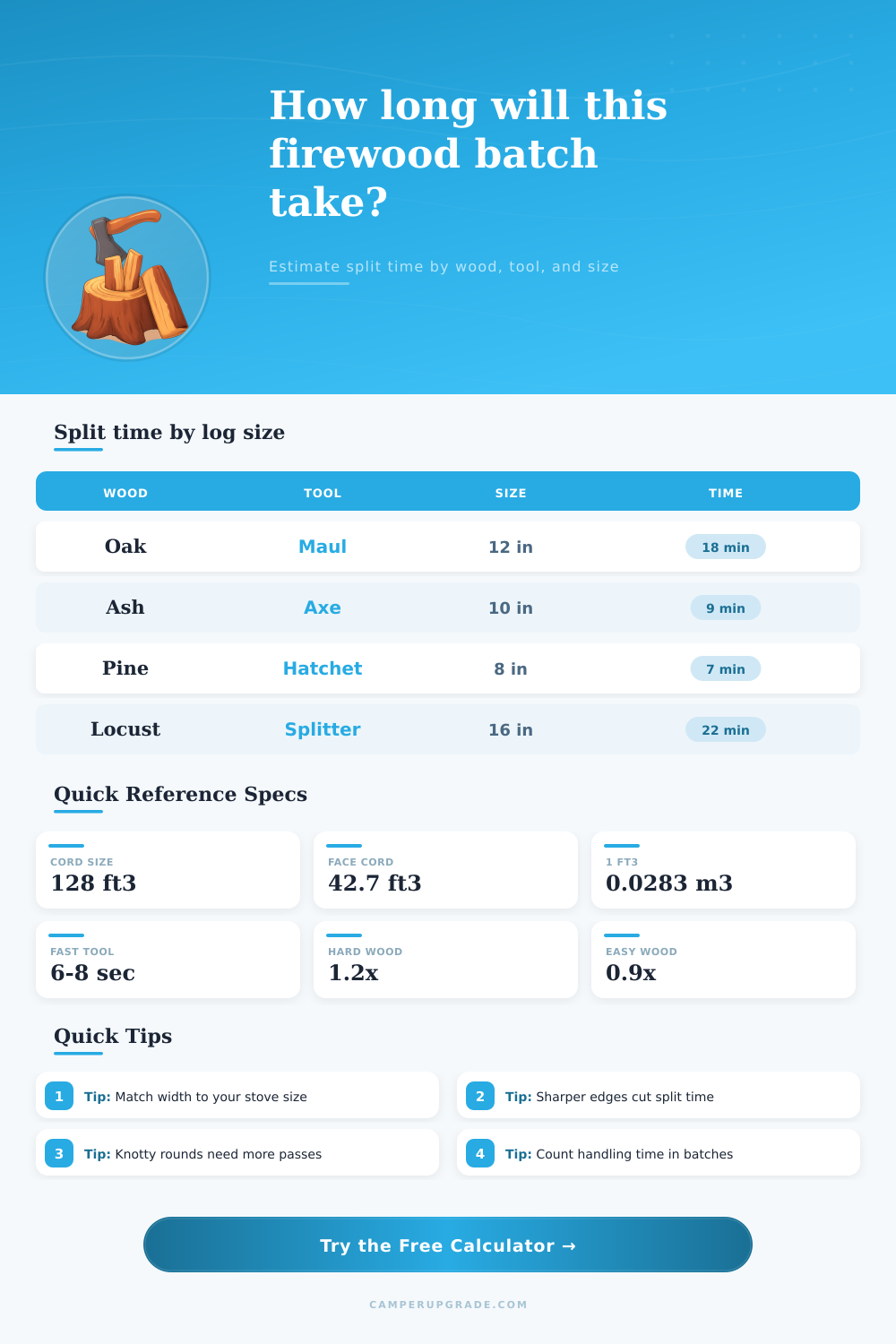
🌲 Firewood Split Time Calculator
Estimate how long a batch of rounds will take to split using species, tool type, grain quality, and log size.
| Tool | Base sec | Handling | Best note |
|---|
| Species | Density | Split factor | Note |
|---|
| Round size | Pieces | Time per log | Use case |
|---|
| Batch | Logs | Hours | Note |
|---|
Splitting firewood require planning because the time that it takes to split the firewood depends on several differance factors. Factors to consider include the type of wood that is to be split, the tools that will be used to split the firewood, and the size of the batches of firewood that is to be split. If you dont carefuly consider the factors, the time that will be required to split the firewood will likely be underestimated, and underestimating the time that will be required will result in the splitting of the wood taking longer then was intended by the individual splitting the wood.
The type of wood that is to be split is one of the main factor to consider when splitting the firewood. The density of the wood will determine the type of effort that is required to split the firewood. For instance, hardwoods like oak or hickory are the densest types of wood, so more effort will be required to split these type of logs compared to softwoods like pine or spruce, which are the least dense types of wood.
How Long It Takes to Split Firewood
Additionally, the moisture content of the wood will impact the ease with which you can split the firewood. Wet wood is more difficult to split than dry wood, so firewood with high moisture content will require more time to split than dry wood. Finally, the grain of the wood will impact the splitting of the firewood; wood with straight grain is more easy to split than wood that has knots or twists in its grain, which will require changes in the angle of the splitting of the firewood.
The tools that will be used to split the firewood will also impact the time that it take to split the firewood. For example, splitting maul are the strongest tools and are effective at splitting dense woods like oak or hickory. Axes are the light tools that are used to split softwoods efficiently.
Wedges can be used to split stubborn piece of firewood, but using wedges will slow the splitting of the firewood, as a sledgehammer will be required to push the wedges into the log. Finally, powered wood splitter can split the wood much faster than an individual using a maul or axe to split the firewood; however, the powered splitter still take some time to split the firewood. The size of the batches of firewood that is to be split is another factor that will impact the time it takes to split the firewood.
For instance, more time will be required to split firewood if it will take longer to flip the round of firewood that are to be split, or if it will take longer to step around each batch of firewood. The diameter of each round of firewood will impact the number of split of firewood that are produced; the larger the diameter of the rounds of firewood, the more piece of firewood that will be split. Finally, the width of the splits of firewood should be considered; splits that are too narrow will waste some of the firewood, but splits that are too wide may prevent the firewood from being able to fit into the stove in which the firewood is to be burn.
Some ways to increase the efficiency of splitting firewood include ensuring that the tool are sharpened. Splitting tools that are not sharpened will waste energy when splitting the firewood; sharp tools will allow the tools to split the firewood without wasting any energy. Additionally, ensuring that the body is in the proper stance when splitting the firewood will help to split the firewood and avoid any physical strain on the body.
Finally, splitting session should include break every ninety minutes to avoid fatigue; after splitting firewood for ninety minutes, an individual will become fatigue, which will slow the splitting of the firewood. Additionally, if an individual has a helper, there helper can increase the rate at which firewood is split; while the individual is splitting the firewood, their helper can be stacking the firewood, thus allowing both individual to split the firewood at the same time. Finally, math and planning can be used to determine how long splitting will take.
For instance, the worker will calculate the time that will be required to split hardwoods in advance of the work, as hardwoods will take more time to split than softwoods. Additionally, the batches of firewood that are to be split should be planned according to the type of wood that will be split; planning according to the type of wood will ensure that an individual is not surprised by the difficulty of splitting the firewood. Thus, by considering each of these different factor, an individual can create an accurate plan for splitting their firewood.