🪵 Firewood Cost per BTU Calculator
Estimate the delivered heat value of firewood by species, cord price, cord fraction, delivered stack volume, moisture content, and usable appliance efficiency.
⚡ Purchase Presets
📋 Firewood Inputs
📊 Comparison Grid
Selected Purchase
Full Cord Equivalent
Mode Reality Check
🌳 Heat Value Grid
Planning values vary by region and species mix; use your seller's listed species when possible.
📘 Species Reference Table
| Wood species | Gross MMBtu per cord | Relative heat | Typical camp use |
|---|---|---|---|
| Hickory | 27.5 | Very high | Long stove burns, cooking coals |
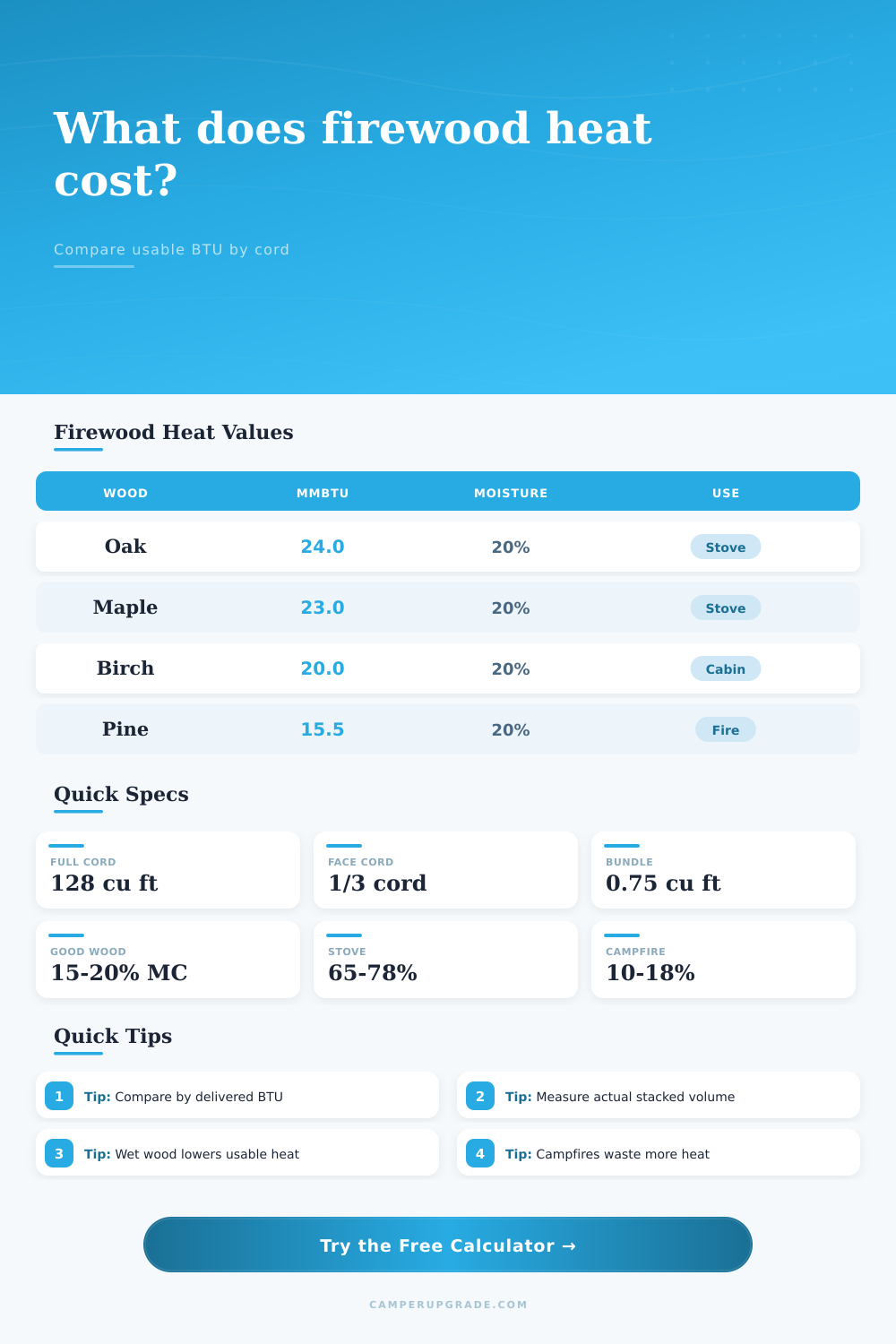
| White/red oak | 24.0 | High | Cabin heat, overnight stove loads |
| Hard maple | 23.0 | High | Clean steady heat |
| Ash | 22.6 | High | Quick-seasoning shoulder wood |
| Douglas fir | 20.7 | Medium | Camp cabins and shoulder nights |
| Cherry | 20.4 | Medium | Fireplace ambience, mild heat |
| Birch | 20.0 | Medium | Easy-starting cabin fires |
| Black walnut | 20.2 | Medium | Small stove loads |
| Pine | 15.5 | Low | Campfires, kindling, quick heat |
| Poplar/aspen | 14.7 | Low | Mild campfire fuel |
📦 Purchase Volume Table
| Purchase type | Cord fraction | Stacked volume | Notes for BTU math |
|---|---|---|---|
| Full cord | 1.000 | 128 cu ft | Baseline for most published heat values |
| Half cord | 0.500 | 64 cu ft | Useful for seasonal cabin trips |
| Face cord | 0.333 | About 43 cu ft | Assumes 16 inch logs in a 4 x 8 row |
| Quarter cord | 0.250 | 32 cu ft | Common pickup or short-stack purchase |
| Retail bundle | 0.006 | 0.75 cu ft | High markup, convenient for campgrounds |
🔥 Mode Efficiency Table
| Mode | Typical usable efficiency | Best comparison unit | Why it matters |
|---|---|---|---|
| Open campfire | 10% to 18% | Cost per evening | Most heat leaves the campsite air column |
| Open fireplace | 10% to 20% | Cost per ambience hour | Draft loss can exceed useful room heat |
| Contained fire pit | 15% to 25% | Cost per shared fire | Wind protection improves radiant comfort |
| Rocket stove/camp cooker | 30% to 45% | Cost per cooking BTU | Focused flame uses small wood efficiently |
| EPA wood stove | 65% to 78% | Cost per useful MMBtu | Most relevant for cabin or camper heat |
🌡 Moisture Adjustment Table
| Moisture content | Calculator heat factor | Burn behavior | Planning note |
|---|---|---|---|
| 10% to 14% | About 102% | Very dry, fast lighting | May burn quicker in open air |
| 15% to 20% | 100% to 101% | Seasoned, efficient | Preferred comparison range |
| 25% | About 96% | Steam loss starts to show | Expect weaker stove output |
| 30% | About 91% | Hisses, smolders, slower heat | Delivered BTU cost rises quickly |
| 40%+ | Under 83% | Wet fuel, poor fire quality | Usually not worth premium pricing |
🧭 Calculation Tips
How to Calculate Real Firewood Value
Don’t make the mistake of purchasing firewood without factoring in its actual heat value; it’s like purchasing gas without reading the octane rating. This is the metric that determines whether you’re getting what you paid for.
How to Find Real Firewood Value
A full cord of oak will be pricier then a cheap face cord of pine, yet oak has a lot more usable warmth compared to pine. Unfortunatly most folks only consider sticker price by the load and that’s where they go wrong. Cost-per-usable-British-Thermal-Unit is the metric.
Once you know the stove efficiency, the wood moisture content, and wood type, calculator above takes care of the rest. Don’t waste your time guessing how much money you burn in your chimney.
First and most important: Wood isn’t all alike. A cord of poplar won’t contain as much energy as a cord of hickory. That’s physics meets biology. Because hardwoods is denser, there’s more mass of fuel in each volume of wood. If you’re heating your cabin, density beats price.
And here’s where things get confusing, volume. Depending on who you buy from, “cord” mean something very different. When someone says they are selling a full cord, that means 128 cubic feet. This is not the case for face cord. Often it’s simply a row of wood with no assurance of its depth. If you don’t know how deep those logs are, you’ve got no clue about amount of heat you’re purchasing. The chart on this page makes it clear (often), a face cord is only a fraction (a third!) of an actual cord.
The only way you’ll know how much you’re getting is to measure what volume of wood has been stack.
Don’t forget the silent budget killer, which is moisture content. Your stove burn fuel to turn that moisture into nothingness (water) so the fuel can produce heat. That wasted energy never enters your room. It merely escapes as steam up the flue. If your firewood contains 30 percent moisture, you’re losing a considerable portion of available heat. You should of aim for seasoned wood with less than 20 percent moisture, so check your wood’s moisture levels with a meter if you can. If the guy selling the wood doesn’t season it, you’re paying to do his job.
The calculator accounts for this lost heat and shows you how much heat are lost each time moisture increases. A tiny thing, yes, but it adds up.
The other side of the coin is efficiency. An open fireplace look romantic but is very inefficient. All that heat just goes right up the chimney. A good EPA-certified wood stove will captures so much more of that heat. If you’re using a campfire to keep warm, it’s very inefficient. The warmth radiates out into air, not into any room. You have to burn a lot more wood to be kept warm. That’s why the tool lets you choose what kind of appliance you use; that reflects how efficient you are. It doesn’t make sense to compare a campfire burn with a stove burn and not adjust for efficiency. Those aren’t the same units of comfort.
Quality counts too. If it’s stacked loose, that’s money spent on air. The calculator includes a factor for how loosely the wood is stack. The wood isn’t neatly packed into your truck bed, so your actual volume decrease. You’re getting less wood but paying the same amount. Before writing any check, examine the stack tightness. Neat stacks will earn you more money than messy stacks of the same size.
Lastly, consider how you’ll be using it. Do you want something to keep you warm throughout the night this winter, or simply want to cozy up next to the fire for a few hours one evening? If it’s for continuous use, softwoods will light up hot but go out fast; hardwoods will produce coals and last longer. If you need something quick, softwood again wins. That’s where knowing your goal comes in, and then the heating hour estimate from the calculator can help you figure out if you’re prepared for that long, cold night coming up.
And remember, it isn’t so much “buying wood,” as it is “buying heat.” When it comes to heating with firewood, the lowest priced wood on the rack may not be the lowest priced wood to burn. The one that’s going to give you the most bang for the buck isn’t necessarily the one with the lowest price tag.
Measure the stack; check the moisture content; consider your stove; check the species. The numbers will show which pile is indeed warm. And this is exactly why.