🌲 Firewood BTU Per Pound Calculator
Estimate net heat from firewood by species, moisture, split quality, bark, and burn efficiency.
📋Quick Presets
🧮Calculator Inputs
Enter the mass of the stack, tote, or sample you want to rate.
20% means 20 lb of water per 100 lb of oven-dry wood.
Represents how much of the fuel energy becomes useful heat.
📋Quick Comparison Grid
🌳Species Heat Reference
| Species | Dry BTU/lb | Seasoned cord lb | Heat note |
|---|---|---|---|
| White oak | 8600 | 3800 | Long, steady heat |
| Red oak | 8550 | 3600 | Dense and reliable |
| Hickory | 8800 | 3900 | Very high output |
| Hard maple | 8500 | 3400 | Balanced burn |
| Ash | 8300 | 3000 | Easy startup |
| Beech | 8400 | 3700 | Dense stove fuel |
| Birch | 8400 | 3200 | Quick ignition hardwood |
| Pine | 7900 | 2200 | Fast-start softwood |
| Cedar | 7300 | 1900 | Quick kindling |
| Poplar | 7300 | 2100 | Low-density heat |
💧Moisture Impact Table
| Moisture | Dry frac. | Net BTU/lb | Use case |
|---|---|---|---|
| 0% MC | 1.00 | 8600 | Oven dry |
| 10% MC | 0.91 | ~7600 | Very dry |
| 20% MC | 0.83 | ~7000 | Good stove fuel |
| 30% MC | 0.77 | ~6300 | Still wet |
| 40% MC | 0.71 | ~5700 | Greenish stack |
| 60% MC | 0.63 | ~4700 | Fresh split |
| 80% MC | 0.56 | ~4000 | Recently cut |
| 100% MC | 0.50 | ~3400 | Very green |
🔧Split and Seasoning Factors
| Condition | Factor | Behavior | Best use |
|---|---|---|---|
| Rounds / unsplit | 0.94 | Slow drying | Outdoor stack |
| Chunky splits | 0.98 | Moderate airflow | Long burns |
| Standard splits | 1.00 | Balanced burn | General heat |
| Small splits | 1.03 | Faster ignition | Shoulder season |
| Kindling | 0.92 | Quick flash | Fire start |
| Fresh cut | 0.90 | High steam loss | Not ideal |
| One season | 0.96 | Mostly dry | Heat stack |
| Two seasons | 1.00 | Stable fuel | Best all-around |
📈Energy Benchmarks
| Benchmark | Typical value | Units | Note |
|---|---|---|---|
| Oven-dry wood | ~8600 | BTU/lb | Chemical basis |
| Seasoned oak cord | ~22-28 | MMBtu/cord | Species dependent |
| Seasoned softwood cord | ~15-20 | MMBtu/cord | Lower density |
| Water evaporation | 970 | BTU/lb water | Moisture loss |
| 1 BTU | 1.055 | kJ | Metric bridge |
| 1 MMBtu | 1.055 | GJ | Large heat load |
| 1 lb fuel | 0.45 | kg | Mass conversion |
| 1 cord | 128 | ft3 | Stack volume |
In order to understand how much heat a person can gets from firewood, it is first necessary to understand teh concept of BTU per pound. The BTU represent the amount of energy that is released from the burning of firewood. The amount of energy that firewood contain is dependent upon a few different factor, such as the type of wood that is burned and the moisture content of the firewood.
For instance, hardwoods like hickory are dense in their structure, meaning that they contain more energy per pound than softwoods like pine. However, although pine will readily ignite when placed in a fire, the soft wood will not retain as much heat as the hardwoods due to a lower density of the pine logs. Another factor that can impact the amount of heat that is released from firewood is moisture content.
How Much Heat Comes from Firewood and What Affects It
The moisture content of firewood is typicaly expressed as a percentage of how much water is contained within the firewood, relative to the weight of the dry wood. Thus, if the moisture content of firewood is twenty percent, five percent of the weight of firewood will be water. When a person burns firewood, energy from the fire is used to evaporate the water within the wood.
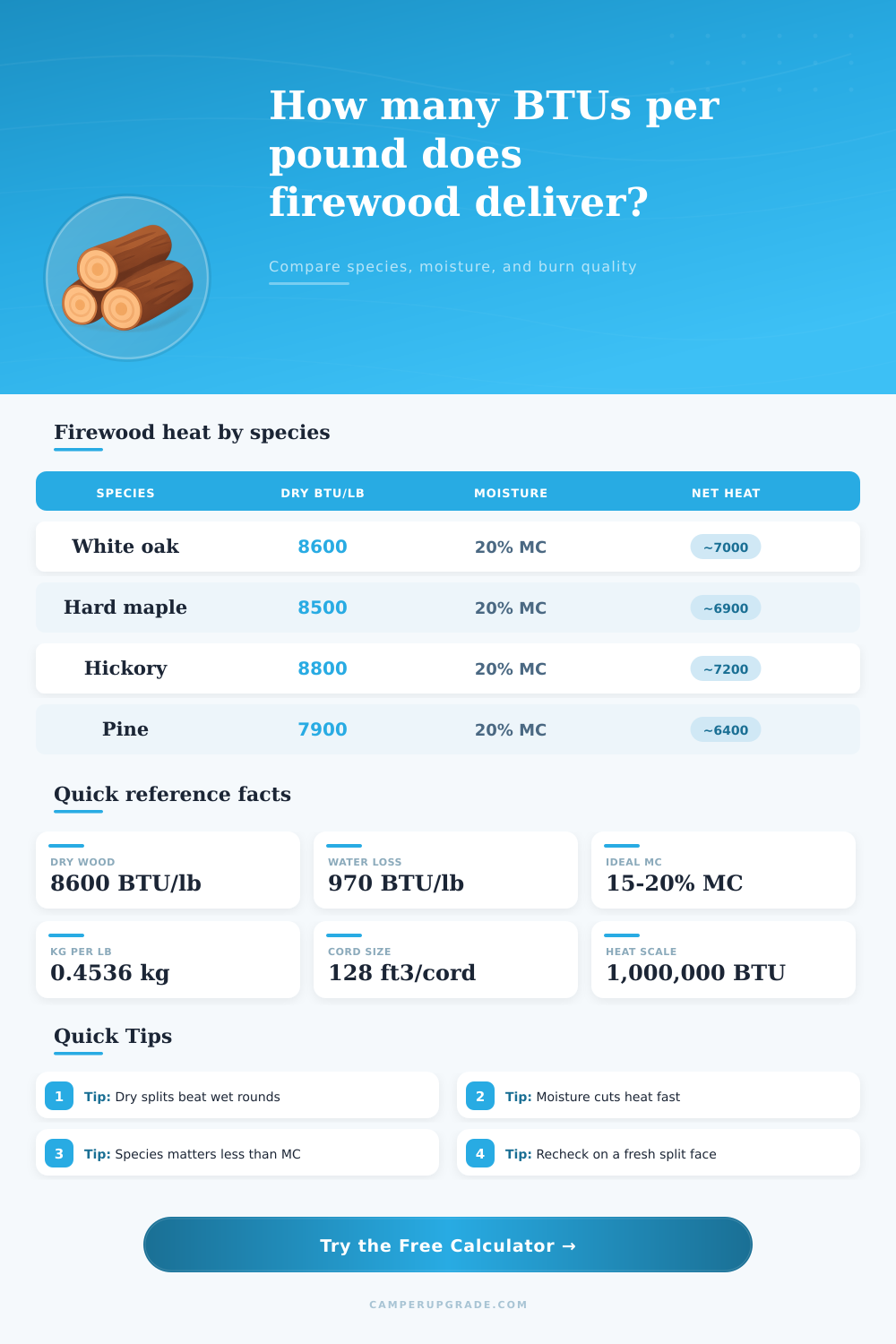
Evaporation of water consumes 970 BTU per pound of water. Thus, the energy available for heat that can warm a room will be less than the total amount of energy that is released by burning the wood. For instance, the energy content of perfect oak wood is 8,600 BTU per pound.
However, if the oak contains high levels of moisture, the amount of energy that the wood makes available to the surrounding area may drop to 7,000 BTU per pound or less. Aside from the type of firewood and the moisture content of the firewood, a third factor that can impact the amount of heat that a person can receive from firewood is the way in which the person prepare the firewood. If firewood rounds are used for firewood, they will dry slow due to the bark that covers the rounds.
In contrast, firewood that is split will dry faster due to the ability of air to reach the center of the split logs. Additionally, the bark that is included in firewood can reduce the efficiency of the firewood itself. The resins that are present within the bark have a natural affinity for the wood to burn, but can also tend to cause the firewood to burn with dirt within its structure.
Furthermore, the efficiency with which a stove burns the wood also impacts how much heat is received by the individual. For instance, a moddern stove may be seventy-five percent efficient, meaning that twenty-five percent of the energy that burned firewood is wasted as heat. The total amount of heat energy that can be released by firewood is calculated as the multiplication of the net BTU per pound for the type of wood that is burned by the total weight of that firewood.
Thus, for a batch of white oak that has been stacked for one year, you can test the moisture content by splitting the fresh face of the wood. If the moisture content of the white oak is eighteen percent, then that number can be used to determine the total amount of heat that the white oak will provide to the home. The moisture content of the firewood is more important than the species of the firewood.
For instance, a dry split of pine will provide more heat than a wet split of hickory, since the moisture in the wood decreases the amount of heat that is emitted by the wood. In order to test the moisture content of the firewood, a person should test the center of the firewood rather than the outside of the firewood. This is because the outside of the firewood may be dry to the touch while the center of the firewood is wet.
Firewood stored under a tarp may still contain a high percentage of moisture. In addition, firewood should be split into smaller pieces during seasons when a person wants to start fires quickly, but larger pieces of firewood should be used if the goal is to maintain coals overnight. Each species of wood contains a different amount of heat when burned.
For instance, hickory contains 8,800 BTU per pound when dry, while pine only contains 7,900 BTU per pound when dry. If the moisture content of any type of firewood reaches forty percent, then the heat output of that firewood will be halved. One cord of firewood weighs 128 cubic feet, but the weight of that firewood will vary based off the species of the firewood.
For instance, a cord of oak weighs 3,800 pounds, but a cord of cedar will weigh less than a cord of oak. If a person desires to burn a mixture of different type of hardwood, it is difficult to calculate the heat output of the firewood. In this case, a proxy species should be used.
The burn style of the stove should also be considered when burning firewood. For instance, if a person uses a balanced draft stove, the energy in the firewood can be used more efficiently than if they are using a high-intensity reload stove. There are some common mistakes made by individuals when burning firewood.
One of the most common is the burning of green wood. Green wood is wood that was recently cut from trees. Wood contains moisture, and if wood is burned when it is green, the moisture will create steam and smoke in the fire.
Another mistake is to use wood rounds that contain thick bark. The thick bark makes the wood smolder, reducing the BTU output of that wood. Lastly, overstacking the firebox is a mistake.
When firewood is overstacked in the firebox, it limits the amount of air that can circulate through the firebox. These mistakes can be avoided by ensuring that firewood is stacked off the ground and under cover. In addition, the moisture content of firewood should be assessed each year, since the moisture content in spring can increase the moisture content of the firewood.