Firewood BTU Calculator
Estimate gross and delivered heating energy from your stack using species, moisture, and appliance efficiency.
🪵Preset Heating Scenarios
⚙BTU Planning Inputs
📊Quick Spec Comparison
📘Reference Tables
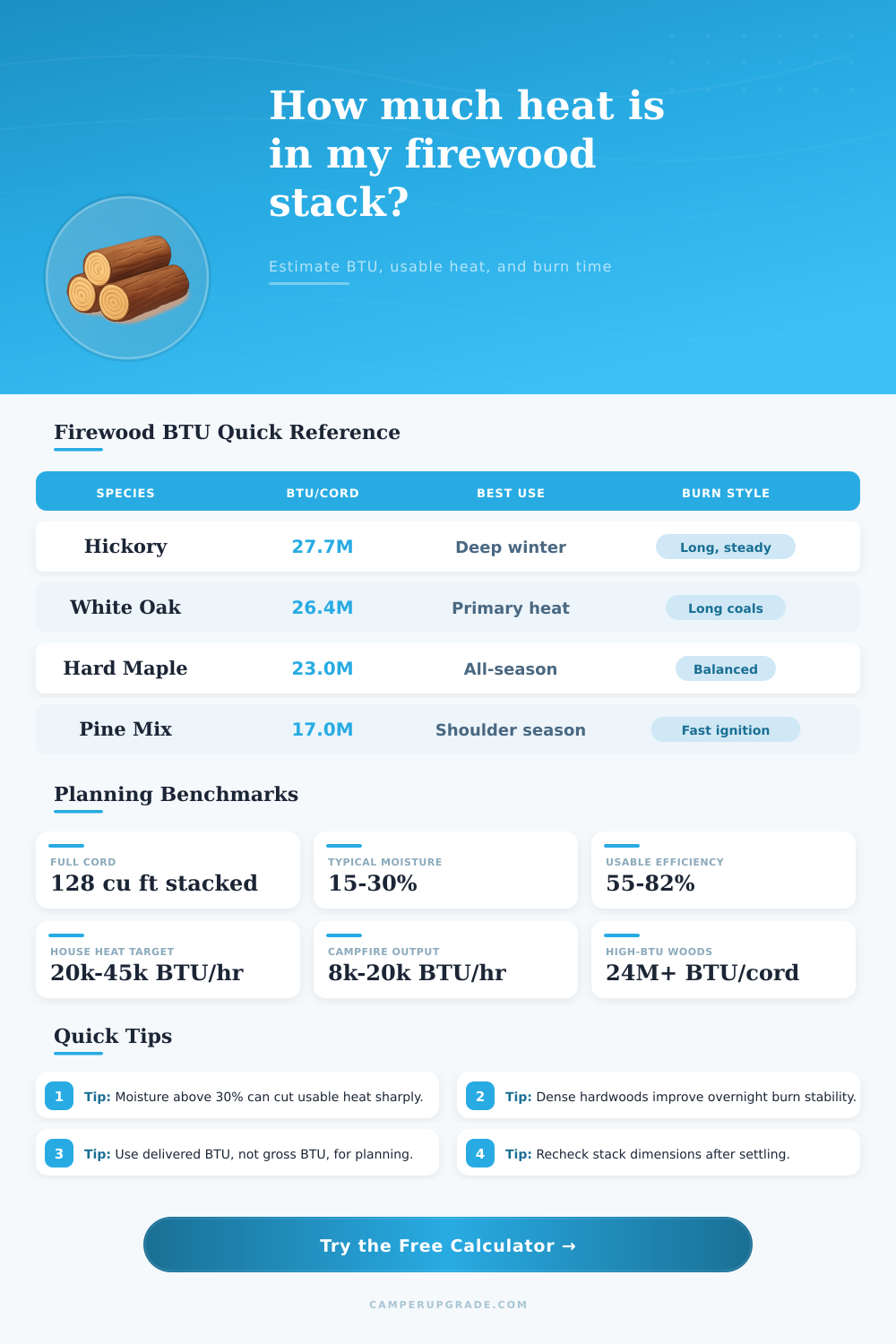
| Species | Approx BTU per Cord | Relative Heat | Typical Burn Character |
|---|---|---|---|
| Hickory | 27.7 million | Very high | Long burn, heavy coals |
| White Oak | 26.4 million | Very high | Long steady output |
| Red Oak | 24.6 million | High | Strong overnight fuel |
| Hard Maple | 23.0 million | High | Even, predictable heat |
| Ash | 20.0 million | Medium | Easy lighting and reloads |
| Yellow Birch | 21.8 million | Medium-high | Clean bright flame |
| Pine Mix | 17.0 million | Lower | Fast ignition shoulder use |
| Moisture Range | Heat Retention Factor | Combustion Quality | Planning Note |
|---|---|---|---|
| 10-15% | 1.00x | Excellent | Kiln-dried / premium seasoned |
| 16-20% | 0.93x | Very good | Ideal target for main heating |
| 21-25% | 0.85x | Good | Usable with stronger draft |
| 26-30% | 0.75x | Fair | Noticeable steam losses |
| 31-40% | 0.62x | Poor | High smoke and reduced output |
| Appliance Type | Typical Efficiency | Best Fuel Profile | Use Case |
|---|---|---|---|
| Open fire ring / fireplace | 35-50% | Mixed splits, quick flame | Ambience and short bursts |
| Non-catalytic stove | 60-72% | Seasoned hardwood blend | Daily cabin heating |
| Catalytic stove | 72-82% | Dry dense hardwood | Long overnight burns |
| EPA insert | 65-78% | Consistent 16 in splits | Home retrofit heating |
| Outdoor boiler | 50-70% | Large mixed hardwood | Whole-property hydronic load |
| Delivered Heat | Heating Oil Equivalent | Propane Equivalent | Natural Gas Equivalent |
|---|---|---|---|
| 1.0 million BTU | 7.2 gal | 10.9 gal | 10.0 therms |
| 5.0 million BTU | 36.1 gal | 54.6 gal | 50.0 therms |
| 10.0 million BTU | 72.2 gal | 109.3 gal | 100.0 therms |
| 20.0 million BTU | 144.4 gal | 218.6 gal | 200.0 therms |
📋Material and Storage Comparison Grid
BTU stands for British Thermal Unit. That is the energy needed for heating one pound of water by one degree Fahrenheit When you choose firewood for a campfire or outdoor boiler, understand the BTU output of wood boilers and their ratings help a lot.
All types of firewood have about the same BTU per pound. Non-resinous wood reach 8,000 to 8,500 BTU per pound, while resinous wood give 8,600 to 9,700 BTU each pound. The actual difference of energy between species depends on the density of the wood.
BTU and How to Choose Firewood
One pound of dense hardwood carries the same amount of energy as one pound of light softwod. The denser the wood, the more weight and heat it delivers per cord.
Even inside one species different blocks of firewood burn hotter than others, because it depends on the dryness and growth conditions. Old wood with tight grain can be almost twice as dense as plantation wood of same type. Hardwoods deliver more BTU if you cut them in winter after leaves fall.
BTU numbers commonly relate to a cord, that has 8 feet long, 4 feet high and 4 feet wide, so 128 cubic feet. They are based on air-dried wood with under 20 percent of humidity. To receive maximum energy from firewood, you must season it well.
The famous red oak does not always lead the BTU lists. It is surpassed by 13 other species, that have even 37 percent more BTU per cord. Osage orange commonly tops lists with around 30 million BTU per cord.
Shagbark hickory, black birch and white oak also reach high. River birch and black birch surprise with there high BTU values.
Lightweight wood like pine gives much BTU quickly, but burns only for a short time. Low BTU wood well removes morning cold. For campfire cooking it makes a difference: deer meat cooks soon or after long waiting.
Raw meats require high heat against bacteria, so use wood that burns strongly at the campsite.
Online many contradictory BTU charts exist for firewood. Many internet ratings err, so compare several sources. Heavy wood delivers more energy, and the dryness increases weight percord, which increases the BTU rating.