Fire Starter Cotton Ball Count Calculator
Estimate treated cotton balls, ignition attempts, reserve tinder, burn minutes, container count, and pack weight for campfire starting kits.
🏕Real Trip Presets
🧮Trip Inputs
Full Calculation Breakdown
📐Formulas Used
Planned fire starts = trip nights × fires per day + backup fire starts.
Base cotton balls = planned fire starts × attempts per fire × cotton balls per attempt.
Adjusted cotton balls = base cotton balls × condition multiplier × (1 + reserve buffer), then rounded up.
Pack weight = cotton balls to pack × prepared starter grams per ball, converted with 1 oz = 28.3495 g.
🧰Preparation Spec Grid
📊Preparation Reference Table
| Preparation | Typical Burn Per Ball | Weight Per Ball | Best Calculation Use |
|---|---|---|---|
| Plain dry cotton ball | 1–2 min | 0.6 g | Backup tinder when other flame is reliable |
| Light petroleum jelly cotton | 3–4 min | 2.4 g | Dry-weather backpacking kits |
| Standard petroleum jelly cotton | 4–6 min | 3.4 g | Most campground and trail kits |
| Heavy petroleum jelly cotton | 6–7 min | 4.2 g | Cold starts and slightly damp kindling |
| Wax-dipped cotton ball | 6–8 min | 5.0 g | Water-resistant kit storage |
| Alcohol-primed cotton ball | 2–3 min | 2.0 g | Short, fast flame for dry kindling |
| Charred cotton fragments | Coal only | 0.4 g | Flint and steel ember kits |
| Jumbo cotton makeup pad | 5–7 min | 4.8 g | Split-pad group fire kits |
☁Condition Multiplier Table
| Camp Condition | Multiplier | Why It Adds Count | Example Use |
|---|---|---|---|
| Dry wood, sheltered wind | 1.00x | Kindling catches quickly | Summer established campground |
| Cool morning, light breeze | 1.15x | Extra relights are plausible | Spring campsite breakfast fire |
| Damp kindling or humid camp | 1.25x | More flame time is needed | Forest campsite after dew |
| Wet ground or steady wind | 1.50x | Failed starts become common | Canoe camp or exposed ridge |
| Cold rain or snow margin | 1.75x | Cold fuel needs longer heat | Winter basecamp reserve kit |
🧴Container Capacity Table
| Container | Typical Fit | Good For | Planning Note |
|---|---|---|---|
| Mini mint tin | 6–10 balls | Day hike emergency tinder | Compress lightly, then fluff before lighting |
| 35 mm film canister | 15–20 balls | Solo or pair weekend kit | Works well with jelly-treated cotton |
| Small screw-top jar | 25–35 balls | Family campground bin | Easy to count and reseal at camp |
| Flat dry pouch | 20–30 balls | Backpacking fire kit | Protect from crushing and leaks |
| Hard dry box insert | 40–60 balls | Canoe, kayak, or overland kit | Use for high-reserve wet trips |
📋Common Trip Count Examples
| Scenario | Inputs Assumed | Suggested Count | Container Fit |
|---|---|---|---|
| Solo weekend trailhead | 2 nights, 1 fire/day, 20% reserve | 7 balls | Mini tin |
| Rainy car camp | 3 nights, wet ground, 30% reserve | 21 balls | Small jar |
| Family campground loop | 4 nights, 2 fires/day, 25% reserve | 23 balls | Small jar |
| Canoe portage dry box | 5 nights, windy wet shore, 40% reserve | 44 balls | Hard dry box |
| Winter basecamp | 3 nights, cold snow margin, 50% reserve | 41 balls | Dry box insert |
| Thru-hike emergency kit | 6 nights, backup starts only, 30% reserve | 11 balls | Mini tin or pouch |
💡Calculation Tip Boxes
There’s something odd about your moddern confidence out here. You can carry fancy gear, sleep with a satellite messenger at your head, yet fire starting become some kind of magic trick. Lighters run dry and friction starters gets wet. Even when it’s dry, sometimes wet wood doesn’t want to catch. That’s where a simple thing called a cotton ball come in to save both dinner and your life.
It’s not just about carrying a single fire starter. It’s about carrying extras for bad weather, failures, and yes, the occasional time you just want a cup of hot stuff as it’s raining outside. The calculator does all the math when you plug in your conditions and desired trip length. It will take away guesswork and save you from wondering if you have too few or too many small white spheres to stay warm.
How to Plan Your Fire Starters
It’s basic math, but the variables are what trip folks up. When planning, consider ignition attempts, not fires. Fires aren’t events: they’re sequences. You light that sucker and the wind flicks it out. You try again and wood is wet. The pilot flame is so weak it needs a second starter just to catch hold. That’s why the tool wants ignition attempts per fire. Optimistically set this at one. If you want to be honest, set it at one point two five. It factors in messiness of reality. If you’re in dry pine in summer, maybe you’ll get by on fewer attempts. But near water or in damp shoulder seasons, you’ll burn through your reserve fast.
If your pack weighs anything, however, then treatment trumps number. A straight cotton ball will burn for seconds. It is not even a starter. It is more like match head. Soak it in wax or petroleum jelly and now you’re burning fuel. Enough that when it goes out, it’ll let kindle go up next. That’s what makes the difference on weight. Treated balls weighs more, sure. But they also last longer. This means you can carry less and still get as much burn.
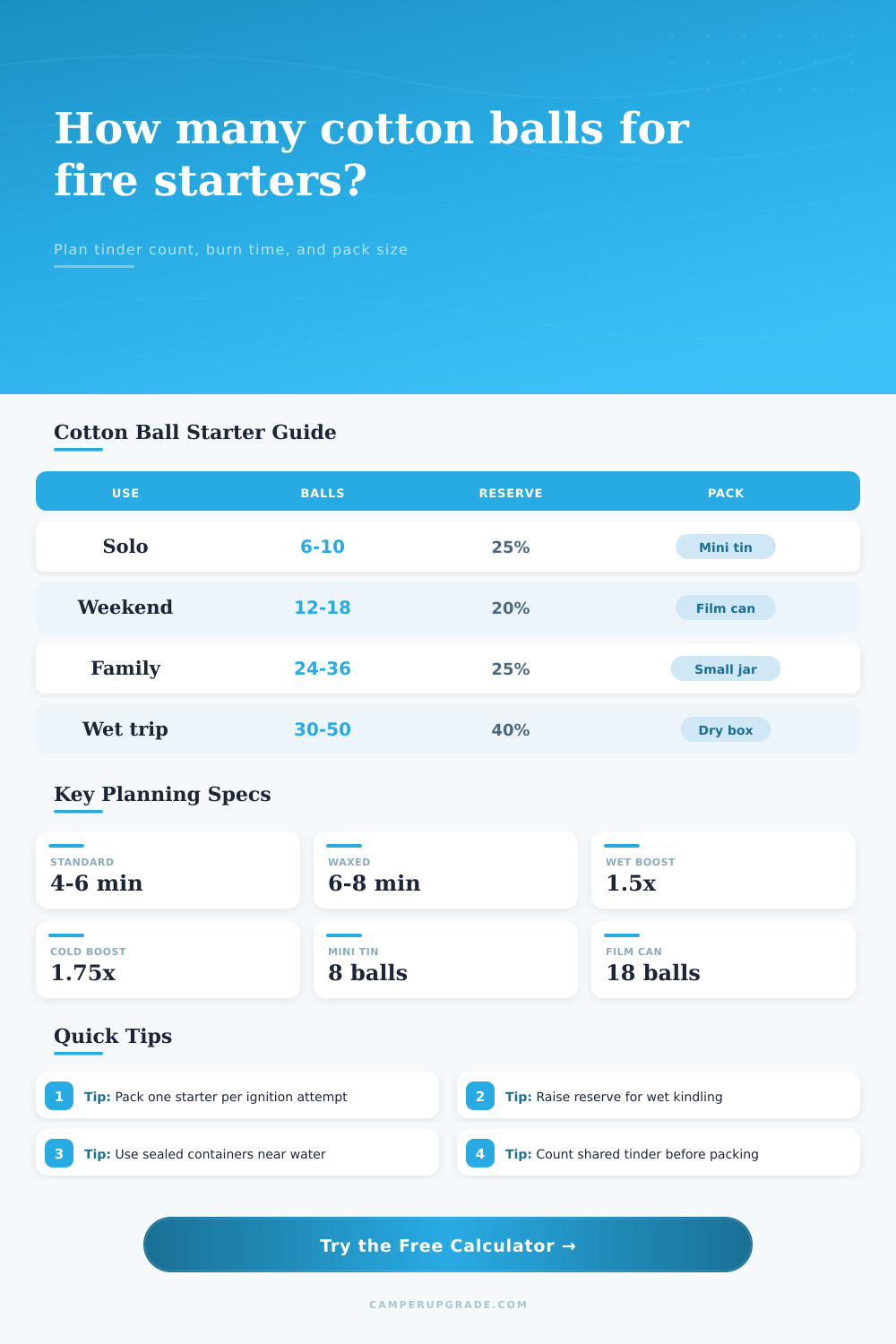
The table on the page spells it all out. It demonstrates how the four- to six-minute burn of a treated jelly ball trades off against quick-and-lighter flame of a dry one. Most folks finds their sweet spot right there in middle with the standard treatment. It offers durability without extra weight of many heavy waxed balls.
You get dealt a set of cards called weather. If it’s snowy, rainy and cold, the conditions multiplier increases. It is not a penalty, but rather insurance. Wet weather draws heat away from wood, meaning fuel must burn at higher temperature to get hot enough to ignite. To further complicate matters, your starter must also work harder and longer to compensate. That’s why folks who ignore this will go out, plan for average days and then freeze on the bad ones.
What you cannot control is the weather. But what you CAN control is your reserve. Twenty percent is a standard buffer on dry trips. Bump it up to forty percent when going out in cold or wet conditions. A small weight increase in your pack buys a huge margin of safety.
The last piece of the puzzle are containers. Something sealed is what you want. Tinder and moisture do not mix. For a weekend trip, a mini tin is fine alone. For two, a film canister is great. Dry boxes or jars is needed for larger numbers. Know how much you have. If you treat your balls a lot, they will be denser and compress less. This means they takes up more room. Twenty plain balls in a tin? Maybe. Fifteen heavy treated balls? Probably. Compare your container volume with your treatment level. It’s a little detail, but when you’re rummaging around in the dark it makes a difference.
It’s neither too much than too little. You are not hoarding. Pack precisely. It is enough for your intended fires, your misses, and your back-up plans in case something goes wrong. You shouldn’t of want to waste space carrying more than necessary.
So that’s where the tool comes into play. It strikes that balance between “plenty” and “enough.” Gives you a confidence number without overdoing it. Follow the math, trust the numbers. Seal up the tin, pack the balls. When the matches stop burning because of the wind, you’ll thank me.
It is better to have it and not need it. But also, knowing precisely what you need helps you know exactly what you don’t need, keeping your pack light and your mind clear. THAT is why you plan.