🔥 Fire Pit Size Calculator
Calculate exactly how much gravel, lava rock, or fire glass you need for your fire pit area
lbs / yd³
lbs / yd³
lbs / yd³
lbs / yd³
lbs / yd³
lbs / yd³
lbs / yd³
lbs / yd³
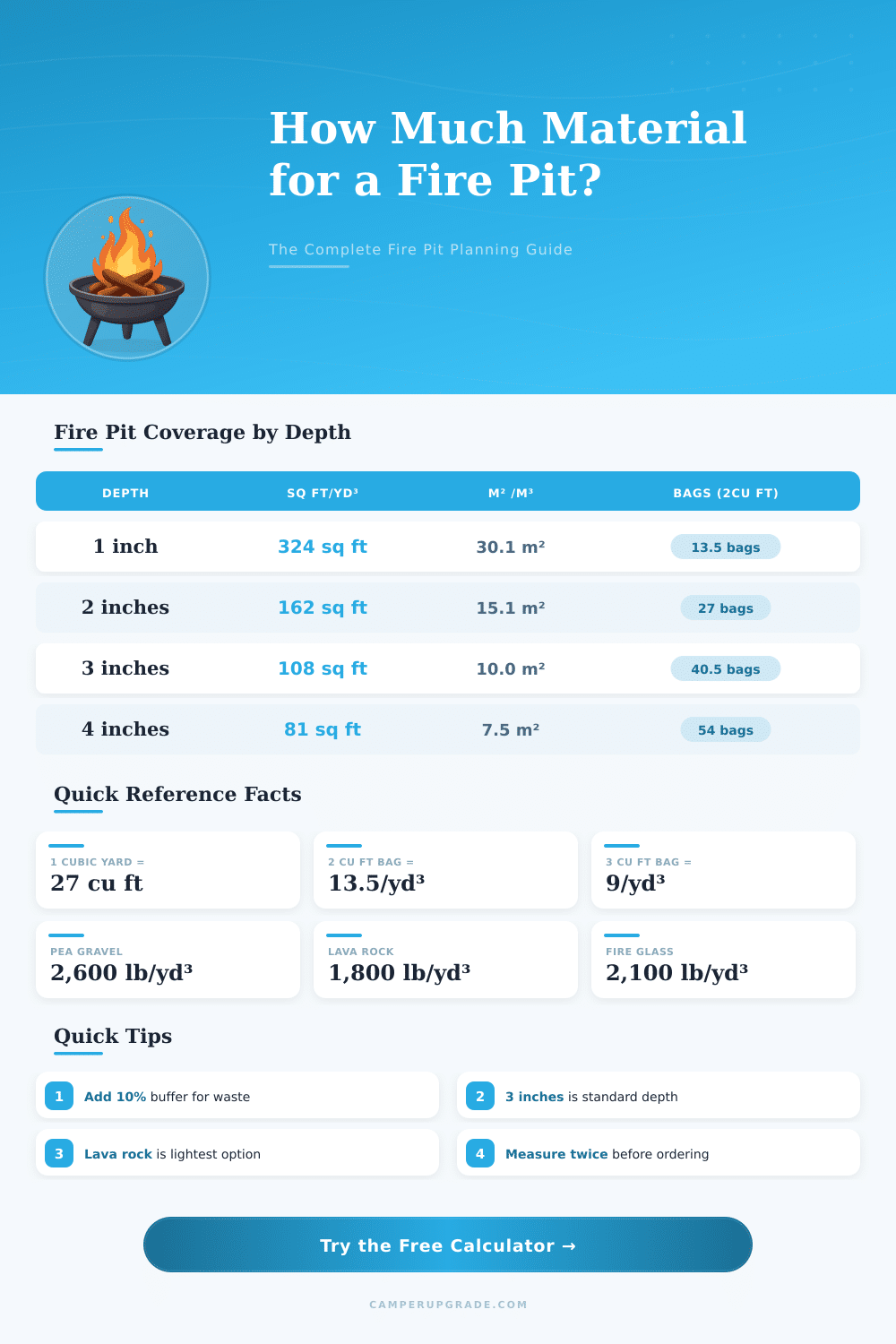
| Depth | Sq Ft per Yd³ | M² per M³ | 2 cu ft Bags/Yd³ | 3 cu ft Bags/Yd³ |
|---|---|---|---|---|
| 1 inch (2.5 cm) | 324 sq ft | 30.1 m² | 13.5 bags | 9 bags |
| 2 inches (5 cm) | 162 sq ft | 15.1 m² | 27 bags | 18 bags |
| 3 inches (7.6 cm) | 108 sq ft | 10.0 m² | 40.5 bags | 27 bags |
| 4 inches (10 cm) | 81 sq ft | 7.5 m² | 54 bags | 36 bags |
| 6 inches (15 cm) | 54 sq ft | 5.0 m² | 81 bags | 54 bags |
| Bag Size | Volume per Bag | Bags per Cubic Yard | Coverage at 3 in depth |
|---|---|---|---|
| Small bag | 0.5 cu ft | 54 bags | 2 sq ft |
| Standard bag | 2 cu ft | 13.5 bags | 8 sq ft |
| Large bag | 3 cu ft | 9 bags | 12 sq ft |
| Half yard bulk | 13.5 cu ft | 0.5 yd³ | 54 sq ft |
| Full yard bulk | 27 cu ft | 1 yd³ | 108 sq ft |
| Project | Area | Cubic Yards (3 in) | Bags Needed (3 cu ft) |
|---|---|---|---|
| Small pit 6ft dia | 28.3 sq ft | 0.26 yd³ | ~3 bags |
| Medium pit 10ft dia | 78.5 sq ft | 0.73 yd³ | ~7 bags |
| Large pit 14ft dia | 153.9 sq ft | 1.43 yd³ | ~13 bags |
| 10x10 patio surround | 100 sq ft | 0.93 yd³ | ~9 bags |
| 12x12 seating area | 144 sq ft | 1.33 yd³ | ~12 bags |
| 15x15 fire zone | 225 sq ft | 2.08 yd³ | ~19 bags |
| 20x20 campsite pad | 400 sq ft | 3.70 yd³ | ~34 bags |
A fire pit is simply stone with a raised edge, but without any chimney. Usually it is designed for use under the sky. It can be a real flame in a hole dug in the soil, although commonly one chooses a standalone structure or lightweight plate.
No need to spend big money because basic forms are present in any hardware store.
How to Choose, Build and Use a Backyard Fire Pit
One finds various kinds to choose. Fire pits with gas, with wood or with propane are all available. Smokeless models well suit to escape irritation.
Propane provides fast flames. Wood brings that classic popping sound. The best choice depends on the mood that you want to create.
Some fire pits are built also for cooking. A heavy wood-burning ranch model from thick steel can become the main decoration of a back garden. Height-adjustable cooking grates allow you to prepare food for the whole family.
One can cook above real wooden flame or use a porcelain-covered coal tray for more precise cooking. Some portable versions work for boiling, simmering or even frying in a checkup.
Portable fire pits please campers and owners of motorhomes. In some parks they ban wood-burning kinds, so propane versions come in handy. One possible model includes a carrying bag, built-in handle and weight of around 31 pounds.
It has foldable feet that raise it off the ground. Some extra forms fold together and store easily. Keeping a fire pit away from meadows matters in strict motorhome resorts, where burns on the soil can cost a costly penalty.
To build a cheap back garden fire pit, the best way is a simple hole-dug version with little depth, gravel and recycled bricks. Concrete block rings cost little and set up quickly. Steel rings give the strongest durability.
During setting of a fire pit with flat stones, well fill at least four to six inches of soil up. One must avoid fresh river stones, because they risk exploding because of steam pressure from heat.
A wood-burning fire pit with a spinning iron shell and rugged hard cover gives rich light during cold nights. A deep circular tin holds carbon or a set of steel logs. A net shape around the edge allows the flame to bee seen and create a classic look.
The trick to reduce smoke is in making a bigger and hotter fire. When it truly flares, the heat pushes the smoke upward and the burn becomes purer. Covering helps to control the wind.
Good arrangement in the back garden can create wonderful times andbring fresh memories.