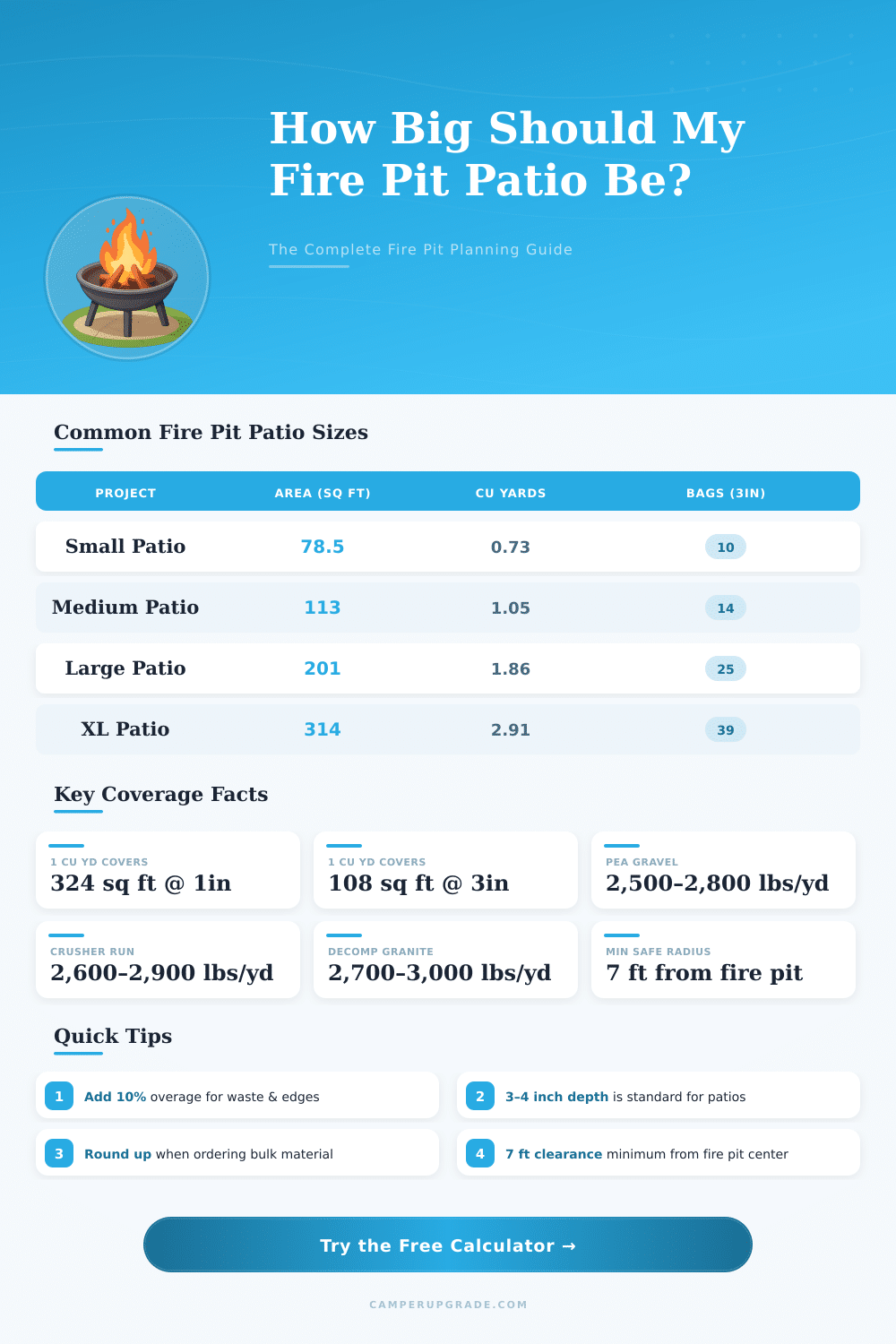
🔥 Fire Pit Patio Size Calculator
Calculate cubic yards, bags, and material needed for your fire pit patio area
| Depth | Sq Ft per Cu Yd | M² per M³ | Notes |
|---|---|---|---|
| 1 inch (2.5 cm) | 324 sq ft | 30.1 m² | Very thin — decorative only |
| 2 inches (5 cm) | 162 sq ft | 15.1 m² | Light traffic areas |
| 3 inches (7.5 cm) | 108 sq ft | 10.0 m² | Standard patio depth |
| 4 inches (10 cm) | 81 sq ft | 7.5 m² | Heavy use or base layer |
| 6 inches (15 cm) | 54 sq ft | 5.0 m² | Sub-base / drainage layer |
| 8 inches (20 cm) | 40.5 sq ft | 3.8 m² | Deep sub-base |
| Bag Size | Volume per Bag | Bags per Cu Yd | Coverage @ 3in |
|---|---|---|---|
| 0.5 cu ft bag | 0.5 cu ft | 54 bags | 2 sq ft |
| 1 cu ft bag | 1 cu ft | 27 bags | 4 sq ft |
| 2 cu ft bag | 2 cu ft | 13.5 bags | 8 sq ft |
| 3 cu ft bag | 3 cu ft | 9 bags | 12 sq ft |
| Bulk (1/2 yd) | 13.5 cu ft | — | 54 sq ft |
| Bulk (1 yd) | 27 cu ft | — | 108 sq ft |
| Project | Area (sq ft) | Cu Yds @ 3in | Bags @ 3in (2 cu ft) |
|---|---|---|---|
| Small Round (10 ft dia) | 78.5 | 0.73 | 10 bags |
| Medium Round (12 ft dia) | 113.1 | 1.05 | 15 bags |
| 10 x 10 Square | 100 | 0.93 | 13 bags |
| 12 x 12 Square | 144 | 1.33 | 18 bags |
| 14 x 14 Square | 196 | 1.81 | 25 bags |
| 16 x 16 Square | 256 | 2.37 | 32 bags |
| 12 x 20 Rectangle | 240 | 2.22 | 30 bags |
| Large Round (16 ft dia) | 201.1 | 1.86 | 26 bags |
A fire pit patio should extend at least 7 feet in all directions from the center of the fire pit. For a standard 36-inch fire pit, that means your patio should be at least 14 feet in diameter (or 14x14 ft for a square). Always verify local fire safety codes for required clearances.
For projects over 1 cubic yard, ordering bulk delivery is typically more efficient than bags. Always add 10–15% overage for irregular edges, compaction, and waste. For crusher run and decomposed granite, expect 10–15% compaction after settling — factor this into your depth calculation.
fire pit in the patio rank between those improvements for the back garden that simply makes everything more pleasant. As homes, roasted sweets and family games appear natural, when one meets around such pit. Stone fire pits add charm to the terrace, and the owner decides, how rustic it looks.
Also gravel works as base, that gives the whole area a feel of camping.
How to Choose and Build a Safe Patio Fire Pit
Outdoor gas fire pits come in various sizes, patterns and shades. Propane fire pit comes in many styles and fits well with any patio. The right model depends on the mood, that one wants to create.
Smokeless pit reduces the discomfort. Propane lights flmaes quickly. Wood burning delivers the typical crackling sound.
Building a fire pit on paved patio, one must consider some spots. One can lay stone with padding directly on the pavers, but you need care about heat transfer, marks and movement. Heavy steel ring for the pit helps, and it goes from the surface down several inches below.
It is possible to also do the pit first and later arrange the paving around it. Like this one saves money four materials, ease the cleaning later and preserve the paving against heat.
Leave spaces for airflow to matter. One method, that caused troubles, was using glue to set stones without spaces. It resulted in very smoky fires.
Drilling holes in the blocks ultimately settled the problem. Mortar sometimes gets skipped, so that the fire breathes through quarter-inch gaps.
If a fire pit does not work for any place, outdoor fire well replaces it. It takes less ground area, leads smoke away from the folks, adds nice decor to the patio and gives heat in cold parts. Also it is safer than open flame.
Some fire pits come with useful extras. One model has a cover flap for safety, when one goes, and the banks around the table help to keep children at distance. Clear panels allow to watch the red embers and feel the heat more well.
It is not fully smokeless, but the smoke stays under control by means of good wood.
Big spot for light around is needed. Stone patio or some concrete works well. Propane fire pits send almost no heat below, so they sit safely on various soils.
Round pits even receive raised covering, that turns them into atable when not in use. Good base is safe floor and some Adirondack chairs around the pit.