Fastpacking Pack Size Calculator
Estimate the pack volume and carry weight for trail-running overnights from mileage, days, season, shelter, sleep system, food bulk, water carry, and gear style.
🏕Fastpacking Trip Presets
⚙Distance, Days, Gear, Bulk, and Season Inputs
📦Gear Bulk and Spec Grid
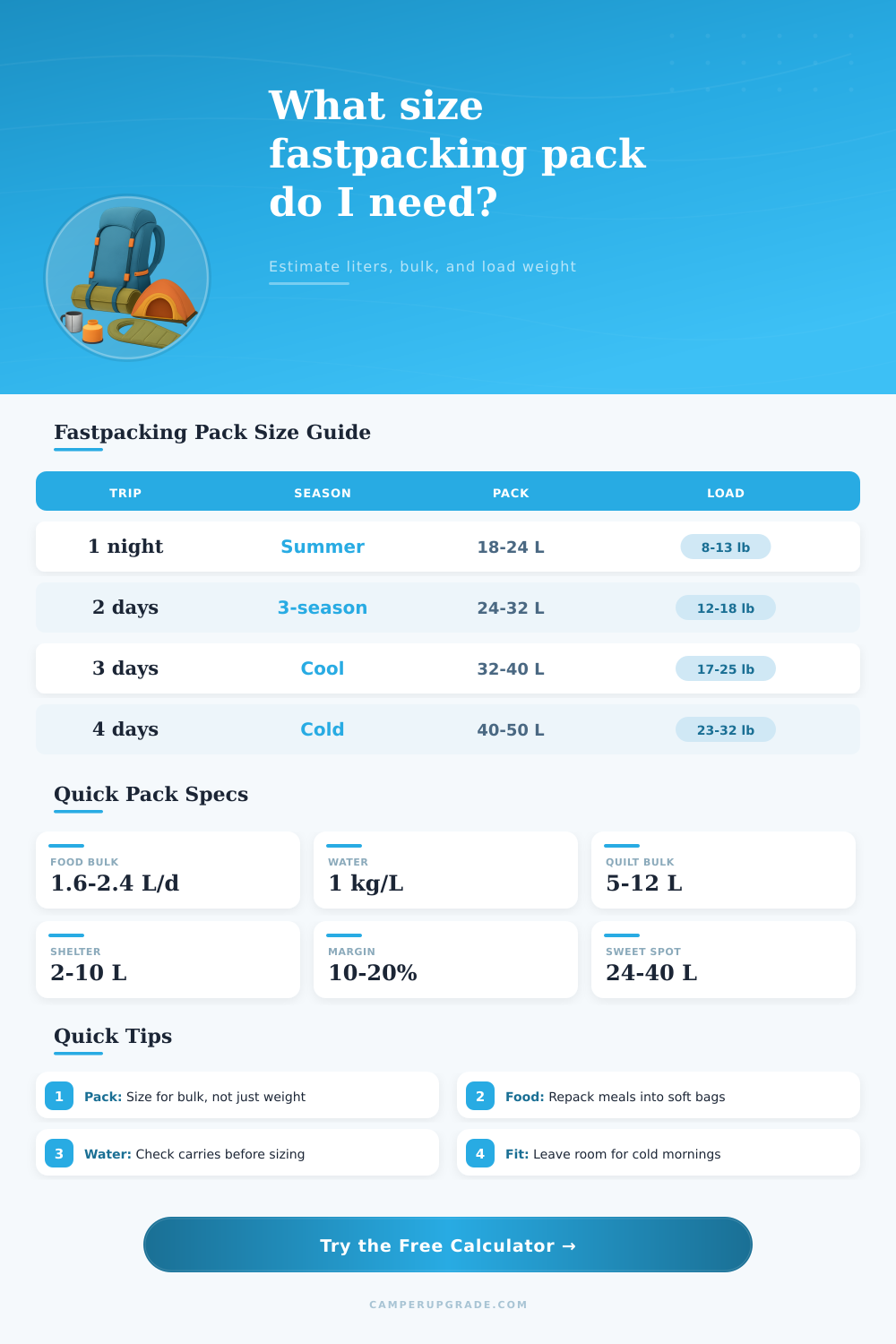
🧮Pack Volume and Load Tables
| Trip Style | Typical Pack | Typical Load | Notes |
|---|---|---|---|
| Supported overnight | 15-22 L | 7-12 lb | Hut, crew, or mild weather |
| Self-supported 1 night | 18-28 L | 9-16 lb | Bivy, compact food, light quilt |
| Two-day mountain loop | 24-35 L | 13-22 lb | More clothing and weather margin |
| Three-day traverse | 32-45 L | 18-28 lb | Food bulk becomes the driver |
| Cold or bear-can route | 40-55 L | 24-35 lb | Rigid canister or winter insulation |
| Gear Choice | Low Bulk | Normal Bulk | Bulky Kit |
|---|---|---|---|
| Shelter | 0-3 L | 4-7 L | 8-12 L |
| Sleep system | 4-7 L | 8-12 L | 13-20 L |
| Clothing | 2-4 L | 5-8 L | 9-15 L |
| Food per day | 1.2-1.6 L | 1.7-2.3 L | 2.4-3.0 L |
| Special gear | 1-2 L | 3-5 L | 6-10 L |
| Season | Night Temp | Bulk Add | Pack Effect |
|---|---|---|---|
| Hot summer | 60 F+ | 0-2 L | Small vest or 20 L pack |
| Mild 3-season | 45-60 F | 3-5 L | Most 24-32 L packs work |
| Cool shoulder | 32-45 F | 6-9 L | Often needs 32-40 L |
| Cold shoulder | 20-32 F | 10-15 L | Usually 40 L or larger |
| Wet range | Variable | 5-11 L | Extra room for damp layers |
| Water Carry | Weight | Main Bag Vol. | Sizing Note |
|---|---|---|---|
| 1 L | 2.2 lb | 0.3-0.5 L | Mostly shoulder bottles |
| 2 L | 4.4 lb | 0.7-1.0 L | Normal mountain carry |
| 3 L | 6.6 lb | 1.0-1.6 L | Dry ridges or slow filters |
| 5 L | 11.0 lb | 2.0-3.0 L | Desert or dry camp |
| 7 L | 15.4 lb | 3.0-4.5 L | Load comfort matters most |
🎒Pack Class Fit Reference
Race Vest Plus
12-18 LFor supported routes, hut nights, emergency bivy kits, and very warm weather.
Overnight Fastpack
18-28 LWorks for one-night self-supported trips with compact sleep gear and low food bulk.
Multi-Day Fastpack
28-40 LThe common range for two or three days when weather layers and food are real.
Large Fastpack
40-55 LFor cold nights, bear canisters, long food carries, or camera and technical gear.
The calculator estimates required volume, then rounds to a practical pack class. A pack with large stretch pockets may carry the same kit with fewer main-compartment liters.
💡Fastpacking Sizing Tips
Fastpacking is a method of travel that exist between trail running and traditional backpacking. For fastpacking, you must choose a pack based off the volume of your gear. It is important to note the difference between the volume of your gear and the weight of your gear.
A particular piece of gear may weigh very little, but it may take up alot of volume. If you choose a pack that is too small for your gear, your gear wont fit into the pack. If you choose a pack that is too large for the volume of your gear, your gear will shift within the pack while you are on the move.
Choose the right pack size
The volume of your gear will depend on the items that you will carry and will change according to the season. During the summer, your gear needs may only include a thin sleeping liner and a bivy. Your gear volume will be low.
During the shoulder seasons, you may need a thicker sleeping quilt, a puffy jacket, and a rain shell. These items will increase the volume of your gear. When calculating your pack size, make sure to account for the volume that these items will take up within the pack.
The volume of your food will also affect your pack size. If you eat food like food gels and food bars, your food volume will be low. If you eat freeze-dried meals, your food volume will be high due to the amount of air that is within the packages of the freeze-dried meals.
Repacking your food into vacuum-sealed bags will reduce the volume of your food within your pack. Make sure that you size your pack according to the volume of your food that you will bring on the trip at the beginning of the trip. As you eat your food during the trip, the volume of your food will decrease.
Another factor that will impact your choice of pack is your carry of water. Many fastpackers choose to use shoulder bottles or flasks to carry there water. Using a shoulder bottle or flask will move the weight of your water outside of your main pack compartment.
If you decide on using a water bladder for your water, it will take up the volume within your main pack. Adding a water bladder to your main pack will change the way that you organize your pack, and it may make it difficult for you to organize your other gear within the pack. Rigid items, such as a bear canister, can be a problem for those who choose to fastpack.
A bear canister is made of rigid plastic and cannot be compressed. If you choose to carry a bear canister, the diameter of the bear canister will dictate how you must organize your pack. It is impossible to compress the bear canister to make space for a rain jacket, for example.
When choosing a pack, you should also include some extra space within the pack for your gear. This extra space is referred to as the margin for your gear. If you choose to fill your pack to 100 percent with your gear, you wont be able to quickly add a layer of clothing to the pack.
By ensuring that your pack allows for a margin for your gear to go in and out of the pack, you will ensure that the pack will not bulge. A pack that does not bulge will allow your weight to remain close to your spine. Finally, you must balance the size of the pack that you choose with the items that you will carry.
For example, you may choose a larger pack to accommodate a large sleep system for winter trips. Alternatively, you may choose to use a smaller pack if you want to force yourself to carry less food on longer trips. By determining the volume and the weight of the gear that you will carry, you can select a pack that best fits your needs.
By accounting for the volume of your sleeping quilt, the volume of your food, and the volume of your water, you can select a pack that best fits your gear.