Fall Factor Calculator
Estimate climbing fall factor, projected catch load, and severity class for lead and top-rope scenarios.
🧗Scenario Presets
⚙Fall Geometry Inputs
📊Rope Response Spec Grid
📘Fall Factor Reference Tables
| Factor Range | Catch Feel | Typical Context | Belay Focus |
|---|---|---|---|
| 0.00-0.30 | Light to mild | Short slips with high rope out | Keep rope smooth and controlled |
| 0.31-0.70 | Moderate | Normal sport whips | Manage slack and stance |
| 0.71-1.00 | Firm catch | Sparse clips or long runouts | Use active belay and rope path care |
| 1.01-1.40 | Hard catch | High above gear, low rope out | Limit extension, reduce extra slack |
| 1.41-2.00 | Very severe | Potential near-anchor falls | Avoid scenario if possible |
| Rope Profile | UIAA Impact (kN) | Dynamic Elongation | Use Case |
|---|---|---|---|
| Single Dynamic Soft | 7.8 | 34% | Comfort-focused outdoor lead |
| Single Dynamic Mid | 8.6 | 31% | Balanced daily climbing |
| Single Dynamic Stiff | 9.3 | 28% | Sharper response for projecting |
| Half Rope Pair | 6.0 | 35% | Alpine or trad rope drag control |
| Twin Rope Pair | 8.0 | 30% | Long pitches with full clipping |
| Low Stretch / Semi-static | 11.0+ | 8% | Haul systems, not lead falls |
| Rope Out | Lead Fall Dist | Approx Factor | What It Means |
|---|---|---|---|
| 10 m | 4 m | 0.40 | Normal clip fall near comfort band |
| 10 m | 10 m | 1.00 | Hard catch, high gear loading |
| 15 m | 6 m | 0.40 | More rope softens deceleration |
| 15 m | 15 m | 1.00 | Long fall with severe feel |
| 25 m | 8 m | 0.32 | Typical long pitch sport whip |
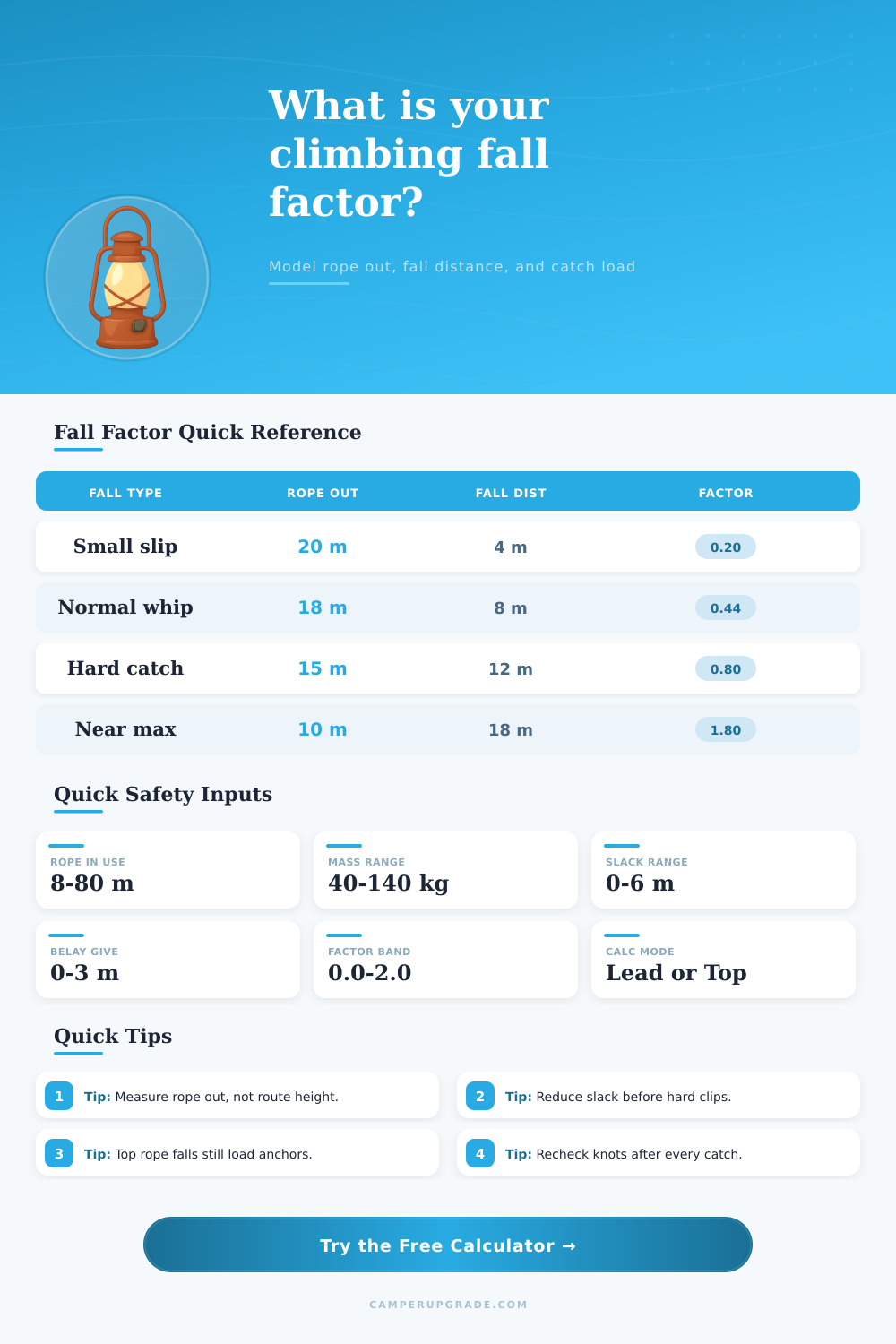
Fall factor is an specific measurement of the intensity of a fall on a climbing route. The fall factor are calculated by dividing the distance of the fall by the length of the rope that is already out from the belayer to the climber. If the distance of the fall are large relative to the length of the rope, the fall factor will be highly.
If the distance of the fall is small relative to the length of the rope, the fall factor will be low. High fall factors leads to higher impact forces for the rope, the gear, and the anchors. Low fall factors leads to lower impact forces for the rope, the gear, and the anchors.
What Is Fall Factor in Climbing
The length of the rope acts as a shock absorber for the climber and the belayer. A longer length of rope acts as a better shock absorber than a shorter length of rope. A short length of rope provides less material to absorb the fall than a longer length of rope.
Thus, a long fall with alot of rope will not be as intense for the climber and the belayer as a short fall with a short length of rope. In order to understanding how intense the falls on a particular route are for the climber, the climbers must understand the concept of fall factor. When climbing in a gym, a person will have a long length of rope out from the climber to the belayer.
For instance, if a person has twenty meters of rope out from themselves and they fall two meters from the last piece of protection, their fall factor will be low. Low fall factors mean that the forces on the rope, the gear, and the anchors will be low. However, when climbing in traditional or alpine climbing, the fall factor will be more higher.
This is because a person will have a long distance to fall but little length of rope out between themselves and the last piece of protection. The factor will be higher because the distance to fall is great and the length of rope to absorb the fall is small. Several factors influence the fall factor of a climber.
The belayer can influence the force during a fall by using belayer give. By moving with the fall, a belayer will reduce the force during the fall by a significant percentage. The slack in the rope influences the force on the rope.
If there is extra slack in the rope, this will influence the distance that the climber falls without adding to the length of rope available to absorb the fall. The type of rope that is used will also influence the force on the rope. If dynamic rope is used, the stretch in the rope will help to spread the force of the fall.
If a stiffer rope is used that creates less stretch, the force on the rope will be higher. Top rope climbing is not the same as lead climbing in regard to fall distance math. In top rope climbing, the climber does not fall twice the height that they are from the last piece of protection.
Thus, the fall factor on a top rope climb is lower than on a lead rope climb. However, the anchors will experience force during the climb and the position of the belayer will matter. Peak rope force is the maximum amount of force that the rope will pull during the fall.
The peak rope force is based on the mass of the climber, the velocity of the fall, and the total amount of stretch in the rope. A heavier climber creates more force during a fall than a lighter climber. Thus, with a fall factor close to 1.0, the peak rope force will be 9 kN or more.
If the forces reach 9 kN or more the gear may wear during that fall or the belayer may feel a very hard yank on the rope. There are some mistakes that many climbers make with fall factor. One of the mistakes is mistaking the height of the route for the length of the rope out.
This is incorrect because the amount of rope out is from the belayer to the last point of protection on the route. Another mistake is with the effect of rope drag. If a climber has rope drag, it is possible that the fall factor will be increased.
Lastly, if a climber has a heavier partner, this will increase the force on the rope. For example, a partner that weighs 100 kg will have more force on the rope than a 50 kg partner. In order to control the factor of fall for the climbers and the belayer, there are specific techniques that should be used.
One technique is for the climber to clip into protection as often as possible so that the fall factor is minimized. The other technique is for the belayer to use give when the climber falls so that the force on the rope is minimized. Additionally, if the climber is aware of the factor of fall on the route, the climber can tell the belayer of the risk of that route.
Furthermore, if a climber is moving above the protection on the route, the climber should tell the belayer. By mastering the control of the fall factor, both the climbers and the belayers can ensure that the climbs are as safe as possible for each person involved in the climb route.