Estimated Arrival Time Calculator
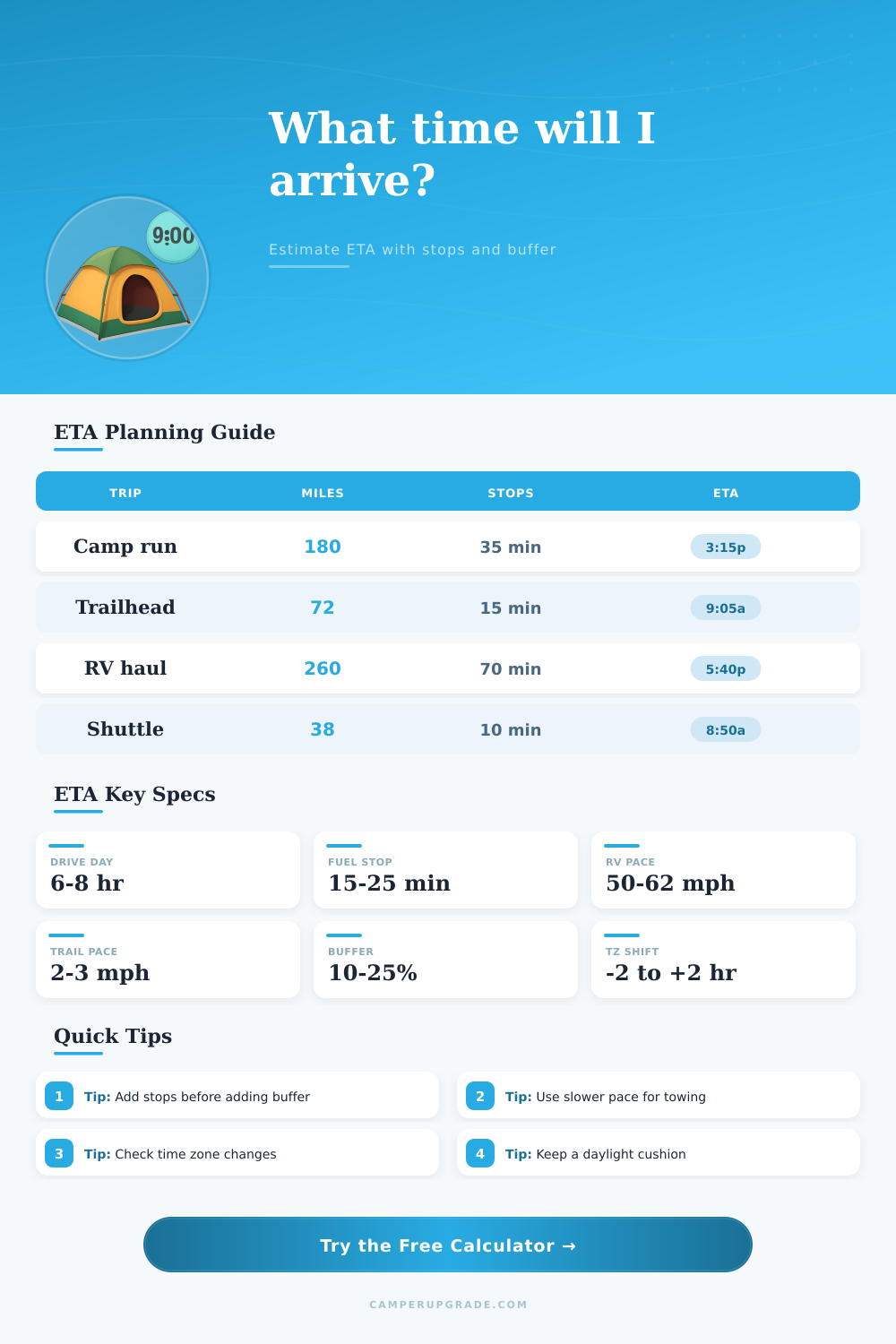
Calculate an arrival time from start time, route distance, average moving speed, road or trail condition, planned stops, delay allowance, time zone change, and arrival buffer.
🏕Real Trip ETA Presets
⚙Route, Stop, Delay, and Buffer Inputs
📐ETA Spec Grid
📊Reference Tables
| Travel type | Realistic speed | Use case | Planning note |
|---|---|---|---|
| Interstate car or van | 62-72 mph / 100-116 km/h | Open highway, light load, easy fuel stops. | Use slowdown for city exits and construction. |
| RV or trailer tow | 50-62 mph / 80-100 km/h | Travel trailer, camper, high-roof van, or heavy load. | Fuel stops and grades often control the day. |
| Mountain roads | 30-50 mph / 48-80 km/h | Passes, switchbacks, lake roads, and scenic routes. | Descending safely can be as slow as climbing. |
| Forest or gravel road | 12-30 mph / 19-48 km/h | Trailhead access, dispersed campsites, washboard roads. | Dust, gates, and tire pressure stops add time. |
| Walking approach | 2-3 mph / 3-5 km/h | Camp approach, shuttle connector, or trailhead walk. | Add stops for water, packs, and navigation. |
| Stop type | Typical time | When to use | ETA effect |
|---|---|---|---|
| Quick restroom or photo | 5-10 min | Short pullout with easy parking. | Small but frequent stops add up fast. |
| Fuel in a car | 10-15 min | Pump, restroom, snack, and short stretch. | Use one stop per fuel range segment. |
| RV fuel or propane | 18-30 min | Trailer lanes, diesel islands, propane fill, or pets. | Often worth modeling as a longer fixed stop. |
| Campground check-in | 10-25 min | Office queue, site assignment, gate pass. | Add as fixed delay if it happens at arrival. |
| Ferry, border, or gate | 20-90 min | Known queue or scheduled loading window. | Use fixed delay plus a larger buffer. |
| Distance | 55 mph drive | 65 mph drive | 2.5 mph walk |
|---|---|---|---|
| 25 mi / 40 km | 27 min | 23 min | 10 hr |
| 75 mi / 121 km | 1 hr 22 min | 1 hr 9 min | 30 hr |
| 150 mi / 241 km | 2 hr 44 min | 2 hr 18 min | 60 hr |
| 300 mi / 483 km | 5 hr 27 min | 4 hr 37 min | 120 hr |
| 450 mi / 724 km | 8 hr 11 min | 6 hr 55 min | 180 hr |
| Scenario | Base route | Stops and buffer | Planner setup |
|---|---|---|---|
| Campground check-in | 180 mi at RV pace | 2 stops, 15% buffer | Good default for weekend arrivals. |
| Trailhead meetup | 72 mi at mountain pace | 1 stop, 10% buffer | Set target to meetup time. |
| Ferry approach | 95 mi at highway pace | Queue delay, 25% buffer | Use fixed delay for loading. |
| Forest road camp | 18 mi gravel finish | Gate delay, 20% buffer | Calculate gravel segment separately if needed. |
| Late-night return | 140 mi at cautious pace | Rest stop, 15% buffer | Use a slower speed if tired. |
💡ETA Planning Tips
An estimated arrival time calculator is a tool that will allow you to calculate your estimated arrival time at a specific destination. The calculator will allow you to incorporate several different variable into the calculation of your estimated arrival time. Variable to consider when calculating your estimated arrival time may include the distance that you need to travel, the speed at which you will travel, the number of stop that you will make along the way, and the amount of buffer time that you will need for that journey to your chosen destination.
Many individuals may attempt to calculate there estimated arrival time with only the distance that they need to travel and the speed at which they will travel. However, calculating only for distance and speed will result in inaccurate calculation of the estimated arrival time. To calculate your estimated arrival time accurate, you must account for the surface of the road that you will travel and the load that your vehicle will have.
How to Calculate Your Estimated Arrival Time
Additionally, you must account for the number of stop that you will make and the amount of buffer time that you will require to arrive at the right time at your destination. If you do not account for the stops that you will make and the buffer time that you will need, then your estimated arrival time will be incorrect, which will make you either late or too early for your destination. Stops that you will make en route to your destination are a factor that many travelers do not anticipate in there travel plans.
For example, a stop to fill up fuel for your car may take ten minute to complete. However, a stop to fill up fuel for your trailer may take twenty minutes because your trailer makes it more difficultly to complete such a stop. The estimated arrival time calculator will allow you to enter the number of stops that you will make and the length of each stop.
Additionally, you can enter other form of delays that will occur along the route, known as fixed delay, such as a border crossing. The amount of time that you allow for the stops that you will make and the buffer time that you will need along your journey is a necessary part of your travel plan. The buffer time will allow for delay along your journey that cannot yet be named.
For example, there may be construction zone along the route of your journey. The percentage of time to allow for such delay can be added after you have accounted for the stops that you will make and any fixed delays. The amount of time that you need for buffer time will depend upon the type of destination that you have chosen.
For instance, if you are traveling to a campground, there may be time for visitors to arrive and check in at the campground. Therefore, the campground does not require as much buffer time. However, if you are traveling to a ferry, there may be a hard cutoff time for travelers to arrive at the ferry.
Thus, travelers need more buffer time to arrive at the ferry without being too late for there ferry crossing. Crossing time zone along your journey will impact the arrival time for travelers. Crossing into a different time zone may impact the arrival time by one hour.
This change in time zone can make it difficult for travelers to determine the correct time for there destination. Most estimated arrival time calculator will calculate the time for the travel, and then it will apply the time zone change to the calculated time. Therefore, travelers can see the time that they will arrive at their destination within the time zone in which they will arrive.
The estimated arrival time calculator will include reference table that help travelers to select the correct inputs for the calculator. These reference tables may include tables that display the impact that each type of road surface can have upon the speed at which travelers will move along the journey. Additionally, these tables may include information regarding the length of stops that may be made during the journey.
These tables can be used to ensure that travelers do not make estimate that are too high for these time variables, which could create error in the estimated arrival time. Travelers may make several common mistake when they are using the estimated arrival time calculator. For example, they may enter the speed limit for the road instead of the adjusted speed at which they can travel.
An adjusted speed is one that takes into account the load of the vehicle and the type of road that is to be traveled. Additionally, travelers may not account for the extra time for a long vehicle and passenger to make stops. Finally, travelers may not account for buffer time.
Buffer time allow for the travelers to account for the unexpected delay en route to their destination. Thus, buffer time is a necessary part of the estimated arrival time plan for travelers. By adjusting the variable of the estimated arrival time calculator to reflect these common mistakes, travelers will have a more accurate calculation of their estimated time of arrival.
The goal of the estimated arrival time calculator is to not eliminate the uncertainty of the arrival time of the travelers. However, the goal is to make the uncertainty of the estimated arrival time visible to the travelers. For example, the calculator can determine how much time stops will use and how much time buffer time will use.
By seeing how much time is taken by stops and buffer time, travelers can determine if it is possible to arrive at the specified time of arrival. The number that this calculator determines is the estimated arrival time for travelers that will make their journey.