Esbit Tablet Count Per Meal Calculator
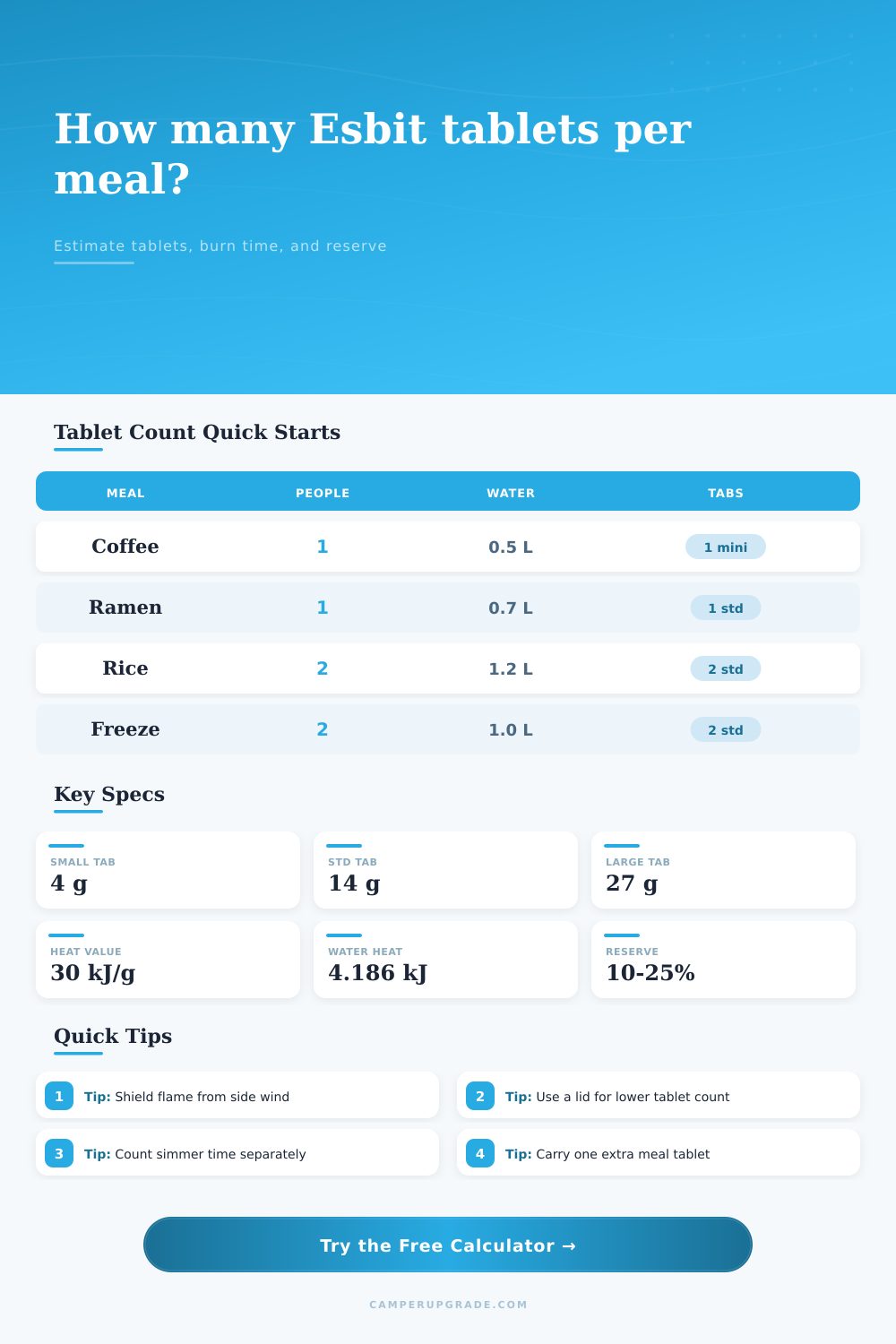
Estimate solid fuel tablets for boils, hot drinks, simmer time, wind, altitude, pot setup, and reserve fuel.
⚡Trail Meal Presets
📝Meal Fuel Inputs
Energy model: water mass × 4.186 kJ/kg·°C × temperature rise, divided by real stove efficiency, then converted to tablet grams and burn minutes.
Fuel Plan Results
🧪Tablet Spec Comparison Grid
🔢Formulas Used
📊Solid Fuel Tablet Reference
| Tablet option | Fuel mass | Typical burn window | Best meal use |
|---|---|---|---|
| Esbit 4 g mini tablet | 4 g / 0.14 oz | 4-6 minutes | Warm drink top-off, tinder-like short heat |
| Half 14 g tablet | 7 g / 0.25 oz | 5-8 minutes | Small mug, sauce, short reheat |
| Esbit 14 g standard tablet | 14 g / 0.49 oz | 7-13 minutes | Solo boil, ramen, freeze-dried pouch |
| Generic 10 g hexamine tablet | 10 g / 0.35 oz | 6-10 minutes | Compact emergency kit meals |
| Coghlan-style 24 g tablet | 24 g / 0.85 oz | 12-18 minutes | Longer simmer or two-person boil |
| Esbit 27 g large tablet | 27 g / 0.95 oz | 12-18 minutes | Cold water, larger pot, exposed meals |
🌡Meal Heat Demand Table
| Meal task | Water volume | Useful heat to 95°C from 15°C | Typical 14 g tablets |
|---|---|---|---|
| Single mug coffee or tea | 0.35 L | 117 kJ | 1 tablet, often partly unused |
| Instant oatmeal and drink | 0.55 L | 184 kJ | 1 tablet sheltered, 2 in wind |
| Solo ramen or soup | 0.70 L | 234 kJ | 1-2 tablets depending on simmer |
| Freeze-dried pouch for two | 1.00 L | 335 kJ | 2 tablets in normal field use |
| Rice or pasta cup for two | 1.20 L | 402 kJ | 2-3 tablets with simmer |
| Cold camp soup pot | 1.50 L | 502 kJ | 3+ tablets, use large tabs if possible |
🌬Field Condition Multipliers
| Condition factor | Low impact | Moderate impact | High impact |
|---|---|---|---|
| Wind exposure | Calm: 1.00x | Breezy: 1.18x | Gusty: 1.45x |
| Pot setup | Heat exchanger: 0.85x | Simple lidded pot: 1.00x | No lid or wide pan: 1.22x |
| Altitude | Low: 1.00x | 5,000-8,000 ft: 1.06x | 8,000-11,000 ft: 1.10x |
| Starting water | Warm source: lower heat | Cool stream: normal heat | Near freezing: much higher heat |
🎒Common Meal Preset Comparison
| Preset meal | People | Water and simmer | Estimated tablet plan |
|---|---|---|---|
| Solo Coffee Boil | 1 | 0.35 L, no simmer | One 4 g mini or part of a 14 g tab |
| Ramen Lunch Stop | 1 | 0.70 L, 3 min simmer | One to two 14 g tablets |
| Freeze-Dried Dinner | 2 | 1.00 L, steep only | Two 14 g tablets with reserve |
| Two-Person Rice Pot | 2 | 1.20 L, 10 min simmer | Three 14 g tablets or two large tabs |
| Snow Melt Soup Meal | 1 | 1.30 L, 5 min simmer | Large tablets recommended for continuity |
📦Packing Conversion Table
| Fuel plan | Total tablets | Fuel mass | Pack note |
|---|---|---|---|
| One solo hot drink meal | 1 mini or 1 standard | 4-14 g | Breakable tablets help avoid waste |
| Three solo boil-only meals | 3 standard tablets | 42 g / 1.48 oz | Add one spare in cold or wind |
| Weekend, two dinners and breakfasts | 6-8 standard tablets | 84-112 g / 3.0-4.0 oz | Match count to actual water liters |
| Group hot drink round | 3-5 standard tablets | 42-70 g / 1.5-2.5 oz | Use a wider pot only with a windscreen |
💡Calculation Tips
With numb fingertips and grumbling gut, you look down at a tiny pot of water that won’t even begin to warm up. Now it’s windy, and your stove just isn’t cooperating. What do you do? You’ve got one more Esbit tablet, but you’ve got two meals worth of food still ahead. And you need something to eat right now. That’s the point where fuel math goes from theory and into survival mode. How much fuel do I have? When am I going to be done? With what’s left of my Esbit, I’m not sure I’ll get enough to make that coffee hot or soften that ramen. Don’t worry about trying to guess in the dark, let the calculator do the energy math for you. Give it your environment, your water amount, and your desired temperature, and it’ll let you know exactly how long it should take until you’re ready to chow down.
Deceptively simple, solid fuel looks like a brick of wax but behaves like chemistry homework. It’ll burn in Costa Rica as consistently than Colorado, putting out a predictable amount of heat. But that doesn’t mean your stove grabs every bit of heat. This is where efficiency becomes the quiet thief. Does that open mug radiate more heat sideways than a lidded pot? Sure. Does it trap steam that could otherwise be converted into boiling water? You betcha. Your pot set-up is really about deciding how much waste you are willing to accept.
How to Plan Your Camping Fuel
People assume a tablet can boil a liter of water. They think that’s true. Dangerous myths. Truth is a standard tablet will barely boil half a liter if there is the slightest hint of wind in its character. Outputs are less important than their inputs, as they make you think about what your cooking environment will be like before you leave.
Wind: “A gusty ridge top can double your fuel consumption compared to a sheltered valley floor.” The calculator has multipliers for wind. So do your eyes. Can’t stay standing unbraced? Your flame will be struggling for breath. Altitude plays a quiet but real role. Boiling water takes longer high up (which sounds good), but then your freeze-dried meals require close-to-boiling to fully hydrate themself (oh). Speed up or slow down, either way you’re losing heat.
Another variable that will throw folks off is simmer time. That’s when the heat load gets added because you’re bringing the water to a boil, but also maintaining heat as your soup stews or your pasta simmers. You can plan for those extra minutes. This means you won’t top off your fuel right before a meal, only to find you have lukewarm sludge because you didn’t pack enough to get it hot all the way through.
Better to have just a little extra fuel than go hungry. When it comes to reserve capacity, experience trumps optimism. Use the calculator to input a percentage of what you think will suffice as a buffer. If you are doing a test run in your backyard where things are controlled, 10 percent is good. If it’s a backcountry trip where clouds might roll in or you might drop a fuel canister, 25 percent is wiser. It’s nearly no weight at all, but it’s insurance against bad luck. Nobody wants to be the guy finishing his last tablet midway through that final boil.
Size has advantages and disadvantages: Mini tablets are easy to drink, but they do not last long. Big ones lasts longer and are great for tasks that take a long time, like melting snow or simmering meals. The most common is the fourteen-gram table. It fits into most wind screen openings and lasts through most meal preparation chores before cooling down at the center during continued use. If you can get your scissor blades sharp enough, you can break one up, but then there’s the mess.
Finally, how useful is it to match your planned fuel with what you actualy do? Do you sip a cup of hot tea slowly, or do you gulp down a cup of coffee? Are you cooking for one or for three? All this stuff matters. The tool lets you scale all that to see the overall weight impact on your pack. A few more grams of fuel don’t matter much when you run out of heat and can’t cook an extra pound of dehydrated food. Go light but go right.
Set up in your livig room, set the timer, take notes. How long does it take you to boil water in your usual pot, using any amount of water and in any wind? You’ll have some numbers that are real instead of average, and those real data points make every calculator better still. The difference between having fun and freezing outdoors is planning ahead instead of just hoping for the best. This means bringing enough heat to survive the worst and enjoying the best when the weather cooperates.
You should of brought extra.