🥫 Emergency Ration Calorie Calculator
Estimate emergency food calories, ration weight, serving counts, and reserve coverage for camping, road trips, basecamps, and shelter kits.
Formula path: baseline calories by age group × total days × ration target × activity factor × weather factor, then add the selected safety buffer.
Full Calculation Breakdown
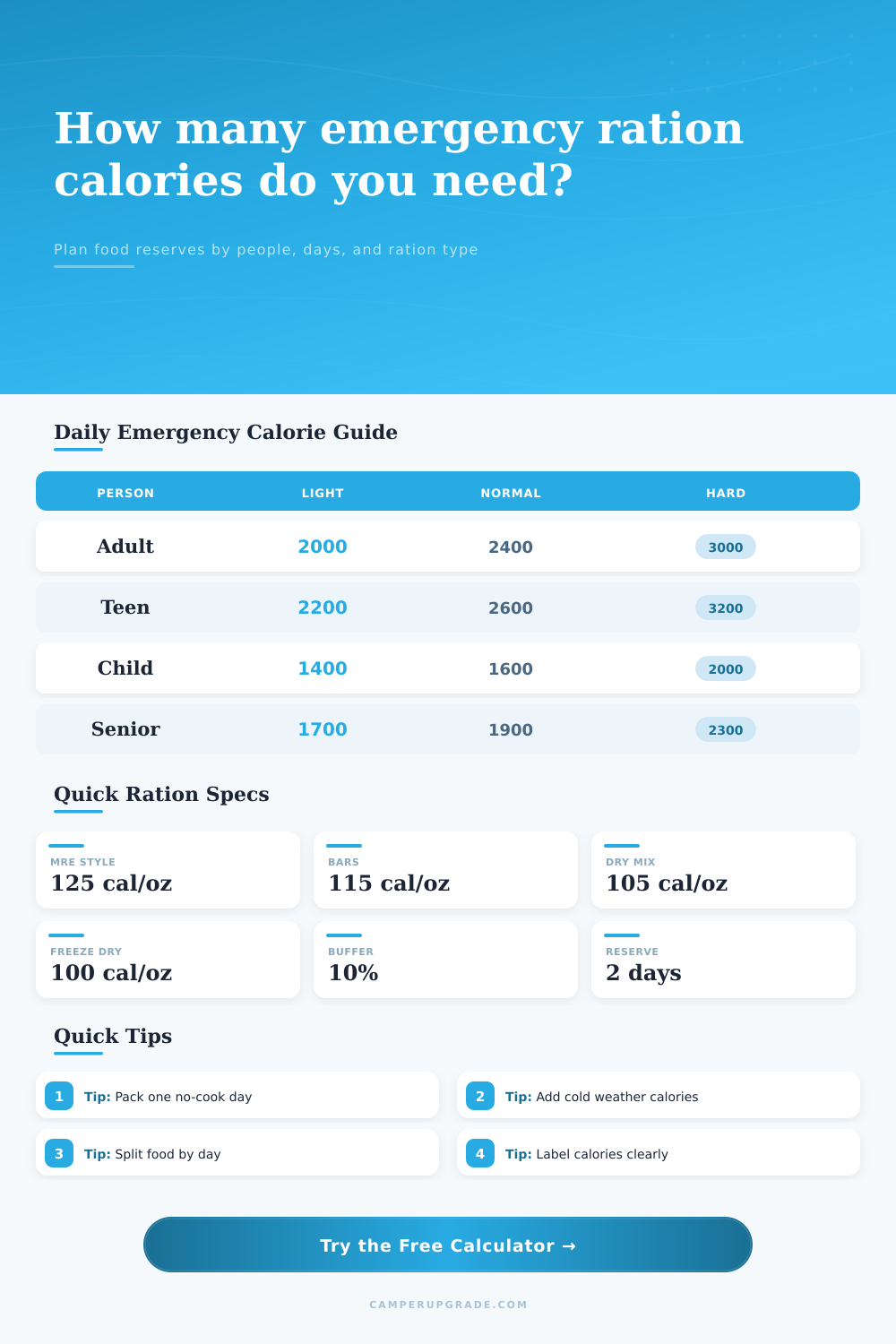
| Person group | Base calories/day | Short ration/day | Hard travel/day |
|---|---|---|---|
| Adult | 2,400 cal | 1,872 cal at 78% | 3,000–3,240 cal |
| Teen | 2,600 cal | 2,028 cal at 78% | 3,200–3,500 cal |
| Child age 5–12 | 1,600 cal | 1,248 cal at 78% | 1,900–2,100 cal |
| Older adult | 1,900 cal | 1,482 cal at 78% | 2,200–2,500 cal |
| Ration format | Calories per ounce | Serving calorie basis | Planning note |
|---|---|---|---|
| MRE-style ready meals | 125 cal/oz | 1,200 cal packet | Heavier packaging, no stove needed |
| Compressed emergency bars | 115 cal/oz | 400 cal bar | Dense and simple to split by day |
| Freeze-dried meal pouches | 100 cal/oz | 600 cal pouch | Lightweight, usually needs hot water |
| Dry staples mix | 105 cal/oz | 500 cal meal | Compact, needs cooking plan |
| Trail mix and nut butter mix | 135 cal/oz | 350 cal snack pack | Very dense but easy to overeat |
| Canned shelf-stable meals | 70 cal/oz | 450 cal can | Bulky but simple for vehicle kits |
| Hybrid no-cook ration | 120 cal/oz | 500 cal packet | Mixes bars, nut butter, jerky, fruit |
| Family pantry staples kit | 95 cal/oz | 700 cal meal set | Best for totes and shelter bins |
| Scenario | Reserve days | Buffer | Use when |
|---|---|---|---|
| Simple weekend overrun | 1 day | 5% | Short camp with nearby supply options |
| Standard 72-hour kit | 2 days | 10% | Road trips, RV travel, and storm delays |
| Remote trail or basecamp | 2–3 days | 15% | Slow evacuation, rough roads, or no resupply |
| Cold-weather standby | 3 days | 20% | Freezing nights or higher burn rate |
| Kit type | People and days | Calories at 100% | Approximate weight |
|---|---|---|---|
| Solo 72-hour bag | 1 adult, 3 days | 7,200 cal before buffer | 3.6–5.7 lb by format |
| Two-person RV delay kit | 2 adults, 5 days | 24,000 cal before buffer | 11.1–21.4 lb by format |
| Family shelter tote | 2 adults, 2 kids, 7 days | 56,000 cal before buffer | 25.9–50.0 lb by format |
| Four-person work crew cache | 4 adults, 6 days | 57,600 cal before buffer | 26.7–51.4 lb by format |
Food: People typicaly use volume, not energy content, as their packing rules. “Tote that bag up till it’s full.” “Bag up till it feels heavy.” Then they cross there fingers.
When those fingers is crossed with three days of delayed travel on a wet mountain pass, most hopes don’t survive long. Moving hard, wearing down clothes, and battling cold temperatures burn calories. This cause hunger to arrive sooner then expected.
How to Pack Food for an Emergency
The calculator does all the guesswork after you specify your conditions and group, no more guessing at daily calorie needs and food densities.
First: Get real about who is using the kit. Under normal circumstances, you’ll need about 2,400 calories per day, but that’s a base line. What if your group include an older adult whose metabolism run slow? Or a teenage girl experiencing a growth spurt? Or a child who is simply rambunctious with lots of energy?
Those factor are taken into account automatically with this tool… A kit for a single backpacker isn’t the same as family shelter kit. You input the number of each type (adults, teens, kids, seniors) and rest of formula is built on that baseline. It is simple enough to get wrong, but it will avoid the one-size-fits-all-meals-for-a-mixed-group error.
But it all depends on how active you will be. Are you going to hike out? Or are you sitting in a snowbound car? The calculator take into account your base rate and then multiplies it by an activity factor that range from low movement to heavy hauling. That means you’ll require far less fuel to sit and wait for rescuers versus walking out yourself.
And then there is weather. Your body requires additional calories just to stay warm if you’re outside in cold air. A few degrees don’t seem like much on paper, but when it comes down to it, that little bump up for weather stress, whether it is wet or a colder night… Ensures you stays warm and functioning.
Weight matter based off what foods you eat. Some foods pack well, such as freeze dried foods; however, they needs stoves and/or water (which adds weight) before eating them. Other foods, like MREs, pack well without adding extra weight, but they also packs fewer calories per ounce. It’s up to you whether you want to save weight over convenience. The table below on this page give you the caloric densities for each.
Decide how much you care about convenience versus weight. In an automobile kit, you can get away with Canned Goods. In a Backpack kit, every ounce count. Compressed Bars/trail mix may make more sense in that case.
Add a buffer. Nothing ever happens as planned in life. Appetite change when stressed. Roads close; trips extend. With this tool, you can throw a safety margin into the mix (typically 10%). You can also account for unforeseen delays and labeling variations. That’s not hoarding, that’s insurance against misfortune.
Beyond that, you should of plan for reserve days outside of your anticipated timeline. A good standard for short camps or road trips is two extra day. For remote basecamps, it could be up to three or four.
Pack what you’ll eat. Packing your food in ways that split portions by day helps keep the mental load of “I’m eating X for this many days” lighter. Plus, you know exactly how much you’ve got and haven’t.
If possible, label your food with calories. You don’t want to be guessing at portion sizes or counting out packets when stressed, organization is clear thinking. Panic is messy thinking.
And lastly, try it out. On one of your normal outings, eat an entire day ration of your emergency food. How does it taste? Is it light enough to carry? Does the prep technique work in the rain? In the dark? Make adjustments to your quantities according to what you’ve learned.
Remember, theory is clean and reality is messy. What you learn from this exercise will help you adjust your numbers until the plan works the way you need it to.
Pack for energy, not just volume, and you’ll have the comfort and confidence to take on whatever comes your way.