Electrolyte Scoops Per Liter Calculator
Convert a powder label into scoops per liter, bottle scoops, sodium concentration, powder grams, and trip totals.
Mixing Result
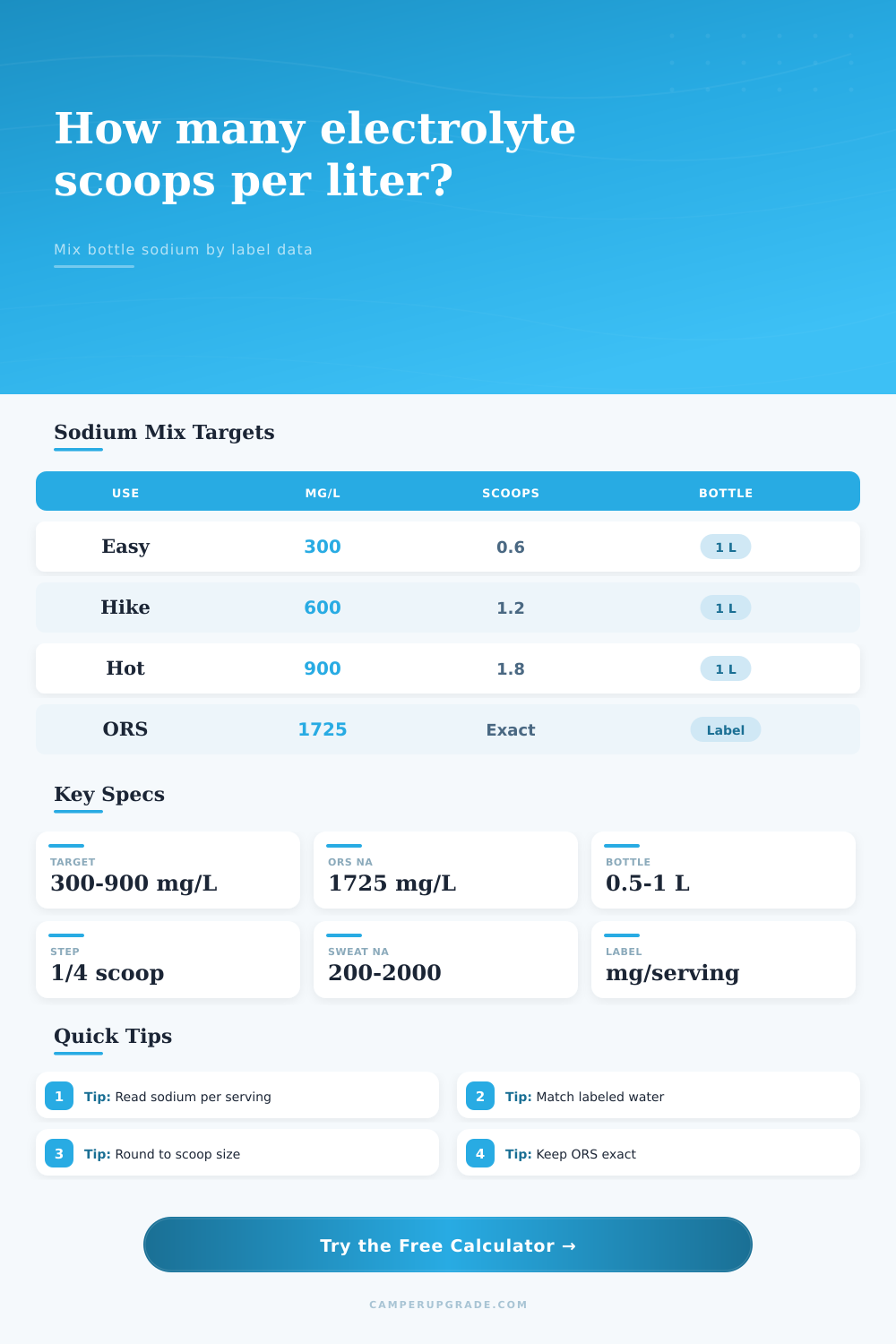
| Mixing context | Sodium target | Best use in this calculator | Watch point |
|---|---|---|---|
| Easy campsite sipping | 200 to 400 mg/L | Manual target for light sweat or flavor-only mixes | May be too low for long hot efforts |
| Steady hiking or paddling | 400 to 700 mg/L | Manual target or 40 to 60% sweat replacement | Check taste and stomach tolerance |
| Hot weather or salty sweater | 700 to 1200 mg/L | Sweat estimate mode with measured drink rate | Avoid stacking with salty food blindly |
| High-sodium race style mix | 1200 to 1700 mg/L | Only when label, plan, and tolerance support it | Not for casual all-day sipping |
| WHO-style reduced-osmolarity ORS sodium | 75 mmol/L, about 1725 mg/L | Use only to verify exact packet dilution | Medical ORS packets should follow the label |
| Container | Liters | Sodium at 500 mg/L | Sodium at 900 mg/L |
|---|---|---|---|
| 500 mL soft flask | 0.50 L | 250 mg | 450 mg |
| 20 fl oz bottle | 0.591 L | 296 mg | 532 mg |
| 24 fl oz cycling bottle | 0.710 L | 355 mg | 639 mg |
| 32 fl oz Nalgene-style bottle | 0.946 L | 473 mg | 851 mg |
| 2 L hydration bladder | 2.00 L | 1000 mg | 1800 mg |
| 5 L camp cooler jug | 5.00 L | 2500 mg | 4500 mg |
| Label example | Sodium per scoop | Target | Result per liter |
|---|---|---|---|
| 250 mg sodium, 1 scoop serving | 250 mg/scoop | 500 mg/L | 2.00 scoops/L |
| 300 mg sodium, 1 scoop serving | 300 mg/scoop | 600 mg/L | 2.00 scoops/L |
| 400 mg sodium, 1 scoop serving | 400 mg/scoop | 800 mg/L | 2.00 scoops/L |
| 500 mg sodium, 2 scoop serving | 250 mg/scoop | 750 mg/L | 3.00 scoops/L |
| 1000 mg sodium, 1 packet or scoop | 1000 mg/scoop | 1000 mg/L | 1.00 scoop/L |
| Ingredient or label spec | Useful conversion | Calculator field affected | Practical note |
|---|---|---|---|
| Sodium chloride | 39.3% sodium by weight | Sodium on label, if formulating from salt mass | Very salty taste at high concentrations |
| Sodium citrate dihydrate | 23.4% sodium by weight | Sodium on label, if using citrate sodium source | Often tastes smoother than table salt |
| Sodium bicarbonate | 27.4% sodium by weight | Sodium on label, if listed as bicarbonate | Can change flavor and stomach feel |
| Potassium chloride | 52.4% potassium by weight | Not counted as sodium in this calculator | Track separately when label lists potassium |
| Serving water volume | Label mg divided by label liters | Label strength comparison | Changing water volume changes concentration |
Formula core: sodium per scoop = serving sodium ÷ serving scoops; scoops per liter = target sodium per liter ÷ sodium per scoop; bottle scoops = scoops per liter × bottle liters.
But on a long hike, even if you’ve got enough food on board, you’ll find yourself suddenley drained of energy before you know it. Why? Because you didn’t account for the sodium you sweated out, yet consumed only plain water all morning. That’s why number of electrolyte scoops per liter is important.
While most folks will eyeball how many scoops they toss into their bottle, eyeballing results either in flat-tasting water or a belly full of brine. By converting the serving size and sodium amounts listed on labels into exact mix ratios, the calculator above does the math for you.
How to Use the Electrolyte Calculator
To start with, you must identify the proper number on package. This requires some explanation because package labels can be confusing. They often list both total weight and a combination of various ingredients. However, this tool cares about only one thing: how many milligrams of sodium are in each serving. Because sodium cause your body to retain water, it becomes the anchor of calculation.
Once you know that a scoop has 300mg of sodium and a single scoop makes up half a liter, the rest is just math. How many scoops do I need to reach my desired concentration? Don’t worry if you’ve never taken chemistry. A chart in the middle of page displays target concentrations for different types of activity, from light sipping to exposure to extreme heat.
Know how much sweat you lose and where you’re running/cycling/hiking. A hilly summer day in the heat will require more sodium then a pleasant spring day. A sweaty workout might also need more than an easy hike with lots of stops. You can estimate your sweat losses and what percent of that should be replaced via hydration by plugging those values into calculator.
For example, if you are a heavy sweater and want to aim for higher concentrations, you’ll enter “700” under “sodium target mg/L” at the top. That’s smarter than blindly chugging water (because you aren’t replacing any sodium), but also taking in too much (which is probably going on now).
Off-the-shelf sports drink formulations are typically made for average user; meaning they tend to be too dilute for salty sweaters, and too concentrated for casual weekenders. Personalizing the mix ensures you stay hydrated AND keep cramps away.
Volume is king. In practice, this means that type of bottle you use will dramatically affect how things work out. A regular 24-ounce cycling bottle contains roughly seven hundred ten milliliters, which is far from one liter, so using a liter’s worth of powder in that much water will make it hyper-salty and taste awful. Tastes awful.
Whether you’re mixing up a two-liter hydration bladder or a tiny soft flask, this baby senses how much water is inside. Then it tells you exactly how much powder to drop in to reach your preferred concentration. No more guessing and no more waste, just the perfect mix each time.
It’s easier to carry in the field Fractional scoops aren’t easily eyeballed and nobody is carrying a digital scale out on the trail. The calculator will round up what it gives you into more useful values such as halves and quarters. It’ll tell you to put in one and a quarter scoops for example. You can do that easy with the included scoop tool. It’s this little tweak that turns an otherwise theoretical plan into something you can actualy execute.
When you’re tired and hungry after a long climb, you want a system you can do without too much thought. Some powders are also available that has sodium citrate/bicarb rather than just straight chloride. They’re smoother-tasting but also have lower sodium content per gram of powder. The spec grid details this, with clear explanations of how each ingredient affects the final concentration level.
So while two seemingly-equivalent-looking scoops of a different brand may be equal in size…they may not offer an equivalent dose of sodium. This bears knowing as it will help you compare across products and know whether to up or down dose to match. Accuracy is better than convenience for performance and recovery mixes when the stakes are high.
Oral rehydration solutions are strictly medicinal formulas. They is high in sodium to treat dehydration from illness rather than exercise, so there are no tweaks. In those situations, just take as directed by following the packet instructions precisely. Getting it wrong, wrong strength, wrong ingredients, won’t help and might make your belly unhappy.
With the rest of life, you have some room to move around. Adjust it based off your tolerance or taste. Some athletes likes a little lighter mix that they’ll actually drink. Others want a super strong concentration because they’re going out on an ultra-long effort and don’t want to risk hyponatremia.
To find your sweet spot, experiment a little. Set a moderate dose and tweak from there. Is it overpowering? Dial back the concentration. Still drained after a long day? Bump up that sodium. It’s fast and simple to tinker thanks to the calculator.
Before heading out, you can try various scenarios and determine which setting is ideal for your body. Prevention is the name of the game (far better than guessing while worn out).
It’s personal. But the science behind it is universal. The best thing about hydration is it’s a tool for your performance, once you understand the targets and how much of it to use. Turns out that paying attention to the details in the powder tub can make a huge difference at the finish line or campsite. The trick is understanding what you’re actually measuring; then stop guessing and get fueled up correctly.