Dutch Oven Size by Group Calculator
Match campers, meal type, portion style, pot depth, fuel layout, and pack weight before the meal plan gets locked in.
Full Sizing Breakdown
| Camp oven size | Usable volume at 85% | Main dish servings | Best fit |
|---|---|---|---|
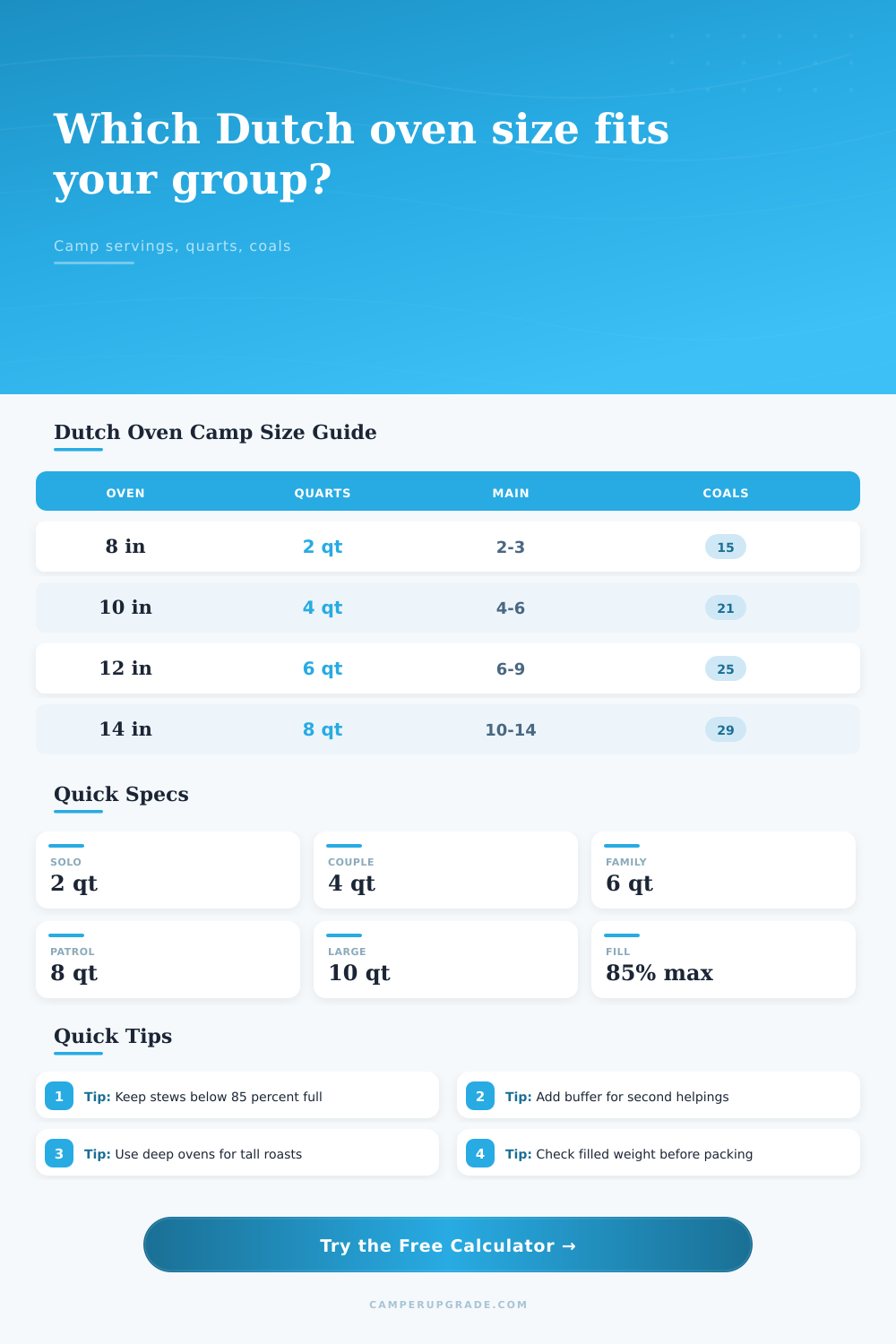
| 8 in / 2 qt | 1.7 qt | 2 to 3 | solo meals, sauces, small dessert |
| 10 in / 4 qt | 3.4 qt | 4 to 6 | couples, small family sides, cobbler |
| 12 in / 6 qt | 5.1 qt | 6 to 9 | family chili, casserole, camp bread |
| 12 in deep / 8 qt | 6.8 qt | 9 to 12 | roast, taller stew, dense breakfast |
| 14 in / 8 qt | 6.8 qt | 10 to 14 | patrol dinner, potluck side, beans |
| 14 in deep / 10 qt | 8.5 qt | 13 to 17 | large roast, rally serving line |
| 16 in / 12 qt | 10.2 qt | 16 to 21 | club meal, big group breakfast |
| Oven diameter | Top coals | Bottom coals | Total for about 350°F |
|---|---|---|---|
| 8 in | 11 | 4 | 15 briquettes |
| 10 in | 14 | 7 | 21 briquettes |
| 12 in | 17 | 8 | 25 briquettes |
| 14 in | 21 | 8 | 29 briquettes |
| 16 in | 24 | 9 | 33 briquettes |
| Meal role | Base quarts per person | Fill cap used | Why it matters |
|---|---|---|---|
| Main stew, chili, beans | 0.62 qt | 85% | liquid foods need stirring room |
| Roast or braise | 0.72 qt | 80% | larger pieces displace volume |
| Side dish | 0.38 qt | 85% | served beside grilled food |
| Cobbler or dessert | 0.45 qt | 80% | topping rises and needs headroom |
| Bread or rolls | 0.33 qt | 65% | dough expansion needs space |
| Breakfast casserole | 0.55 qt | 80% | eggs and potatoes puff as they cook |
| Common camp project | People | Meal style | Likely oven size |
|---|---|---|---|
| Solo camper stew | 1 to 2 | main stew | 8 in / 2 qt |
| Couple dessert night | 2 to 4 | cobbler | 10 in / 4 qt |
| Family campsite chili | 5 to 8 | main stew | 12 in / 6 qt |
| Awning breakfast hash | 6 to 10 | breakfast | 12 in deep / 8 qt |
| Scout patrol beans | 10 to 14 | side or main | 14 in / 8 qt |
| RV rally dinner | 16 to 22 | main dish | 16 in / 12 qt |
Dutch oven cooking defeats novice not because it’s inedible, but because the dish is cooked with wrong-sized vessel. Use a too-small pot and it’ll boil over and scorch the coals. Use one that’s too large, and everything scorches on bottom while middle remains half-cooked and raw. That’s why your chili isn’t coming out right; it’s because kitchen measures don’t directly apply to campfire heat.
There are reasons behind the numbers which you can plug into the calculator above. It’ll match your group size to real-world realities of cast iron. First off, understand that amount of food you cook on a trail is not the same than the amount you cook in a kitchen. At home, you have constant airflow and exact heat control. Here, you’re piling on briquettes and crossing your fingers.
How to Choose the Right Dutch Oven
That’s what those portion style and meal role input is for. Bread requires rising room (vertical) while a stew have more liquid headroom so it doesn’t bubble out. And when you’ve got bunch of hikers who haven’t eaten in hours, they aren’t eating normal portions; they’re eating hungry. So the tool take into account the scale-up of quarts needed. This way you don’t get left with nothing but a thin layer of sauce for eight ravenous hiker. It’s just a little tweak in the software but it’s the difference between a snack and a meal.
And then there’s question of weight. Cast iron is heavy. That cute little oven that measure a dozen inches across may seem doable in shop, but add six quarts of chili to its belly and top it with a heavy lid and all of a sudden you’re hauling around some serious weight. And this is why knowing its filled weight is important. This number let you know whether or not you’re going to be able to grab that pot from over the fire without dropping dinner all over your boots or straining back. When numbers get too high for you to feel comfortabley carrying them, the tool will recommend downsizing the pot (or maybe switching materials) based off the number you just entered.
Knowing weight of cast iron can help you avoid injuring your back, but aluminum pans will conduct heat at different rate. You have to weigh the convenience against retaining heat every time. Cast iron retains heat better, forgiving on those breezy nights, while aluminum cools quickly, great for precise control but risky if you step away for a minute.
It’s the same with charcoal count. How many coals should I use? You’ll notice most folks guess at it. Some stack ’em up too high, burning food, while others underfuel the lid leaving top of dish raw. The reference table on this page show that about twenty-five briquettes will hold a twelve-inch oven steady at around three hundred fifty degrees. It is not random. It is based off heat loss and surface area. Know it before you strike the match. Save yourself the awkward dance of moving coals while your stew simmers. Turn your guesswork into a plan.
Sometimes it’s all about depth. For example, an 8 quart deep 12 inch oven is different than a regular 12 inch oven that has a 6 quart capacity. That extra height are important for something like a tall loaf of bread (or a whole chicken). You want it to fit the shape of item you’re cooking. The calculator take that kind of preference into account. No point in trying to jam a tall roast into a shallow pan. It will change the shape, the texture, how long it takes to cook. It’s about matching shape of your container with the shape of what you want to cook.
Last but not least, let’s talk about that buffer. Camping is always unexpected. Kids get more hungry than expected, others show up later than planned. Having a ten to fifteen percent cushion on your portion calculation isn’t wasteful. It’s insurance. It is insurance against the mood-killing empty bowl at campfire. You can set that buffer in tool. This way it will give you a realistic idea of what you realy need to prep for. Better to have bit leftover than to have people going to bed hungry.
With coals, there’s no dial to turn; it’s not about exact temperatures as much as it is about setting yourself up for success. The only constant control you have is getting the pot size correct. After that, it’s all practice. Add fuel. Remove fuel. Count your coals. Check the weight. Respect the headroom. Once you have the right vessel, the rest is just practice. And so are your knees when your dinner come out.