Dual Battery Isolator Sizing Calculator
Estimate isolator continuous and surge amps, safe fuse sizing, cable gauge, and voltage drop for camper auxiliary battery charging.
Recommended dual battery sizing
| Copper cable | Ohms per 1000 ft | Planning ampacity | Typical isolator use |
|---|---|---|---|
| 10 AWG | 0.999 | 30 A | Small trailer maintainer |
| 8 AWG | 0.628 | 50 A | Compact camper charge line |
| 6 AWG | 0.395 | 70 A | Common van auxiliary bank |
| 4 AWG | 0.249 | 100 A | Longer rear battery run |
| 2 AWG | 0.156 | 150 A | High current AGM bank |
| 1/0 AWG | 0.098 | 200 A | Large combiner or inverter bank |
| 2/0 AWG | 0.078 | 250 A | Heavy overland build |
| 4/0 AWG | 0.049 | 350 A | Very high current trunk line |
| Chemistry | Bulk current guide | Voltage behavior | Isolator note |
|---|---|---|---|
| Flooded lead-acid | 0.10C to 0.15C | Accepts less as SOC rises | Simple VSR often works when vented |
| Gel lead-acid | 0.15C to 0.20C | Sensitive to over-voltage | Keep charging voltage conservative |
| AGM lead-acid | 0.20C to 0.30C | Higher acceptance when low | Good match for relay isolators |
| Lead carbon | 0.30C to 0.40C | Better partial-SOC cycling | Confirm maker charge limits |
| LiFePO4 lithium | 0.30C to 0.50C | Can hold high current | Use DC-DC control or limiter |
| Target charge amps | Minimum continuous isolator | Suggested surge rating | Common fuse range |
|---|---|---|---|
| 20 A | 40 A | 80 A | 30 A to 40 A |
| 40 A | 80 A | 120 A | 50 A to 70 A |
| 60 A | 100 A | 150 A | 80 A to 100 A |
| 100 A | 150 A | 250 A | 125 A to 150 A |
| 150 A | 200 A | 350 A | 175 A to 225 A |
| 200 A | 300 A | 500 A | 250 A to 300 A |
| Vehicle setup | Aux bank | Charge target | Typical hardware |
|---|---|---|---|
| Weekend camper van | 100 Ah AGM | 30 A | 80 A relay, 6 AWG short run |
| Truck camper | 200 Ah AGM | 60 A | 120 A isolator, 4 AWG cable |
| Lithium overland rig | 200 Ah LiFePO4 | 50 A limited | DC-DC charger, 6 or 4 AWG |
| Large expedition build | 300 Ah lithium | 100 A limited | 200 A combiner, 2 AWG cable |
You buy the van, you install the lithium bank. After driving to camp, you realize you has forty percent left on your house battery. More than likely, it’s not the battery but the wiring connecting the alternator to the battery. Matching the battery chemistry with the cable tolerance for electrons is less about finding the biggest relay and more about sizing a dual battery isolator. Too big of a fuse doesn’t protect the circuit; too small of an isolator shuts down too soon, preventing charge. Melting happens if wire isn’t thick enough. Then you won’t have a start or a fridge.
All you do is plug in your target current, the length of wire you’re using, and voltage of your system. The rest is left up to the calculator. It figures out the current limit reduction and voltage drop factor for you. Most DIY’ers mess this part up.
How to Size Your Wiring and Fuse
You have to realize your alternator isn’t some magic box that makes infinite current. Yes, it spits out x amount of current but a portion of that get consumed by the vehicle. Fuel pump, ECU, fans, lights, etc., all consume current before it can be routed to the auxiliary bank. So you take the rated output from the alternator and minus out what’s used by the vehicle (reserve) to get your true surplus. Your surplus equals your ceiling; everything else in build has to stay below it.
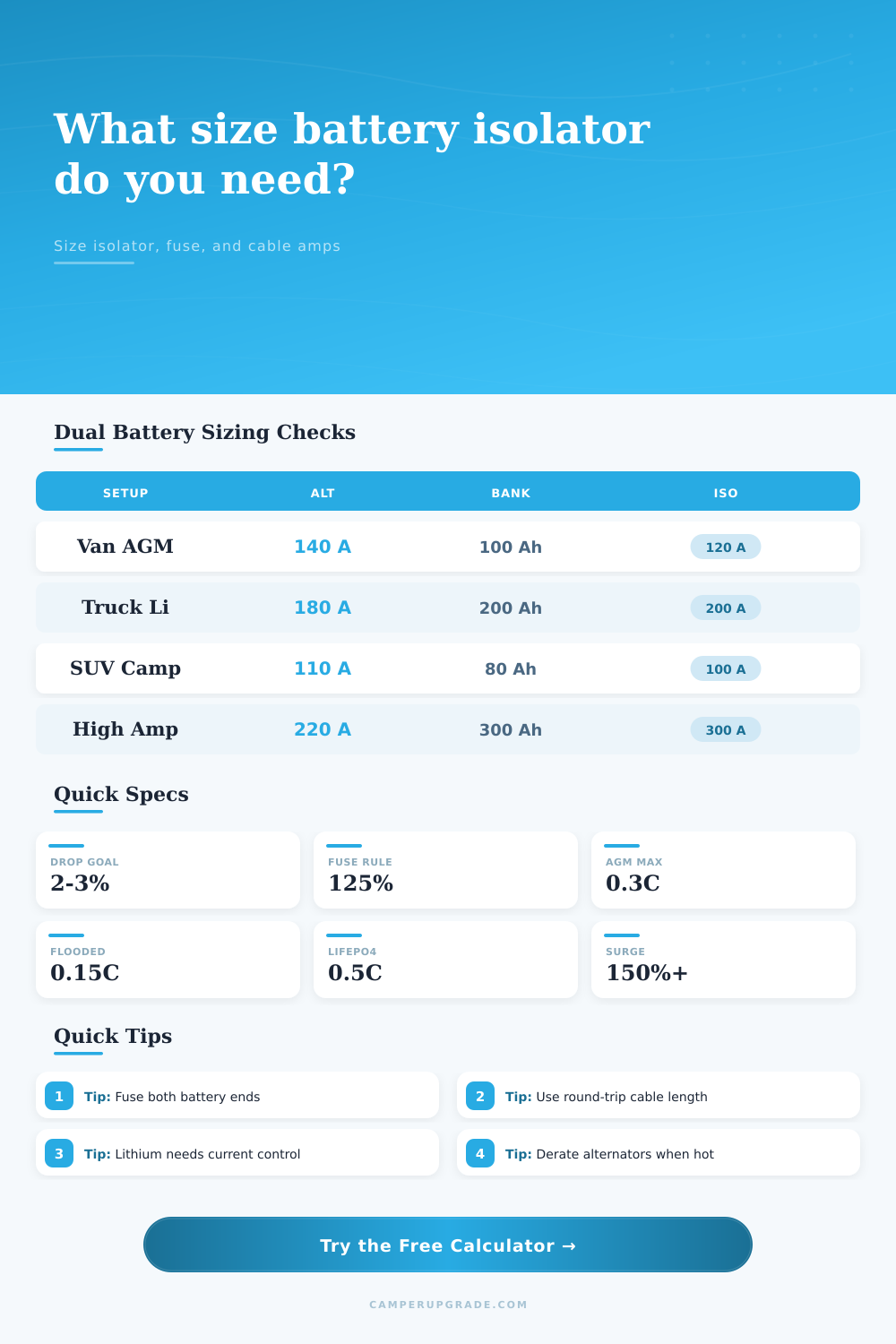
The lower limit is determined by battery chemistry. Flooded lead-acid batteries takes time to charge. They don’t tolerate big surges well, as they’ll degrade their plates or just gas-out. You have to charge them slowly (usually ~15% of their capacity). AGMs are better (30%), and lithium batteries even better (often 50%+), but will require accurate voltage cutoffs. For instance if your setup has a lithium bank, using a basic voltage-sensing relay can cause it to be overcharged since the relay doesn’t know when to quit pushing current into it. The calculator considers this by only recommending charge targets right for the chosen chemistry. It makes a difference in battery longevity.
The way power gets there physically is through cable gauge. Voltage drop, which few folks consider when purchasing cable, happens with long cables made from small wire. That’s because any wire have some resistance, it’s like having a resistor in your circuit. So the output voltage of the alternator isn’t what you get at the battery. And if the wire size is insufficient, the alternator may have to work harder than needed, or the charger thinks the battery is charged when it really isn’t. The tool determines how big the wire needs to be based off the one-way distance and the desired percentage of voltage loss. It doubles the length inside because power flows both ways… Out and then back. That round trip lowers the efficiency.
The last safety net is fusing. Because a short on either side might be the cause, you must fuse near the positive terminal of every battery. A good rule is to size the fuse for 125% of its continuous current draw. That way, it won’t blow during normal fluctuations, but will trip immediately with a dead short. The calculator bases the fuse rating on the maximum capacity of your cable and the target current. That means the fuse will always blow before the wire overheats.
This equation also depends on heat; as alternators becomes warm, they also become less efficient. If you’re crawling across a trail on a hot day, your alternator bay is going to be suffocating. By lowering the projected output based on surrounding conditions, the calculator accounts for efficiency loss. You shouldn’ of plan on getting a maximum output that you won’t actualy get in real life. Under promise, over deliver.
On the page it’s laid out clearly in the reference table where you’ll see examples of common setups ranging from the weekend van to a serious expedition rig. A big battery doesn’t necessarily need a big isolator. What it does mean is it takes a long time to charge. The isolator only has to handle what the battery accepts and the alternator can give it.
In summary, however, it comes down to restriction and flow. You need thick enough wire to carry current without losing it, a sensitive fuse that catches faults, and an isolator sturdy enough to remain closed. The sum total is the electrons flowing freely. If not, there will be voltage drop, heat, and a dead battery.
Follow the calculator’s recommendations initially, but test for physical fit of terminals and quality of the connection. Nothing is better than a perfect calculation if the ring terminal do not seat properly.