Drysuit Thickness Calculator
Estimate paddling underlayer thickness, thermal risk, comfort window, and hypothermia buffer from water temperature, air temperature, immersion time, wind, gasket type, activity level, cold sensitivity, and rescue delay.
Drysuit thermal estimate
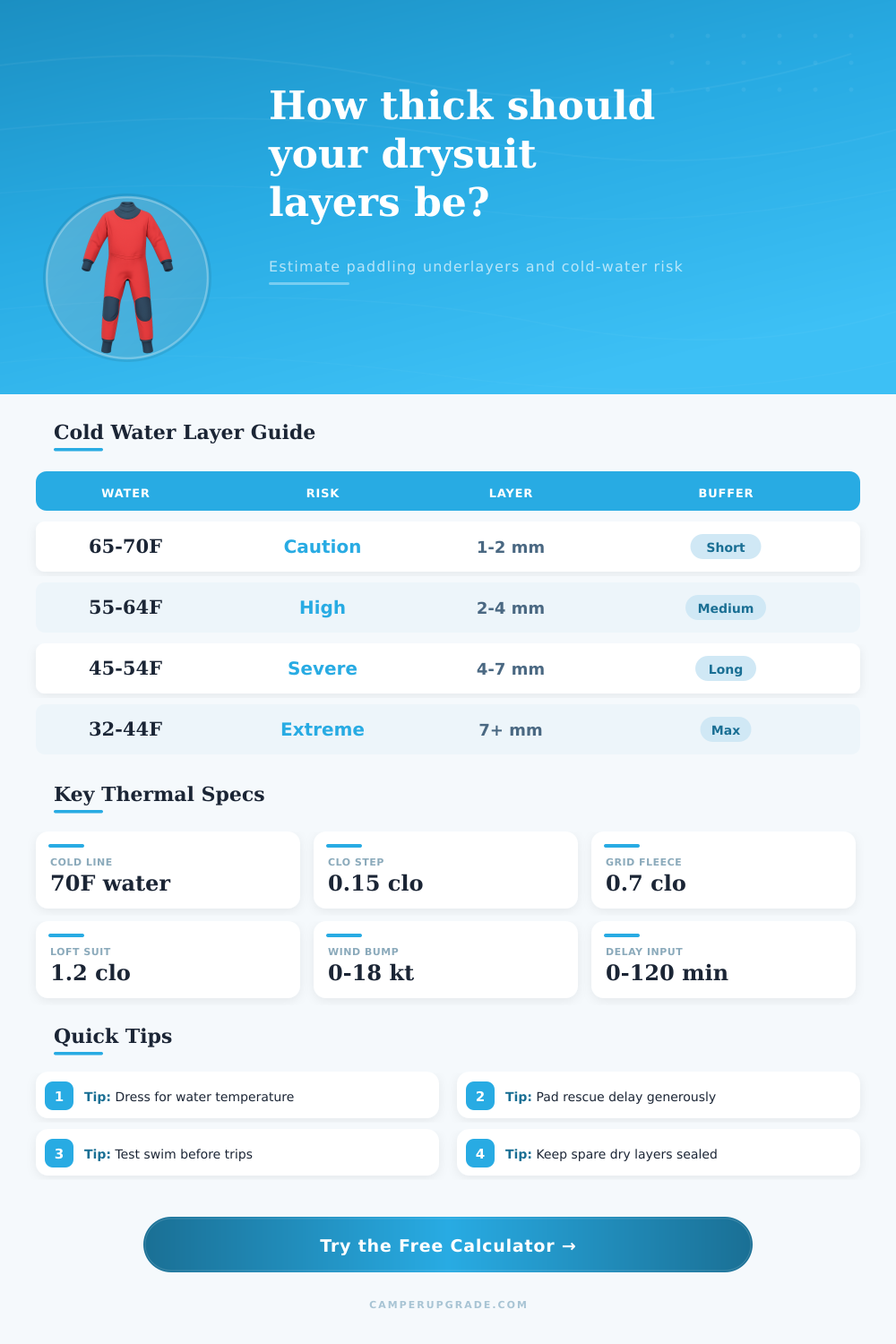
| Water temperature | Planning risk | Typical drysuit underlayer | Immersion planning note |
|---|---|---|---|
| 65-70 deg F / 18-21 deg C | Caution | Base layer or thin fleece, 0.3-0.6 clo | Breathing control can still be affected after a swim |
| 55-64 deg F / 13-18 deg C | High | Midweight fleece, 0.6-1.0 clo | Plan for cold shock, remount delay, and wet hands |
| 45-54 deg F / 7-12 deg C | Severe | Heavy fleece or one-piece liner, 1.0-1.5 clo | Short swims can become serious if rescue is slow |
| 32-44 deg F / 0-7 deg C | Extreme | Lofted suit plus base, 1.5-2.2 clo | Use conservative margins and practiced rescue systems |
| Below 32 deg F / below 0 deg C | Ice exposure | Expedition insulation, hands and head protected | Ice, current, and access can dominate the risk |
| Layer type | Approx clo | Fleece-equivalent thickness | Best drysuit use |
|---|---|---|---|
| Wicking synthetic base layer | 0.20-0.35 clo | 1-2 mm | Warm water, sweat control, or first layer |
| Light grid fleece | 0.45-0.70 clo | 3-5 mm | Cool touring and rolling practice |
| Midweight pile or fleece suit | 0.75-1.10 clo | 5-8 mm | Cold-water paddling with short rescue windows |
| Heavy lofted drysuit liner | 1.10-1.60 clo | 8-12 mm | Winter touring, rescue drills, and long delays |
| Expedition layered system | 1.60-2.40 clo | 12-18 mm | Ice-edge work, remote trips, and severe exposure |
| Factor | Low effect | High effect | Calculator treatment |
|---|---|---|---|
| Wind while wet or waiting | 0-6 kt | 18+ kt | Adds up to 0.25 clo demand and reduces comfort time |
| Gasket leakage | Latex seals | Loose or worn seals | Adds flushing penalty when the suit may weep |
| Activity heat | Waiting | Hard paddling | Offsets 0.00-0.20 clo before immersion |
| Cold sensitivity | Runs warm | Very cold-sensitive | Moves target insulation by -0.10 to +0.35 clo |
| Compressed insulation | Roomy fit | Crushed loft | Adjusts effective clo before comparing the target |
| Scenario | Water and air | Delay assumption | Layer target |
|---|---|---|---|
| Summer lake capsize | 68F water, 75F air | 5-10 min | Base layer or light fleece |
| Spring sea kayak | 52F water, 48F air | 20-40 min | Midweight fleece and warm headwear |
| Cold whitewater run | 43F water, 40F air | 15-30 min | Heavy fleece suit with hand protection |
| Coastal delay | 48F water, 42F air | 45-90 min | Lofted liner and spare dry insulation |
| Ice-edge training | 34F water, 28F air | 30-60 min | Expedition liner, hood, gloves, and team support |
A drysuit is designed to keep water away from you skin. However, a drysuit does not provide heat for you by itself. Your bodys insulation, which you wear underneath your drysuits, is the part that will warm you.
You have to make sure that the amount of insulation you choose is the correct amount for you so that you dont end up either too cold or uncomfortably in the water. Your body lose heat much faster in the water than it does in the air. For that reason, you must consider the water temperature for your comfort in a wilderness.
How Much Insulation to Wear Under a Drysuit
The calculator will help you determine how much insulation to wear based off certain data point. These data points includes the temperature of the water that you will be in, how long you will be in the water, and the amount of time that you will take to reach dry shelter after entering the water. Your activity level will also play a role in the amount of heat that your body will produce.
The calculator will account for this. If you are on the water, your body will produce heat; however, if you stop paddle, that heat will leave your body. Therefore, the calculator will tell you how much insulation to wear based on whether you will be resting, cruise, or working hard on the water.
Other factors in the water that can impact the amount of heat that will leave your body include the wind and the condition of your drysuit. If the wind blow across your body or your drysuit, your body will lose heat at a rapid rate. The wind will make the air in the wilderness feel more colder than it is.
Additionally, if your drysuit has a latex seal that allow water to enter your suit, that water will undermine the insulation that your drysuit is supposed to provide. The calculator takes both of these factors into consideration to provide you with an estimation of the amount of insulation you must wear in the wilderness. Your body is different than other in relation to how cold-sensitive you are.
Some people has more body mass and body fat than others. Those with less body fat and body mass will become cold much more quickly than others. The calculator will allow you to input whether you are an average temperature for cold-sensitive individuals, quick to get cold, or if you are one of the very cold-sensitive individuals.
This will provide a better safety margin when entering the water. This is crucial for those who may become fatigued or not eat enough food prior to heading into the wilderness for the day. The calculator will help you determine the amount of insulation to wear.
However, these are signals only. The calculator will represent the amount of time that you can go without feeling a heavy chill. Additionally, the calculator will also show the hypothermia buffer for your trip.
If your hypothermia buffer is close to zero, you will have to plan to have a fast rescue plan for you and to ensure that your drysuit has good seals. If your hypothermia buffer is at a negative number, you will have to either add more insulation, shorten the time you are in the water, or change your plan for entering the water. The numbers entered into the calculator may not be the same as what you experience in the wilderness.
It might take longer to find you than you have estimated due to the wind or the position of your trip partners. Because of the changing conditions in the wilderness, you can use the reference tables on the page. These will tell you what type of insulation will work for you in various temperatures.
For example, a fleece suit may work for you for a forty-five-minute period in the water but may not provide you with enough warmth to stay in the water for ninety minutes. Use the drysuit insulation calculator before you go on your trip into the wilderness but not after you have entered the water. Use the calculator to enter the temperature of the water, the length of time that you will be in the water, and the level of cold sensitivity that you have as an individual to the cold weather.
This will help to show you the amount of insulation to wear under your drysuit. Once you have dressed appropriately for the water temperature, the insulation will work in the background so that you can focus on paddling your kayak or canoe in the wilderness.