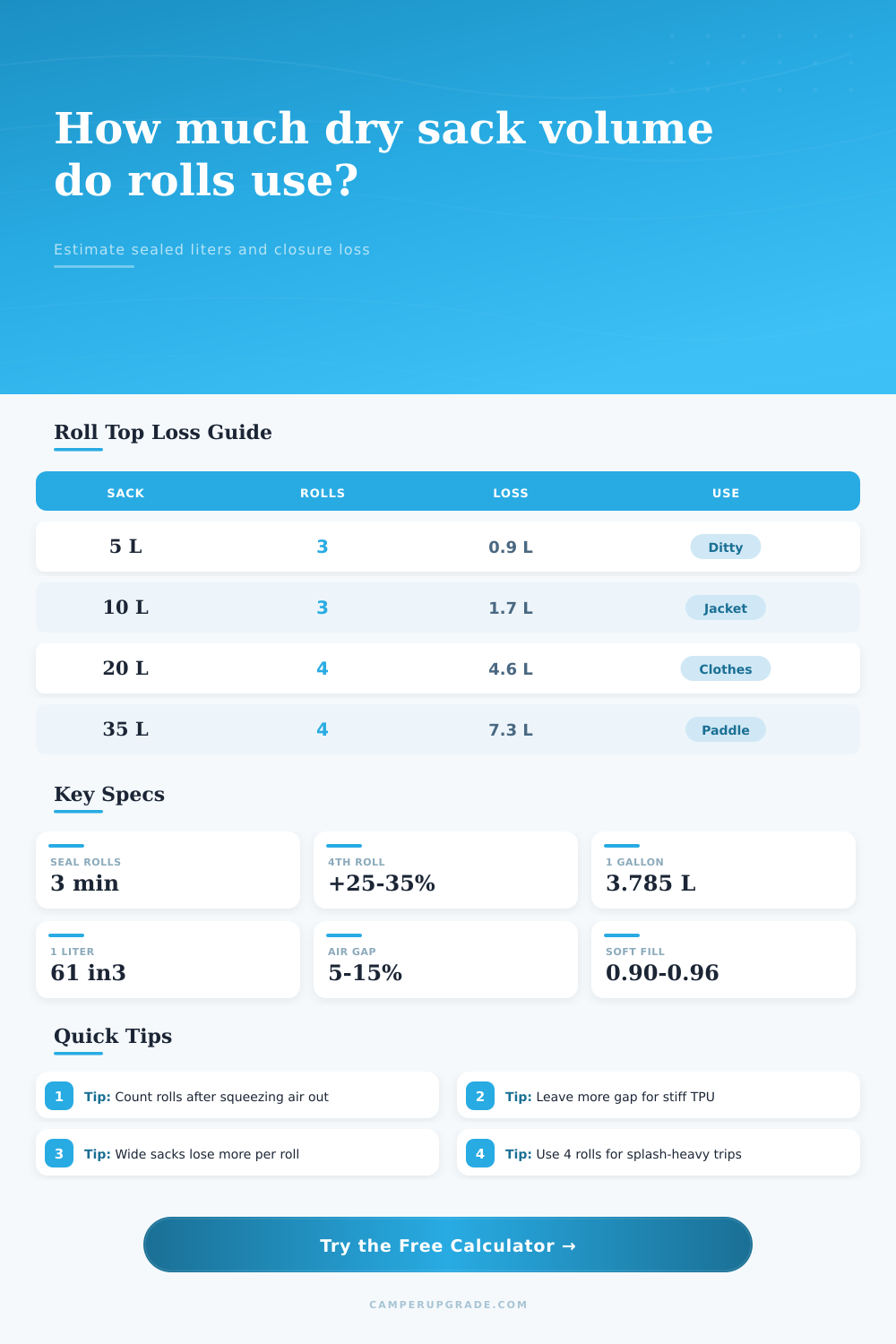
Dry Sack Roll Top Volume Loss Calculator
Estimate how many liters disappear into the rolled closure, how tall the sealed pack becomes, and whether your contents fit with a realistic waterproofing margin.
🎒Named Dry Sack Presets
📏Dry Sack Dimensions And Closure Inputs
Dry Sack Volume Result
🧮Roll Top Formulas Used
circumference = 2 × flat mouth width; diameter = circumference / π
body volume = adjusted cross-section area × packable body height
roll loss height = rolls × roll diameter × material take-up + seal reserve
usable volume = (body volume - closure loss) × compression factor × air-gap buffer
🧵Material / Spec Comparison Grid
📊Closure Roll Count Reference
| Closure Setup | Typical Use | Height Consumed | Volume Effect |
|---|---|---|---|
| 2 rolls | Organizer pouch inside a pack, low splash risk | 2 roll diameters plus reserve | Lowest loss, weakest closure margin |
| 3 rolls | Backpacking, kayaking hatch storage, general camping | 3 roll diameters plus reserve | Common balance of seal and capacity |
| 4 rolls | Open canoe, raft, wet pack exterior, winter snow travel | 4 roll diameters plus reserve | Often loses another 20-35% of closure volume |
| 5+ rolls | Very stiff or oversized bags when contents sit low | 5 or more roll diameters plus reserve | Strong margin, but quickly reduces usable height |
🛶Dry Sack Material Behavior Table
| Material | Roll Take-Up Factor | Contents Factor | Best Calculator Use |
|---|---|---|---|
| 15D ultralight nylon | 1.03 | Soft, easy to squeeze | Small ditty sacks, quilts, clothing cubes |
| 30D silnylon | 1.05 | Flexible with slight air trapping | Backpacking dry sacks and pack organization |
| 40D PU nylon | 1.07 | Moderate fabric memory | General waterproof stuff sacks |
| DCF composite | 1.08 | Low stretch, crisp fold lines | Ultralight sacks where width measurements are precise |
| TPU laminated nylon | 1.12 | Stiffer roll and more trapped air | Paddling, bikepacking, and wet exterior carry |
| Heavy PVC river bag | 1.22 | Bulky closure stack | Rafting dry bags, duffels, and expedition sacks |
| Waxed canvas dry bag | 1.18 | Thick fold and low compression | Heritage style sacks with dense fabric folds |
| Compression dry sack | 1.10 | Closure plus strap squeeze | Sleeping bags and down layers after compression |
📐Bag Shape And Measurement Reference
| Packed Shape | Area Factor | When It Applies | Volume Note |
|---|---|---|---|
| Round, evenly stuffed | 1.00 | Clothing or quilt fills the sack evenly | Closest to cylinder math from flat mouth width |
| Oval, normal field packing | 0.92 | Mixed camp gear creates a mild oval | Good default for real packing with soft edges |
| Flat/rectangular soft goods | 0.84 | Clothes are folded, not stuffed round | Allows for corner folds and flatter panels |
| Lumpy hard items | 0.76 | Cook kits, food blocks, bottles, camera cases | Lower effective volume because gaps remain |
🏕Common Dry Sack Size Examples
| Scenario | Labelled Size | Common Rolls | Expected Sealed Capacity |
|---|---|---|---|
| First aid and headlamp ditty sack | 3-5 L | 3 rolls | Usually 75-85% after reserve |
| Down jacket or camp clothing bag | 8-13 L | 3 rolls | Soft contents compress into the closure loss |
| Weekend canoe clothing sack | 20 L | 3-4 rolls | Plan around 15-25% roll-top loss |
| Pack liner with sleeping gear | 30-40 L | 3 rolls | Usable volume depends heavily on air squeezed out |
| River duffel or expedition dry bag | 55-70 L | 4 rolls | Stiff fabrics can take a large vertical bite |
💡Field Calculation Tips
For example: That 20 liter dry bag’s label is an optimistic suggestion rather than a guarantee of what will actualy fit inside. You get all your stuff in there, close up the top, start rolling….and each time you make another fold, you’re losing some space. The material closes around the buckles…which then click shut…and still there’s no way that much stuff fit. Use this calculator to determine how many liters of space are taken up by rolling prior to departure.
Material characteristics and geometry is to blame here. When closed, a roll-top bag doesn’t magically dissapears. It becomes a pile of fabric that take up vertical space inside the cylinder. Because they have greater circumference, wider bags has less remaining interior volume for each fold/roll. Heavier fabrics (e.g., heavy PVC vs. TPU laminate) require more cloth to achieve a secure seal; thus they create thicker folds that eats into your storage capacity. TPU laminate require more cloth to get a secure seal. This creates a taller column of fabric with fewer rolls, which decrease capacity. Even soft silnylon may gain an inch or two on stiffer river gear…if it’s stuffed hard enough.
Why Dry Bags Do Not Fit What They Say
People use one size and think they has enough room. They don’t realize they must leave a gap for water proofing. You also need space above the items so you can close it without pulling on it too much. If you do, it just pops open as soon as someone squashes it into a kayak hatch or puts pressure on it. That’s why I let you put in a buffer percentage in my calculator which gives you the right amount of space after you get done rolling so it really doesn’t go wet.
The density of your contents will also change that. Softer things like down quilts is compressed a lot during the rolling process. Harder things like camera bricks or food bricks won’t compress at all no matter how hard you push. This makes a huge difference in terms of what your effective size become. Capacity numbers on a spec sheet aren’t what matter, it’s the material they’re made from. For instance, a 35 liter thin nylon bag could actually fit more closed gear than a 20 liter PVC duffel. That thick plastic take up space as a bulky collar at the top. It also impacts what happens with folding and the table includes that data so you get a realistic expectation instead of some theoretical max.
What you’re really doing is exchanging internal space for closure security. Each time you do a roll, that costs you space. When it’s nice out you can fill that bag up to the brim. And then wish you hadn’t when the rain starts falling. The stakes are higher now and your seal might pop open if you didn’t leave yourself some breathing room. The stakes is higher now. You have a bag full of soaked gear because you didn’t leave yourself any extra space.
Five percent sounds like nothing on paper but this is how you leave room for the last fold, the one that holds your jacket, and space for fumbling around with wet hands in the real world. Because you don’t just want it packed; you want it dry. It’s a simple piece of math that makes sense. The width is the same as the cross section. Multiply it by the available height. Subtract one inch for every roll, multiplied by that material’s thickness factor. It sounds complex, but really, it’s just about understanding how many inches your closure takes up. If you don’t account for that, you’re going to have gear sticking out the top. It might also be a poor seal where water can sneak in between your rolls due to tiny gaps.
Margin, not precision, is the name of the field packing game. Savvy backpackers leave room for the unplanned souvenir. Space for the repair kit. Emptying out a few dry sacks to accommodate an additional layer of clothes or a few extra cords of cordage. That’s what happens when you know precisely how much you’re giving up in liters. The number on the side lets you pack confidently. It tells you whether your rain jacket will fit without a guess.
Before departure take a look at the dimensions of your bags. How big are they? How many roll of film? What’s in there? Hard objects don’t shrink. Soft stuff shrinks well. Stiff fabrics will need more space to close securely. And if you know how big your bag is, you’ll also know how far you can push it and still respect its limitations. Accepting that part of the closure must be for the closure ensures your dry stuff remains dry. It keeps you from leaving them wet in the tall grass. This is how you pack light and not leave anything behind.