Dry Ice Sublimation Rate Calculator
Estimate dry ice loss per hour, remaining weight after a trip leg, replacement weight, and CO2 gas volume for camping coolers, food totes, and RV transport.
This calculator estimates sublimation under camping conditions. Actual loss changes with packaging, lid seal, load temperature, venting, and how often warm air enters the container.
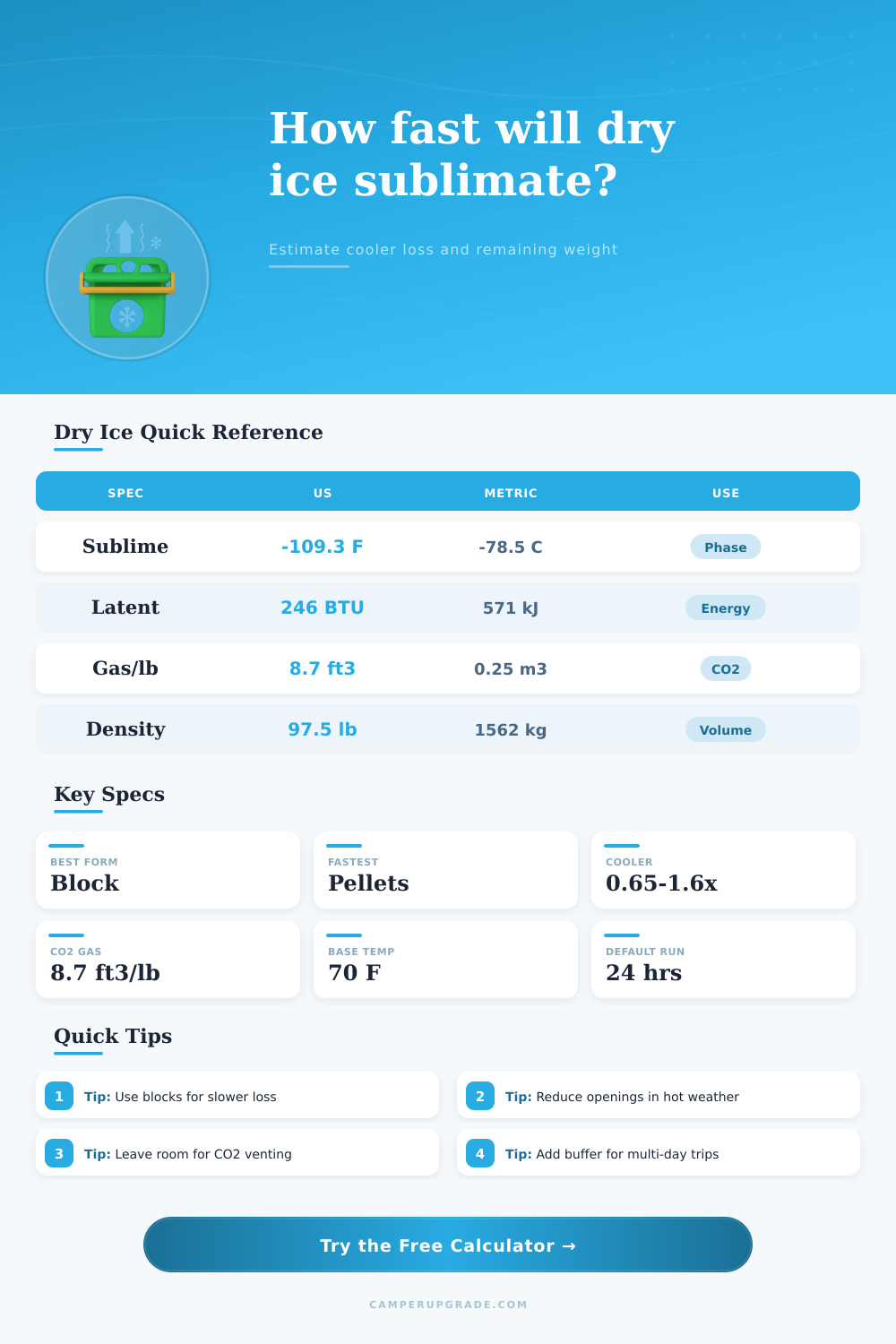
| Dry ice property | Imperial value | Metric value | Calculator use |
|---|---|---|---|
| Sublimation point at 1 atm | -109.3°F | -78.5°C | Explains direct solid-to-gas change |
| Latent heat of sublimation | About 246 BTU/lb | About 571 kJ/kg | Cooling energy absorbed while sublimating |
| Solid dry ice density | About 97.5 lb/ft³ | About 1562 kg/m³ | Surface-area and packing context |
| Gas expansion at room conditions | About 8.7 ft³/lb | About 0.245 m³/lb | CO2 gas volume estimate |
| Dry ice form | Relative rate factor | Typical camping behavior | Best use case |
|---|---|---|---|
| Wrapped block or paper bag | 0.65x | Lowest exposed surface area | Long cooler holds |
| Solid slab with low exposure | 0.75x | Large mass, fewer exposed edges | Chest coolers and frozen food |
| Standard block, partly exposed | 1.00x | Baseline for this calculator | General RV and camping use |
| Nuggets or small chunks | 1.70x | More edges and air contact | Short-term distribution |
| Pellets | 2.30x | High surface area, fast cooling | Small samples or quick chill |
| Crushed dry ice | 3.00x | Very high surface area | Brief use with rapid sublimation |
| Container condition | Heat factor | Example | Planning note |
|---|---|---|---|
| Freezer compartment | 0.50x | Closed RV or home freezer cavity | Slowest listed heat gain |
| Rotomolded premium cooler | 0.65x | Thick insulated ice chest | Good for multi-day planning |
| Standard camping cooler | 1.00x | Common hard cooler | Calculator baseline |
| Thin-walled ice chest | 1.60x | Lightweight budget cooler | Add margin in warm vehicles |
| Cardboard shipper or thin tote | 2.40x | Short grocery or sample run | Expect faster loss |
| Open tray or uninsulated bin | 3.40x | Tailgate display or demo tray | Use only for short windows |
| Camping scenario | Starting dry ice | Typical duration | Reference expectation |
|---|---|---|---|
| Small grocery return in a cooler | 5 lb block | 4 to 8 hours | Usually ample if lid stays closed |
| Weekend frozen food chest | 10 to 15 lb block | 24 to 48 hours | Depends heavily on cooler quality |
| Hot vehicle desert transit | 20 lb block | 12 to 24 hours | Heat and openings dominate loss |
| Open tray demonstration | 5 lb pellets | 1 to 3 hours | High airflow causes rapid sublimation |
With a sense of accomplishment, or maybe even superiority at being so logistically minded, you proudly load up the cooler. The food are carefully arranged. The block is tighty wrapped. The lid is securely closed. A few hours down the road, however, it’s all but demolished. Not bad luck, it’s physics, and physics is exacty what cause your dry ice to vanish.
The sublimation rate calculator on this page can take the guesswork away when you’re trying to figure out if you’ll need 10 pounds or 30 pounds for your weekend outing. Just input your scenario, and let the calculator work. Knowing how numbers shift… And why they do, matter just as much as knowing numbers themselves.
Why Dry Ice Disappears
But what’s the real deal? Surface area. Unlike normal ice, which melts, dry ice sublimates, turns straight into gaseous carbon dioxide, at minus one zero nine degrees Fahrenheit. How fast this occur depends entirely based off its exposure to ambient warmth, and the more surface area it have, the quicker that process will occurs. Enter form factor. One solid mass will outlast an equivalent amount spread across smaller chunks or pellets.
That’s why those multipliers exists within the calculator: they’re meant to account for whether your dry ice is loose nugget form or encased in a wrap known as a “slab.” It isn’t simply a matter of having enough. No, it’s a question of geometry too. So even if you add more dry ice, it’ll vanish in seconds if it’s all in tiny bit.
There’s also the matter of insulation which, while it does play a role, tends to do so in a more subtle way than some might think. Obviously, a thin-walled plastic chest isn’t as good as rotomolded cooler; even the best insulation will slow the process, but it will never stop it completely.
It’s typically human error that kills the party. Each time you open that cooler to reach for a sandwich or check the beer level, you let hot air in. You are also letting all that cold gas escape. You could of planned everything perfectly for several hours and still ruin it by opening the lid too many times. The tool allows you to think about how frequently you’ll probably open up the container throughout the day. Most folks tend to overestimate themselves when it comes to curiosity.
If you’re taking this thing camping or tailgating with friends, then you has to plan for how often that cool air seal will be broken. Of course, temperature’s involved, but there are subtleties between airflow and temp. Yes, loss will be accelerated on a hot desert day. But even then, if you prop open the lid on the cooler and expose it directly to the sun, wind can play a huge role.
Wind will strip off the thin cushion of cold air that sticks to the surface of dry ice. Without this buffer, warm air rushes in more quickly. The calculator includes questions about whether there is airflow around the ice and whether the container is closed tightly or has gaps. It is a small detail, but it matters. Propping open a lid or having a loose gasket will make what would otherwise be a slow sublimation event into a rapid one.
Then there’s the issue of space. About eight point seven cubic feet of CO2 are create for each pound of disappearing dry ice. That pressure inside an unvented and sealed container can be hazardous. It can crack plastic tubs, or blow off lids. Make sure you have some means for releasing that gas without admitting heat into your cooler. It’s a fine line between too much and not enough. Loosen it up just enough to let the gas escape as it expands but make sure it’s snug enough to retain cold air.
For extended trips like an RV excursion or a multi-day hunt, it’s smart to add a buffer. If you add ten or twenty percent more weight to account for the unknown, the calculator allows you to factor that in. Roads become rough and weather changes causing lids to pop open. Cold is cold and people forget just how cold it can be inside. It’s not pessimism, it’s realism; a buffer.
Consider the container, the form, and your habits before purchasing that ice. You’ll save money by packing a big block into a good cooler that’s only occasionally opened as opposed to dumping a bunch of pellets into a flimsy bin that sees constant traffic. Use the calculator to get an estimate at the baseline. Then use your judgment to fill in the gaps.
If you pack it right, close it tight, and let the physics work for you instead of against you, thats how you make the ice last.