💧 Dry Bag Size Guide & Calculator
Find the perfect dry bag capacity for kayaking, camping, rafting & more
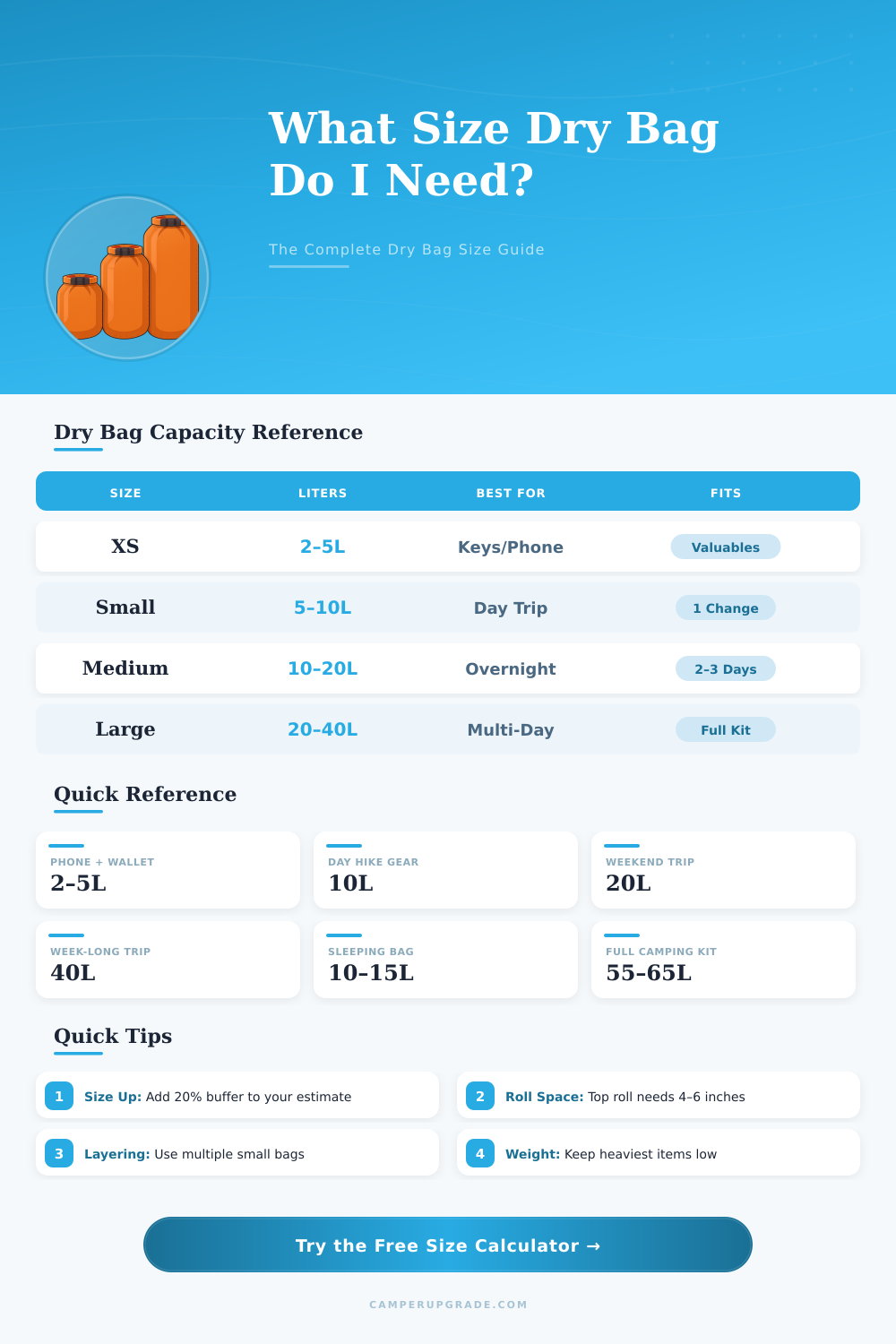
| Bag Size | Capacity (L) | Capacity (cu in) | Best Use Cases |
|---|---|---|---|
| XS | 2–5 L | 122–305 cu in | Phone, wallet, keys, small valuables |
| Small | 5–10 L | 305–610 cu in | Snacks, 1 change of clothes, first aid kit |
| Medium | 10–20 L | 610–1,220 cu in | Day hike, kayak day trip, camera gear |
| Large | 20–30 L | 1,220–1,830 cu in | Overnight canoe, 2–3 day clothing |
| XL | 30–40 L | 1,830–2,440 cu in | Multi-day kayak trip, sleeping bag + clothes |
| XXL | 40–65 L | 2,440–3,966 cu in | Extended camping, rafting full kit |
| Expedition | 65–100 L | 3,966–6,102 cu in | Week+ expeditions, group dry storage |
| Item | Volume (L) | Volume (cu in) | Notes |
|---|---|---|---|
| Smartphone | 0.2–0.3 L | 12–18 cu in | Always protect from water |
| Wallet + Keys | 0.2–0.5 L | 12–30 cu in | Fits in 2L dry bag easily |
| T-shirt (rolled) | 0.5–1 L | 30–61 cu in | Compress for best results |
| Shorts / Pants | 1–2 L | 61–122 cu in | Roll tightly to save space |
| Rain Jacket | 1–3 L | 61–183 cu in | Packable versions compress smaller |
| Sleeping Bag (3-season) | 8–12 L | 488–732 cu in | Compresses to ~10L in stuff sack |
| Sleeping Pad (inflatable) | 3–5 L | 183–305 cu in | Foam pads: 15–20L |
| Point-and-Shoot Camera | 0.5–1 L | 30–61 cu in | Use padded dry case |
| DSLR Camera + Lens | 3–6 L | 183–366 cu in | Needs padded protection |
| Food for 1 day (1 person) | 2–4 L | 122–244 cu in | Varies by meal type |
| Water Bottles (2x 1L) | 2–3 L | 122–183 cu in | Keep outside bag if possible |
| First Aid Kit (basic) | 1–2 L | 61–122 cu in | Always waterproof separately |
| Activity | Recommended Setup | Total Volume | Priority Items |
|---|---|---|---|
| Kayak Day Trip | 1x 10L + 1x 2L | ~12L | Valuables, spare clothes |
| Whitewater Rafting | 1x 5L (waterproof phone case) | ~5L | Phone, keys, sunscreen |
| Overnight Canoe | 1x 20L + 1x 5L + 1x 2L | ~27L | Sleeping bag, clothes, valuables |
| Weekend Camping | 2x 20L or 1x 40L | ~40L | Full clothing, shelter, food |
| Multi-Day Kayaking | 1x 40L + 1x 10L + 1x 5L | ~55L | Full kit + sleeping system |
| Stand-Up Paddleboard | 1x 10L (deck bag) | ~10L | Essentials only, stay light |
| Sailing Weekend | 1x 30L + 1x 10L | ~40L | Clothing, electronics, food |
| Beach Day | 1x 10L or 2x 5L | ~10L | Towel, phone, snacks, sunscreen |
| Liters (L) | Cubic Inches | Cubic Feet | US Gallons |
|---|---|---|---|
| 2 L | 122 cu in | 0.071 cu ft | 0.53 gal |
| 5 L | 305 cu in | 0.176 cu ft | 1.32 gal |
| 10 L | 610 cu in | 0.353 cu ft | 2.64 gal |
| 15 L | 915 cu in | 0.530 cu ft | 3.96 gal |
| 20 L | 1,220 cu in | 0.706 cu ft | 5.28 gal |
| 30 L | 1,831 cu in | 1.059 cu ft | 7.93 gal |
| 40 L | 2,441 cu in | 1.412 cu ft | 10.57 gal |
| 55 L | 3,356 cu in | 1.942 cu ft | 14.53 gal |
| 65 L | 3,967 cu in | 2.295 cu ft | 17.17 gal |
| 100 L | 6,102 cu in | 3.531 cu ft | 26.42 gal |
Choose the right size of dry bags can seem hard, but it mainly depends on your needs for gear. Dry bags come in various sizes from small 2-liter to big 50-, 60- or even 90-liter. Some reach even around 100 liters, which works for almost everything one can carry.
The most useful options usually fall between 5 and 50 liters.
How to Choose the Right Size Dry Bag
Choose the right size matters for keeping gear sorted and safe, while one reduces overall bulk. Right sizes help to protect stuff against water and make the packing more efficient overall.
For small items like electronic devices, tiny bags work very well. A 4-liter bag can store around four pairs of underwear and four pairs of stockings or two shirts. Around 7 liters form a solid general size.
And 5-liter and 10-liter bags always find use during trips. A 13-liter bag is enough for a cover of 20 degrees and extra clothes without a rain coat. 10-liter pressing bags work well for clothes, while 2-liter options care about tinier stuff like stockings, caps, gloves or medicines.
15- to 20-liter bags reach an ideal level of flexibility. Two complete changes of clothes fit easily in a 15-liter bag. A 20-liter bag served well as an easily reachable option, that fits in a pack for canoe carrying.
Going to bigger sizes can sometimes be more practical, because a big bag less disturbs than handling of many small. Roll-closures allow to role the bag down when it is not fully full, so extra space never truly lost.
For heavy loads like sleeping bags, tents and clothes for long camping trips, big bags work. A 35-liter roll-closed dry bag works well and can roll down when not at full capacity. A 70-liter bag stores a tent, cushion, sleeping bag, blanket and a fast change of dry clothes.
During canoe trips, two 65-liter canoe bags should be enough for gear of backpacking, shared between two people. A middle 30-liter bag works for swim trips, with clothes and personal gear for some days.
Newest dry bags are made of vinyl (PVC) or polyurethane-covered fabric. The thickness of material also matters. A 70-denier nylon bag feels quite a lot rugged for water sports, while stays light for backpacking.
Thinner materials, like 20 or 30 denier, can seem too flimsy. Bags above 30 liters work best with padded shoulder straps. Dry bags are designed for water sports, camping and climbing, keeping gear against water, mud andother places.
They have roll-closures, that seal against water, and come in various shapes and colors.