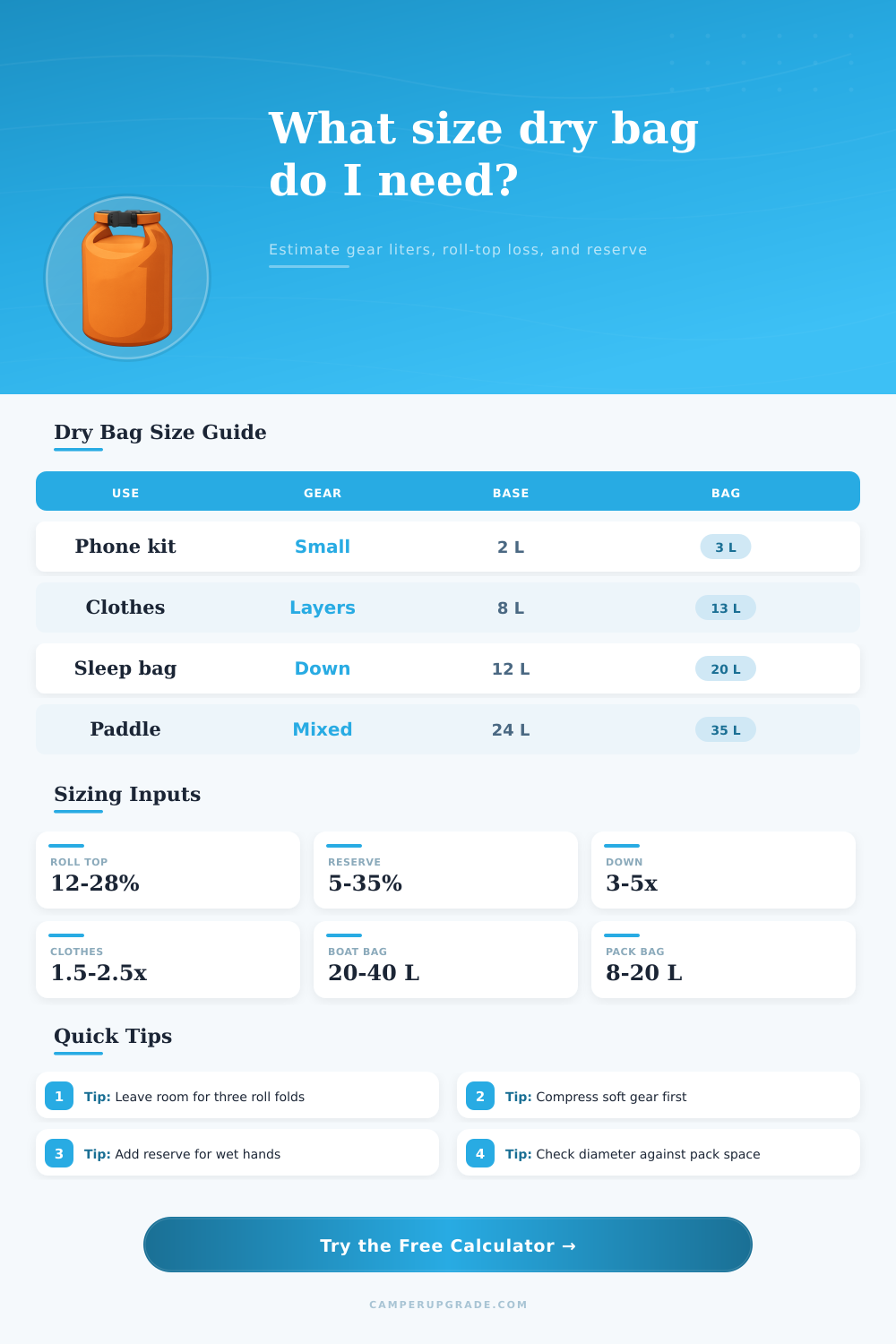
Dry Bag Liters Needed Calculator
Estimate the dry bag size needed after soft gear compression, roll-top closure loss, reserve space, moisture conditions, and pack or boat fit limits.
🎒Dry Bag Presets
📏Gear and Bag Inputs
📊Dry Bag Spec Grid
📘Dry Bag Reference Tables
| Nominal Size | Usable at 3 Folds | Good For | Typical Diameter |
|---|---|---|---|
| 3 L | 2.2-2.5 L | Phone, first aid, snacks | 4-5 in |
| 5 L | 3.8-4.2 L | Shells or small electronics | 5-6 in |
| 8 L | 6.0-6.8 L | Day layers or compact food | 6-7 in |
| 13 L | 9.5-11.0 L | Clothes or light sleep kit | 7-8 in |
| 20 L | 14.5-17.0 L | Sleeping bag or boat layers | 8-10 in |
| 35 L | 25.0-30.0 L | Paddle clothing bundle | 10-12 in |
| Gear Type | Normal Ratio | Firm Ratio | Planning Note |
|---|---|---|---|
| Electronics kit | 1.0x | 1.0x | Count box volume, no crush |
| Rain shells | 1.5x | 1.8x | Slippery but not lofty |
| Mixed clothes | 1.9x | 2.4x | Depends on fleece content |
| Down insulation | 3.8x | 5.0x | Release after travel |
| Synthetic insulation | 2.4x | 3.1x | Use roomier sizing |
| Soft food | 1.25x | 1.45x | Protect fragile food |
| Roll Folds | Closure Loss | Use Case | Comment |
|---|---|---|---|
| 2 folds | 8-15% | Only low-risk packing | Not ideal for splashes |
| 3 folds | 12-22% | Normal outdoor minimum | Best default |
| 4 folds | 18-28% | Rain or paddling | Needs more nominal liters |
| 5 folds | 24-34% | High splash loading | Use a taller bag |
| Scenario | Loose Volume | Common Bag | Reserve Target |
|---|---|---|---|
| Phone and keys | 1-2 L | 3 L | 20% |
| Day hike layers | 8-12 L | 8-13 L | 15% |
| Weekend clothes | 20-30 L | 13-20 L | 20% |
| Down sleeping bag | 35-55 L | 13-20 L | 15% |
| Canoe clothing | 35-55 L | 20-35 L | 25% |
| Winter sleep kit | 70-100 L | 35-55 L | 25% |
💡Dry Bag Sizing Tips
Beyond considering the numerical capacity of a dry bag is considering how to ensure that the dry bag will fit the volumes of the gear that will be packed into the dry bag. Many individuals chooses dry bags based upon the memory of how many item will fit in a dry bag during a previous trip, but choosing a dry bag based upon memory may result in purchasing a dry bag that is too small or too large to fit the gear. The volume of the gear may not be the same when packed as it is when unpacked, and additional volume within a dry bag are required for the closure of the dry bag.
Additionally, extra volume is required within the dry bag to account for the potential difficulty of packing the dry bag while the individual has wet hands. The volume that the gear occupy can vary. For instance, gear like a down sleeping bag will compress to take up less volume when the sleeping bag is compressed compared than when it is stuffed with the sleeping individual.
How to pick the right dry bag size
In contrast, gear like fleece clothing may compress to take up less volume when packed compared to the down sleeping bag. The calculator included with these reference tables account for these variables, requiring the individual to input the number of liter that the gear will occupy when compressed, the number of liters that the roll top closure of the dry bag will occupy, the gear’s volume when fully compressed, and the number of folds that the roll-top closure will require to ensure that the dry bag remain water-secure. The calculator accounts for these variables and indicates how many liters of volume the dry bag must have to ensure that all gear will fit when compressed and when the roll-top closure are properly secured.
In addition to the factors that the calculator accounts for, additional space within a dry bag may be required for trips that are of long durations, or for trips in which the weather is likely to be variable and wet. Wet hands will make it more difficult for an individual to both properly pack the dry bag, and to properly unpack the gear. Furthermore, the additional space will ensure that it will not be necessary to force gear into the dry bag.
While the volume of the dry bag may be correct for the gear to fit, the gear may not be able to fit through the opening of an individual’s backpack or boat compartments. The reference tables included on this page help to provide the actual volume that will be within dry bags of different size once the roll-top closure is accounted for. These reference tables additionally indicate the volume that gear of different types will take up when the gear is compressed.
Because gear can differ in the way that they compresses, gear like down sleeping bags and rain shells may require different volume within dry bags even if the gear is of the same size. These reference tables can help to avoid purchasing either a dry bag that is too small or too large for the gear that will be packed. Due to the tendency of many backpackers and paddlers to not own a separate dry bag for each type of gear, most individuals owns only two or three dry bags that are able to fit the majority of the type of gear that can be encountered on a trip.
The calculator can help to determine the breakpoints in which purchasing dry bags of certain sizes will provide enough volume for wet gear while still leaving room for other gear. With an understanding of these breakpoints, individuals will be able to purchase dry bags more quick and select dry bags that will allow the individual’s gear to fit when being packed. Beyond considering the numerical capacity of a dry bag is considering how to ensure that the dry bag will fit the volumes of the gear that will be packed into the dry bag.
Many individuals chooses dry bags based upon the memory of how many item will fit in a dry bag during a previous trip, but choosing a dry bag based upon memory may result in purchasing a dry bag that is too small or too large to fit the gear. The volume of the gear may not be the same when packed as it is when unpacked, and additional volume within a dry bag are required for the closure of the dry bag. Additionally, extra volume is required within the dry bag to account for the potential difficulty of packing the dry bag while the individual has wet hands.
The volume that the gear occupy can vary. For instance, gear like a down sleeping bag will compress to take up less volume when the sleeping bag is compressed compared than when it is stuffed with the sleeping individual. In contrast, gear like fleece clothing may compress to take up less volume when packed compared to the down sleeping bag.
The calculator included with these reference tables account for these variables, requiring the individual to input the number of liter that the gear will occupy when compressed, the number of liters that the roll top closure of the dry bag will occupy, the gear’s volume when fully compressed, and the number of folds that the roll-top closure will require to ensure that the dry bag remain water-secure. The calculator accounts for these variables and indicates how many liters of volume the dry bag must have to ensure that all gear will fit when compressed and when the roll-top closure are properly secured. In addition to the factors that the calculator accounts for, additional space within a dry bag may be required for trips that are of long durations, or for trips in which the weather is likely to be variable and wet.
Wet hands will make it more difficult for an individual to both properly pack the dry bag, and to properly unpack the gear. Furthermore, the additional space will ensure that it will not be necessary to force gear into the dry bag. While the volume of the dry bag may be correct for the gear to fit, the gear may not be able to fit through the opening of an individual’s backpack or boat compartments.
The reference tables included on this page help to provide the actual volume that will be within dry bags of different size once the roll-top closure is accounted for. These reference tables additionally indicate the volume that gear of different types will take up when the gear is compressed. Because gear can differ in the way that they compresses, gear like down sleeping bags and rain shells may require different volume within dry bags even if the gear is of the same size.
These reference tables can help to avoid purchasing either a dry bag that is too small or too large for the gear that will be packed. Due to the tendency of many backpackers and paddlers to not own a separate dry bag for each type of gear, most individuals owns only two or three dry bags that are able to fit the majority of the type of gear that can be encountered on a trip. The calculator can help to determine the breakpoints in which purchasing dry bags of certain sizes will provide enough volume for wet gear while still leaving room for other gear.
With an understanding of these breakpoints, individuals will be able to purchase dry bags more quick and select dry bags that will allow the individual’s gear to fit when being packed. Beyond considering the numerical capacity of a dry bag is considering how to ensure that the dry bag will fit the volumes of the gear that will be packed into the dry bag. Many individuals chooses dry bags based upon the memory of how many item will fit in a dry bag during a previous trip, but choosing a dry bag based upon memory may result in purchasing a dry bag that is too small or too large to fit the gear.
The volume of the gear may not be the same when packed as it is when unpacked, and additional volume within a dry bag are required for the closure of the dry bag. Additionally, extra volume is required within the dry bag to account for the potential difficulty of packing the dry bag while the individual has wet hands. The volume that the gear occupy can vary.
For instance, gear like a down sleeping bag will compress to take up less volume when the sleeping bag is compressed compared than when it is stuffed with the sleeping individual. In contrast, gear like fleece clothing may compress to take up less volume when packed compared to the down sleeping bag. The calculator included with these reference tables account for these variables, requiring the individual to input the number of liter that the gear will occupy when compressed, the number of liters that the roll top closure of the dry bag will occupy, the gear’s volume when fully compressed, and the number of folds that the roll-top closure will require to ensure that the dry bag remain water-secure.
The calculator accounts for these variables and indicates how many liters of volume the dry bag must have to ensure that all gear will fit when compressed and when the roll-top closure are properly secured. In addition to the factors that the calculator accounts for, additional space within a dry bag may be required for trips that are of long durations, or for trips in which the weather is likely to be variable and wet. Wet hands will make it more difficult for an individual to both properly pack the dry bag, and to properly unpack the gear.
Furthermore, the additional space will ensure that it will not be necessary to force gear into the dry bag. While the volume of the dry bag may be correct for the gear to fit, the gear may not be able to fit through the opening of an individual’s backpack or boat compartments. The reference tables included on this page help to provide the actual volume that will be within dry bags of different size once the roll-top closure is accounted for.
These reference tables additionally indicate the volume that gear of different types will take up when the gear is compressed. Because gear can differ in the way that they compresses, gear like down sleeping bags and rain shells may require different volume within dry bags even if the gear is of the same size. These reference tables can help to avoid purchasing either a dry bag that is too small or too large for the gear that will be packed.
Due to the tendency of many backpackers and paddlers to not own a separate dry bag for each type of gear, most individuals owns only two or three dry bags that are able to fit the majority of the type of gear that can be encountered on a trip. The calculator can help to determine the breakpoints in which purchasing dry bags of certain sizes will provide enough volume for wet gear while still leaving room for other gear. With an understanding of these breakpoints, individuals will be able to purchase dry bags more quick and select dry bags that will allow the individual’s gear to fit when being packed.
Beyond considering the numerical capacity of a dry bag is considering how to ensure that the dry bag will fit the volumes of the gear that will be packed into the dry bag. Many individuals chooses dry bags based upon the memory of how many item will fit in a dry bag during a previous trip, but choosing a dry bag based upon memory may result in purchasing a dry bag that is too small or too large to fit the gear. The volume of the gear may not be the same when packed as it is when unpacked, and additional volume within a dry bag are required for the closure of the dry bag.
Additionally, extra volume is required within the dry bag to account for the potential difficulty of packing the dry bag while the individual has wet hands. The volume that the gear occupy can vary. For instance, gear like a down sleeping bag will compress to take up less volume when the sleeping bag is compressed compared than when it is stuffed with the sleeping individual.
In contrast, gear like fleece clothing may compress to take up less volume when packed compared to the down sleeping bag. The calculator included with these reference tables account for these variables, requiring the individual to input the number of liter that the gear will occupy when compressed, the number of liters that the roll top closure of the dry bag will occupy, the gear’s volume when fully compressed, and the number of folds that the roll-top closure will require to ensure that the dry bag remain water-secure. The calculator accounts for these variables and indicates how many liters of volume the dry bag must have to ensure that all gear will fit when compressed and when the roll-top closure are properly secured.
In addition to the factors that the calculator accounts for, additional space within a dry bag may be required for trips that are of long durations, or for trips in which the weather is likely to be variable and wet. Wet hands will make it more difficult for an individual to both properly pack the dry bag, and to properly unpack the gear. Furthermore, the additional space will ensure that it will not be necessary to force gear into the dry bag.
While the volume of the dry bag may be correct for the gear to fit, the gear may not be able to fit through the opening of an individual’s backpack or boat compartments. The reference tables included on this page help to provide the actual volume that will be within dry bags of different size once the roll-top closure is accounted for. These reference tables additionally indicate the volume that gear of different types will take up when the gear is compressed.
Because gear can differ in the way that they compresses, gear like down sleeping bags and rain shells may require different volume within dry bags even if the gear is of the same size. These reference tables can help to avoid purchasing either a dry bag that is too small or too large for the gear that will be packed. Due to the tendency of many backpackers and paddlers to not own a separate dry bag for each type of gear, most individuals owns only two or three dry bags that are able to fit the majority of the type of gear that can be encountered on a trip.
The calculator can help to determine the breakpoints in which purchasing dry bags of certain sizes will provide enough volume for wet gear while still leaving room for other gear. With an understanding of these breakpoints, individuals will be able to purchase dry bags more quick and select dry bags that will allow the individual’s gear to fit when being packed. Beyond considering the numerical capacity of a dry bag is considering how to ensure that the dry bag will fit the volumes of the gear that will be packed into the dry bag.
Many individuals chooses dry bags based upon the memory of how many item will fit in a dry bag during a previous trip, but choosing a dry bag based upon memory may result in purchasing a dry bag that is too small or too large to fit the gear. The volume of the gear may not be the same when packed as it is when unpacked, and additional volume within a dry bag are required for the closure of the dry bag. Additionally, extra volume is required within the dry bag to account for the potential difficulty of packing the dry bag while the individual has wet hands.
The volume that the gear occupy can vary. For instance, gear like a down sleeping bag will compress to take up less volume when the sleeping bag is compressed compared than when it is stuffed with the sleeping individual. In contrast, gear like fleece clothing may compress to take up less volume when packed compared to the down sleeping bag.
The calculator included with these reference tables account for these variables, requiring the individual to input the number of liter that the gear will occupy when compressed, the number of liters that the roll top closure of the dry bag will occupy, the gear’s volume when fully compressed, and the number of folds that the roll-top closure will require to ensure that the dry bag remain water-secure. The calculator accounts for these variables and indicates how many liters of volume the dry bag must have to ensure that all gear will fit when compressed and when the roll-top closure are properly secured. In addition to the factors that the calculator accounts for, additional space within a dry bag may be required for trips that are of long durations, or for trips in which the weather is likely to be variable and wet.
Wet hands will make it more difficult for an individual to both properly pack the dry bag, and to properly unpack the gear. Furthermore, the additional space will ensure that it will not be necessary to force gear into the dry bag. While the volume of the dry bag may be correct for the gear to fit, the gear may not be able to fit through the opening of an individual’s backpack or boat compartments.
The reference tables included on this page help to provide the actual volume that will be within dry bags of different size once the roll-top closure is accounted for. These reference tables additionally indicate the volume that gear of different types will take up when the gear is compressed. Because gear can differ in the way that they compresses, gear like down sleeping bags and rain shells may require different volume within dry bags even if the gear is of the same size.
These reference tables can help to avoid purchasing either a dry bag that is too small or too large for the gear that will be packed. Due to the tendency of many backpackers and paddlers to not own a separate dry bag for each type of gear, most individuals owns only two or three dry bags that are able to fit the majority of the type of gear that can be encountered on a trip. The calculator can help to determine the breakpoints in which purchasing dry bags of certain sizes will provide enough volume for wet gear while still leaving room for other gear.
With an understanding of these breakpoints, individuals will be able to purchase dry bags more quick and select dry bags that will allow the individual’s gear to fit when being packed. Beyond considering the numerical capacity of a dry bag is considering how to ensure that the dry bag will fit the volumes of the gear that will be packed into the dry bag. Many individuals chooses dry bags based upon the memory of how many item will fit in a dry bag during a previous trip, but choosing a dry bag based upon memory may result in purchasing a dry bag that is too small or too large to fit the gear.
The volume of the gear may not be the same when packed as it is when unpacked, and additional volume within a dry bag are required for the closure of the dry bag. Additionally, extra volume is required within the dry bag to account for the potential difficulty of packing the dry bag while the individual has wet hands. The volume that the gear occupy can vary.
For instance, gear like a down sleeping bag will compress to take up less volume when the sleeping bag is compressed compared than when it is stuffed with the sleeping individual. In contrast, gear like fleece clothing may compress to take up less volume when packed compared to the down sleeping bag. The calculator included with these reference tables account for these variables, requiring the individual to input the number of liter that the gear will occupy when compressed, the number of liters that the roll top closure of the dry bag will occupy, the gear’s volume when fully compressed, and the number of folds that the roll-top closure will require to ensure that the dry bag remain water-secure.
The calculator accounts for these variables and indicates how many liters of volume the dry bag must have to ensure that all gear will fit when compressed and when the roll-top closure are properly secured. In addition to the factors that the calculator accounts for, additional space within a dry bag may be required for trips that are of long durations, or for trips in which the weather is likely to be variable and wet. Wet hands will make it more difficult for an individual to both properly pack the dry bag, and to properly unpack the gear.
Furthermore, the additional space will ensure that it will not be necessary to force gear into the dry bag. While the volume of the dry bag may be correct for the gear to fit, the gear may not be able to fit through the opening of an individual’s backpack or boat compartments. The reference tables included on this page help to provide the actual volume that will be within dry bags of different size once the roll-top closure is accounted for.
These reference tables additionally indicate the volume that gear of different types will take up when the gear is compressed. Because gear can differ in the way that they compresses, gear like down sleeping bags and rain shells may require different volume within dry bags even if the gear is of the same size. These reference tables can help to avoid purchasing either a dry bag that is too small or too large for the gear that will be packed.
Due to the tendency of many backpackers and paddlers to not own a separate dry bag for each type of gear, most individuals owns only two or three dry bags that are able to fit the majority of the type of gear that can be encountered on a trip. The calculator can help to determine the breakpoints in which purchasing dry bags of certain sizes will provide enough volume for wet gear while still leaving room for other gear. With an understanding of these breakpoints, individuals will be able to purchase dry bags more quick and select dry bags that will allow the individual’s gear to fit when being packed.
Beyond considering the numerical capacity of a dry bag is considering how to ensure that the dry bag will fit the volumes of the gear that will be packed into the dry bag. Many individuals chooses dry bags based upon the memory of how many item will fit in a dry bag during a previous trip, but choosing a dry bag based upon memory may result in purchasing a dry bag that is too small or too large to fit the gear. The volume of the gear may not be the same when packed as it is when unpacked, and additional volume within a dry bag are required for the closure of the dry bag.
Additionally, extra volume is required within the dry bag to account for the potential difficulty of packing the dry bag while the individual has wet hands. The volume that the gear occupy can vary. For instance, gear like a down sleeping bag will compress to take up less volume when the sleeping bag is compressed compared than when it is stuffed with the sleeping individual.
In contrast, gear like fleece clothing may compress to take up less volume when packed compared to the down sleeping bag. The calculator included with these reference tables account for these variables, requiring the individual to input the number of liter that the gear will occupy when compressed, the number of liters that the roll top closure of the dry bag will occupy, the gear’s volume when fully compressed, and the number of folds that the roll-top closure will require to ensure that the dry bag remain water-secure. The calculator accounts for these variables and indicates how many liters of volume the dry bag must have to ensure that all gear will fit when compressed and when the roll-top closure are properly secured.
In addition to the factors that the calculator accounts for, additional space within a dry bag may be required for trips that are of long durations, or for trips in which the weather is likely to be variable and wet. Wet hands will make it more difficult for an individual to both properly pack the dry bag, and to properly unpack the gear. Furthermore, the additional space will ensure that it will not be necessary to force gear into the dry bag.
While the volume of the dry bag may be correct for the gear to fit, the gear may not be able to fit through the opening of an individual’s backpack or boat compartments. The reference tables included on this page help to provide the actual volume that will be within dry bags of different size once the roll-top closure is accounted for. These reference tables additionally indicate the volume that gear of different types will take up when the gear is compressed.
Because gear can differ in the way that they compresses, gear like down sleeping bags and rain shells may require different volume within dry bags even if the gear is of the same size. These reference tables can help to avoid purchasing either a dry bag that is too small or too large for the gear that will be packed. Due to the tendency of many backpackers and paddlers to not own a separate dry bag for each type of gear, most individuals owns only two or three dry bags that are able to fit the majority of the type of gear that can be encountered on a trip.
The calculator can help to determine the breakpoints in which purchasing dry bags of certain sizes will provide enough volume for wet gear while still leaving room for other gear. With an understanding of these breakpoints, individuals will be able to purchase dry bags more quick and select dry bags that will allow the individual’s gear to fit when being packed. Beyond considering the numerical capacity of a dry bag is considering how to ensure that the dry bag will fit the volumes of the gear that will be packed into the dry bag.
Many individuals chooses dry bags based upon the memory of how many item will fit in a dry bag during a previous trip, but choosing a dry bag based upon memory may result in purchasing a dry bag that is too small or too large to fit the gear. The volume of the gear may not be the same when packed as it is when unpacked, and additional volume within a dry bag are required for the closure of the dry bag. Additionally, extra volume is required within the dry bag to account for the potential difficulty of packing the dry bag while the individual has wet hands.
The volume that the gear occupy can vary. For instance, gear like a down sleeping bag will compress to take up less volume when the sleeping bag is compressed compared than when it is stuffed with the sleeping individual. In contrast, gear like fleece clothing may compress to take up less volume when packed compared to the down sleeping bag.
The calculator included with these reference tables account for these variables, requiring the individual to input the number of liter that the gear will occupy when compressed, the number of liters that the roll top closure of the dry bag will occupy, the gear’s volume when fully compressed, and the number of folds that the roll-top closure will require to ensure that the dry bag remain water-secure. The calculator accounts for these variables and indicates how many liters of volume the dry bag must have to ensure that all gear will fit when compressed and when the roll-top closure are properly secured. In addition to the factors that the calculator accounts for, additional space within a dry bag may be required for trips that are of long durations, or for trips in which the weather is likely to be variable and wet.
Wet hands will make it more difficult for an individual to both properly pack the dry bag, and to properly unpack the gear. Furthermore, the additional space will ensure that it will not be necessary to force gear into the dry bag. While the volume of the dry bag may be correct for the gear to fit, the gear may not be able to fit through the opening of an individual’s backpack or boat compartments.
The reference tables included on this page help to provide the actual volume that will be within dry bags of different size once the roll-top closure is accounted for. These reference tables additionally indicate the volume that gear of different types will take up when the gear is compressed. Because gear can differ in the way that they compresses, gear like down sleeping bags and rain shells may require different volume within dry bags even if the gear is of the same size.
These reference tables can help to avoid purchasing either a dry bag that is too small or too large for the gear that will be packed. Due to the tendency of many backpackers and paddlers to not own a separate dry bag for each type of gear, most individuals owns only two or three dry bags that are able to fit the majority of the type of gear that can be encountered on a trip. The calculator can help to determine the breakpoints in which purchasing dry bags of certain sizes will provide enough volume for wet gear while still leaving room for other gear.
With an understanding of these breakpoints, individuals will be able to purchase dry bags more quick and select dry bags that will allow the individual’s gear to fit when being packed. Beyond considering the numerical capacity of a dry bag is considering how to ensure that the dry bag will fit the volumes of the gear that will be packed into the dry bag. Many individuals chooses dry bags based upon the memory of how many item will fit in a dry bag during a previous trip, but choosing a dry bag based upon memory may result in purchasing a dry bag that is too small or too large to fit the gear.
The volume of the gear may not be the same when packed as it is when unpacked, and additional volume within a dry bag are required for the closure of the dry bag. Additionally, extra volume is required within the dry bag to account for the potential difficulty of packing the dry bag while the individual has wet hands. The volume that the gear occupy can vary.
For instance, gear like a down sleeping bag will compress to take up less volume when the sleeping bag is compressed compared than when it is stuffed with the sleeping individual. In contrast, gear like fleece clothing may compress to take up less volume when packed compared to the down sleeping bag. The calculator included with these reference tables account for these variables, requiring the individual to input the number of liter that the gear will occupy when compressed, the number of liters that the roll top closure of the dry bag will occupy, the gear’s volume when fully compressed, and the number of folds that the roll-top closure will require to ensure that the dry bag remain water-secure.
The calculator accounts for these variables and indicates how many liters of volume the dry bag must have to ensure that all gear will fit when compressed and when the roll-top closure are properly secured. In addition to the factors that the calculator accounts for, additional space within a dry bag may be required for trips that are of long durations, or for trips in which the weather is likely to be variable and wet. Wet hands will make it more difficult for an individual to both properly pack the dry bag, and to properly unpack the gear.
Furthermore, the additional space will ensure that it will not be necessary to force gear into the dry bag. While the volume of the dry bag may be correct for the gear to fit, the gear may not be able to fit through the opening of an individual’s backpack or boat compartments. The reference tables included on this page help to provide the actual volume that will be within dry bags of different size once the roll-top closure is accounted for.
These reference tables additionally indicate the volume that gear of different types will take up when the gear is compressed. Because gear can differ in the way that they compresses, gear like down sleeping bags and rain shells may require different volume within dry bags even if the gear is of the same size. These reference tables can help to avoid purchasing either a dry bag that is too small or too large for the gear that will be packed.
Due to the tendency of many backpackers and paddlers to not own a separate dry bag for each type of gear, most individuals owns only two or three dry bags that are able to fit the majority of the type of gear that can be encountered on a trip. The calculator can help to determine the breakpoints in which purchasing dry bags of certain sizes will provide enough volume for wet gear while still leaving room for other gear. With an understanding of these breakpoints, individuals will be able to purchase dry bags more quick and select dry bags that will allow the individual’s gear to fit when being packed.
Beyond considering the numerical capacity of a dry bag is considering how to ensure that the dry bag will fit the volumes of the gear that will be packed into the dry bag. Many individuals chooses dry bags based upon the memory of how many item will fit in a dry bag during a previous trip, but choosing a dry bag based upon memory may result in purchasing a dry bag that is too small or too large to fit the gear. The volume of the gear may not be the same when packed as it is when unpacked, and additional volume within a dry bag are required for the closure of the dry bag.
Additionally, extra volume is required within the dry bag to account for the potential difficulty of packing the dry bag while the individual has wet hands. The volume that the gear occupy can vary. For instance, gear like a down sleeping bag will compress to take up less volume when the sleeping bag is compressed compared than when it is stuffed with the sleeping individual.
In contrast, gear like fleece clothing may compress to take up less volume when packed compared to the down sleeping bag. The calculator included with these reference tables account for these variables, requiring the individual to input the number of liter that the gear will occupy when compressed, the number of liters that the roll top closure of the dry bag will occupy, the gear’s volume when fully compressed, and the number of folds that the roll-top closure will require to ensure that the dry bag remain water-secure. The calculator accounts for these variables and indicates how many liters of volume the dry bag must have to ensure that all gear will fit when compressed and when the roll-top closure are properly secured.
In addition to the factors that the calculator accounts for, additional space within a dry bag may be required for trips that are of long durations, or for trips in which the weather is likely to be variable and wet. Wet hands will make it more difficult for an individual to both properly pack the dry bag, and to properly unpack the gear. Furthermore, the additional space will ensure that it will not be necessary to force gear into the dry bag.
While the volume of the dry bag may be correct for the gear to fit, the gear may not be able to fit through the opening of an individual’s backpack or boat compartments. The reference tables included on this page help to provide the actual volume that will be within dry bags of different size once the roll-top closure is accounted for. These reference tables additionally indicate the volume that gear of different types will take up when the gear is compressed.
Because gear can differ in the way that they compresses, gear like down sleeping bags and rain shells may require different volume within dry bags even if the gear is of the same size. These reference tables can help to avoid purchasing either a dry bag that is too small or too large for the gear that will be packed. Due to the tendency of many backpackers and paddlers to not own a separate dry bag for each type of gear, most individuals owns only two or three dry bags that are able to fit the majority of the type of gear that can be encountered on a trip.
The calculator can help to determine the breakpoints in which purchasing dry bags of certain sizes will provide enough volume for wet gear while still leaving room for other gear. With an understanding of these breakpoints, individuals will be able to purchase dry bags more quick and select dry bags that will allow the individual’s gear to fit when being packed. Beyond considering the numerical capacity of a dry bag is considering how to ensure that the dry bag will fit the volumes of the gear that will be packed into the dry bag.
Many individuals chooses dry bags based upon the memory of how many item will fit in a dry bag during a previous trip, but choosing a dry bag based upon memory may result in purchasing a dry bag that is too small or too large to fit the gear. The volume of the gear may not be the same when packed as it is when unpacked, and additional volume within a dry bag are required for the closure of the dry bag. Additionally, extra volume is required within the dry bag to account for the potential difficulty of packing the dry bag while the individual has wet hands.
The volume that the gear occupy can vary. For instance, gear like a down sleeping bag will compress to take up less volume when the sleeping bag is compressed compared than when it is stuffed with the sleeping individual. In contrast, gear like fleece clothing may compress to take up less volume when packed compared to the down sleeping bag.
The calculator included with these reference tables account for these variables, requiring the individual to input the number of liter that the gear will occupy when compressed, the number of liters that the roll top closure of the dry bag will occupy, the gear’s volume when fully compressed, and the number of folds that the roll-top closure will require to ensure that the dry bag remain water-secure. The calculator accounts for these variables and indicates how many liters of volume the dry bag must have to ensure that all gear will fit when compressed and when the roll-top closure are properly secured. In addition to the factors that the calculator accounts for, additional space within a dry bag may be required for trips that are of long durations, or for trips in which the weather is likely to be variable and wet.
Wet hands will make it more difficult for an individual to both properly pack the dry bag, and to properly unpack the gear. Furthermore, the additional space will ensure that it will not be necessary to force gear into the dry bag. While the volume of the dry bag may be correct for the gear to fit, the gear may not be able to fit through the opening of an individual’s backpack or boat compartments.
The reference tables included on this page help to provide the actual volume that will be within dry bags of different size once the roll-top closure is accounted for. These reference tables additionally indicate the volume that gear of different types will take up when the gear is compressed. Because gear can differ in the way that they compresses, gear like down sleeping bags and rain shells may require different volume within dry bags even if the gear is of the same size.
These reference tables can help to avoid purchasing either a dry bag that is too small or too large for the gear that will be packed. Due to the tendency of many backpackers and paddlers to not own a separate dry bag for each type of gear, most individuals owns only two or three dry bags that are able to fit the majority of the type of gear that can be encountered on a trip. The calculator can help to determine the breakpoints in which purchasing dry bags of certain sizes will provide enough volume for wet gear while still leaving room for other gear.
With an understanding of these breakpoints, individuals will be able to purchase dry bags more quick and select dry bags that will allow the individual’s gear to fit when being packed. Beyond considering the numerical capacity of a dry bag is considering how to ensure that the dry bag will fit the volumes of the gear that will be packed into the dry bag. Many individuals chooses dry bags based upon the memory of how many item will fit in a dry bag during a previous trip, but choosing a dry bag based upon memory may result in purchasing a dry bag that is too small or too large to fit the gear.
The volume of the gear may not be the same when packed as it is when unpacked, and additional volume within a dry bag are required for the closure of the dry bag. Additionally, extra volume is required within the dry bag to account for the potential difficulty of packing the dry bag while the individual has wet hands. The volume that the gear occupy can vary.
For instance, gear like a down sleeping bag will compress to take up less volume when the sleeping bag is compressed compared than when it is stuffed with the sleeping individual. In contrast, gear like fleece clothing may compress to take up less volume when packed compared to the down sleeping bag. The calculator included with these reference tables account for these variables, requiring the individual to input the number of liter that the gear will occupy when compressed, the number of liters that the roll top closure of the dry bag will occupy, the gear’s volume when fully compressed, and the number of folds that the roll-top closure will require to ensure that the dry bag remain water-secure.
The calculator accounts for these variables and indicates how many liters of volume the dry bag must have to ensure that all gear will fit when compressed and when the roll-top closure are properly secured. In addition to the factors that the calculator accounts for, additional space within a dry bag may be required for trips that are of long durations, or for trips in which the weather is likely to be variable and wet. Wet hands will make it more difficult for an individual to both properly pack the dry bag, and to properly unpack the gear.
Furthermore, the additional space will ensure that it will not be necessary to force gear into the dry bag. While the volume of the dry bag may be correct for the gear to fit, the gear may not be able to fit through the opening of an individual’s backpack or boat compartments. The reference tables included on this page help to provide the actual volume that will be within dry bags of different size once the roll-top closure is accounted for.
These reference tables additionally indicate the volume that gear of different types will take up when the gear is compressed. Because gear can differ in the way that they compresses, gear like down sleeping bags and rain shells may require different volume within dry bags even if the gear is of the same size. These reference tables can help to avoid purchasing either a dry bag that is too small or too large for the gear that will be packed.
Due to the tendency of many backpackers and paddlers to not own a separate dry bag for each type of gear, most individuals owns only two or three dry bags that are able to fit the majority of the type of gear that can be encountered on a trip. The calculator can help to determine the breakpoints in which purchasing dry bags of certain sizes will provide enough volume for wet gear while still leaving room for other gear. With an understanding of these breakpoints, individuals will be able to purchase dry bags more quick and select dry bags that will allow the individual’s gear to fit when being packed.
Beyond considering the numerical capacity of a dry bag is considering how to ensure that the dry bag will fit the volumes of the gear that will be packed into the dry bag. Many individuals chooses dry bags based upon the memory of how many item will fit in a dry bag during a previous trip, but choosing a dry bag based upon memory may result in purchasing a dry bag that is too small or too large to fit the gear. The volume of the gear may not be the same when packed as it is when unpacked, and additional volume within a dry bag are required for the closure of the dry bag.
Additionally, extra volume is required within the dry bag to account for the potential difficulty of packing the dry bag while the individual has wet hands. The volume that the gear occupy can vary. For instance, gear like a down sleeping bag will compress to take up less volume when the sleeping bag is compressed compared than when it is stuffed with the sleeping individual.
In contrast, gear like fleece clothing may compress to take up less volume when packed compared to the down sleeping bag. The calculator included with these reference tables account for these variables, requiring the individual to input the number of liter that the gear will occupy when compressed, the number of liters that the roll top closure of the dry bag will occupy, the gear’s volume when fully compressed, and the number of folds that the roll-top closure will require to ensure that the dry bag remain water-secure. The calculator accounts for these variables and indicates how many liters of volume the dry bag must have to ensure that all gear will fit when compressed and when the roll-top closure are properly secured.
In addition to the factors that the calculator accounts for, additional space within a dry bag may be required for trips that are of long durations, or for trips in which the weather is likely to be variable and wet. Wet hands will make it more difficult for an individual to both properly pack the dry bag, and to properly unpack the gear. Furthermore, the additional space will ensure that it will not be necessary to force gear into the dry bag.
While the volume of the dry bag may be correct for the gear to fit, the gear may not be able to fit through the opening of an individual’s backpack or boat compartments. The reference tables included on this page help to provide the actual volume that will be within dry bags of different size once the roll-top closure is accounted for. These reference tables additionally indicate the volume that gear of different types will take up when the gear is compressed.
Because gear can differ in the way that they compresses, gear like down sleeping bags and rain shells may require different volume within dry bags even if the gear is of the same size. These reference tables can help to avoid purchasing either a dry bag that is too small or too large for the gear that will be packed. Due to the tendency of many backpackers and paddlers to not own a separate dry bag for each type of gear, most individuals owns only two or three dry bags that are able to fit the majority of the type of gear that can be encountered on a trip.
The calculator can help to determine the breakpoints in which purchasing dry bags of certain sizes will provide enough volume for wet gear while still leaving room for other gear. With an understanding of these breakpoints, individuals will be able to purchase dry bags more quick and select dry bags that will allow the individual’s gear to fit when being packed. Beyond considering the numerical capacity of a dry bag is considering how to ensure that the dry bag will fit the volumes of the gear that will be packed into the dry bag.
Many individuals chooses dry bags based upon the memory of how many item will fit in a dry bag during a previous trip, but choosing a dry bag based upon memory may result in purchasing a dry bag that is too small or too large to fit the gear. The volume of the gear may not be the same when packed as it is when unpacked, and additional volume within a dry bag are required for the closure of the dry bag. Additionally, extra volume is required within the dry bag to account for the potential difficulty of packing the dry bag while the individual has wet hands.
The volume that the gear occupy can vary. For instance, gear like a down sleeping bag will compress to take up less volume when the sleeping bag is compressed compared than when it is stuffed with the sleeping individual. In contrast, gear like fleece clothing may compress to take up less volume when packed compared to the down sleeping bag.
The calculator included with these reference tables account for these variables, requiring the individual to input the number of liter that the gear will occupy when compressed, the number of liters that the roll top closure of the dry bag will occupy, the gear’s volume when fully compressed, and the number of folds that the roll-top closure will require to ensure that the dry bag remain water-secure. The calculator accounts for these variables and indicates how many liters of volume the dry bag must have to ensure that all gear will fit when compressed and when the roll-top closure are properly secured. In addition to the factors that the calculator accounts for, additional space within a dry bag may be required for trips that are of long durations, or for trips in which the weather is likely to be variable and wet.
Wet hands will make it more difficult for an individual to both properly pack the dry bag, and to properly unpack the gear. Furthermore, the additional space will ensure that it will not be necessary to force gear into the dry bag. While the volume of the dry bag may be correct for the gear to fit, the gear may not be able to fit through the opening of an individual’s backpack or boat compartments.
The reference tables included on this page help to provide the actual volume that will be within dry bags of different size once the roll-top closure is accounted for. These reference tables additionally indicate the volume that gear of different types will take up when the gear is compressed. Because gear can differ in the way that they compresses, gear like down sleeping bags and rain shells may require different volume within dry bags even if the gear is of the same size.
These reference tables can help to avoid purchasing either a dry bag that is too small or too large for the gear that will be packed. Due to the tendency of many backpackers and paddlers to not own a separate dry bag for each type of gear, most individuals owns only two or three dry bags that are able to fit the majority of the type of gear that can be encountered on a trip. The calculator can help to determine the breakpoints in which purchasing dry bags of certain sizes will provide enough volume for wet gear while still leaving room for other gear.
With an understanding of these breakpoints, individuals will be able to purchase dry bags more quick and select dry bags that will allow the individual’s gear to fit when being packed. Beyond considering the numerical capacity of a dry bag is considering how to ensure that the dry bag will fit the volumes of the gear that will be packed into the dry bag. Many individuals chooses dry bags based upon the memory of how many item will fit in a dry bag during a previous trip, but choosing a dry bag based upon memory may result in purchasing a dry bag that is too small or too large to fit the gear.
The volume of the gear may not be the same when packed as it is when unpacked, and additional volume within a dry bag are required for the closure of the dry bag. Additionally, extra volume is required within the dry bag to account for the potential difficulty of packing the dry bag while the individual has wet hands. The volume that the gear occupy can vary.
For instance, gear like a down sleeping bag will compress to take up less volume when the sleeping bag is compressed compared than when it is stuffed with the sleeping individual. In contrast, gear like fleece clothing may compress to take up less volume when packed compared to the down sleeping bag. The calculator included with these reference tables account for these variables, requiring the individual to input the number of liter that the gear will occupy when compressed, the number of liters that the roll top closure of the dry bag will occupy, the gear’s volume when fully compressed, and the number of folds that the roll-top closure will require to ensure that the dry bag remain water-secure.
The calculator accounts for these variables and indicates how many liters of volume the dry bag must have to ensure that all gear will fit when compressed and when the roll-top closure are properly secured. In addition to the factors that the calculator accounts for, additional space within a dry bag may be required for trips that are of long durations, or for trips in which the weather is likely to be variable and wet. Wet hands will make it more difficult for an individual to both properly pack the dry bag, and to properly unpack the gear.
Furthermore, the additional space will ensure that it will not be necessary to force gear into the dry bag. While the volume of the dry bag may be correct for the gear to fit, the gear may not be able to fit through the opening of an individual’s backpack or boat compartments. The reference tables included on this page help to provide the actual volume that will be within dry bags of different size once the roll-top closure is accounted for.
These reference tables additionally indicate the volume that gear of different types will take up when the gear is compressed. Because gear can differ in the way that they compresses, gear like down sleeping bags and rain shells may require different volume within dry bags even if the gear is of the same size. These reference tables can help to avoid purchasing either a dry bag that is too small or too large for the gear that will be packed.
Due to the tendency of many backpackers and paddlers to not own a separate dry bag for each type of gear, most individuals owns only two or three dry bags that are able to fit the majority of the type of gear that can be encountered on a trip. The calculator can help to determine the breakpoints in which purchasing dry bags of certain sizes will provide enough volume for wet gear while still leaving room for other gear. With an understanding of these breakpoints, individuals will be able to purchase dry bags more quick and select dry bags that will allow the individual’s gear to fit when being packed.
Beyond considering the numerical capacity of a dry bag is considering how to ensure that the dry bag will fit the volumes of the gear that will be packed into the dry bag. Many individuals chooses dry bags based upon the memory of how many item will fit in a dry bag during a previous trip, but choosing a dry bag based upon memory may result in purchasing a dry bag that is too small or too large to fit the gear. The volume of the gear may not be the same when packed as it is when unpacked, and additional volume within a dry bag are required for the closure of the dry bag.
Additionally, extra volume is required within the dry bag to account for the potential difficulty of packing the dry bag while the individual has wet hands. The volume that the gear occupy can vary. For instance, gear like a down sleeping bag will compress to take up less volume when the sleeping bag is compressed compared than when it is stuffed with the sleeping individual.
In contrast, gear like fleece clothing may compress to take up less volume when packed compared to the down sleeping bag. The calculator included with these reference tables account for these variables, requiring the individual to input the number of liter that the gear will occupy when compressed, the number of liters that the roll top closure of the dry bag will occupy, the gear’s volume when fully compressed, and the number of folds that the roll-top closure will require to ensure that the dry bag remain water-secure. The calculator accounts for these variables and indicates how many liters of volume the dry bag must have to ensure that all gear will fit when compressed and when the roll-top closure are properly secured.
In addition to the factors that the calculator accounts for, additional space within a dry bag may be required for trips that are of long durations, or for trips in which the weather is likely to be variable and wet. Wet hands will make it more difficult for an individual to both properly pack the dry bag, and to properly unpack the gear. Furthermore, the additional space will ensure that it will not be necessary to force gear into the dry bag.
While the volume of the dry bag may be correct for the gear to fit, the gear may not be able to fit through the opening of an individual’s backpack or boat compartments. The reference tables included on this page help to provide the actual volume that will be within dry bags of different size once the roll-top closure is accounted for. These reference tables additionally indicate the volume that gear of different types will take up when the gear is compressed.
Because gear can differ in the way that they compresses, gear like down sleeping bags and rain shells may require different volume within dry bags even if the gear is of the same size. These reference tables can help to avoid purchasing either a dry bag that is too small or too large for the gear that will be packed. Due to the tendency of many backpackers and paddlers to not own a separate dry bag for each type of gear, most individuals owns only two or three dry bags that are able to fit the majority of the type of gear that can be encountered on a trip.
The calculator can help to determine the breakpoints in which purchasing dry bags of certain sizes will provide enough volume for wet gear while still leaving room for other gear. With an understanding of these breakpoints, individuals will be able to purchase dry bags more quick and select dry bags that will allow the individual’s gear to fit when being packed. Beyond considering the numerical capacity of a dry bag is considering how to ensure that the dry bag will fit the volumes of the gear that will be packed into the dry bag.
Many individuals chooses dry bags based upon the memory of how many item will fit in a dry bag during a previous trip, but choosing a dry bag based upon memory may result in purchasing a dry bag that is too small or too large to fit the gear. The volume of the gear may not be the same when packed as it is when unpacked, and additional volume within a dry bag are required for the closure of the dry bag. Additionally, extra volume is required within the dry bag to account for the potential difficulty of packing the dry bag while the individual has wet hands.
The volume that the gear occupy can vary. For instance, gear like a down sleeping bag will compress to take up less volume when the sleeping bag is compressed compared than when it is stuffed with the sleeping individual. In contrast, gear like fleece clothing may compress to take up less volume when packed compared to the down sleeping bag.
The calculator included with these reference tables account for these variables, requiring the individual to input the number of liter that the gear will occupy when compressed, the number of liters that the roll top closure of the dry bag will occupy, the gear’s volume when fully compressed, and the number of folds that the roll-top closure will require to ensure that the dry bag remain water-secure. The calculator accounts for these variables and indicates how many liters of volume the dry bag must have to ensure that all gear will fit when compressed and when the roll-top closure are properly secured. In addition to the factors that the calculator accounts for, additional space within a dry bag may be required for trips that are of long durations, or for trips in which the weather is likely to be variable and wet.
Wet hands will make it more difficult for an individual to both properly pack the dry bag, and to properly unpack the gear. Furthermore, the additional space will ensure that it will not be necessary to force gear into the dry bag. While the volume of the dry bag may be correct for the gear to fit, the gear may not be able to fit through the opening of an individual’s backpack or boat compartments.
The reference tables included on this page help to provide the actual volume that will be within dry bags of different size once the roll-top closure is accounted for. These reference tables additionally indicate the volume that gear of different types will take up when the gear is compressed. Because gear can differ in the way that they compresses, gear like down sleeping bags and rain shells may require different volume within dry bags even if the gear is of the same size.
These reference tables can help to avoid purchasing either a dry bag that is too small or too large for the gear that will be packed. Due to the tendency of many backpackers and paddlers to not own a separate dry bag for each type of gear, most individuals owns only two or three dry bags that are able to fit the majority of the type of gear that can be encountered on a trip. The calculator can help to determine the breakpoints in which purchasing dry bags of certain sizes will provide enough volume for wet gear while still leaving room for other gear.
With an understanding of these breakpoints, individuals will be able to purchase dry bags more quick and select dry bags that will allow the individual’s gear to fit when being packed. Beyond considering the numerical capacity of a dry bag is considering how to ensure that the dry bag will fit the volumes of the gear that will be packed into the dry bag. Many individuals chooses dry bags based upon the memory of how many item will fit in a dry bag during a previous trip, but choosing a dry bag based upon memory may result in purchasing a dry bag that is too small or too large to fit the gear.
The volume of the gear may not be the same when packed as it is when unpacked, and additional volume within a dry bag are required for the closure of the dry bag. Additionally, extra volume is required within the dry bag to account for the potential difficulty of packing the dry bag while the individual has wet hands. The volume that the gear occupy can vary.
For instance, gear like a down sleeping bag will compress to take up less volume when the sleeping bag is compressed compared than when it is stuffed with the sleeping individual. In contrast, gear like fleece clothing may compress to take up less volume when packed compared to the down sleeping bag. The calculator included with these reference tables account for these variables, requiring the individual to input the number of liter that the gear will occupy when compressed, the number of liters that the roll top closure of the dry bag will occupy, the gear’s volume when fully compressed, and the number of folds that the roll-top closure will require to ensure that the dry bag remain water-secure.
The calculator accounts for these variables and indicates how many liters of volume the dry bag must have to ensure that all gear will fit when compressed and when the roll-top closure are properly secured. In addition to the factors that the calculator accounts for, additional space within a dry bag may be required for trips that are of long durations, or for trips in which the weather is likely to be variable and wet. Wet hands will make it more difficult for an individual to both properly pack the dry bag, and to properly unpack the gear.
Furthermore, the additional space will ensure that it will not be necessary to force gear into the dry bag. While the volume of the dry bag may be correct for the gear to fit, the gear may not be able to fit through the opening of an individual’s backpack or boat compartments. The reference tables included on this page help to provide the actual volume that will be within dry bags of different size once the roll-top closure is accounted for.
These reference tables additionally indicate the volume that gear of different types will take up when the gear is compressed. Because gear can differ in the way that they compresses, gear like down sleeping bags and rain shells may require different volume within dry bags even if the gear is of the same size. These reference tables can help to avoid purchasing either a dry bag that is too small or too large for the gear that will be packed.
Due to the tendency of many backpackers and paddlers to not own a separate dry bag for each type of gear, most individuals owns only two or three dry bags that are able to fit the majority of the type of gear that can be encountered on a trip. The calculator can help to determine the breakpoints in which purchasing dry bags of certain sizes will provide enough volume for wet gear while still leaving room for other gear. With an understanding of these breakpoints, individuals will be able to purchase dry bags more quick and select dry bags that will allow the individual’s gear to fit when being packed.
Beyond considering the numerical capacity of a dry bag is considering how to ensure that the dry bag will fit the volumes of the gear that will be packed into the dry bag. Many individuals chooses dry bags based upon the memory of how many item will fit in a dry bag during a previous trip, but choosing a dry bag based upon memory may result in purchasing a dry bag that is too small or too large to fit the gear. The volume of the gear may not be the same when packed as it is when unpacked, and additional volume within a dry bag are required for the closure of the dry bag.
Additionally, extra volume is required within the dry bag to account for the potential difficulty of packing the dry bag while the individual has wet hands. The volume that the gear occupy can vary. For instance, gear like a down sleeping bag will compress to take up less volume when the sleeping bag is compressed compared than when it is stuffed with the sleeping individual.
In contrast, gear like fleece clothing may compress to take up less volume when packed compared to the down sleeping bag. The calculator included with these reference tables account for these variables, requiring the individual to input the number of liter that the gear will occupy when compressed, the number of liters that the roll top closure of the dry bag will occupy, the gear’s volume when fully compressed, and the number of folds that the roll-top closure will require to ensure that the dry bag remain water-secure. The calculator accounts for these variables and indicates how many liters of volume the dry bag must have to ensure that all gear will fit when compressed and when the roll-top closure are properly secured.
In addition to the factors that the calculator accounts for, additional space within a dry bag may be required for trips that are of long durations, or for trips in which the weather is likely to be variable and wet. Wet hands will make it more difficult for an individual to both properly pack the dry bag, and to properly unpack the gear. Furthermore, the additional space will ensure that it will not be necessary to force gear into the dry bag.
While the volume of the dry bag may be correct for the gear to fit, the gear may not be able to fit through the opening of an individual’s backpack or boat compartments. The reference tables included on this page help to provide the actual volume that will be within dry bags of different size once the roll-top closure is accounted for. These reference tables additionally indicate the volume that gear of different types will take up when the gear is compressed.
Because gear can differ in the way that they compresses, gear like down sleeping bags and rain shells may require different volume within dry bags even if the gear is of the same size. These reference tables can help to avoid purchasing either a dry bag that is too small or too large for the gear that will be packed. Due to the tendency of many backpackers and paddlers to not own a separate dry bag for each type of gear, most individuals owns only two or three dry bags that are able to fit the majority of the type of gear that can be encountered on a trip.
The calculator can help to determine the breakpoints in which purchasing dry bags of certain sizes will provide enough volume for wet gear while still leaving room for other gear. With an understanding of these breakpoints, individuals will be able to purchase dry bags more quick and select dry bags that will allow the individual’s gear to fit when being packed. Beyond considering the numerical capacity of a dry bag is considering how to ensure that the dry bag will fit the volumes of the gear that will be packed into the dry bag.
Many individuals chooses dry bags based upon the memory of how many item will fit in a dry bag during a previous trip, but choosing a dry bag based upon memory may result in purchasing a dry bag that is too small or too large to fit the gear. The volume of the gear may not be the same when packed as it is when unpacked, and additional volume within a dry bag are required for the closure of the dry bag. Additionally, extra volume is required within the dry bag to account for the potential difficulty of packing the dry bag while the individual has wet hands.
The volume that the gear occupy can vary. For instance, gear like a down sleeping bag will compress to take up less volume when the sleeping bag is compressed compared than when it is stuffed with the sleeping individual. In contrast, gear like fleece clothing may compress to take up less volume when packed compared to the down sleeping bag.
The calculator included with these reference tables account for these variables, requiring the individual to input the number of liter that the gear will occupy when compressed, the number of liters that the roll top closure of the dry bag will occupy, the gear’s volume when fully compressed, and the number of folds that the roll-top closure will require to ensure that the dry bag remain water-secure. The calculator accounts for these variables and indicates how many liters of volume the dry bag must have to ensure that all gear will fit when compressed and when the roll-top closure are properly secured. In addition to the factors that the calculator accounts for, additional space within a dry bag may be required for trips that are of long durations, or for trips in which the weather is likely to be variable and wet.
Wet hands will make it more difficult for an individual to both properly pack the dry bag, and to properly unpack the gear. Furthermore, the additional space will ensure that it will not be necessary to force gear into the dry bag. While the volume of the dry bag may be correct for the gear to fit, the gear may not be able to fit through the opening of an individual’s backpack or boat compartments.
The reference tables included on this page help to provide the actual volume that will be within dry bags of different size once the roll-top closure is accounted for. These reference tables additionally indicate the volume that gear of different types will take up when the gear is compressed. Because gear can differ in the way that they compresses, gear like down sleeping bags and rain shells may require different volume within dry bags even if the gear is of the same size.
These reference tables can help to avoid purchasing either a dry bag that is too small or too large for the gear that will be packed. Due to the tendency of many backpackers and paddlers to not own a separate dry bag for each type of gear, most individuals owns only two or three dry bags that are able to fit the majority of the type of gear that can be encountered on a trip. The calculator can help to determine the breakpoints in which purchasing dry bags of certain sizes will provide enough volume for wet gear while still leaving room for other gear.
With an understanding of these breakpoints, individuals will be able to purchase dry bags more quick and select dry bags that will allow the individual’s gear to fit when being packed. Beyond considering the numerical capacity of a dry bag is considering how to ensure that the dry bag will fit the volumes of the gear that will be packed into the dry bag. Many individuals chooses dry bags based upon the memory of how many item will fit in a dry bag during a previous trip, but choosing a dry bag based upon memory may result in purchasing a dry bag that is too small or too large to fit the gear.
The volume of the gear may not be the same when packed as it is when unpacked, and additional volume within a dry bag are required for the closure of the dry bag. Additionally, extra volume is required within the dry bag to account for the potential difficulty of packing the dry bag while the individual has wet hands. The volume that the gear occupy can vary.
For instance, gear like a down sleeping bag will compress to take up less volume when the sleeping bag is compressed compared than when it is stuffed with the sleeping individual. In contrast, gear like fleece clothing may compress to take up less volume when packed compared to the down sleeping bag. The calculator included with these reference tables account for these variables, requiring the individual to input the number of liter that the gear will occupy when compressed, the number of liters that the roll top closure of the dry bag will occupy, the gear’s volume when fully compressed, and the number of folds that the roll-top closure will require to ensure that the dry bag remain water-secure.
The calculator accounts for these variables and indicates how many liters of volume the dry bag must have to ensure that all gear will fit when compressed and when the roll-top closure are properly secured. In addition to the factors that the calculator accounts for, additional space within a dry bag may be required for trips that are of long durations, or for trips in which the weather is likely to be variable and wet. Wet hands will make it more difficult for an individual to both properly pack the dry bag, and to properly unpack the gear.
Furthermore, the additional space will ensure that it will not be necessary to force gear into the dry bag. While the volume of the dry bag may be correct for the gear to fit, the gear may not be able to fit through the opening of an individual’s backpack or boat compartments. The reference tables included on this page help to provide the actual volume that will be within dry bags of different size once the roll-top closure is accounted for.
These reference tables additionally indicate the volume that gear of different types will take up when the gear is compressed. Because gear can differ in the way that they compresses, gear like down sleeping bags and rain shells may require different volume within dry bags even if the gear is of the same size. These reference tables can help to avoid purchasing either a dry bag that is too small or too large for the gear that will be packed.
Due to the tendency of many backpackers and paddlers to not own a separate dry bag for each type of gear, most individuals owns only two or three dry bags that are able to fit the majority of the type of gear that can be encountered on a trip. The calculator can help to determine the breakpoints in which purchasing dry bags of certain sizes will provide enough volume for wet gear while still leaving room for other gear. With an understanding of these breakpoints, individuals will be able to purchase dry bags more quick and select dry bags that will allow the individual’s gear to fit when being packed.
Beyond considering the numerical capacity of a dry bag is considering how to ensure that the dry bag will fit the volumes of the gear that will be packed into the dry bag. Many individuals chooses dry bags based upon the memory of how many item will fit in a dry bag during a previous trip, but choosing a dry bag based upon memory may result in purchasing a dry bag that is too small or too large to fit the gear. The volume of the gear may not be the same when packed as it is when unpacked, and additional volume within a dry bag are required for the closure of the dry bag.
Additionally, extra volume is required within the dry bag to account for the potential difficulty of packing the dry bag while the individual has wet hands. The volume that the gear occupy can vary. For instance, gear like a down sleeping bag will compress to take up less volume when the sleeping bag is compressed compared than when it is stuffed with the sleeping individual.
In contrast, gear like fleece clothing may compress to take up less volume when packed compared to the down sleeping bag. The calculator included with these reference tables account for these variables, requiring the individual to input the number of liter that the gear will occupy when compressed, the number of liters that the roll top closure of the dry bag will occupy, the gear’s volume when fully compressed, and the number of folds that the roll-top closure will require to ensure that the dry bag remain water-secure. The calculator accounts for these variables and indicates how many liters of volume the dry bag must have to ensure that all gear will fit when compressed and when the roll-top closure are properly secured.
In addition to the factors that the calculator accounts for, additional space within a dry bag may be required for trips that are of long durations, or for trips in which the weather is likely to be variable and wet. Wet hands will make it more difficult for an individual to both properly pack the dry bag, and to properly unpack the gear. Furthermore, the additional space will ensure that it will not be necessary to force gear into the dry bag.
While the volume of the dry bag may be correct for the gear to fit, the gear may not be able to fit through the opening of an individual’s backpack or boat compartments. The reference tables included on this page help to provide the actual volume that will be within dry bags of different size once the roll-top closure is accounted for. These reference tables additionally indicate the volume that gear of different types will take up when the gear is compressed.
Because gear can differ in the way that they compresses, gear like down sleeping bags and rain shells may require different volume within dry bags even if the gear is of the same size. These reference tables can help to avoid purchasing either a dry bag that is too small or too large for the gear that will be packed. Due to the tendency of many backpackers and paddlers to not own a separate dry bag for each type of gear, most individuals owns only two or three dry bags that are able to fit the majority of the type of gear that can be encountered on a trip.
The calculator can help to determine the breakpoints in which purchasing dry bags of certain sizes will provide enough volume for wet gear while still leaving room for other gear. With an understanding of these breakpoints, individuals will be able to purchase dry bags more quick and select dry bags that will allow the individual’s gear to fit when being packed. Beyond considering the numerical capacity of a dry bag is considering how to ensure that the dry bag will fit the volumes of the gear that will be packed into the dry bag.
Many individuals chooses dry bags based upon the memory of how many item will fit in a dry bag during a previous trip, but choosing a dry bag based upon memory may result in purchasing a dry bag that is too small or too large to fit the gear. The volume of the gear may not be the same when packed as it is when unpacked, and additional volume within a dry bag are required for the closure of the dry bag. Additionally, extra volume is required within the dry bag to account for the potential difficulty of packing the dry bag while the individual has wet hands.
The volume that the gear occupy can vary. For instance, gear like a down sleeping bag will compress to take up less volume when the sleeping bag is compressed compared than when it is stuffed with the sleeping individual. In contrast, gear like fleece clothing may compress to take up less volume when packed compared to the down sleeping bag.
The calculator included with these reference tables account for these variables, requiring the individual to input the number of liter that the gear will occupy when compressed, the number of liters that the roll top closure of the dry bag will occupy, the gear’s volume when fully compressed, and the number of folds that the roll-top closure will require to ensure that the dry bag remain water-secure. The calculator accounts for these variables and indicates how many liters of volume the dry bag must have to ensure that all gear will fit when compressed and when the roll-top closure are properly secured. In addition to the factors that the calculator accounts for, additional space within a dry bag may be required for trips that are of long durations, or for trips in which the weather is likely to be variable and wet.
Wet hands will make it more difficult for an individual to both properly pack the dry bag, and to properly unpack the gear. Furthermore, the additional space will ensure that it will not be necessary to force gear into the dry bag. While the volume of the dry bag may be correct for the gear to fit, the gear may not be able to fit through the opening of an individual’s backpack or boat compartments.
The reference tables included on this page help to provide the actual volume that will be within dry bags of different size once the roll-top closure is accounted for. These reference tables additionally indicate the volume that gear of different types will take up when the gear is compressed. Because gear can differ in the way that they compresses, gear like down sleeping bags and rain shells may require different volume within dry bags even if the gear is of the same size.
These reference tables can help to avoid purchasing either a dry bag that is too small or too large for the gear that will be packed. Due to the tendency of many backpackers and paddlers to not own a separate dry bag for each type of gear, most individuals owns only two or three dry bags that are able to fit the majority of the type of gear that can be encountered on a trip. The calculator can help to determine the breakpoints in which purchasing dry bags of certain sizes will provide enough volume for wet gear while still leaving room for other gear.
With an understanding of these breakpoints, individuals will be able to purchase dry bags more quick and select dry bags that will allow the individual’s gear to fit when being packed. Beyond considering the numerical capacity of a dry bag is considering how to ensure that the dry bag will fit the volumes of the gear that will be packed into the dry bag. Many individuals chooses dry bags based upon the memory of how many item will fit in a dry bag during a previous trip, but choosing a dry bag based upon memory may result in purchasing a dry bag that is too small or too large to fit the gear.
The volume of the gear may not be the same when packed as it is when unpacked, and additional volume within a dry bag are required for the closure of the dry bag. Additionally, extra volume is required within the dry bag to account for the potential difficulty of packing the dry bag while the individual has wet hands. The volume that the gear occupy can vary.
For instance, gear like a down sleeping bag will compress to take up less volume when the sleeping bag is compressed compared than when it is stuffed with the sleeping individual. In contrast, gear like fleece clothing may compress to take up less volume when packed compared to the down sleeping bag. The calculator included with these reference tables account for these variables, requiring the individual to input the number of liter that the gear will occupy when compressed, the number of liters that the roll top closure of the dry bag will occupy, the gear’s volume when fully compressed, and the number of folds that the roll-top closure will require to ensure that the dry bag remain water-secure.
The calculator accounts for these variables and indicates how many liters of volume the dry bag must have to ensure that all gear will fit when compressed and when the roll-top closure are properly secured. In addition to the factors that the calculator accounts for, additional space within a dry bag may be required for trips that are of long durations, or for trips in which the weather is likely to be variable and wet. Wet hands will make it more difficult for an individual to both properly pack the dry bag, and to properly unpack the gear.
Furthermore, the additional space will ensure that it will not be necessary to force gear into the dry bag. While the volume of the dry bag may be correct for the gear to fit, the gear may not be able to fit through the opening of an individual’s backpack or boat compartments. The reference tables included on this page help to provide the actual volume that will be within dry bags of different size once the roll-top closure is accounted for.
These reference tables additionally indicate the volume that gear of different types will take up when the gear is compressed. Because gear can differ in the way that they compresses, gear like down sleeping bags and rain shells may require different volume within dry bags even if the gear is of the same size. These reference tables can help to avoid purchasing either a dry bag that is too small or too large for the gear that will be packed.
Due to the tendency of many backpackers and paddlers to not own a separate dry bag for each type of gear, most individuals owns only two or three dry bags that are able to fit the majority of the type of gear that can be encountered on a trip. The calculator can help to determine the breakpoints in which purchasing dry bags of certain sizes will provide enough volume for wet gear while still leaving room for other gear. With an understanding of these breakpoints, individuals will be able to purchase dry bags more quick and select dry bags that will allow the individual’s gear to fit when being packed.
Beyond considering the numerical capacity of a dry bag is considering how to ensure that the dry bag will fit the volumes of the gear that will be packed into the dry bag. Many individuals chooses dry bags based upon the memory of how many item will fit in a dry bag during a previous trip, but choosing a dry bag based upon memory may result in purchasing a dry bag that is too small or too large to fit the gear. The volume of the gear may not be the same when packed as it is when unpacked, and additional volume within a dry bag are required for the closure of the dry bag.
Additionally, extra volume is required within the dry bag to account for the potential difficulty of packing the dry bag while the individual has wet hands. The volume that the gear occupy can vary. For instance, gear like a down sleeping bag will compress to take up less volume when the sleeping bag is compressed compared than when it is stuffed with the sleeping individual.
In contrast, gear like fleece clothing may compress to take up less volume when packed compared to the down sleeping bag. The calculator included with these reference tables account for these variables, requiring the individual to input the number of liter that the gear will occupy when compressed, the number of liters that the roll top closure of the dry bag will occupy, the gear’s volume when fully compressed, and the number of folds that the roll-top closure will require to ensure that the dry bag remain water-secure. The calculator accounts for these variables and indicates how many liters of volume the dry bag must have to ensure that all gear will fit when compressed and when the roll-top closure are properly secured.
In addition to the factors that the calculator accounts for, additional space within a dry bag may be required for trips that are of long durations, or for trips in which the weather is likely to be variable and wet. Wet hands will make it more difficult for an individual to both properly pack the dry bag, and to properly unpack the gear. Furthermore, the additional space will ensure that it will not be necessary to force gear into the dry bag.
While the volume of the dry bag may be correct for the gear to fit, the gear may not be able to fit through the opening of an individual’s backpack or boat compartments. The reference tables included on this page help to provide the actual volume that will be within dry bags of different size once the roll-top closure is accounted for. These reference tables additionally indicate the volume that gear of different types will take up when the gear is compressed.
Because gear can differ in the way that they compresses, gear like down sleeping bags and rain shells may require different volume within dry bags even if the gear is of the same size. These reference tables can help to avoid purchasing either a dry bag that is too small or too large for the gear that will be packed. Due to the tendency of many backpackers and paddlers to not own a separate dry bag for each type of gear, most individuals owns only two or three dry bags that are able to fit the majority of the type of gear that can be encountered on a trip.
The calculator can help to determine the breakpoints in which purchasing dry bags of certain sizes will provide enough volume for wet gear while still leaving room for other gear. With an understanding of these breakpoints, individuals will be able to purchase dry bags more quick and select dry bags that will allow the individual’s gear to fit when being packed. Beyond considering the numerical capacity of a dry bag is considering how to ensure that the dry bag will fit the volumes of the gear that will be packed into the dry bag.
Many individuals chooses dry bags based upon the memory of how many item will fit in a dry bag during a previous trip, but choosing a dry bag based upon memory may result in purchasing a dry bag that is too small or too large to fit the gear. The volume of the gear may not be the same when packed as it is when unpacked, and additional volume within a dry bag are required for the closure of the dry bag. Additionally, extra volume is required within the dry bag to account for the potential difficulty of packing the dry bag while the individual has wet hands.
The volume that the gear occupy can vary. For instance, gear like a down sleeping bag will compress to take up less volume when the sleeping bag is compressed compared than when it is stuffed with the sleeping individual. In contrast, gear like fleece clothing may compress to take up less volume when packed compared to the down sleeping bag.
The calculator included with these reference tables account for these variables, requiring the individual to input the number of liter that the gear will occupy when compressed, the number of liters that the roll top closure of the dry bag will occupy, the gear’s volume when fully compressed, and the number of folds that the roll-top closure will require to ensure that the dry bag remain water-secure. The calculator accounts for these variables and indicates how many liters of volume the dry bag must have to ensure that all gear will fit when compressed and when the roll-top closure are properly secured. In addition to the factors that the calculator accounts for, additional space within a dry bag may be required for trips that are of long durations, or for trips in which the weather is likely to be variable and wet.
Wet hands will make it more difficult for an individual to both properly pack the dry bag, and to properly unpack the gear. Furthermore, the additional space will ensure that it will not be necessary to force gear into the dry bag. While the volume of the dry bag may be correct for the gear to fit, the gear may not be able to fit through the opening of an individual’s backpack or boat compartments.
The reference tables included on this page help to provide the actual volume that will be within dry bags of different size once the roll-top closure is accounted for. These reference tables additionally indicate the volume that gear of different types will take up when the gear is compressed. Because gear can differ in the way that they compresses, gear like down sleeping bags and rain shells may require different volume within dry bags even if the gear is of the same size.
These reference tables can help to avoid purchasing either a dry bag that is too small or too large for the gear that will be packed. Due to the tendency of many backpackers and paddlers to not own a separate dry bag for each type of gear, most individuals owns only two or three dry bags that are able to fit the majority of the type of gear that can be encountered on a trip. The calculator can help to determine the breakpoints in which purchasing dry bags of certain sizes will provide enough volume for wet gear while still leaving room for other gear.
With an understanding of these breakpoints, individuals will be able to purchase dry bags more quick and select dry bags that will allow the individual’s gear to fit when being packed. Beyond considering the numerical capacity of a dry bag is considering how to ensure that the dry bag will fit the volumes of the gear that will be packed into the dry bag. Many individuals chooses dry bags based upon the memory of how many item will fit in a dry bag during a previous trip, but choosing a dry bag based upon memory may result in purchasing a dry bag that is too small or too large to fit the gear.
The volume of the gear may not be the same when packed as it is when unpacked, and additional volume within a dry bag are required for the closure of the dry bag. Additionally, extra volume is required within the dry bag to account for the potential difficulty of packing the dry bag while the individual has wet hands. The volume that the gear occupy can vary.
For instance, gear like a down sleeping bag will compress to take up less volume when the sleeping bag is compressed compared than when it is stuffed with the sleeping individual. In contrast, gear like fleece clothing may compress to take up less volume when packed compared to the down sleeping bag. The calculator included with these reference tables account for these variables, requiring the individual to input the number of liter that the gear will occupy when compressed, the number of liters that the roll top closure of the dry bag will occupy, the gear’s volume when fully compressed, and the number of folds that the roll-top closure will require to ensure that the dry bag remain water-secure.
The calculator accounts for these variables and indicates how many liters of volume the dry bag must have to ensure that all gear will fit when compressed and when the roll-top closure are properly secured. In addition to the factors that the calculator accounts for, additional space within a dry bag may be required for trips that are of long durations, or for trips in which the weather is likely to be variable and wet. Wet hands will make it more difficult for an individual to both properly pack the dry bag, and to properly unpack the gear.
Furthermore, the additional space will ensure that it will not be necessary to force gear into the dry bag. While the volume of the dry bag may be correct for the gear to fit, the gear may not be able to fit through the opening of an individual’s backpack or boat compartments. The reference tables included on this page help to provide the actual volume that will be within dry bags of different size once the roll-top closure is accounted for.
These reference tables additionally indicate the volume that gear of different types will take up when the gear is compressed. Because gear can differ in the way that they compresses, gear like down sleeping bags and rain shells may require different volume within dry bags even if the gear is of the same size. These reference tables can help to avoid purchasing either a dry bag that is too small or too large for the gear that will be packed.
Due to the tendency of many backpackers and paddlers to not own a separate dry bag for each type of gear, most individuals owns only two or three dry bags that are able to fit the majority of the type of gear that can be encountered on a trip. The calculator can help to determine the breakpoints in which purchasing dry bags of certain sizes will provide enough volume for wet gear while still leaving room for other gear. With an understanding of these breakpoints, individuals will be able to purchase dry bags more quick and select dry bags that will allow the individual’s gear to fit when being packed.
Beyond considering the numerical capacity of a dry bag is considering how to ensure that the dry bag will fit the volumes of the gear that will be packed into the dry bag. Many individuals chooses dry bags based upon the memory of how many item will fit in a dry bag during a previous trip, but choosing a dry bag based upon memory may result in purchasing a dry bag that is too small or too large to fit the gear. The volume of the gear may not be the same when packed as it is when unpacked, and additional volume within a dry bag are required for the closure of the dry bag.
Additionally, extra volume is required within the dry bag to account for the potential difficulty of packing the dry bag while the individual has wet hands. The volume that the gear occupy can vary. For instance, gear like a down sleeping bag will compress to take up less volume when the sleeping bag is compressed compared than when it is stuffed with the sleeping individual.
In contrast, gear like fleece clothing may compress to take up less volume when packed compared to the down sleeping bag. The calculator included with these reference tables account for these variables, requiring the individual to input the number of liter that the gear will occupy when compressed, the number of liters that the roll top closure of the dry bag will occupy, the gear’s volume when fully compressed, and the number of folds that the roll-top closure will require to ensure that the dry bag remain water-secure. The calculator accounts for these variables and indicates how many liters of volume the dry bag must have to ensure that all gear will fit when compressed and when the roll-top closure are properly secured.
In addition to the factors that the calculator accounts for, additional space within a dry bag may be required for trips that are of long durations, or for trips in which the weather is likely to be variable and wet. Wet hands will make it more difficult for an individual to both properly pack the dry bag, and to properly unpack the gear. Furthermore, the additional space will ensure that it will not be necessary to force gear into the dry bag.
While the volume of the dry bag may be correct for the gear to fit, the gear may not be able to fit through the opening of an individual’s backpack or boat compartments. The reference tables included on this page help to provide the actual volume that will be within dry bags of different size once the roll-top closure is accounted for. These reference tables additionally indicate the volume that gear of different types will take up when the gear is compressed.
Because gear can differ in the way that they compresses, gear like down sleeping bags and rain shells may require different volume within dry bags even if the gear is of the same size. These reference tables can help to avoid purchasing either a dry bag that is too small or too large for the gear that will be packed. Due to the tendency of many backpackers and paddlers to not own a separate dry bag for each type of gear, most individuals owns only two or three dry bags that are able to fit the majority of the type of gear that can be encountered on a trip.
The calculator can help to determine the breakpoints in which purchasing dry bags of certain sizes will provide enough volume for wet gear while still leaving room for other gear. With an understanding of these breakpoints, individuals will be able to purchase dry bags more quick and select dry bags that will allow the individual’s gear to fit when being packed. Beyond considering the numerical capacity of a dry bag is considering how to ensure that the dry bag will fit the volumes of the gear that will be packed into the dry bag.
Many individuals chooses dry bags based upon the memory of how many item will fit in a dry bag during a previous trip, but choosing a dry bag based upon memory may result in purchasing a dry bag that is too small or too large to fit the gear. The volume of the gear may not be the same when packed as it is when unpacked, and additional volume within a dry bag are required for the closure of the dry bag. Additionally, extra volume is required within the dry bag to account for the potential difficulty of packing the dry bag while the individual has wet hands.
The volume that the gear occupy can vary. For instance, gear like a down sleeping bag will compress to take up less volume when the sleeping bag is compressed compared than when it is stuffed with the sleeping individual. In contrast, gear like fleece clothing may compress to take up less volume when packed compared to the down sleeping bag.
The calculator included with these reference tables account for these variables, requiring the individual to input the number of liter that the gear will occupy when compressed, the number of liters that the roll top closure of the dry bag will occupy, the gear’s volume when fully compressed, and the number of folds that the roll-top closure will require to ensure that the dry bag remain water-secure. The calculator accounts for these variables and indicates how many liters of volume the dry bag must have to ensure that all gear will fit when compressed and when the roll-top closure are properly secured. In addition to the factors that the calculator accounts for, additional space within a dry bag may be required for trips that are of long durations, or for trips in which the weather is likely to be variable and wet.
Wet hands will make it more difficult for an individual to both properly pack the dry bag, and to properly unpack the gear. Furthermore, the additional space will ensure that it will not be necessary to force gear into the dry bag. While the volume of the dry bag may be correct for the gear to fit, the gear may not be able to fit through the opening of an individual’s backpack or boat compartments.
The reference tables included on this page help to provide the actual volume that will be within dry bags of different size once the roll-top closure is accounted for. These reference tables additionally indicate the volume that gear of different types will take up when the gear is compressed. Because gear can differ in the way that they compresses, gear like down sleeping bags and rain shells may require different volume within dry bags even if the gear is of the same size.
These reference tables can help to avoid purchasing either a dry bag that is too small or too large for the gear that will be packed. Due to the tendency of many backpackers and paddlers to not own a separate dry bag for each type of gear, most individuals owns only two or three dry bags that are able to fit the majority of the type of gear that can be encountered on a trip. The calculator can help to determine the breakpoints in which purchasing dry bags of certain sizes will provide enough volume for wet gear while still leaving room for other gear.
With an understanding of these breakpoints, individuals will be able to purchase dry bags more quick and select dry bags that will allow the individual’s gear to fit when being packed. Beyond considering the numerical capacity of a dry bag is considering how to ensure that the dry bag will fit the volumes of the gear that will be packed into the dry bag. Many individuals chooses dry bags based upon the memory of how many item will fit in a dry bag during a previous trip, but choosing a dry bag based upon memory may result in purchasing a dry bag that is too small or too large to fit the gear.
The volume of the gear may not be the same when packed as it is when unpacked, and additional volume within a dry bag are required for the closure of the dry bag. Additionally, extra volume is required within the dry bag to account for the potential difficulty of packing the dry bag while the individual has wet hands. The volume that the gear occupy can vary.
For instance, gear like a down sleeping bag will compress to take up less volume when the sleeping bag is compressed compared than when it is stuffed with the sleeping individual. In contrast, gear like fleece clothing may compress to take up less volume when packed compared to the down sleeping bag. The calculator included with these reference tables account for these variables, requiring the individual to input the number of liter that the gear will occupy when compressed, the number of liters that the roll top closure of the dry bag will occupy, the gear’s volume when fully compressed, and the number of folds that the roll-top closure will require to ensure that the dry bag remain water-secure.
The calculator accounts for these variables and indicates how many liters of volume the dry bag must have to ensure that all gear will fit when compressed and when the roll-top closure are properly secured. In addition to the factors that the calculator accounts for, additional space within a dry bag may be required for trips that are of long durations, or for trips in which the weather is likely to be variable and wet. Wet hands will make it more difficult for an individual to both properly pack the dry bag, and to properly unpack the gear.
Furthermore, the additional space will ensure that it will not be necessary to force gear into the dry bag. While the volume of the dry bag may be correct for the gear to fit, the gear may not be able to fit through the opening of an individual’s backpack or boat compartments. The reference tables included on this page help to provide the actual volume that will be within dry bags of different size once the roll-top closure is accounted for.
These reference tables additionally indicate the volume that gear of different types will take up when the gear is compressed. Because gear can differ in the way that they compresses, gear like down sleeping bags and rain shells may require different volume within dry bags even if the gear is of the same size. These reference tables can help to avoid purchasing either a dry bag that is too small or too large for the gear that will be packed.
Due to the tendency of many backpackers and paddlers to not own a separate dry bag for each type of gear, most individuals owns only two or three dry bags that are able to fit the majority of the type of gear that can be encountered on a trip. The calculator can help to determine the breakpoints in which purchasing dry bags of certain sizes will provide enough volume for wet gear while still leaving room for other gear. With an understanding of these breakpoints, individuals will be able to purchase dry bags more quick and select dry bags that will allow the individual’s gear to fit when being packed.
Beyond considering the numerical capacity of a dry bag is considering how to ensure that the dry bag will fit the volumes of the gear that will be packed into the dry bag. Many individuals chooses dry bags based upon the memory of how many item will fit in a dry bag during a previous trip, but choosing a dry bag based upon memory may result in purchasing a dry bag that is too small or too large to fit the gear. The volume of the gear may not be the same when packed as it is when unpacked, and additional volume within a dry bag are required for the closure of the dry bag.
Additionally, extra volume is required within the dry bag to account for the potential difficulty of packing the dry bag while the individual has wet hands. The volume that the gear occupy can vary. For instance, gear like a down sleeping bag will compress to take up less volume when the sleeping bag is compressed compared than when it is stuffed with the sleeping individual.
In contrast, gear like fleece clothing may compress to take up less volume when packed compared to the down sleeping bag. The calculator included with these reference tables account for these variables, requiring the individual to input the number of liter that the gear will occupy when compressed, the number of liters that the roll top closure of the dry bag will occupy, the gear’s volume when fully compressed, and the number of folds that the roll-top closure will require to ensure that the dry bag remain water-secure. The calculator accounts for these variables and indicates how many liters of volume the dry bag must have to ensure that all gear will fit when compressed and when the roll-top closure are properly secured.
In addition to the factors that the calculator accounts for, additional space within a dry bag may be required for trips that are of long durations, or for trips in which the weather is likely to be variable and wet. Wet hands will make it more difficult for an individual to both properly pack the dry bag, and to properly unpack the gear. Furthermore, the additional space will ensure that it will not be necessary to force gear into the dry bag.
While the volume of the dry bag may be correct for the gear to fit, the gear may not be able to fit through the opening of an individual’s backpack or boat compartments. The reference tables included on this page help to provide the actual volume that will be within dry bags of different size once the roll-top closure is accounted for. These reference tables additionally indicate the volume that gear of different types will take up when the gear is compressed.
Because gear can differ in the way that they compresses, gear like down sleeping bags and rain shells may require different volume within dry bags even if the gear is of the same size. These reference tables can help to avoid purchasing either a dry bag that is too small or too large for the gear that will be packed. Due to the tendency of many backpackers and paddlers to not own a separate dry bag for each type of gear, most individuals owns only two or three dry bags that are able to fit the majority of the type of gear that can be encountered on a trip.
The calculator can help to determine the breakpoints in which purchasing dry bags of certain sizes will provide enough volume for wet gear while still leaving room for other gear. With an understanding of these breakpoints, individuals will be able to purchase dry bags more quick and select dry bags that will allow the individual’s gear to fit when being packed. Beyond considering the numerical capacity of a dry bag is considering how to ensure that the dry bag will fit the volumes of the gear that will be packed into the dry bag.
Many individuals chooses dry bags based upon the memory of how many item will fit in a dry bag during a previous trip, but choosing a dry bag based upon memory may result in purchasing a dry bag that is too small or too large to fit the gear. The volume of the gear may not be the same when packed as it is when unpacked, and additional volume within a dry bag are required for the closure of the dry bag. Additionally, extra volume is required within the dry bag to account for the potential difficulty of packing the dry bag while the individual has wet hands.
The volume that the gear occupy can vary. For instance, gear like a down sleeping bag will compress to take up less volume when the sleeping bag is compressed compared than when it is stuffed with the sleeping individual. In contrast, gear like fleece clothing may compress to take up less volume when packed compared to the down sleeping bag.
The calculator included with these reference tables account for these variables, requiring the individual to input the number of liter that the gear will occupy when compressed, the number of liters that the roll top closure of the dry bag will occupy, the gear’s volume when fully compressed, and the number of folds that the roll-top closure will require to ensure that the dry bag remain water-secure. The calculator accounts for these variables and indicates how many liters of volume the dry bag must have to ensure that all gear will fit when compressed and when the roll-top closure are properly secured. In addition to the factors that the calculator accounts for, additional space within a dry bag may be required for trips that are of long durations, or for trips in which the weather is likely to be variable and wet.
Wet hands will make it more difficult for an individual to both properly pack the dry bag, and to properly unpack the gear. Furthermore, the additional space will ensure that it will not be necessary to force gear into the dry bag. While the volume of the dry bag may be correct for the gear to fit, the gear may not be able to fit through the opening of an individual’s backpack or boat compartments.
The reference tables included on this page help to provide the actual volume that will be within dry bags of different size once the roll-top closure is accounted for. These reference tables additionally indicate the volume that gear of different types will take up when the gear is compressed. Because gear can differ in the way that they compresses, gear like down sleeping bags and rain shells may require different volume within dry bags even if the gear is of the same size.
These reference tables can help to avoid purchasing either a dry bag that is too small or too large for the gear that will be packed. Due to the tendency of many backpackers and paddlers to not own a separate dry bag for each type of gear, most individuals owns only two or three dry bags that are able to fit the majority of the type of gear that can be encountered on a trip. The calculator can help to determine the breakpoints in which purchasing dry bags of certain sizes will provide enough volume for wet gear while still leaving room for other gear.
With an understanding of these breakpoints, individuals will be able to purchase dry bags more quick and select dry bags that will allow the individual’s gear to fit when being packed. Beyond considering the numerical capacity of a dry bag is considering how to ensure that the dry bag will fit the volumes of the gear that will be packed into the dry bag. Many individuals chooses dry bags based upon the memory of how many item will fit in a dry bag during a previous trip, but choosing a dry bag based upon memory may result in purchasing a dry bag that is too small or too large to fit the gear.
The volume of the gear may not be the same when packed as it is when unpacked, and additional volume within a dry bag are required for the closure of the dry bag. Additionally, extra volume is required within the dry bag to account for the potential difficulty of packing the dry bag while the individual has wet hands. The volume that the gear occupy can vary.
For instance, gear like a down sleeping bag will compress to take up less volume when the sleeping bag is compressed compared than when it is stuffed with the sleeping individual. In contrast, gear like fleece clothing may compress to take up less volume when packed compared to the down sleeping bag. The calculator included with these reference tables account for these variables, requiring the individual to input the number of liter that the gear will occupy when compressed, the number of liters that the roll top closure of the dry bag will occupy, the gear’s volume when fully compressed, and the number of folds that the roll-top closure will require to ensure that the dry bag remain water-secure.
The calculator accounts for these variables and indicates how many liters of volume the dry bag must have to ensure that all gear will fit when compressed and when the roll-top closure are properly secured. In addition to the factors that the calculator accounts for, additional space within a dry bag may be required for trips that are of long durations, or for trips in which the weather is likely to be variable and wet. Wet hands will make it more difficult for an individual to both properly pack the dry bag, and to properly unpack the gear.
Furthermore, the additional space will ensure that it will not be necessary to force gear into the dry bag. While the volume of the dry bag may be correct for the gear to fit, the gear may not be able to fit through the opening of an individual’s backpack or boat compartments. The reference tables included on this page help to provide the actual volume that will be within dry bags of different size once the roll-top closure is accounted for.
These reference tables additionally indicate the volume that gear of different types will take up when the gear is compressed. Because gear can differ in the way that they compresses, gear like down sleeping bags and rain shells may require different volume within dry bags even if the gear is of the same size. These reference tables can help to avoid purchasing either a dry bag that is too small or too large for the gear that will be packed.
Due to the tendency of many backpackers and paddlers to not own a separate dry bag for each type of gear, most individuals owns only two or three dry bags that are able to fit the majority of the type of gear that can be encountered on a trip. The calculator can help to determine the breakpoints in which purchasing dry bags of certain sizes will provide enough volume for wet gear while still leaving room for other gear. With an understanding of these breakpoints, individuals will be able to purchase dry bags more quick and select dry bags that will allow the individual’s gear to fit when being packed.
Beyond considering the numerical capacity of a dry bag is considering how to ensure that the dry bag will fit the volumes of the gear that will be packed into the dry bag. Many individuals chooses dry bags based upon the memory of how many item will fit in a dry bag during a previous trip, but choosing a dry bag based upon memory may result in purchasing a dry bag that is too small or too large to fit the gear. The volume of the gear may not be the same when packed as it is when unpacked, and additional volume within a dry bag are required for the closure of the dry bag.
Additionally, extra volume is required within the dry bag to account for the potential difficulty of packing the dry bag while the individual has wet hands. The volume that the gear occupy can vary. For instance, gear like a down sleeping bag will compress to take up less volume when the sleeping bag is compressed compared than when it is stuffed with the sleeping individual.
In contrast, gear like fleece clothing may compress to take up less volume when packed compared to the down sleeping bag. The calculator included with these reference tables account for these variables, requiring the individual to input the number of liter that the gear will occupy when compressed, the number of liters that the roll top closure of the dry bag will occupy, the gear’s volume when fully compressed, and the number of folds that the roll-top closure will require to ensure that the dry bag remain water-secure. The calculator accounts for these variables and indicates how many liters of volume the dry bag must have to ensure that all gear will fit when compressed and when the roll-top closure are properly secured.
In addition to the factors that the calculator accounts for, additional space within a dry bag may be required for trips that are of long durations, or for trips in which the weather is likely to be variable and wet. Wet hands will make it more difficult for an individual to both properly pack the dry bag, and to properly unpack the gear. Furthermore, the additional space will ensure that it will not be necessary to force gear into the dry bag.
While the volume of the dry bag may be correct for the gear to fit, the gear may not be able to fit through the opening of an individual’s backpack or boat compartments. The reference tables included on this page help to provide the actual volume that will be within dry bags of different size once the roll-top closure is accounted for. These reference tables additionally indicate the volume that gear of different types will take up when the gear is compressed.
Because gear can differ in the way that they compresses, gear like down sleeping bags and rain shells may require different volume within dry bags even if the gear is of the same size. These reference tables can help to avoid purchasing either a dry bag that is too small or too large for the gear that will be packed. Due to the tendency of many backpackers and paddlers to not own a separate dry bag for each type of gear, most individuals owns only two or three dry bags that are able to fit the majority of the type of gear that can be encountered on a trip.
The calculator can help to determine the breakpoints in which purchasing dry bags of certain sizes will provide enough volume for wet gear while still leaving room for other gear. With an understanding of these breakpoints, individuals will be able to purchase dry bags more quick and select dry bags that will allow the individual’s gear to fit when being packed. Beyond considering the numerical capacity of a dry bag is considering how to ensure that the dry bag will fit the volumes of the gear that will be packed into the dry bag.
Many individuals chooses dry bags based upon the memory of how many item will fit in a dry bag during a previous trip, but choosing a dry bag based upon memory may result in purchasing a dry bag that is too small or too large to fit the gear. The volume of the gear may not be the same when packed as it is when unpacked, and additional volume within a dry bag are required for the closure of the dry bag. Additionally, extra volume is required within the dry bag to account for the potential difficulty of packing the dry bag while the individual has wet hands.
The volume that the gear occupy can vary. For instance, gear like a down sleeping bag will compress to take up less volume when the sleeping bag is compressed compared than when it is stuffed with the sleeping individual. In contrast, gear like fleece clothing may compress to take up less volume when packed compared to the down sleeping bag.
The calculator included with these reference tables account for these variables, requiring the individual to input the number of liter that the gear will occupy when compressed, the number of liters that the roll top closure of the dry bag will occupy, the gear’s volume when fully compressed, and the number of folds that the roll-top closure will require to ensure that the dry bag remain water-secure. The calculator accounts for these variables and indicates how many liters of volume the dry bag must have to ensure that all gear will fit when compressed and when the roll-top closure are properly secured. In addition to the factors that the calculator accounts for, additional space within a dry bag may be required for trips that are of long durations, or for trips in which the weather is likely to be variable and wet.
Wet hands will make it more difficult for an individual to both properly pack the dry bag, and to properly unpack the gear. Furthermore, the additional space will ensure that it will not be necessary to force gear into the dry bag. While the volume of the dry bag may be correct for the gear to fit, the gear may not be able to fit through the opening of an individual’s backpack or boat compartments.
The reference tables included on this page help to provide the actual volume that will be within dry bags of different size once the roll-top closure is accounted for. These reference tables additionally indicate the volume that gear of different types will take up when the gear is compressed. Because gear can differ in the way that they compresses, gear like down sleeping bags and rain shells may require different volume within dry bags even if the gear is of the same size.
These reference tables can help to avoid purchasing either a dry bag that is too small or too large for the gear that will be packed. Due to the tendency of many backpackers and paddlers to not own a separate dry bag for each type of gear, most individuals owns only two or three dry bags that are able to fit the majority of the type of gear that can be encountered on a trip. The calculator can help to determine the breakpoints in which purchasing dry bags of certain sizes will provide enough volume for wet gear while still leaving room for other gear.
With an understanding of these breakpoints, individuals will be able to purchase dry bags more quick and select dry bags that will allow the individual’s gear to fit when being packed. Beyond considering the numerical capacity of a dry bag is considering how to ensure that the dry bag will fit the volumes of the gear that will be packed into the dry bag. Many individuals chooses dry bags based upon the memory of how many item will fit in a dry bag during a previous trip, but choosing a dry bag based upon memory may result in purchasing a dry bag that is too small or too large to fit the gear.
The volume of the gear may not be the same when packed as it is when unpacked, and additional volume within a dry bag are required for the closure of the dry bag. Additionally, extra volume is required within the dry bag to account for the potential difficulty of packing the dry bag while the individual has wet hands. The volume that the gear occupy can vary.
For instance, gear like a down sleeping bag will compress to take up less volume when the sleeping bag is compressed compared than when it is stuffed with the sleeping individual. In contrast, gear like fleece clothing may compress to take up less volume when packed compared to the down sleeping bag. The calculator included with these reference tables account for these variables, requiring the individual to input the number of liter that the gear will occupy when compressed, the number of liters that the roll top closure of the dry bag will occupy, the gear’s volume when fully compressed, and the number of folds that the roll-top closure will require to ensure that the dry bag remain water-secure.
The calculator accounts for these variables and indicates how many liters of volume the dry bag must have to ensure that all gear will fit when compressed and when the roll-top closure are properly secured. In addition to the factors that the calculator accounts for, additional space within a dry bag may be required for trips that are of long durations, or for trips in which the weather is likely to be variable and wet. Wet hands will make it more difficult for an individual to both properly pack the dry bag, and to properly unpack the gear.
Furthermore, the additional space will ensure that it will not be necessary to force gear into the dry bag. While the volume of the dry bag may be correct for the gear to fit, the gear may not be able to fit through the opening of an individual’s backpack or boat compartments. The reference tables included on this page help to provide the actual volume that will be within dry bags of different size once the roll-top closure is accounted for.
These reference tables additionally indicate the volume that gear of different types will take up when the gear is compressed. Because gear can differ in the way that they compresses, gear like down sleeping bags and rain shells may require different volume within dry bags even if the gear is of the same size. These reference tables can help to avoid purchasing either a dry bag that is too small or too large for the gear that will be packed.
Due to the tendency of many backpackers and paddlers to not own a separate dry bag for each type of gear, most individuals owns only two or three dry bags that are able to fit the majority of the type of gear that can be encountered on a trip. The calculator can help to determine the breakpoints in which purchasing dry bags of certain sizes will provide enough volume for wet gear while still leaving room for other gear. With an understanding of these breakpoints, individuals will be able to purchase dry bags more quick and select dry bags that will allow the individual’s gear to fit when being packed.
Beyond considering the numerical capacity of a dry bag is considering how to ensure that the dry bag will fit the volumes of the gear that will be packed into the dry bag. Many individuals chooses dry bags based upon the memory of how many item will fit in a dry bag during a previous trip, but choosing a dry bag based upon memory may result in purchasing a dry bag that is too small or too large to fit the gear. The volume of the gear may not be the same when packed as it is when unpacked, and additional volume within a dry bag are required for the closure of the dry bag.
Additionally, extra volume is required within the dry bag to account for the potential difficulty of packing the dry bag while the individual has wet hands. The volume that the gear occupy can vary. For instance, gear like a down sleeping bag will compress to take up less volume when the sleeping bag is compressed compared than when it is stuffed with the sleeping individual.
In contrast, gear like fleece clothing may compress to take up less volume when packed compared to the down sleeping bag. The calculator included with these reference tables account for these variables, requiring the individual to input the number of liter that the gear will occupy when compressed, the number of liters that the roll top closure of the dry bag will occupy, the gear’s volume when fully compressed, and the number of folds that the roll-top closure will require to ensure that the dry bag remain water-secure. The calculator accounts for these variables and indicates how many liters of volume the dry bag must have to ensure that all gear will fit when compressed and when the roll-top closure are properly secured.
In addition to the factors that the calculator accounts for, additional space within a dry bag may be required for trips that are of long durations, or for trips in which the weather is likely to be variable and wet. Wet hands will make it more difficult for an individual to both properly pack the dry bag, and to properly unpack the gear. Furthermore, the additional space will ensure that it will not be necessary to force gear into the dry bag.
While the volume of the dry bag may be correct for the gear to fit, the gear may not be able to fit through the opening of an individual’s backpack or boat compartments. The reference tables included on this page help to provide the actual volume that will be within dry bags of different size once the roll-top closure is accounted for. These reference tables additionally indicate the volume that gear of different types will take up when the gear is compressed.
Because gear can differ in the way that they compresses, gear like down sleeping bags and rain shells may require different volume within dry bags even if the gear is of the same size. These reference tables can help to avoid purchasing either a dry bag that is too small or too large for the gear that will be packed. Due to the tendency of many backpackers and paddlers to not own a separate dry bag for each type of gear, most individuals owns only two or three dry bags that are able to fit the majority of the type of gear that can be encountered on a trip.
The calculator can help to determine the breakpoints in which purchasing dry bags of certain sizes will provide enough volume for wet gear while still leaving room for other gear. With an understanding of these breakpoints, individuals will be able to purchase dry bags more quick and select dry bags that will allow the individual’s gear to fit when being packed. Beyond considering the numerical capacity of a dry bag is considering how to ensure that the dry bag will fit the volumes of the gear that will be packed into the dry bag.
Many individuals chooses dry bags based upon the memory of how many item will fit in a dry bag during a previous trip, but choosing a dry bag based upon memory may result in purchasing a dry bag that is too small or too large to fit the gear. The volume of the gear may not be the same when packed as it is when unpacked, and additional volume within a dry bag are required for the closure of the dry bag. Additionally, extra volume is required within the dry bag to account for the potential difficulty of packing the dry bag while the individual has wet hands.
The volume that the gear occupy can vary. For instance, gear like a down sleeping bag will compress to take up less volume when the sleeping bag is compressed compared than when it is stuffed with the sleeping individual. In contrast, gear like fleece clothing may compress to take up less volume when packed compared to the down sleeping bag.
The calculator included with these reference tables account for these variables, requiring the individual to input the number of liter that the gear will occupy when compressed, the number of liters that the roll top closure of the dry bag will occupy, the gear’s volume when fully compressed, and the number of folds that the roll-top closure will require to ensure that the dry bag remain water-secure. The calculator accounts for these variables and indicates how many liters of volume the dry bag must have to ensure that all gear will fit when compressed and when the roll-top closure are properly secured. In addition to the factors that the calculator accounts for, additional space within a dry bag may be required for trips that are of long durations, or for trips in which the weather is likely to be variable and wet.
Wet hands will make it more difficult for an individual to both properly pack the dry bag, and to properly unpack the gear. Furthermore, the additional space will ensure that it will not be necessary to force gear into the dry bag. While the volume of the dry bag may be correct for the gear to fit, the gear may not be able to fit through the opening of an individual’s backpack or boat compartments.
The reference tables included on this page help to provide the actual volume that will be within dry bags of different size once the roll-top closure is accounted for. These reference tables additionally indicate the volume that gear of different types will take up when the gear is compressed. Because gear can differ in the way that they compresses, gear like down sleeping bags and rain shells may require different volume within dry bags even if the gear is of the same size.
These reference tables can help to avoid purchasing either a dry bag that is too small or too large for the gear that will be packed. Due to the tendency of many backpackers and paddlers to not own a separate dry bag for each type of gear, most individuals owns only two or three dry bags that are able to fit the majority of the type of gear that can be encountered on a trip. The calculator can help to determine the breakpoints in which purchasing dry bags of certain sizes will provide enough volume for wet gear while still leaving room for other gear.
With an understanding of these breakpoints, individuals will be able to purchase dry bags more quick and select dry bags that will allow the individual’s gear to fit when being packed. Beyond considering the numerical capacity of a dry bag is considering how to ensure that the dry bag will fit the volumes of the gear that will be packed into the dry bag. Many individuals chooses dry bags based upon the memory of how many item will fit in a dry bag during a previous trip, but choosing a dry bag based upon memory may result in purchasing a dry bag that is too small or too large to fit the gear.
The volume of the gear may not be the same when packed as it is when unpacked, and additional volume within a dry bag are required for the closure of the dry bag. Additionally, extra volume is required within the dry bag to account for the potential difficulty of packing the dry bag while the individual has wet hands. The volume that the gear occupy can vary.
For instance, gear like a down sleeping bag will compress to take up less volume when the sleeping bag is compressed compared than when it is stuffed with the sleeping individual. In contrast, gear like fleece clothing may compress to take up less volume when packed compared to the down sleeping bag. The calculator included with these reference tables account for these variables, requiring the individual to input the number of liter that the gear will occupy when compressed, the number of liters that the roll top closure of the dry bag will occupy, the gear’s volume when fully compressed, and the number of folds that the roll-top closure will require to ensure that the dry bag remain water-secure.
The calculator accounts for these variables and indicates how many liters of volume the dry bag must have to ensure that all gear will fit when compressed and when the roll-top closure are properly secured. In addition to the factors that the calculator accounts for, additional space within a dry bag may be required for trips that are of long durations, or for trips in which the weather is likely to be variable and wet. Wet hands will make it more difficult for an individual to both properly pack the dry bag, and to properly unpack the gear.
Furthermore, the additional space will ensure that it will not be necessary to force gear into the dry bag. While the volume of the dry bag may be correct for the gear to fit, the gear may not be able to fit through the opening of an individual’s backpack or boat compartments. The reference tables included on this page help to provide the actual volume that will be within dry bags of different size once the roll-top closure is accounted for.
These reference tables additionally indicate the volume that gear of different types will take up when the gear is compressed. Because gear can differ in the way that they compresses, gear like down sleeping bags and rain shells may require different volume within dry bags even if the gear is of the same size. These reference tables can help to avoid purchasing either a dry bag that is too small or too large for the gear that will be packed.
Due to the tendency of many backpackers and paddlers to not own a separate dry bag for each type of gear, most individuals owns only two or three dry bags that are able to fit the majority of the type of gear that can be encountered on a trip. The calculator can help to determine the breakpoints in which purchasing dry bags of certain sizes will provide enough volume for wet gear while still leaving room for other gear. With an understanding of these breakpoints, individuals will be able to purchase dry bags more quick and select dry bags that will allow the individual’s gear to fit when being packed.
Beyond considering the numerical capacity of a dry bag is considering how to ensure that the dry bag will fit the volumes of the gear that will be packed into the dry bag. Many individuals chooses dry bags based upon the memory of how many item will fit in a dry bag during a previous trip, but choosing a dry bag based upon memory may result in purchasing a dry bag that is too small or too large to fit the gear. The volume of the gear may not be the same when packed as it is when unpacked, and additional volume within a dry bag are required for the closure of the dry bag.
Additionally, extra volume is required within the dry bag to account for the potential difficulty of packing the dry bag while the individual has wet hands. The volume that the gear occupy can vary. For instance, gear like a down sleeping bag will compress to take up less volume when the sleeping bag is compressed compared than when it is stuffed with the sleeping individual.
In contrast, gear like fleece clothing may compress to take up less volume when packed compared to the down sleeping bag. The calculator included with these reference tables account for these variables, requiring the individual to input the number of liter that the gear will occupy when compressed, the number of liters that the roll top closure of the dry bag will occupy, the gear’s volume when fully compressed, and the number of folds that the roll-top closure will require to ensure that the dry bag remain water-secure. The calculator accounts for these variables and indicates how many liters of volume the dry bag must have to ensure that all gear will fit when compressed and when the roll-top closure are properly secured.
In addition to the factors that the calculator accounts for, additional space within a dry bag may be required for trips that are of long durations, or for trips in which the weather is likely to be variable and wet. Wet hands will make it more difficult for an individual to both properly pack the dry bag, and to properly unpack the gear. Furthermore, the additional space will ensure that it will not be necessary to force gear into the dry bag.
While the volume of the dry bag may be correct for the gear to fit, the gear may not be able to fit through the opening of an individual’s backpack or boat compartments. The reference tables included on this page help to provide the actual volume that will be within dry bags of different size once the roll-top closure is accounted for. These reference tables additionally indicate the volume that gear of different types will take up when the gear is compressed.
Because gear can differ in the way that they compresses, gear like down sleeping bags and rain shells may require different volume within dry bags even if the gear is of the same size. These reference tables can help to avoid purchasing either a dry bag that is too small or too large for the gear that will be packed. Due to the tendency of many backpackers and paddlers to not own a separate dry bag for each type of gear, most individuals owns only two or three dry bags that are able to fit the majority of the type of gear that can be encountered on a trip.
The calculator can help to determine the breakpoints in which purchasing dry bags of certain sizes will provide enough volume for wet gear while still leaving room for other gear. With an understanding of these breakpoints, individuals will be able to purchase dry bags more quick and select dry bags that will allow the individual’s gear to fit when being packed. Beyond considering the numerical capacity of a dry bag is considering how to ensure that the dry bag will fit the volumes of the gear that will be packed into the dry bag.
Many individuals chooses dry bags based upon the memory of how many item will fit in a dry bag during a previous trip, but choosing a dry bag based upon memory may result in purchasing a dry bag that is too small or too large to fit the gear. The volume of the gear may not be the same when packed as it is when unpacked, and additional volume within a dry bag are required for the closure of the dry bag. Additionally, extra volume is required within the dry bag to account for the potential difficulty of packing the dry bag while the individual has wet hands.
The volume that the gear occupy can vary. For instance, gear like a down sleeping bag will compress to take up less volume when the sleeping bag is compressed compared than when it is stuffed with the sleeping individual. In contrast, gear like fleece clothing may compress to take up less volume when packed compared to the down sleeping bag.
The calculator included with these reference tables account for these variables, requiring the individual to input the number of liter that the gear will occupy when compressed, the number of liters that the roll top closure of the dry bag will occupy, the gear’s volume when fully compressed, and the number of folds that the roll-top closure will require to ensure that the dry bag remain water-secure. The calculator accounts for these variables and indicates how many liters of volume the dry bag must have to ensure that all gear will fit when compressed and when the roll-top closure are properly secured. In addition to the factors that the calculator accounts for, additional space within a dry bag may be required for trips that are of long durations, or for trips in which the weather is likely to be variable and wet.
Wet hands will make it more difficult for an individual to both properly pack the dry bag, and to properly unpack the gear. Furthermore, the additional space will ensure that it will not be necessary to force gear into the dry bag. While the volume of the dry bag may be correct for the gear to fit, the gear may not be able to fit through the opening of an individual’s backpack or boat compartments.
The reference tables included on this page help to provide the actual volume that will be within dry bags of different size once the roll-top closure is accounted for. These reference tables additionally indicate the volume that gear of different types will take up when the gear is compressed. Because gear can differ in the way that they compresses, gear like down sleeping bags and rain shells may require different volume within dry bags even if the gear is of the same size.
These reference tables can help to avoid purchasing either a dry bag that is too small or too large for the gear that will be packed. Due to the tendency of many backpackers and paddlers to not own a separate dry bag for each type of gear, most individuals owns only two or three dry bags that are able to fit the majority of the type of gear that can be encountered on a trip. The calculator can help to determine the breakpoints in which purchasing dry bags of certain sizes will provide enough volume for wet gear while still leaving room for other gear.
With an understanding of these breakpoints, individuals will be able to purchase dry bags more quick and select dry bags that will allow the individual’s gear to fit when being packed. Beyond considering the numerical capacity of a dry bag is considering how to ensure that the dry bag will fit the volumes of the gear that will be packed into the dry bag. Many individuals chooses dry bags based upon the memory of how many item will fit in a dry bag during a previous trip, but choosing a dry bag based upon memory may result in purchasing a dry bag that is too small or too large to fit the gear.
The volume of the gear may not be the same when packed as it is when unpacked, and additional volume within a dry bag are required for the closure of the dry bag. Additionally, extra volume is required within the dry bag to account for the potential difficulty of packing the dry bag while the individual has wet hands. The volume that the gear occupy can vary.
For instance, gear like a down sleeping bag will compress to take up less volume when the sleeping bag is compressed compared than when it is stuffed with the sleeping individual. In contrast, gear like fleece clothing may compress to take up less volume when packed compared to the down sleeping bag. The calculator included with these reference tables account for these variables, requiring the individual to input the number of liter that the gear will occupy when compressed, the number of liters that the roll top closure of the dry bag will occupy, the gear’s volume when fully compressed, and the number of folds that the roll-top closure will require to ensure that the dry bag remain water-secure.
The calculator accounts for these variables and indicates how many liters of volume the dry bag must have to ensure that all gear will fit when compressed and when the roll-top closure are properly secured. In addition to the factors that the calculator accounts for, additional space within a dry bag may be required for trips that are of long durations, or for trips in which the weather is likely to be variable and wet. Wet hands will make it more difficult for an individual to both properly pack the dry bag, and to properly unpack the gear.
Furthermore, the additional space will ensure that it will not be necessary to force gear into the dry bag. While the volume of the dry bag may be correct for the gear to fit, the gear may not be able to fit through the opening of an individual’s backpack or boat compartments. The reference tables included on this page help to provide the actual volume that will be within dry bags of different size once the roll-top closure is accounted for.
These reference tables additionally indicate the volume that gear of different types will take up when the gear is compressed. Because gear can differ in the way that they compresses, gear like down sleeping bags and rain shells may require different volume within dry bags even if the gear is of the same size. These reference tables can help to avoid purchasing either a dry bag that is too small or too large for the gear that will be packed.
Due to the tendency of many backpackers and paddlers to not own a separate dry bag for each type of gear, most individuals owns only two or three dry bags that are able to fit the majority of the type of gear that can be encountered on a trip. The calculator can help to determine the breakpoints in which purchasing dry bags of certain sizes will provide enough volume for wet gear while still leaving room for other gear. With an understanding of these breakpoints, individuals will be able to purchase dry bags more quick and select dry bags that will allow the individual’s gear to fit when being packed.
Beyond considering the numerical capacity of a dry bag is considering how to ensure that the dry bag will fit the volumes of the gear that will be packed into the dry bag. Many individuals chooses dry bags based upon the memory of how many item will fit in a dry bag during a previous trip, but choosing a dry bag based upon memory may result in purchasing a dry bag that is too small or too large to fit the gear. The volume of the gear may not be the same when packed as it is when unpacked, and additional volume within a dry bag are required for the closure of the dry bag.
Additionally, extra volume is required within the dry bag to account for the potential difficulty of packing the dry bag while the individual has wet hands. The volume that the gear occupy can vary. For instance, gear like a down sleeping bag will compress to take up less volume when the sleeping bag is compressed compared than when it is stuffed with the sleeping individual.
In contrast, gear like fleece clothing may compress to take up less volume when packed compared to the down sleeping bag. The calculator included with these reference tables account for these variables, requiring the individual to input the number of liter that the gear will occupy when compressed, the number of liters that the roll top closure of the dry bag will occupy, the gear’s volume when fully compressed, and the number of folds that the roll-top closure will require to ensure that the dry bag remain water-secure. The calculator accounts for these variables and indicates how many liters of volume the dry bag must have to ensure that all gear will fit when compressed and when the roll-top closure are properly secured.
In addition to the factors that the calculator accounts for, additional space within a dry bag may be required for trips that are of long durations, or for trips in which the weather is likely to be variable and wet. Wet hands will make it more difficult for an individual to both properly pack the dry bag, and to properly unpack the gear. Furthermore, the additional space will ensure that it will not be necessary to force gear into the dry bag.
While the volume of the dry bag may be correct for the gear to fit, the gear may not be able to fit through the opening of an individual’s backpack or boat compartments. The reference tables included on this page help to provide the actual volume that will be within dry bags of different size once the roll-top closure is accounted for. These reference tables additionally indicate the volume that gear of different types will take up when the gear is compressed.
Because gear can differ in the way that they compresses, gear like down sleeping bags and rain shells may require different volume within dry bags even if the gear is of the same size. These reference tables can help to avoid purchasing either a dry bag that is too small or too large for the gear that will be packed. Due to the tendency of many backpackers and paddlers to not own a separate dry bag for each type of gear, most individuals owns only two or three dry bags that are able to fit the majority of the type of gear that can be encountered on a trip.
The calculator can help to determine the breakpoints in which purchasing dry bags of certain sizes will provide enough volume for wet gear while still leaving room for other gear. With an understanding of these breakpoints, individuals will be able to purchase dry bags more quick and select dry bags that will allow the individual’s gear to fit when being packed. Beyond considering the numerical capacity of a dry bag is considering how to ensure that the dry bag will fit the volumes of the gear that will be packed into the dry bag.
Many individuals chooses dry bags based upon the memory of how many item will fit in a dry bag during a previous trip, but choosing a dry bag based upon memory may result in purchasing a dry bag that is too small or too large to fit the gear. The volume of the gear may not be the same when packed as it is when unpacked, and additional volume within a dry bag are required for the closure of the dry bag. Additionally, extra volume is required within the dry bag to account for the potential difficulty of packing the dry bag while the individual has wet hands.
The volume that the gear occupy can vary. For instance, gear like a down sleeping bag will compress to take up less volume when the sleeping bag is compressed compared than when it is stuffed with the sleeping individual. In contrast, gear like fleece clothing may compress to take up less volume when packed compared to the down sleeping bag.
The calculator included with these reference tables account for these variables, requiring the individual to input the number of liter that the gear will occupy when compressed, the number of liters that the roll top closure of the dry bag will occupy, the gear’s volume when fully compressed, and the number of folds that the roll-top closure will require to ensure that the dry bag remain water-secure. The calculator accounts for these variables and indicates how many liters of volume the dry bag must have to ensure that all gear will fit when compressed and when the roll-top closure are properly secured. In addition to the factors that the calculator accounts for, additional space within a dry bag may be required for trips that are of long durations, or for trips in which the weather is likely to be variable and wet.
Wet hands will make it more difficult for an individual to both properly pack the dry bag, and to properly unpack the gear. Furthermore, the additional space will ensure that it will not be necessary to force gear into the dry bag. While the volume of the dry bag may be correct for the gear to fit, the gear may not be able to fit through the opening of an individual’s backpack or boat compartments.
The reference tables included on this page help to provide the actual volume that will be within dry bags of different size once the roll-top closure is accounted for. These reference tables additionally indicate the volume that gear of different types will take up when the gear is compressed. Because gear can differ in the way that they compresses, gear like down sleeping bags and rain shells may require different volume within dry bags even if the gear is of the same size.
These reference tables can help to avoid purchasing either a dry bag that is too small or too large for the gear that will be packed. Due to the tendency of many backpackers and paddlers to not own a separate dry bag for each type of gear, most individuals owns only two or three dry bags that are able to fit the majority of the type of gear that can be encountered on a trip. The calculator can help to determine the breakpoints in which purchasing dry bags of certain sizes will provide enough volume for wet gear while still leaving room for other gear.
With an understanding of these breakpoints, individuals will be able to purchase dry bags more quick and select dry bags that will allow the individual’s gear to fit when being packed. Beyond considering the numerical capacity of a dry bag is considering how to ensure that the dry bag will fit the volumes of the gear that will be packed into the dry bag. Many individuals chooses dry bags based upon the memory of how many item will fit in a dry bag during a previous trip, but choosing a dry bag based upon memory may result in purchasing a dry bag that is too small or too large to fit the gear.
The volume of the gear may not be the same when packed as it is when unpacked, and additional volume within a dry bag are required for the closure of the dry bag. Additionally, extra volume is required within the dry bag to account for the potential difficulty of packing the dry bag while the individual has wet hands. The volume that the gear occupy can vary.
For instance, gear like a down sleeping bag will compress to take up less volume when the sleeping bag is compressed compared than when it is stuffed with the sleeping individual. In contrast, gear like fleece clothing may compress to take up less volume when packed compared to the down sleeping bag. The calculator included with these reference tables account for these variables, requiring the individual to input the number of liter that the gear will occupy when compressed, the number of liters that the roll top closure of the dry bag will occupy, the gear’s volume when fully compressed, and the number of folds that the roll-top closure will require to ensure that the dry bag remain water-secure.
The calculator accounts for these variables and indicates how many liters of volume the dry bag must have to ensure that all gear will fit when compressed and when the roll-top closure are properly secured. In addition to the factors that the calculator accounts for, additional space within a dry bag may be required for trips that are of long durations, or for trips in which the weather is likely to be variable and wet. Wet hands will make it more difficult for an individual to both properly pack the dry bag, and to properly unpack the gear.
Furthermore, the additional space will ensure that it will not be necessary to force gear into the dry bag. While the volume of the dry bag may be correct for the gear to fit, the gear may not be able to fit through the opening of an individual’s backpack or boat compartments. The reference tables included on this page help to provide the actual volume that will be within dry bags of different size once the roll-top closure is accounted for.
These reference tables additionally indicate the volume that gear of different types will take up when the gear is compressed. Because gear can differ in the way that they compresses, gear like down sleeping bags and rain shells may require different volume within dry bags even if the gear is of the same size. These reference tables can help to avoid purchasing either a dry bag that is too small or too large for the gear that will be packed.
Due to the tendency of many backpackers and paddlers to not own a separate dry bag for each type of gear, most individuals owns only two or three dry bags that are able to fit the majority of the type of gear that can be encountered on a trip. The calculator can help to determine the breakpoints in which purchasing dry bags of certain sizes will provide enough volume for wet gear while still leaving room for other gear. With an understanding of these breakpoints, individuals will be able to purchase dry bags more quick and select dry bags that will allow the individual’s gear to fit when being packed.
Beyond considering the numerical capacity of a dry bag is considering how to ensure that the dry bag will fit the volumes of the gear that will be packed into the dry bag. Many individuals chooses dry bags based upon the memory of how many item will fit in a dry bag during a previous trip, but choosing a dry bag based upon memory may result in purchasing a dry bag that is too small or too large to fit the gear. The volume of the gear may not be the same when packed as it is when unpacked, and additional volume within a dry bag are required for the closure of the dry bag.
Additionally, extra volume is required within the dry bag to account for the potential difficulty of packing the dry bag while the individual has wet hands. The volume that the gear occupy can vary. For instance, gear like a down sleeping bag will compress to take up less volume when the sleeping bag is compressed compared than when it is stuffed with the sleeping individual.
In contrast, gear like fleece clothing may compress to take up less volume when packed compared to the down sleeping bag. The calculator included with these reference tables account for these variables, requiring the individual to input the number of liter that the gear will occupy when compressed, the number of liters that the roll top closure of the dry bag will occupy, the gear’s volume when fully compressed, and the number of folds that the roll-top closure will require to ensure that the dry bag remain water-secure. The calculator accounts for these variables and indicates how many liters of volume the dry bag must have to ensure that all gear will fit when compressed and when the roll-top closure are properly secured.
In addition to the factors that the calculator accounts for, additional space within a dry bag may be required for trips that are of long durations, or for trips in which the weather is likely to be variable and wet. Wet hands will make it more difficult for an individual to both properly pack the dry bag, and to properly unpack the gear. Furthermore, the additional space will ensure that it will not be necessary to force gear into the dry bag.
While the volume of the dry bag may be correct for the gear to fit, the gear may not be able to fit through the opening of an individual’s backpack or boat compartments. The reference tables included on this page help to provide the actual volume that will be within dry bags of different size once the roll-top closure is accounted for. These reference tables additionally indicate the volume that gear of different types will take up when the gear is compressed.
Because gear can differ in the way that they compresses, gear like down sleeping bags and rain shells may require different volume within dry bags even if the gear is of the same size. These reference tables can help to avoid purchasing either a dry bag that is too small or too large for the gear that will be packed. Due to the tendency of many backpackers and paddlers to not own a separate dry bag for each type of gear, most individuals owns only two or three dry bags that are able to fit the majority of the type of gear that can be encountered on a trip.
The calculator can help to determine the breakpoints in which purchasing dry bags of certain sizes will provide enough volume for wet gear while still leaving room for other gear. With an understanding of these breakpoints, individuals will be able to purchase dry bags more quick and select dry bags that will allow the individual’s gear to fit when being packed. Beyond considering the numerical capacity of a dry bag is considering how to ensure that the dry bag will fit the volumes of the gear that will be packed into the dry bag.
Many individuals chooses dry bags based upon the memory of how many item will fit in a dry bag during a previous trip, but choosing a dry bag based upon memory may result in purchasing a dry bag that is too small or too large to fit the gear. The volume of the gear may not be the same when packed as it is when unpacked, and additional volume within a dry bag are required for the closure of the dry bag. Additionally, extra volume is required within the dry bag to account for the potential difficulty of packing the dry bag while the individual has wet hands.
The volume that the gear occupy can vary. For instance, gear like a down sleeping bag will compress to take up less volume when the sleeping bag is compressed compared than when it is stuffed with the sleeping individual. In contrast, gear like fleece clothing may compress to take up less volume when packed compared to the down sleeping bag.
The calculator included with these reference tables account for these variables, requiring the individual to input the number of liter that the gear will occupy when compressed, the number of liters that the roll top closure of the dry bag will occupy, the gear’s volume when fully compressed, and the number of folds that the roll-top closure will require to ensure that the dry bag remain water-secure. The calculator accounts for these variables and indicates how many liters of volume the dry bag must have to ensure that all gear will fit when compressed and when the roll-top closure are properly secured. In addition to the factors that the calculator accounts for, additional space within a dry bag may be required for trips that are of long durations, or for trips in which the weather is likely to be variable and wet.
Wet hands will make it more difficult for an individual to both properly pack the dry bag, and to properly unpack the gear. Furthermore, the additional space will ensure that it will not be necessary to force gear into the dry bag. While the volume of the dry bag may be correct for the gear to fit, the gear may not be able to fit through the opening of an individual’s backpack or boat compartments.
The reference tables included on this page help to provide the actual volume that will be within dry bags of different size once the roll-top closure is accounted for. These reference tables additionally indicate the volume that gear of different types will take up when the gear is compressed. Because gear can differ in the way that they compresses, gear like down sleeping bags and rain shells may require different volume within dry bags even if the gear is of the same size.
These reference tables can help to avoid purchasing either a dry bag that is too small or too large for the gear that will be packed. Due to the tendency of many backpackers and paddlers to not own a separate dry bag for each type of gear, most individuals owns only two or three dry bags that are able to fit the majority of the type of gear that can be encountered on a trip. The calculator can help to determine the breakpoints in which purchasing dry bags of certain sizes will provide enough volume for wet gear while still leaving room for other gear.
With an understanding of these breakpoints, individuals will be able to purchase dry bags more quick and select dry bags that will allow the individual’s gear to fit when being packed. Beyond considering the numerical capacity of a dry bag is considering how to ensure that the dry bag will fit the volumes of the gear that will be packed into the dry bag. Many individuals chooses dry bags based upon the memory of how many item will fit in a dry bag during a previous trip, but choosing a dry bag based upon memory may result in purchasing a dry bag that is too small or too large to fit the gear.
The volume of the gear may not be the same when packed as it is when unpacked, and additional volume within a dry bag are required for the closure of the dry bag. Additionally, extra volume is required within the dry bag to account for the potential difficulty of packing the dry bag while the individual has wet hands. The volume that the gear occupy can vary.
For instance, gear like a down sleeping bag will compress to take up less volume when the sleeping bag is compressed compared than when it is stuffed with the sleeping individual. In contrast, gear like fleece clothing may compress to take up less volume when packed compared to the down sleeping bag. The calculator included with these reference tables account for these variables, requiring the individual to input the number of liter that the gear will occupy when compressed, the number of liters that the roll top closure of the dry bag will occupy, the gear’s volume when fully compressed, and the number of folds that the roll-top closure will require to ensure that the dry bag remain water-secure.
The calculator accounts for these variables and indicates how many liters of volume the dry bag must have to ensure that all gear will fit when compressed and when the roll-top closure are properly secured. In addition to the factors that the calculator accounts for, additional space within a dry bag may be required for trips that are of long durations, or for trips in which the weather is likely to be variable and wet. Wet hands will make it more difficult for an individual to both properly pack the dry bag, and to properly unpack the gear.
Furthermore, the additional space will ensure that it will not be necessary to force gear into the dry bag. While the volume of the dry bag may be correct for the gear to fit, the gear may not be able to fit through the opening of an individual’s backpack or boat compartments. The reference tables included on this page help to provide the actual volume that will be within dry bags of different size once the roll-top closure is accounted for.
These reference tables additionally indicate the volume that gear of different types will take up when the gear is compressed. Because gear can differ in the way that they compresses, gear like down sleeping bags and rain shells may require different volume within dry bags even if the gear is of the same size. These reference tables can help to avoid purchasing either a dry bag that is too small or too large for the gear that will be packed.
Due to the tendency of many backpackers and paddlers to not own a separate dry bag for each type of gear, most individuals owns only two or three dry bags that are able to fit the majority of the type of gear that can be encountered on a trip. The calculator can help to determine the breakpoints in which purchasing dry bags of certain sizes will provide enough volume for wet gear while still leaving room for other gear. With an understanding of these breakpoints, individuals will be able to purchase dry bags more quick and select dry bags that will allow the individual’s gear to fit when being packed.
Beyond considering the numerical capacity of a dry bag is considering how to ensure that the dry bag will fit the volumes of the gear that will be packed into the dry bag. Many individuals chooses dry bags based upon the memory of how many item will fit in a dry bag during a previous trip, but choosing a dry bag based upon memory may result in purchasing a dry bag that is too small or too large to fit the gear. The volume of the gear may not be the same when packed as it is when unpacked, and additional volume within a dry bag are required for the closure of the dry bag.
Additionally, extra volume is required within the dry bag to account for the potential difficulty of packing the dry bag while the individual has wet hands. The volume that the gear occupy can vary. For instance, gear like a down sleeping bag will compress to take up less volume when the sleeping bag is compressed compared than when it is stuffed with the sleeping individual.
In contrast, gear like fleece clothing may compress to take up less volume when packed compared to the down sleeping bag. The calculator included with these reference tables account for these variables, requiring the individual to input the number of liter that the gear will occupy when compressed, the number of liters that the roll top closure of the dry bag will occupy, the gear’s volume when fully compressed, and the number of folds that the roll-top closure will require to ensure that the dry bag remain water-secure. The calculator accounts for these variables and indicates how many liters of volume the dry bag must have to ensure that all gear will fit when compressed and when the roll-top closure are properly secured.
In addition to the factors that the calculator accounts for, additional space within a dry bag may be required for trips that are of long durations, or for trips in which the weather is likely to be variable and wet. Wet hands will make it more difficult for an individual to both properly pack the dry bag, and to properly unpack the gear. Furthermore, the additional space will ensure that it will not be necessary to force gear into the dry bag.
While the volume of the dry bag may be correct for the gear to fit, the gear may not be able to fit through the opening of an individual’s backpack or boat compartments. The reference tables included on this page help to provide the actual volume that will be within dry bags of different size once the roll-top closure is accounted for. These reference tables additionally indicate the volume that gear of different types will take up when the gear is compressed.
Because gear can differ in the way that they compresses, gear like down sleeping bags and rain shells may require different volume within dry bags even if the gear is of the same size. These reference tables can help to avoid purchasing either a dry bag that is too small or too large for the gear that will be packed. Due to the tendency of many backpackers and paddlers to not own a separate dry bag for each type of gear, most individuals owns only two or three dry bags that are able to fit the majority of the type of gear that can be encountered on a trip.
The calculator can help to determine the breakpoints in which purchasing dry bags of certain sizes will provide enough volume for wet gear while still leaving room for other gear. With an understanding of these breakpoints, individuals will be able to purchase dry bags more quick and select dry bags that will allow the individual’s gear to fit when being packed. Beyond considering the numerical capacity of a dry bag is considering how to ensure that the dry bag will fit the volumes of the gear that will be packed into the dry bag.
Many individuals chooses dry bags based upon the memory of how many item will fit in a dry bag during a previous trip, but choosing a dry bag based upon memory may result in purchasing a dry bag that is too small or too large to fit the gear. The volume of the gear may not be the same when packed as it is when unpacked, and additional volume within a dry bag are required for the closure of the dry bag. Additionally, extra volume is required within the dry bag to account for the potential difficulty of packing the dry bag while the individual has wet hands.
The volume that the gear occupy can vary. For instance, gear like a down sleeping bag will compress to take up less volume when the sleeping bag is compressed compared than when it is stuffed with the sleeping individual. In contrast, gear like fleece clothing may compress to take up less volume when packed compared to the down sleeping bag.
The calculator included with these reference tables account for these variables, requiring the individual to input the number of liter that the gear will occupy when compressed, the number of liters that the roll top closure of the dry bag will occupy, the gear’s volume when fully compressed, and the number of folds that the roll-top closure will require to ensure that the dry bag remain water-secure. The calculator accounts for these variables and indicates how many liters of volume the dry bag must have to ensure that all gear will fit when compressed and when the roll-top closure are properly secured. In addition to the factors that the calculator accounts for, additional space within a dry bag may be required for trips that are of long durations, or for trips in which the weather is likely to be variable and wet.
Wet hands will make it more difficult for an individual to both properly pack the dry bag, and to properly unpack the gear. Furthermore, the additional space will ensure that it will not be necessary to force gear into the dry bag. While the volume of the dry bag may be correct for the gear to fit, the gear may not be able to fit through the opening of an individual’s backpack or boat compartments.
The reference tables included on this page help to provide the actual volume that will be within dry bags of different size once the roll-top closure is accounted for. These reference tables additionally indicate the volume that gear of different types will take up when the gear is compressed. Because gear can differ in the way that they compresses, gear like down sleeping bags and rain shells may require different volume within dry bags even if the gear is of the same size.
These reference tables can help to avoid purchasing either a dry bag that is too small or too large for the gear that will be packed. Due to the tendency of many backpackers and paddlers to not own a separate dry bag for each type of gear, most individuals owns only two or three dry bags that are able to fit the majority of the type of gear that can be encountered on a trip. The calculator can help to determine the breakpoints in which purchasing dry bags of certain sizes will provide enough volume for wet gear while still leaving room for other gear.
With an understanding of these breakpoints, individuals will be able to purchase dry bags more quick and select dry bags that will allow the individual’s gear to fit when being packed. Beyond considering the numerical capacity of a dry bag is considering how to ensure that the dry bag will fit the volumes of the gear that will be packed into the dry bag. Many individuals chooses dry bags based upon the memory of how many item will fit in a dry bag during a previous trip, but choosing a dry bag based upon memory may result in purchasing a dry bag that is too small or too large to fit the gear.
The volume of the gear may not be the same when packed as it is when unpacked, and additional volume within a dry bag are required for the closure of the dry bag. Additionally, extra volume is required within the dry bag to account for the potential difficulty of packing the dry bag while the individual has wet hands. The volume that the gear occupy can vary.
For instance, gear like a down sleeping bag will compress to take up less volume when the sleeping bag is compressed compared than when it is stuffed with the sleeping individual. In contrast, gear like fleece clothing may compress to take up less volume when packed compared to the down sleeping bag. The calculator included with these reference tables account for these variables, requiring the individual to input the number of liter that the gear will occupy when compressed, the number of liters that the roll top closure of the dry bag will occupy, the gear’s volume when fully compressed, and the number of folds that the roll-top closure will require to ensure that the dry bag remain water-secure.
The calculator accounts for these variables and indicates how many liters of volume the dry bag must have to ensure that all gear will fit when compressed and when the roll-top closure are properly secured. In addition to the factors that the calculator accounts for, additional space within a dry bag may be required for trips that are of long durations, or for trips in which the weather is likely to be variable and wet. Wet hands will make it more difficult for an individual to both properly pack the dry bag, and to properly unpack the gear.
Furthermore, the additional space will ensure that it will not be necessary to force gear into the dry bag. While the volume of the dry bag may be correct for the gear to fit, the gear may not be able to fit through the opening of an individual’s backpack or boat compartments. The reference tables included on this page help to provide the actual volume that will be within dry bags of different size once the roll-top closure is accounted for.
These reference tables additionally indicate the volume that gear of different types will take up when the gear is compressed. Because gear can differ in the way that they compresses, gear like down sleeping bags and rain shells may require different volume within dry bags even if the gear is of the same size. These reference tables can help to avoid purchasing either a dry bag that is too small or too large for the gear that will be packed.
Due to the tendency of many backpackers and paddlers to not own a separate dry bag for each type of gear, most individuals owns only two or three dry bags that are able to fit the majority of the type of gear that can be encountered on a trip. The calculator can help to determine the breakpoints in which purchasing dry bags of certain sizes will provide enough volume for wet gear while still leaving room for other gear. With an understanding of these breakpoints, individuals will be able to purchase dry bags more quick and select dry bags that will allow the individual’s gear to fit when being packed.
Beyond considering the numerical capacity of a dry bag is considering how to ensure that the dry bag will fit the volumes of the gear that will be packed into the dry bag. Many individuals chooses dry bags based upon the memory of how many item will fit in a dry bag during a previous trip, but choosing a dry bag based upon memory may result in purchasing a dry bag that is too small or too large to fit the gear. The volume of the gear may not be the same when packed as it is when unpacked, and additional volume within a dry bag are required for the closure of the dry bag.
Additionally, extra volume is required within the dry bag to account for the potential difficulty of packing the dry bag while the individual has wet hands. The volume that the gear occupy can vary. For instance, gear like a down sleeping bag will compress to take up less volume when the sleeping bag is compressed compared than when it is stuffed with the sleeping individual.
In contrast, gear like fleece clothing may compress to take up less volume when packed compared to the down sleeping bag. The calculator included with these reference tables account for these variables, requiring the individual to input the number of liter that the gear will occupy when compressed, the number of liters that the roll top closure of the dry bag will occupy, the gear’s volume when fully compressed, and the number of folds that the roll-top closure will require to ensure that the dry bag remain water-secure. The calculator accounts for these variables and indicates how many liters of volume the dry bag must have to ensure that all gear will fit when compressed and when the roll-top closure are properly secured.
In addition to the factors that the calculator accounts for, additional space within a dry bag may be required for trips that are of long durations, or for trips in which the weather is likely to be variable and wet. Wet hands will make it more difficult for an individual to both properly pack the dry bag, and to properly unpack the gear. Furthermore, the additional space will ensure that it will not be necessary to force gear into the dry bag.
While the volume of the dry bag may be correct for the gear to fit, the gear may not be able to fit through the opening of an individual’s backpack or boat compartments. The reference tables included on this page help to provide the actual volume that will be within dry bags of different size once the roll-top closure is accounted for. These reference tables additionally indicate the volume that gear of different types will take up when the gear is compressed.
Because gear can differ in the way that they compresses, gear like down sleeping bags and rain shells may require different volume within dry bags even if the gear is of the same size. These reference tables can help to avoid purchasing either a dry bag that is too small or too large for the gear that will be packed. Due to the tendency of many backpackers and paddlers to not own a separate dry bag for each type of gear, most individuals owns only two or three dry bags that are able to fit the majority of the type of gear that can be encountered on a trip.
The calculator can help to determine the breakpoints in which purchasing dry bags of certain sizes will provide enough volume for wet gear while still leaving room for other gear. With an understanding of these breakpoints, individuals will be able to purchase dry bags more quick and select dry bags that will allow the individual’s gear to fit when being packed. Beyond considering the numerical capacity of a dry bag is considering how to ensure that the dry bag will fit the volumes of the gear that will be packed into the dry bag.
Many individuals chooses dry bags based upon the memory of how many item will fit in a dry bag during a previous trip, but choosing a dry bag based upon memory may result in purchasing a dry bag that is too small or too large to fit the gear. The volume of the gear may not be the same when packed as it is when unpacked, and additional volume within a dry bag are required for the closure of the dry bag. Additionally, extra volume is required within the dry bag to account for the potential difficulty of packing the dry bag while the individual has wet hands.
The volume that the gear occupy can vary. For instance, gear like a down sleeping bag will compress to take up less volume when the sleeping bag is compressed compared than when it is stuffed with the sleeping individual. In contrast, gear like fleece clothing may compress to take up less volume when packed compared to the down sleeping bag.
The calculator included with these reference tables account for these variables, requiring the individual to input the number of liter that the gear will occupy when compressed, the number of liters that the roll top closure of the dry bag will occupy, the gear’s volume when fully compressed, and the number of folds that the roll-top closure will require to ensure that the dry bag remain water-secure. The calculator accounts for these variables and indicates how many liters of volume the dry bag must have to ensure that all gear will fit when compressed and when the roll-top closure are properly secured. In addition to the factors that the calculator accounts for, additional space within a dry bag may be required for trips that are of long durations, or for trips in which the weather is likely to be variable and wet.
Wet hands will make it more difficult for an individual to both properly pack the dry bag, and to properly unpack the gear. Furthermore, the additional space will ensure that it will not be necessary to force gear into the dry bag. While the volume of the dry bag may be correct for the gear to fit, the gear may not be able to fit through the opening of an individual’s backpack or boat compartments.
The reference tables included on this page help to provide the actual volume that will be within dry bags of different size once the roll-top closure is accounted for. These reference tables additionally indicate the volume that gear of different types will take up when the gear is compressed. Because gear can differ in the way that they compresses, gear like down sleeping bags and rain shells may require different volume within dry bags even if the gear is of the same size.
These reference tables can help to avoid purchasing either a dry bag that is too small or too large for the gear that will be packed. Due to the tendency of many backpackers and paddlers to not own a separate dry bag for each type of gear, most individuals owns only two or three dry bags that are able to fit the majority of the type of gear that can be encountered on a trip. The calculator can help to determine the breakpoints in which purchasing dry bags of certain sizes will provide enough volume for wet gear while still leaving room for other gear.
With an understanding of these breakpoints, individuals will be able to purchase dry bags more quick and select dry bags that will allow the individual’s gear to fit when being packed. Beyond considering the numerical capacity of a dry bag is considering how to ensure that the dry bag will fit the volumes of the gear that will be packed into the dry bag. Many individuals chooses dry bags based upon the memory of how many item will fit in a dry bag during a previous trip, but choosing a dry bag based upon memory may result in purchasing a dry bag that is too small or too large to fit the gear.
The volume of the gear may not be the same when packed as it is when unpacked, and additional volume within a dry bag are required for the closure of the dry bag. Additionally, extra volume is required within the dry bag to account for the potential difficulty of packing the dry bag while the individual has wet hands. The volume that the gear occupy can vary.
For instance, gear like a down sleeping bag will compress to take up less volume when the sleeping bag is compressed compared than when it is stuffed with the sleeping individual. In contrast, gear like fleece clothing may compress to take up less volume when packed compared to the down sleeping bag. The calculator included with these reference tables account for these variables, requiring the individual to input the number of liter that the gear will occupy when compressed, the number of liters that the roll top closure of the dry bag will occupy, the gear’s volume when fully compressed, and the number of folds that the roll-top closure will require to ensure that the dry bag remain water-secure.
The calculator accounts for these variables and indicates how many liters of volume the dry bag must have to ensure that all gear will fit when compressed and when the roll-top closure are properly secured. In addition to the factors that the calculator accounts for, additional space within a dry bag may be required for trips that are of long durations, or for trips in which the weather is likely to be variable and wet. Wet hands will make it more difficult for an individual to both properly pack the dry bag, and to properly unpack the gear.
Furthermore, the additional space will ensure that it will not be necessary to force gear into the dry bag. While the volume of the dry bag may be correct for the gear to fit, the gear may not be able to fit through the opening of an individual’s backpack or boat compartments. The reference tables included on this page help to provide the actual volume that will be within dry bags of different size once the roll-top closure is accounted for.
These reference tables additionally indicate the volume that gear of different types will take up when the gear is compressed. Because gear can differ in the way that they compresses, gear like down sleeping bags and rain shells may require different volume within dry bags even if the gear is of the same size. These reference tables can help to avoid purchasing either a dry bag that is too small or too large for the gear that will be packed.
Due to the tendency of many backpackers and paddlers to not own a separate dry bag for each type of gear, most individuals owns only two or three dry bags that are able to fit the majority of the type of gear that can be encountered on a trip. The calculator can help to determine the breakpoints in which purchasing dry bags of certain sizes will provide enough volume for wet gear while still leaving room for other gear. With an understanding of these breakpoints, individuals will be able to purchase dry bags more quick and select dry bags that will allow the individual’s gear to fit when being packed.
Beyond considering the numerical capacity of a dry bag is considering how to ensure that the dry bag will fit the volumes of the gear that will be packed into the dry bag. Many individuals chooses dry bags based upon the memory of how many item will fit in a dry bag during a previous trip, but choosing a dry bag based upon memory may result in purchasing a dry bag that is too small or too large to fit the gear. The volume of the gear may not be the same when packed as it is when unpacked, and additional volume within a dry bag are required for the closure of the dry bag.
Additionally, extra volume is required within the dry bag to account for the potential difficulty of packing the dry bag while the individual has wet hands. The volume that the gear occupy can vary. For instance, gear like a down sleeping bag will compress to take up less volume when the sleeping bag is compressed compared than when it is stuffed with the sleeping individual.
In contrast, gear like fleece clothing may compress to take up less volume when packed compared to the down sleeping bag. The calculator included with these reference tables account for these variables, requiring the individual to input the number of liter that the gear will occupy when compressed, the number of liters that the roll top closure of the dry bag will occupy, the gear’s volume when fully compressed, and the number of folds that the roll-top closure will require to ensure that the dry bag remain water-secure. The calculator accounts for these variables and indicates how many liters of volume the dry bag must have to ensure that all gear will fit when compressed and when the roll-top closure are properly secured.
In addition to the factors that the calculator accounts for, additional space within a dry bag may be required for trips that are of long durations, or for trips in which the weather is likely to be variable and wet. Wet hands will make it more difficult for an individual to both properly pack the dry bag, and to properly unpack the gear. Furthermore, the additional space will ensure that it will not be necessary to force gear into the dry bag.
While the volume of the dry bag may be correct for the gear to fit, the gear may not be able to fit through the opening of an individual’s backpack or boat compartments. The reference tables included on this page help to provide the actual volume that will be within dry bags of different size once the roll-top closure is accounted for. These reference tables additionally indicate the volume that gear of different types will take up when the gear is compressed.
Because gear can differ in the way that they compresses, gear like down sleeping bags and rain shells may require different volume within dry bags even if the gear is of the same size. These reference tables can help to avoid purchasing either a dry bag that is too small or too large for the gear that will be packed. Due to the tendency of many backpackers and paddlers to not own a separate dry bag for each type of gear, most individuals owns only two or three dry bags that are able to fit the majority of the type of gear that can be encountered on a trip.
The calculator can help to determine the breakpoints in which purchasing dry bags of certain sizes will provide enough volume for wet gear while still leaving room for other gear. With an understanding of these breakpoints, individuals will be able to purchase dry bags more quick and select dry bags that will allow the individual’s gear to fit when being packed. Beyond considering the numerical capacity of a dry bag is considering how to ensure that the dry bag will fit the volumes of the gear that will be packed into the dry bag.
Many individuals chooses dry bags based upon the memory of how many item will fit in a dry bag during a previous trip, but choosing a dry bag based upon memory may result in purchasing a dry bag that is too small or too large to fit the gear. The volume of the gear may not be the same when packed as it is when unpacked, and additional volume within a dry bag are required for the closure of the dry bag. Additionally, extra volume is required within the dry bag to account for the potential difficulty of packing the dry bag while the individual has wet hands.
The volume that the gear occupy can vary. For instance, gear like a down sleeping bag will compress to take up less volume when the sleeping bag is compressed compared than when it is stuffed with the sleeping individual. In contrast, gear like fleece clothing may compress to take up less volume when packed compared to the down sleeping bag.
The calculator included with these reference tables account for these variables, requiring the individual to input the number of liter that the gear will occupy when compressed, the number of liters that the roll top closure of the dry bag will occupy, the gear’s volume when fully compressed, and the number of folds that the roll-top closure will require to ensure that the dry bag remain water-secure. The calculator accounts for these variables and indicates how many liters of volume the dry bag must have to ensure that all gear will fit when compressed and when the roll-top closure are properly secured. In addition to the factors that the calculator accounts for, additional space within a dry bag may be required for trips that are of long durations, or for trips in which the weather is likely to be variable and wet.
Wet hands will make it more difficult for an individual to both properly pack the dry bag, and to properly unpack the gear. Furthermore, the additional space will ensure that it will not be necessary to force gear into the dry bag. While the volume of the dry bag may be correct for the gear to fit, the gear may not be able to fit through the opening of an individual’s backpack or boat compartments.
The reference tables included on this page help to provide the actual volume that will be within dry bags of different size once the roll-top closure is accounted for. These reference tables additionally indicate the volume that gear of different types will take up when the gear is compressed. Because gear can differ in the way that they compresses, gear like down sleeping bags and rain shells may require different volume within dry bags even if the gear is of the same size.
These reference tables can help to avoid purchasing either a dry bag that is too small or too large for the gear that will be packed. Due to the tendency of many backpackers and paddlers to not own a separate dry bag for each type of gear, most individuals owns only two or three dry bags that are able to fit the majority of the type of gear that can be encountered on a trip. The calculator can help to determine the breakpoints in which purchasing dry bags of certain sizes will provide enough volume for wet gear while still leaving room for other gear.
With an understanding of these breakpoints, individuals will be able to purchase dry bags more quick and select dry bags that will allow the individual’s gear to fit when being packed. Beyond considering the numerical capacity of a dry bag is considering how to ensure that the dry bag will fit the volumes of the gear that will be packed into the dry bag. Many individuals chooses dry bags based upon the memory of how many item will fit in a dry bag during a previous trip, but choosing a dry bag based upon memory may result in purchasing a dry bag that is too small or too large to fit the gear.
The volume of the gear may not be the same when packed as it is when unpacked, and additional volume within a dry bag are required for the closure of the dry bag. Additionally, extra volume is required within the dry bag to account for the potential difficulty of packing the dry bag while the individual has wet hands. The volume that the gear occupy can vary.
For instance, gear like a down sleeping bag will compress to take up less volume when the sleeping bag is compressed compared than when it is stuffed with the sleeping individual. In contrast, gear like fleece clothing may compress to take up less volume when packed compared to the down sleeping bag. The calculator included with these reference tables account for these variables, requiring the individual to input the number of liter that the gear will occupy when compressed, the number of liters that the roll top closure of the dry bag will occupy, the gear’s volume when fully compressed, and the number of folds that the roll-top closure will require to ensure that the dry bag remain water-secure.
The calculator accounts for these variables and indicates how many liters of volume the dry bag must have to ensure that all gear will fit when compressed and when the roll-top closure are properly secured. In addition to the factors that the calculator accounts for, additional space within a dry bag may be required for trips that are of long durations, or for trips in which the weather is likely to be variable and wet. Wet hands will make it more difficult for an individual to both properly pack the dry bag, and to properly unpack the gear.
Furthermore, the additional space will ensure that it will not be necessary to force gear into the dry bag. While the volume of the dry bag may be correct for the gear to fit, the gear may not be able to fit through the opening of an individual’s backpack or boat compartments. The reference tables included on this page help to provide the actual volume that will be within dry bags of different size once the roll-top closure is accounted for.
These reference tables additionally indicate the volume that gear of different types will take up when the gear is compressed. Because gear can differ in the way that they compresses, gear like down sleeping bags and rain shells may require different volume within dry bags even if the gear is of the same size. These reference tables can help to avoid purchasing either a dry bag that is too small or too large for the gear that will be packed.
Due to the tendency of many backpackers and paddlers to not own a separate dry bag for each type of gear, most individuals owns only two or three dry bags that are able to fit the majority of the type of gear that can be encountered on a trip. The calculator can help to determine the breakpoints in which purchasing dry bags of certain sizes will provide enough volume for wet gear while still leaving room for other gear. With an understanding of these breakpoints, individuals will be able to purchase dry bags more quick and select dry bags that will allow the individual’s gear to fit when being packed.
Beyond considering the numerical capacity of a dry bag is considering how to ensure that the dry bag will fit the volumes of the gear that will be packed into the dry bag. Many individuals chooses dry bags based upon the memory of how many item will fit in a dry bag during a previous trip, but choosing a dry bag based upon memory may result in purchasing a dry bag that is too small or too large to fit the gear. The volume of the gear may not be the same when packed as it is when unpacked, and additional volume within a dry bag are required for the closure of the dry bag.
Additionally, extra volume is required within the dry bag to account for the potential difficulty of packing the dry bag while the individual has wet hands. The volume that the gear occupy can vary. For instance, gear like a down sleeping bag will compress to take up less volume when the sleeping bag is compressed compared than when it is stuffed with the sleeping individual.
In contrast, gear like fleece clothing may compress to take up less volume when packed compared to the down sleeping bag. The calculator included with these reference tables account for these variables, requiring the individual to input the number of liter that the gear will occupy when compressed, the number of liters that the roll top closure of the dry bag will occupy, the gear’s volume when fully compressed, and the number of folds that the roll-top closure will require to ensure that the dry bag remain water-secure. The calculator accounts for these variables and indicates how many liters of volume the dry bag must have to ensure that all gear will fit when compressed and when the roll-top closure are properly secured.
In addition to the factors that the calculator accounts for, additional space within a dry bag may be required for trips that are of long durations, or for trips in which the weather is likely to be variable and wet. Wet hands will make it more difficult for an individual to both properly pack the dry bag, and to properly unpack the gear. Furthermore, the additional space will ensure that it will not be necessary to force gear into the dry bag.
While the volume of the dry bag may be correct for the gear to fit, the gear may not be able to fit through the opening of an individual’s backpack or boat compartments. The reference tables included on this page help to provide the actual volume that will be within dry bags of different size once the roll-top closure is accounted for. These reference tables additionally indicate the volume that gear of different types will take up when the gear is compressed.
Because gear can differ in the way that they compresses, gear like down sleeping bags and rain shells may require different volume within dry bags even if the gear is of the same size. These reference tables can help to avoid purchasing either a dry bag that is too small or too large for the gear that will be packed. Due to the tendency of many backpackers and paddlers to not own a separate dry bag for each type of gear, most individuals owns only two or three dry bags that are able to fit the majority of the type of gear that can be encountered on a trip.
The calculator can help to determine the breakpoints in which purchasing dry bags of certain sizes will provide enough volume for wet gear while still leaving room for other gear. With an understanding of these breakpoints, individuals will be able to purchase dry bags more quick and select dry bags that will allow the individual’s gear to fit when being packed. Beyond considering the numerical capacity of a dry bag is considering how to ensure that the dry bag will fit the volumes of the gear that will be packed into the dry bag.
Many individuals chooses dry bags based upon the memory of how many item will fit in a dry bag during a previous trip, but choosing a dry bag based upon memory may result in purchasing a dry bag that is too small or too large to fit the gear. The volume of the gear may not be the same when packed as it is when unpacked, and additional volume within a dry bag are required for the closure of the dry bag. Additionally, extra volume is required within the dry bag to account for the potential difficulty of packing the dry bag while the individual has wet hands.
The volume that the gear occupy can vary. For instance, gear like a down sleeping bag will compress to take up less volume when the sleeping bag is compressed compared than when it is stuffed with the sleeping individual. In contrast, gear like fleece clothing may compress to take up less volume when packed compared to the down sleeping bag.
The calculator included with these reference tables account for these variables, requiring the individual to input the number of liter that the gear will occupy when compressed, the number of liters that the roll top closure of the dry bag will occupy, the gear’s volume when fully compressed, and the number of folds that the roll-top closure will require to ensure that the dry bag remain water-secure. The calculator accounts for these variables and indicates how many liters of volume the dry bag must have to ensure that all gear will fit when compressed and when the roll-top closure are properly secured. In addition to the factors that the calculator accounts for, additional space within a dry bag may be required for trips that are of long durations, or for trips in which the weather is likely to be variable and wet.
Wet hands will make it more difficult for an individual to both properly pack the dry bag, and to properly unpack the gear. Furthermore, the additional space will ensure that it will not be necessary to force gear into the dry bag. While the volume of the dry bag may be correct for the gear to fit, the gear may not be able to fit through the opening of an individual’s backpack or boat compartments.
The reference tables included on this page help to provide the actual volume that will be within dry bags of different size once the roll-top closure is accounted for. These reference tables additionally indicate the volume that gear of different types will take up when the gear is compressed. Because gear can differ in the way that they compresses, gear like down sleeping bags and rain shells may require different volume within dry bags even if the gear is of the same size.
These reference tables can help to avoid purchasing either a dry bag that is too small or too large for the gear that will be packed. Due to the tendency of many backpackers and paddlers to not own a separate dry bag for each type of gear, most individuals owns only two or three dry bags that are able to fit the majority of the type of gear that can be encountered on a trip. The calculator can help to determine the breakpoints in which purchasing dry bags of certain sizes will provide enough volume for wet gear while still leaving room for other gear.
With an understanding of these breakpoints, individuals will be able to purchase dry bags more quick and select dry bags that will allow the individual’s gear to fit when being packed. Beyond considering the numerical capacity of a dry bag is considering how to ensure that the dry bag will fit the volumes of the gear that will be packed into the dry bag. Many individuals chooses dry bags based upon the memory of how many item will fit in a dry bag during a previous trip, but choosing a dry bag based upon memory may result in purchasing a dry bag that is too small or too large to fit the gear.
The volume of the gear may not be the same when packed as it is when unpacked, and additional volume within a dry bag are required for the closure of the dry bag. Additionally, extra volume is required within the dry bag to account for the potential difficulty of packing the dry bag while the individual has wet hands. The volume that the gear occupy can vary.
For instance, gear like a down sleeping bag will compress to take up less volume when the sleeping bag is compressed compared than when it is stuffed with the sleeping individual. In contrast, gear like fleece clothing may compress to take up less volume when packed compared to the down sleeping bag. The calculator included with these reference tables account for these variables, requiring the individual to input the number of liter that the gear will occupy when compressed, the number of liters that the roll top closure of the dry bag will occupy, the gear’s volume when fully compressed, and the number of folds that the roll-top closure will require to ensure that the dry bag remain water-secure.
The calculator accounts for these variables and indicates how many liters of volume the dry bag must have to ensure that all gear will fit when compressed and when the roll-top closure are properly secured. In addition to the factors that the calculator accounts for, additional space within a dry bag may be required for trips that are of long durations, or for trips in which the weather is likely to be variable and wet. Wet hands will make it more difficult for an individual to both properly pack the dry bag, and to properly unpack the gear.
Furthermore, the additional space will ensure that it will not be necessary to force gear into the dry bag. While the volume of the dry bag may be correct for the gear to fit, the gear may not be able to fit through the opening of an individual’s backpack or boat compartments. The reference tables included on this page help to provide the actual volume that will be within dry bags of different size once the roll-top closure is accounted for.
These reference tables additionally indicate the volume that gear of different types will take up when the gear is compressed. Because gear can differ in the way that they compresses, gear like down sleeping bags and rain shells may require different volume within dry bags even if the gear is of the same size. These reference tables can help to avoid purchasing either a dry bag that is too small or too large for the gear that will be packed.
Due to the tendency of many backpackers and paddlers to not own a separate dry bag for each type of gear, most individuals owns only two or three dry bags that are able to fit the majority of the type of gear that can be encountered on a trip. The calculator can help to determine the breakpoints in which purchasing dry bags of certain sizes will provide enough volume for wet gear while still leaving room for other gear. With an understanding of these breakpoints, individuals will be able to purchase dry bags more quick and select dry bags that will allow the individual’s gear to fit when being packed.
Beyond considering the numerical capacity of a dry bag is considering how to ensure that the dry bag will fit the volumes of the gear that will be packed into the dry bag. Many individuals chooses dry bags based upon the memory of how many item will fit in a dry bag during a previous trip, but choosing a dry bag based upon memory may result in purchasing a dry bag that is too small or too large to fit the gear. The volume of the gear may not be the same when packed as it is when unpacked, and additional volume within a dry bag are required for the closure of the dry bag.
Additionally, extra volume is required within the dry bag to account for the potential difficulty of packing the dry bag while the individual has wet hands. The volume that the gear occupy can vary. For instance, gear like a down sleeping bag will compress to take up less volume when the sleeping bag is compressed compared than when it is stuffed with the sleeping individual.
In contrast, gear like fleece clothing may compress to take up less volume when packed compared to the down sleeping bag. The calculator included with these reference tables account for these variables, requiring the individual to input the number of liter that the gear will occupy when compressed, the number of liters that the roll top closure of the dry bag will occupy, the gear’s volume when fully compressed, and the number of folds that the roll-top closure will require to ensure that the dry bag remain water-secure. The calculator accounts for these variables and indicates how many liters of volume the dry bag must have to ensure that all gear will fit when compressed and when the roll-top closure are properly secured.
In addition to the factors that the calculator accounts for, additional space within a dry bag may be required for trips that are of long durations, or for trips in which the weather is likely to be variable and wet. Wet hands will make it more difficult for an individual to both properly pack the dry bag, and to properly unpack the gear. Furthermore, the additional space will ensure that it will not be necessary to force gear into the dry bag.
While the volume of the dry bag may be correct for the gear to fit, the gear may not be able to fit through the opening of an individual’s backpack or boat compartments. The reference tables included on this page help to provide the actual volume that will be within dry bags of different size once the roll-top closure is accounted for. These reference tables additionally indicate the volume that gear of different types will take up when the gear is compressed.
Because gear can differ in the way that they compresses, gear like down sleeping bags and rain shells may require different volume within dry bags even if the gear is of the same size. These reference tables can help to avoid purchasing either a dry bag that is too small or too large for the gear that will be packed. Due to the tendency of many backpackers and paddlers to not own a separate dry bag for each type of gear, most individuals owns only two or three dry bags that are able to fit the majority of the type of gear that can be encountered on a trip.
The calculator can help to determine the breakpoints in which purchasing dry bags of certain sizes will provide enough volume for wet gear while still leaving room for other gear. With an understanding of these breakpoints, individuals will be able to purchase dry bags more quick and select dry bags that will allow the individual’s gear to fit when being packed. Beyond considering the numerical capacity of a dry bag is considering how to ensure that the dry bag will fit the volumes of the gear that will be packed into the dry bag.
Many individuals chooses dry bags based upon the memory of how many item will fit in a dry bag during a previous trip, but choosing a dry bag based upon memory may result in purchasing a dry bag that is too small or too large to fit the gear. The volume of the gear may not be the same when packed as it is when unpacked, and additional volume within a dry bag are required for the closure of the dry bag. Additionally, extra volume is required within the dry bag to account for the potential difficulty of packing the dry bag while the individual has wet hands.
The volume that the gear occupy can vary. For instance, gear like a down sleeping bag will compress to take up less volume when the sleeping bag is compressed compared than when it is stuffed with the sleeping individual. In contrast, gear like fleece clothing may compress to take up less volume when packed compared to the down sleeping bag.
The calculator included with these reference tables account for these variables, requiring the individual to input the number of liter that the gear will occupy when compressed, the number of liters that the roll top closure of the dry bag will occupy, the gear’s volume when fully compressed, and the number of folds that the roll-top closure will require to ensure that the dry bag remain water-secure. The calculator accounts for these variables and indicates how many liters of volume the dry bag must have to ensure that all gear will fit when compressed and when the roll-top closure are properly secured. In addition to the factors that the calculator accounts for, additional space within a dry bag may be required for trips that are of long durations, or for trips in which the weather is likely to be variable and wet.
Wet hands will make it more difficult for an individual to both properly pack the dry bag, and to properly unpack the gear. Furthermore, the additional space will ensure that it will not be necessary to force gear into the dry bag. While the volume of the dry bag may be correct for the gear to fit, the gear may not be able to fit through the opening of an individual’s backpack or boat compartments.
The reference tables included on this page help to provide the actual volume that will be within dry bags of different size once the roll-top closure is accounted for. These reference tables additionally indicate the volume that gear of different types will take up when the gear is compressed. Because gear can differ in the way that they compresses, gear like down sleeping bags and rain shells may require different volume within dry bags even if the gear is of the same size.
These reference tables can help to avoid purchasing either a dry bag that is too small or too large for the gear that will be packed. Due to the tendency of many backpackers and paddlers to not own a separate dry bag for each type of gear, most individuals owns only two or three dry bags that are able to fit the majority of the type of gear that can be encountered on a trip. The calculator can help to determine the breakpoints in which purchasing dry bags of certain sizes will provide enough volume for wet gear while still leaving room for other gear.
With an understanding of these breakpoints, individuals will be able to purchase dry bags more quick and select dry bags that will allow the individual’s gear to fit when being packed. Beyond considering the numerical capacity of a dry bag is considering how to ensure that the dry bag will fit the volumes of the gear that will be packed into the dry bag. Many individuals chooses dry bags based upon the memory of how many item will fit in a dry bag during a previous trip, but choosing a dry bag based upon memory may result in purchasing a dry bag that is too small or too large to fit the gear.
The volume of the gear may not be the same when packed as it is when unpacked, and additional volume within a dry bag are required for the closure of the dry bag. Additionally, extra volume is required within the dry bag to account for the potential difficulty of packing the dry bag while the individual has wet hands. The volume that the gear occupy can vary.
For instance, gear like a down sleeping bag will compress to take up less volume when the sleeping bag is compressed compared than when it is stuffed with the sleeping individual. In contrast, gear like fleece clothing may compress to take up less volume when packed compared to the down sleeping bag. The calculator included with these reference tables account for these variables, requiring the individual to input the number of liter that the gear will occupy when compressed, the number of liters that the roll top closure of the dry bag will occupy, the gear’s volume when fully compressed, and the number of folds that the roll-top closure will require to ensure that the dry bag remain water-secure.
The calculator accounts for these variables and indicates how many liters of volume the dry bag must have to ensure that all gear will fit when compressed and when the roll-top closure are properly secured. In addition to the factors that the calculator accounts for, additional space within a dry bag may be required for trips that are of long durations, or for trips in which the weather is likely to be variable and wet. Wet hands will make it more difficult for an individual to both properly pack the dry bag, and to properly unpack the gear.
Furthermore, the additional space will ensure that it will not be necessary to force gear into the dry bag. While the volume of the dry bag may be correct for the gear to fit, the gear may not be able to fit through the opening of an individual’s backpack or boat compartments. The reference tables included on this page help to provide the actual volume that will be within dry bags of different size once the roll-top closure is accounted for.
These reference tables additionally indicate the volume that gear of different types will take up when the gear is compressed. Because gear can differ in the way that they compresses, gear like down sleeping bags and rain shells may require different volume within dry bags even if the gear is of the same size. These reference tables can help to avoid purchasing either a dry bag that is too small or too large for the gear that will be packed.
Due to the tendency of many backpackers and paddlers to not own a separate dry bag for each type of gear, most individuals owns only two or three dry bags that are able to fit the majority of the type of gear that can be encountered on a trip. The calculator can help to determine the breakpoints in which purchasing dry bags of certain sizes will provide enough volume for wet gear while still leaving room for other gear. With an understanding of these breakpoints, individuals will be able to purchase dry bags more quick and select dry bags that will allow the individual’s gear to fit when being packed.
Beyond considering the numerical capacity of a dry bag is considering how to ensure that the dry bag will fit the volumes of the gear that will be packed into the dry bag. Many individuals chooses dry bags based upon the memory of how many item will fit in a dry bag during a previous trip, but choosing a dry bag based upon memory may result in purchasing a dry bag that is too small or too large to fit the gear. The volume of the gear may not be the same when packed as it is when unpacked, and additional volume within a dry bag are required for the closure of the dry bag.
Additionally, extra volume is required within the dry bag to account for the potential difficulty of packing the dry bag while the individual has wet hands. The volume that the gear occupy can vary. For instance, gear like a down sleeping bag will compress to take up less volume when the sleeping bag is compressed compared than when it is stuffed with the sleeping individual.
In contrast, gear like fleece clothing may compress to take up less volume when packed compared to the down sleeping bag. The calculator included with these reference tables account for these variables, requiring the individual to input the number of liter that the gear will occupy when compressed, the number of liters that the roll top closure of the dry bag will occupy, the gear’s volume when fully compressed, and the number of folds that the roll-top closure will require to ensure that the dry bag remain water-secure. The calculator accounts for these variables and indicates how many liters of volume the dry bag must have to ensure that all gear will fit when compressed and when the roll-top closure are properly secured.
In addition to the factors that the calculator accounts for, additional space within a dry bag may be required for trips that are of long durations, or for trips in which the weather is likely to be variable and wet. Wet hands will make it more difficult for an individual to both properly pack the dry bag, and to properly unpack the gear. Furthermore, the additional space will ensure that it will not be necessary to force gear into the dry bag.
While the volume of the dry bag may be correct for the gear to fit, the gear may not be able to fit through the opening of an individual’s backpack or boat compartments. The reference tables included on this page help to provide the actual volume that will be within dry bags of different size once the roll-top closure is accounted for. These reference tables additionally indicate the volume that gear of different types will take up when the gear is compressed.
Because gear can differ in the way that they compresses, gear like down sleeping bags and rain shells may require different volume within dry bags even if the gear is of the same size. These reference tables can help to avoid purchasing either a dry bag that is too small or too large for the gear that will be packed. Due to the tendency of many backpackers and paddlers to not own a separate dry bag for each type of gear, most individuals owns only two or three dry bags that are able to fit the majority of the type of gear that can be encountered on a trip.
The calculator can help to determine the breakpoints in which purchasing dry bags of certain sizes will provide enough volume for wet gear while still leaving room for other gear. With an understanding of these breakpoints, individuals will be able to purchase dry bags more quick and select dry bags that will allow the individual’s gear to fit when being packed. Beyond considering the numerical capacity of a dry bag is considering how to ensure that the dry bag will fit the volumes of the gear that will be packed into the dry bag.
Many individuals chooses dry bags based upon the memory of how many item will fit in a dry bag during a previous trip, but choosing a dry bag based upon memory may result in purchasing a dry bag that is too small or too large to fit the gear. The volume of the gear may not be the same when packed as it is when unpacked, and additional volume within a dry bag are required for the closure of the dry bag. Additionally, extra volume is required within the dry bag to account for the potential difficulty of packing the dry bag while the individual has wet hands.
The volume that the gear occupy can vary. For instance, gear like a down sleeping bag will compress to take up less volume when the sleeping bag is compressed compared than when it is stuffed with the sleeping individual. In contrast, gear like fleece clothing may compress to take up less volume when packed compared to the down sleeping bag.
The calculator included with these reference tables account for these variables, requiring the individual to input the number of liter that the gear will occupy when compressed, the number of liters that the roll top closure of the dry bag will occupy, the gear’s volume when fully compressed, and the number of folds that the roll-top closure will require to ensure that the dry bag remain water-secure. The calculator accounts for these variables and indicates how many liters of volume the dry bag must have to ensure that all gear will fit when compressed and when the roll-top closure are properly secured. In addition to the factors that the calculator accounts for, additional space within a dry bag may be required for trips that are of long durations, or for trips in which the weather is likely to be variable and wet.
Wet hands will make it more difficult for an individual to both properly pack the dry bag, and to properly unpack the gear. Furthermore, the additional space will ensure that it will not be necessary to force gear into the dry bag. While the volume of the dry bag may be correct for the gear to fit, the gear may not be able to fit through the opening of an individual’s backpack or boat compartments.
The reference tables included on this page help to provide the actual volume that will be within dry bags of different size once the roll-top closure is accounted for. These reference tables additionally indicate the volume that gear of different types will take up when the gear is compressed. Because gear can differ in the way that they compresses, gear like down sleeping bags and rain shells may require different volume within dry bags even if the gear is of the same size.
These reference tables can help to avoid purchasing either a dry bag that is too small or too large for the gear that will be packed. Due to the tendency of many backpackers and paddlers to not own a separate dry bag for each type of gear, most individuals owns only two or three dry bags that are able to fit the majority of the type of gear that can be encountered on a trip. The calculator can help to determine the breakpoints in which purchasing dry bags of certain sizes will provide enough volume for wet gear while still leaving room for other gear.
With an understanding of these breakpoints, individuals will be able to purchase dry bags more quick and select dry bags that will allow the individual’s gear to fit when being packed. Beyond considering the numerical capacity of a dry bag is considering how to ensure that the dry bag will fit the volumes of the gear that will be packed into the dry bag. Many individuals chooses dry bags based upon the memory of how many item will fit in a dry bag during a previous trip, but choosing a dry bag based upon memory may result in purchasing a dry bag that is too small or too large to fit the gear.
The volume of the gear may not be the same when packed as it is when unpacked, and additional volume within a dry bag are required for the closure of the dry bag. Additionally, extra volume is required within the dry bag to account for the potential difficulty of packing the dry bag while the individual has wet hands. The volume that the gear occupy can vary.
For instance, gear like a down sleeping bag will compress to take up less volume when the sleeping bag is compressed compared than when it is stuffed with the sleeping individual. In contrast, gear like fleece clothing may compress to take up less volume when packed compared to the down sleeping bag. The calculator included with these reference tables account for these variables, requiring the individual to input the number of liter that the gear will occupy when compressed, the number of liters that the roll top closure of the dry bag will occupy, the gear’s volume when fully compressed, and the number of folds that the roll-top closure will require to ensure that the dry bag remain water-secure.
The calculator accounts for these variables and indicates how many liters of volume the dry bag must have to ensure that all gear will fit when compressed and when the roll-top closure are properly secured. In addition to the factors that the calculator accounts for, additional space within a dry bag may be required for trips that are of long durations, or for trips in which the weather is likely to be variable and wet. Wet hands will make it more difficult for an individual to both properly pack the dry bag, and to properly unpack the gear.
Furthermore, the additional space will ensure that it will not be necessary to force gear into the dry bag. While the volume of the dry bag may be correct for the gear to fit, the gear may not be able to fit through the opening of an individual’s backpack or boat compartments. The reference tables included on this page help to provide the actual volume that will be within dry bags of different size once the roll-top closure is accounted for.
These reference tables additionally indicate the volume that gear of different types will take up when the gear is compressed. Because gear can differ in the way that they compresses, gear like down sleeping bags and rain shells may require different volume within dry bags even if the gear is of the same size. These reference tables can help to avoid purchasing either a dry bag that is too small or too large for the gear that will be packed.
Due to the tendency of many backpackers and paddlers to not own a separate dry bag for each type of gear, most individuals owns only two or three dry bags that are able to fit the majority of the type of gear that can be encountered on a trip. The calculator can help to determine the breakpoints in which purchasing dry bags of certain sizes will provide enough volume for wet gear while still leaving room for other gear. With an understanding of these breakpoints, individuals will be able to purchase dry bags more quick and select dry bags that will allow the individual’s gear to fit when being packed.
Beyond considering the numerical capacity of a dry bag is considering how to ensure that the dry bag will fit the volumes of the gear that will be packed into the dry bag. Many individuals chooses dry bags based upon the memory of how many item will fit in a dry bag during a previous trip, but choosing a dry bag based upon memory may result in purchasing a dry bag that is too small or too large to fit the gear. The volume of the gear may not be the same when packed as it is when unpacked, and additional volume within a dry bag are required for the closure of the dry bag.
Additionally, extra volume is required within the dry bag to account for the potential difficulty of packing the dry bag while the individual has wet hands. The volume that the gear occupy can vary. For instance, gear like a down sleeping bag will compress to take up less volume when the sleeping bag is compressed compared than when it is stuffed with the sleeping individual.
In contrast, gear like fleece clothing may compress to take up less volume when packed compared to the down sleeping bag. The calculator included with these reference tables account for these variables, requiring the individual to input the number of liter that the gear will occupy when compressed, the number of liters that the roll top closure of the dry bag will occupy, the gear’s volume when fully compressed, and the number of folds that the roll-top closure will require to ensure that the dry bag remain water-secure. The calculator accounts for these variables and indicates how many liters of volume the dry bag must have to ensure that all gear will fit when compressed and when the roll-top closure are properly secured.
In addition to the factors that the calculator accounts for, additional space within a dry bag may be required for trips that are of long durations, or for trips in which the weather is likely to be variable and wet. Wet hands will make it more difficult for an individual to both properly pack the dry bag, and to properly unpack the gear. Furthermore, the additional space will ensure that it will not be necessary to force gear into the dry bag.
While the volume of the dry bag may be correct for the gear to fit, the gear may not be able to fit through the opening of an individual’s backpack or boat compartments. The reference tables included on this page help to provide the actual volume that will be within dry bags of different size once the roll-top closure is accounted for. These reference tables additionally indicate the volume that gear of different types will take up when the gear is compressed.
Because gear can differ in the way that they compresses, gear like down sleeping bags and rain shells may require different volume within dry bags even if the gear is of the same size. These reference tables can help to avoid purchasing either a dry bag that is too small or too large for the gear that will be packed. Due to the tendency of many backpackers and paddlers to not own a separate dry bag for each type of gear, most individuals owns only two or three dry bags that are able to fit the majority of the type of gear that can be encountered on a trip.
The calculator can help to determine the breakpoints in which purchasing dry bags of certain sizes will provide enough volume for wet gear while still leaving room for other gear. With an understanding of these breakpoints, individuals will be able to purchase dry bags more quick and select dry bags that will allow the individual’s gear to fit when being packed. Beyond considering the numerical capacity of a dry bag is considering how to ensure that the dry bag will fit the volumes of the gear that will be packed into the dry bag.
Many individuals chooses dry bags based upon the memory of how many item will fit in a dry bag during a previous trip, but choosing a dry bag based upon memory may result in purchasing a dry bag that is too small or too large to fit the gear. The volume of the gear may not be the same when packed as it is when unpacked, and additional volume within a dry bag are required for the closure of the dry bag. Additionally, extra volume is required within the dry bag to account for the potential difficulty of packing the dry bag while the individual has wet hands.
The volume that the gear occupy can vary. For instance, gear like a down sleeping bag will compress to take up less volume when the sleeping bag is compressed compared than when it is stuffed with the sleeping individual. In contrast, gear like fleece clothing may compress to take up less volume when packed compared to the down sleeping bag.
The calculator included with these reference tables account for these variables, requiring the individual to input the number of liter that the gear will occupy when compressed, the number of liters that the roll top closure of the dry bag will occupy, the gear’s volume when fully compressed, and the number of folds that the roll-top closure will require to ensure that the dry bag remain water-secure. The calculator accounts for these variables and indicates how many liters of volume the dry bag must have to ensure that all gear will fit when compressed and when the roll-top closure are properly secured. In addition to the factors that the calculator accounts for, additional space within a dry bag may be required for trips that are of long durations, or for trips in which the weather is likely to be variable and wet.
Wet hands will make it more difficult for an individual to both properly pack the dry bag, and to properly unpack the gear. Furthermore, the additional space will ensure that it will not be necessary to force gear into the dry bag. While the volume of the dry bag may be correct for the gear to fit, the gear may not be able to fit through the opening of an individual’s backpack or boat compartments.
The reference tables included on this page help to provide the actual volume that will be within dry bags of different size once the roll-top closure is accounted for. These reference tables additionally indicate the volume that gear of different types will take up when the gear is compressed. Because gear can differ in the way that they compresses, gear like down sleeping bags and rain shells may require different volume within dry bags even if the gear is of the same size.
These reference tables can help to avoid purchasing either a dry bag that is too small or too large for the gear that will be packed. Due to the tendency of many backpackers and paddlers to not own a separate dry bag for each type of gear, most individuals owns only two or three dry bags that are able to fit the majority of the type of gear that can be encountered on a trip. The calculator can help to determine the breakpoints in which purchasing dry bags of certain sizes will provide enough volume for wet gear while still leaving room for other gear.
With an understanding of these breakpoints, individuals will be able to purchase dry bags more quick and select dry bags that will allow the individual’s gear to fit when being packed. Beyond considering the numerical capacity of a dry bag is considering how to ensure that the dry bag will fit the volumes of the gear that will be packed into the dry bag. Many individuals chooses dry bags based upon the memory of how many item will fit in a dry bag during a previous trip, but choosing a dry bag based upon memory may result in purchasing a dry bag that is too small or too large to fit the gear.
The volume of the gear may not be the same when packed as it is when unpacked, and additional volume within a dry bag are required for the closure of the dry bag. Additionally, extra volume is required within the dry bag to account for the potential difficulty of packing the dry bag while the individual has wet hands. The volume that the gear occupy can vary.
For instance, gear like a down sleeping bag will compress to take up less volume when the sleeping bag is compressed compared than when it is stuffed with the sleeping individual. In contrast, gear like fleece clothing may compress to take up less volume when packed compared to the down sleeping bag. The calculator included with these reference tables account for these variables, requiring the individual to input the number of liter that the gear will occupy when compressed, the number of liters that the roll top closure of the dry bag will occupy, the gear’s volume when fully compressed, and the number of folds that the roll-top closure will require to ensure that the dry bag remain water-secure.
The calculator accounts for these variables and indicates how many liters of volume the dry bag must have to ensure that all gear will fit when compressed and when the roll-top closure are properly secured. In addition to the factors that the calculator accounts for, additional space within a dry bag may be required for trips that are of long durations, or for trips in which the weather is likely to be variable and wet. Wet hands will make it more difficult for an individual to both properly pack the dry bag, and to properly unpack the gear.
Furthermore, the additional space will ensure that it will not be necessary to force gear into the dry bag. While the volume of the dry bag may be correct for the gear to fit, the gear may not be able to fit through the opening of an individual’s backpack or boat compartments. The reference tables included on this page help to provide the actual volume that will be within dry bags of different size once the roll-top closure is accounted for.
These reference tables additionally indicate the volume that gear of different types will take up when the gear is compressed. Because gear can differ in the way that they compresses, gear like down sleeping bags and rain shells may require different volume within dry bags even if the gear is of the same size. These reference tables can help to avoid purchasing either a dry bag that is too small or too large for the gear that will be packed.
Due to the tendency of many backpackers and paddlers to not own a separate dry bag for each type of gear, most individuals owns only two or three dry bags that are able to fit the majority of the type of gear that can be encountered on a trip. The calculator can help to determine the breakpoints in which purchasing dry bags of certain sizes will provide enough volume for wet gear while still leaving room for other gear. With an understanding of these breakpoints, individuals will be able to purchase dry bags more quick and select dry bags that will allow the individual’s gear to fit when being packed.
Beyond considering the numerical capacity of a dry bag is considering how to ensure that the dry bag will fit the volumes of the gear that will be packed into the dry bag. Many individuals chooses dry bags based upon the memory of how many item will fit in a dry bag during a previous trip, but choosing a dry bag based upon memory may result in purchasing a dry bag that is too small or too large to fit the gear. The volume of the gear may not be the same when packed as it is when unpacked, and additional volume within a dry bag are required for the closure of the dry bag.
Additionally, extra volume is required within the dry bag to account for the potential difficulty of packing the dry bag while the individual has wet hands. The volume that the gear occupy can vary. For instance, gear like a down sleeping bag will compress to take up less volume when the sleeping bag is compressed compared than when it is stuffed with the sleeping individual.
In contrast, gear like fleece clothing may compress to take up less volume when packed compared to the down sleeping bag. The calculator included with these reference tables account for these variables, requiring the individual to input the number of liter that the gear will occupy when compressed, the number of liters that the roll top closure of the dry bag will occupy, the gear’s volume when fully compressed, and the number of folds that the roll-top closure will require to ensure that the dry bag remain water-secure. The calculator accounts for these variables and indicates how many liters of volume the dry bag must have to ensure that all gear will fit when compressed and when the roll-top closure are properly secured.
In addition to the factors that the calculator accounts for, additional space within a dry bag may be required for trips that are of long durations, or for trips in which the weather is likely to be variable and wet. Wet hands will make it more difficult for an individual to both properly pack the dry bag, and to properly unpack the gear. Furthermore, the additional space will ensure that it will not be necessary to force gear into the dry bag.
While the volume of the dry bag may be correct for the gear to fit, the gear may not be able to fit through the opening of an individual’s backpack or boat compartments. The reference tables included on this page help to provide the actual volume that will be within dry bags of different size once the roll-top closure is accounted for. These reference tables additionally indicate the volume that gear of different types will take up when the gear is compressed.
Because gear can differ in the way that they compresses, gear like down sleeping bags and rain shells may require different volume within dry bags even if the gear is of the same size. These reference tables can help to avoid purchasing either a dry bag that is too small or too large for the gear that will be packed. Due to the tendency of many backpackers and paddlers to not own a separate dry bag for each type of gear, most individuals owns only two or three dry bags that are able to fit the majority of the type of gear that can be encountered on a trip.
The calculator can help to determine the breakpoints in which purchasing dry bags of certain sizes will provide enough volume for wet gear while still leaving room for other gear. With an understanding of these breakpoints, individuals will be able to purchase dry bags more quick and select dry bags that will allow the individual’s gear to fit when being packed. Beyond considering the numerical capacity of a dry bag is considering how to ensure that the dry bag will fit the volumes of the gear that will be packed into the dry bag.
Many individuals chooses dry bags based upon the memory of how many item will fit in a dry bag during a previous trip, but choosing a dry bag based upon memory may result in purchasing a dry bag that is too small or too large to fit the gear. The volume of the gear may not be the same when packed as it is when unpacked, and additional volume within a dry bag are required for the closure of the dry bag. Additionally, extra volume is required within the dry bag to account for the potential difficulty of packing the dry bag while the individual has wet hands.
The volume that the gear occupy can vary. For instance, gear like a down sleeping bag will compress to take up less volume when the sleeping bag is compressed compared than when it is stuffed with the sleeping individual. In contrast, gear like fleece clothing may compress to take up less volume when packed compared to the down sleeping bag.
The calculator included with these reference tables account for these variables, requiring the individual to input the number of liter that the gear will occupy when compressed, the number of liters that the roll top closure of the dry bag will occupy, the gear’s volume when fully compressed, and the number of folds that the roll-top closure will require to ensure that the dry bag remain water-secure. The calculator accounts for these variables and indicates how many liters of volume the dry bag must have to ensure that all gear will fit when compressed and when the roll-top closure are properly secured. In addition to the factors that the calculator accounts for, additional space within a dry bag may be required for trips that are of long durations, or for trips in which the weather is likely to be variable and wet.
Wet hands will make it more difficult for an individual to both properly pack the dry bag, and to properly unpack the gear. Furthermore, the additional space will ensure that it will not be necessary to force gear into the dry bag. While the volume of the dry bag may be correct for the gear to fit, the gear may not be able to fit through the opening of an individual’s backpack or boat compartments.
The reference tables included on this page help to provide the actual volume that will be within dry bags of different size once the roll-top closure is accounted for. These reference tables additionally indicate the volume that gear of different types will take up when the gear is compressed. Because gear can differ in the way that they compresses, gear like down sleeping bags and rain shells may require different volume within dry bags even if the gear is of the same size.
These reference tables can help to avoid purchasing either a dry bag that is too small or too large for the gear that will be packed. Due to the tendency of many backpackers and paddlers to not own a separate dry bag for each type of gear, most individuals owns only two or three dry bags that are able to fit the majority of the type of gear that can be encountered on a trip. The calculator can help to determine the breakpoints in which purchasing dry bags of certain sizes will provide enough volume for wet gear while still leaving room for other gear.
With an understanding of these breakpoints, individuals will be able to purchase dry bags more quick and select dry bags that will allow the individual’s gear to fit when being packed. Beyond considering the numerical capacity of a dry bag is considering how to ensure that the dry bag will fit the volumes of the gear that will be packed into the dry bag. Many individuals chooses dry bags based upon the memory of how many item will fit in a dry bag during a previous trip, but choosing a dry bag based upon memory may result in purchasing a dry bag that is too small or too large to fit the gear.
The volume of the gear may not be the same when packed as it is when unpacked, and additional volume within a dry bag are required for the closure of the dry bag. Additionally, extra volume is required within the dry bag to account for the potential difficulty of packing the dry bag while the individual has wet hands. The volume that the gear occupy can vary.
For instance, gear like a down sleeping bag will compress to take up less volume when the sleeping bag is compressed compared than when it is stuffed with the sleeping individual. In contrast, gear like fleece clothing may compress to take up less volume when packed compared to the down sleeping bag. The calculator included with these reference tables account for these variables, requiring the individual to input the number of liter that the gear will occupy when compressed, the number of liters that the roll top closure of the dry bag will occupy, the gear’s volume when fully compressed, and the number of folds that the roll-top closure will require to ensure that the dry bag remain water-secure.
The calculator accounts for these variables and indicates how many liters of volume the dry bag must have to ensure that all gear will fit when compressed and when the roll-top closure are properly secured. In addition to the factors that the calculator accounts for, additional space within a dry bag may be required for trips that are of long durations, or for trips in which the weather is likely to be variable and wet. Wet hands will make it more difficult for an individual to both properly pack the dry bag, and to properly unpack the gear.
Furthermore, the additional space will ensure that it will not be necessary to force gear into the dry bag. While the volume of the dry bag may be correct for the gear to fit, the gear may not be able to fit through the opening of an individual’s backpack or boat compartments. The reference tables included on this page help to provide the actual volume that will be within dry bags of different size once the roll-top closure is accounted for.
These reference tables additionally indicate the volume that gear of different types will take up when the gear is compressed. Because gear can differ in the way that they compresses, gear like down sleeping bags and rain shells may require different volume within dry bags even if the gear is of the same size. These reference tables can help to avoid purchasing either a dry bag that is too small or too large for the gear that will be packed.
Due to the tendency of many backpackers and paddlers to not own a separate dry bag for each type of gear, most individuals owns only two or three dry bags that are able to fit the majority of the type of gear that can be encountered on a trip. The calculator can help to determine the breakpoints in which purchasing dry bags of certain sizes will provide enough volume for wet gear while still leaving room for other gear. With an understanding of these breakpoints, individuals will be able to purchase dry bags more quick and select dry bags that will allow the individual’s gear to fit when being packed.
Beyond considering the numerical capacity of a dry bag is considering how to ensure that the dry bag will fit the volumes of the gear that will be packed into the dry bag. Many individuals chooses dry bags based upon the memory of how many item will fit in a dry bag during a previous trip, but choosing a dry bag based upon memory may result in purchasing a dry bag that is too small or too large to fit the gear. The volume of the gear may not be the same when packed as it is when unpacked, and additional volume within a dry bag are required for the closure of the dry bag.
Additionally, extra volume is required within the dry bag to account for the potential difficulty of packing the dry bag while the individual has wet hands. The volume that the gear occupy can vary. For instance, gear like a down sleeping bag will compress to take up less volume when the sleeping bag is compressed compared than when it is stuffed with the sleeping individual.
In contrast, gear like fleece clothing may compress to take up less volume when packed compared to the down sleeping bag. The calculator included with these reference tables account for these variables, requiring the individual to input the number of liter that the gear will occupy when compressed, the number of liters that the roll top closure of the dry bag will occupy, the gear’s volume when fully compressed, and the number of folds that the roll-top closure will require to ensure that the dry bag remain water-secure. The calculator accounts for these variables and indicates how many liters of volume the dry bag must have to ensure that all gear will fit when compressed and when the roll-top closure are properly secured.
In addition to the factors that the calculator accounts for, additional space within a dry bag may be required for trips that are of long durations, or for trips in which the weather is likely to be variable and wet. Wet hands will make it more difficult for an individual to both properly pack the dry bag, and to properly unpack the gear. Furthermore, the additional space will ensure that it will not be necessary to force gear into the dry bag.
While the volume of the dry bag may be correct for the gear to fit, the gear may not be able to fit through the opening of an individual’s backpack or boat compartments. The reference tables included on this page help to provide the actual volume that will be within dry bags of different size once the roll-top closure is accounted for. These reference tables additionally indicate the volume that gear of different types will take up when the gear is compressed.
Because gear can differ in the way that they compresses, gear like down sleeping bags and rain shells may require different volume within dry bags even if the gear is of the same size. These reference tables can help to avoid purchasing either a dry bag that is too small or too large for the gear that will be packed. Due to the tendency of many backpackers and paddlers to not own a separate dry bag for each type of gear, most individuals owns only two or three dry bags that are able to fit the majority of the type of gear that can be encountered on a trip.
The calculator can help to determine the breakpoints in which purchasing dry bags of certain sizes will provide enough volume for wet gear while still leaving room for other gear. With an understanding of these breakpoints, individuals will be able to purchase dry bags more quick and select dry bags that will allow the individual’s gear to fit when being packed. Beyond considering the numerical capacity of a dry bag is considering how to ensure that the dry bag will fit the volumes of the gear that will be packed into the dry bag.
Many individuals chooses dry bags based upon the memory of how many item will fit in a dry bag during a previous trip, but choosing a dry bag based upon memory may result in purchasing a dry bag that is too small or too large to fit the gear. The volume of the gear may not be the same when packed as it is when unpacked, and additional volume within a dry bag are required for the closure of the dry bag. Additionally, extra volume is required within the dry bag to account for the potential difficulty of packing the dry bag while the individual has wet hands.
The volume that the gear occupy can vary. For instance, gear like a down sleeping bag will compress to take up less volume when the sleeping bag is compressed compared than when it is stuffed with the sleeping individual. In contrast, gear like fleece clothing may compress to take up less volume when packed compared to the down sleeping bag.
The calculator included with these reference tables account for these variables, requiring the individual to input the number of liter that the gear will occupy when compressed, the number of liters that the roll top closure of the dry bag will occupy, the gear’s volume when fully compressed, and the number of folds that the roll-top closure will require to ensure that the dry bag remain water-secure. The calculator accounts for these variables and indicates how many liters of volume the dry bag must have to ensure that all gear will fit when compressed and when the roll-top closure are properly secured. In addition to the factors that the calculator accounts for, additional space within a dry bag may be required for trips that are of long durations, or for trips in which the weather is likely to be variable and wet.
Wet hands will make it more difficult for an individual to both properly pack the dry bag, and to properly unpack the gear. Furthermore, the additional space will ensure that it will not be necessary to force gear into the dry bag. While the volume of the dry bag may be correct for the gear to fit, the gear may not be able to fit through the opening of an individual’s backpack or boat compartments.
The reference tables included on this page help to provide the actual volume that will be within dry bags of different size once the roll-top closure is accounted for. These reference tables additionally indicate the volume that gear of different types will take up when the gear is compressed. Because gear can differ in the way that they compresses, gear like down sleeping bags and rain shells may require different volume within dry bags even if the gear is of the same size.
These reference tables can help to avoid purchasing either a dry bag that is too small or too large for the gear that will be packed. Due to the tendency of many backpackers and paddlers to not own a separate dry bag for each type of gear, most individuals owns only two or three dry bags that are able to fit the majority of the type of gear that can be encountered on a trip. The calculator can help to determine the breakpoints in which purchasing dry bags of certain sizes will provide enough volume for wet gear while still leaving room for other gear.
With an understanding of these breakpoints, individuals will be able to purchase dry bags more quick and select dry bags that will allow the individual’s gear to fit when being packed. Beyond considering the numerical capacity of a dry bag is considering how to ensure that the dry bag will fit the volumes of the gear that will be packed into the dry bag. Many individuals chooses dry bags based upon the memory of how many item will fit in a dry bag during a previous trip, but choosing a dry bag based upon memory may result in purchasing a dry bag that is too small or too large to fit the gear.
The volume of the gear may not be the same when packed as it is when unpacked, and additional volume within a dry bag are required for the closure of the dry bag. Additionally, extra volume is required within the dry bag to account for the potential difficulty of packing the dry bag while the individual has wet hands. The volume that the gear occupy can vary.
For instance, gear like a down sleeping bag will compress to take up less volume when the sleeping bag is compressed compared than when it is stuffed with the sleeping individual. In contrast, gear like fleece clothing may compress to take up less volume when packed compared to the down sleeping bag. The calculator included with these reference tables account for these variables, requiring the individual to input the number of liter that the gear will occupy when compressed, the number of liters that the roll top closure of the dry bag will occupy, the gear’s volume when fully compressed, and the number of folds that the roll-top closure will require to ensure that the dry bag remain water-secure.
The calculator accounts for these variables and indicates how many liters of volume the dry bag must have to ensure that all gear will fit when compressed and when the roll-top closure are properly secured. In addition to the factors that the calculator accounts for, additional space within a dry bag may be required for trips that are of long durations, or for trips in which the weather is likely to be variable and wet. Wet hands will make it more difficult for an individual to both properly pack the dry bag, and to properly unpack the gear.
Furthermore, the additional space will ensure that it will not be necessary to force gear into the dry bag. While the volume of the dry bag may be correct for the gear to fit, the gear may not be able to fit through the opening of an individual’s backpack or boat compartments. The reference tables included on this page help to provide the actual volume that will be within dry bags of different size once the roll-top closure is accounted for.
These reference tables additionally indicate the volume that gear of different types will take up when the gear is compressed. Because gear can differ in the way that they compresses, gear like down sleeping bags and rain shells may require different volume within dry bags even if the gear is of the same size. These reference tables can help to avoid purchasing either a dry bag that is too small or too large for the gear that will be packed.
Due to the tendency of many backpackers and paddlers to not own a separate dry bag for each type of gear, most individuals owns only two or three dry bags that are able to fit the majority of the type of gear that can be encountered on a trip. The calculator can help to determine the breakpoints in which purchasing dry bags of certain sizes will provide enough volume for wet gear while still leaving room for other gear. With an understanding of these breakpoints, individuals will be able to purchase dry bags more quick and select dry bags that will allow the individual’s gear to fit when being packed.
Beyond considering the numerical capacity of a dry bag is considering how to ensure that the dry bag will fit the volumes of the gear that will be packed into the dry bag. Many individuals chooses dry bags based upon the memory of how many item will fit in a dry bag during a previous trip, but choosing a dry bag based upon memory may result in purchasing a dry bag that is too small or too large to fit the gear. The volume of the gear may not be the same when packed as it is when unpacked, and additional volume within a dry bag are required for the closure of the dry bag.
Additionally, extra volume is required within the dry bag to account for the potential difficulty of packing the dry bag while the individual has wet hands. The volume that the gear occupy can vary. For instance, gear like a down sleeping bag will compress to take up less volume when the sleeping bag is compressed compared than when it is stuffed with the sleeping individual.
In contrast, gear like fleece clothing may compress to take up less volume when packed compared to the down sleeping bag. The calculator included with these reference tables account for these variables, requiring the individual to input the number of liter that the gear will occupy when compressed, the number of liters that the roll top closure of the dry bag will occupy, the gear’s volume when fully compressed, and the number of folds that the roll-top closure will require to ensure that the dry bag remain water-secure. The calculator accounts for these variables and indicates how many liters of volume the dry bag must have to ensure that all gear will fit when compressed and when the roll-top closure are properly secured.
In addition to the factors that the calculator accounts for, additional space within a dry bag may be required for trips that are of long durations, or for trips in which the weather is likely to be variable and wet. Wet hands will make it more difficult for an individual to both properly pack the dry bag, and to properly unpack the gear. Furthermore, the additional space will ensure that it will not be necessary to force gear into the dry bag.
While the volume of the dry bag may be correct for the gear to fit, the gear may not be able to fit through the opening of an individual’s backpack or boat compartments. The reference tables included on this page help to provide the actual volume that will be within dry bags of different size once the roll-top closure is accounted for. These reference tables additionally indicate the volume that gear of different types will take up when the gear is compressed.
Because gear can differ in the way that they compresses, gear like down sleeping bags and rain shells may require different volume within dry bags even if the gear is of the same size. These reference tables can help to avoid purchasing either a dry bag that is too small or too large for the gear that will be packed. Due to the tendency of many backpackers and paddlers to not own a separate dry bag for each type of gear, most individuals owns only two or three dry bags that are able to fit the majority of the type of gear that can be encountered on a trip.
The calculator can help to determine the breakpoints in which purchasing dry bags of certain sizes will provide enough volume for wet gear while still leaving room for other gear. With an understanding of these breakpoints, individuals will be able to purchase dry bags more quick and select dry bags that will allow the individual’s gear to fit when being packed. Beyond considering the numerical capacity of a dry bag is considering how to ensure that the dry bag will fit the volumes of the gear that will be packed into the dry bag.
Many individuals chooses dry bags based upon the memory of how many item will fit in a dry bag during a previous trip, but choosing a dry bag based upon memory may result in purchasing a dry bag that is too small or too large to fit the gear. The volume of the gear may not be the same when packed as it is when unpacked, and additional volume within a dry bag are required for the closure of the dry bag. Additionally, extra volume is required within the dry bag to account for the potential difficulty of packing the dry bag while the individual has wet hands.
The volume that the gear occupy can vary. For instance, gear like a down sleeping bag will compress to take up less volume when the sleeping bag is compressed compared than when it is stuffed with the sleeping individual. In contrast, gear like fleece clothing may compress to take up less volume when packed compared to the down sleeping bag.
The calculator included with these reference tables account for these variables, requiring the individual to input the number of liter that the gear will occupy when compressed, the number of liters that the roll top closure of the dry bag will occupy, the gear’s volume when fully compressed, and the number of folds that the roll-top closure will require to ensure that the dry bag remain water-secure. The calculator accounts for these variables and indicates how many liters of volume the dry bag must have to ensure that all gear will fit when compressed and when the roll-top closure are properly secured. In addition to the factors that the calculator accounts for, additional space within a dry bag may be required for trips that are of long durations, or for trips in which the weather is likely to be variable and wet.
Wet hands will make it more difficult for an individual to both properly pack the dry bag, and to properly unpack the gear. Furthermore, the additional space will ensure that it will not be necessary to force gear into the dry bag. While the volume of the dry bag may be correct for the gear to fit, the gear may not be able to fit through the opening of an individual’s backpack or boat compartments.
The reference tables included on this page help to provide the actual volume that will be within dry bags of different size once the roll-top closure is accounted for. These reference tables additionally indicate the volume that gear of different types will take up when the gear is compressed. Because gear can differ in the way that they compresses, gear like down sleeping bags and rain shells may require different volume within dry bags even if the gear is of the same size.
These reference tables can help to avoid purchasing either a dry bag that is too small or too large for the gear that will be packed. Due to the tendency of many backpackers and paddlers to not own a separate dry bag for each type of gear, most individuals owns only two or three dry bags that are able to fit the majority of the type of gear that can be encountered on a trip. The calculator can help to determine the breakpoints in which purchasing dry bags of certain sizes will provide enough volume for wet gear while still leaving room for other gear.
With an understanding of these breakpoints, individuals will be able to purchase dry bags more quick and select dry bags that will allow the individual’s gear to fit when being packed. Beyond considering the numerical capacity of a dry bag is considering how to ensure that the dry bag will fit the volumes of the gear that will be packed into the dry bag. Many individuals chooses dry bags based upon the memory of how many item will fit in a dry bag during a previous trip, but choosing a dry bag based upon memory may result in purchasing a dry bag that is too small or too large to fit the gear.
The volume of the gear may not be the same when packed as it is when unpacked, and additional volume within a dry bag are required for the closure of the dry bag. Additionally, extra volume is required within the dry bag to account for the potential difficulty of packing the dry bag while the individual has wet hands. The volume that the gear occupy can vary.
For instance, gear like a down sleeping bag will compress to take up less volume when the sleeping bag is compressed compared than when it is stuffed with the sleeping individual. In contrast, gear like fleece clothing may compress to take up less volume when packed compared to the down sleeping bag. The calculator included with these reference tables account for these variables, requiring the individual to input the number of liter that the gear will occupy when compressed, the number of liters that the roll top closure of the dry bag will occupy, the gear’s volume when fully compressed, and the number of folds that the roll-top closure will require to ensure that the dry bag remain water-secure.
The calculator accounts for these variables and indicates how many liters of volume the dry bag must have to ensure that all gear will fit when compressed and when the roll-top closure are properly secured. In addition to the factors that the calculator accounts for, additional space within a dry bag may be required for trips that are of long durations, or for trips in which the weather is likely to be variable and wet. Wet hands will make it more difficult for an individual to both properly pack the dry bag, and to properly unpack the gear.
Furthermore, the additional space will ensure that it will not be necessary to force gear into the dry bag. While the volume of the dry bag may be correct for the gear to fit, the gear may not be able to fit through the opening of an individual’s backpack or boat compartments. The reference tables included on this page help to provide the actual volume that will be within dry bags of different size once the roll-top closure is accounted for.
These reference tables additionally indicate the volume that gear of different types will take up when the gear is compressed. Because gear can differ in the way that they compresses, gear like down sleeping bags and rain shells may require different volume within dry bags even if the gear is of the same size. These reference tables can help to avoid purchasing either a dry bag that is too small or too large for the gear that will be packed.
Due to the tendency of many backpackers and paddlers to not own a separate dry bag for each type of gear, most individuals owns only two or three dry bags that are able to fit the majority of the type of gear that can be encountered on a trip. The calculator can help to determine the breakpoints in which purchasing dry bags of certain sizes will provide enough volume for wet gear while still leaving room for other gear. With an understanding of these breakpoints, individuals will be able to purchase dry bags more quick and select dry bags that will allow the individual’s gear to fit when being packed.
Beyond considering the numerical capacity of a dry bag is considering how to ensure that the dry bag will fit the volumes of the gear that will be packed into the dry bag. Many individuals chooses dry bags based upon the memory of how many item will fit in a dry bag during a previous trip, but choosing a dry bag based upon memory may result in purchasing a dry bag that is too small or too large to fit the gear. The volume of the gear may not be the same when packed as it is when unpacked, and additional volume within a dry bag are required for the closure of the dry bag.
Additionally, extra volume is required within the dry bag to account for the potential difficulty of packing the dry bag while the individual has wet hands. The volume that the gear occupy can vary. For instance, gear like a down sleeping bag will compress to take up less volume when the sleeping bag is compressed compared than when it is stuffed with the sleeping individual.
In contrast, gear like fleece clothing may compress to take up less volume when packed compared to the down sleeping bag. The calculator included with these reference tables account for these variables, requiring the individual to input the number of liter that the gear will occupy when compressed, the number of liters that the roll top closure of the dry bag will occupy, the gear’s volume when fully compressed, and the number of folds that the roll-top closure will require to ensure that the dry bag remain water-secure. The calculator accounts for these variables and indicates how many liters of volume the dry bag must have to ensure that all gear will fit when compressed and when the roll-top closure are properly secured.
In addition to the factors that the calculator accounts for, additional space within a dry bag may be required for trips that are of long durations, or for trips in which the weather is likely to be variable and wet. Wet hands will make it more difficult for an individual to both properly pack the dry bag, and to properly unpack the gear. Furthermore, the additional space will ensure that it will not be necessary to force gear into the dry bag.
While the volume of the dry bag may be correct for the gear to fit, the gear may not be able to fit through the opening of an individual’s backpack or boat compartments. The reference tables included on this page help to provide the actual volume that will be within dry bags of different size once the roll-top closure is accounted for. These reference tables additionally indicate the volume that gear of different types will take up when the gear is compressed.
Because gear can differ in the way that they compresses, gear like down sleeping bags and rain shells may require different volume within dry bags even if the gear is of the same size. These reference tables can help to avoid purchasing either a dry bag that is too small or too large for the gear that will be packed. Due to the tendency of many backpackers and paddlers to not own a separate dry bag for each type of gear, most individuals owns only two or three dry bags that are able to fit the majority of the type of gear that can be encountered on a trip.
The calculator can help to determine the breakpoints in which purchasing dry bags of certain sizes will provide enough volume for wet gear while still leaving room for other gear. With an understanding of these breakpoints, individuals will be able to purchase dry bags more quick and select dry bags that will allow the individual’s gear to fit when being packed. Beyond considering the numerical capacity of a dry bag is considering how to ensure that the dry bag will fit the volumes of the gear that will be packed into the dry bag.
Many individuals chooses dry bags based upon the memory of how many item will fit in a dry bag during a previous trip, but choosing a dry bag based upon memory may result in purchasing a dry bag that is too small or too large to fit the gear. The volume of the gear may not be the same when packed as it is when unpacked, and additional volume within a dry bag are required for the closure of the dry bag. Additionally, extra volume is required within the dry bag to account for the potential difficulty of packing the dry bag while the individual has wet hands.
The volume that the gear occupy can vary. For instance, gear like a down sleeping bag will compress to take up less volume when the sleeping bag is compressed compared than when it is stuffed with the sleeping individual. In contrast, gear like fleece clothing may compress to take up less volume when packed compared to the down sleeping bag.
The calculator included with these reference tables account for these variables, requiring the individual to input the number of liter that the gear will occupy when compressed, the number of liters that the roll top closure of the dry bag will occupy, the gear’s volume when fully compressed, and the number of folds that the roll-top closure will require to ensure that the dry bag remain water-secure. The calculator accounts for these variables and indicates how many liters of volume the dry bag must have to ensure that all gear will fit when compressed and when the roll-top closure are properly secured. In addition to the factors that the calculator accounts for, additional space within a dry bag may be required for trips that are of long durations, or for trips in which the weather is likely to be variable and wet.
Wet hands will make it more difficult for an individual to both properly pack the dry bag, and to properly unpack the gear. Furthermore, the additional space will ensure that it will not be necessary to force gear into the dry bag. While the volume of the dry bag may be correct for the gear to fit, the gear may not be able to fit through the opening of an individual’s backpack or boat compartments.
The reference tables included on this page help to provide the actual volume that will be within dry bags of different size once the roll-top closure is accounted for. These reference tables additionally indicate the volume that gear of different types will take up when the gear is compressed. Because gear can differ in the way that they compresses, gear like down sleeping bags and rain shells may require different volume within dry bags even if the gear is of the same size.
These reference tables can help to avoid purchasing either a dry bag that is too small or too large for the gear that will be packed. Due to the tendency of many backpackers and paddlers to not own a separate dry bag for each type of gear, most individuals owns only two or three dry bags that are able to fit the majority of the type of gear that can be encountered on a trip. The calculator can help to determine the breakpoints in which purchasing dry bags of certain sizes will provide enough volume for wet gear while still leaving room for other gear.
With an understanding of these breakpoints, individuals will be able to purchase dry bags more quick and select dry bags that will allow the individual’s gear to fit when being packed. Beyond considering the numerical capacity of a dry bag is considering how to ensure that the dry bag will fit the volumes of the gear that will be packed into the dry bag. Many individuals chooses dry bags based upon the memory of how many item will fit in a dry bag during a previous trip, but choosing a dry bag based upon memory may result in purchasing a dry bag that is too small or too large to fit the gear.
The volume of the gear may not be the same when packed as it is when unpacked, and additional volume within a dry bag are required for the closure of the dry bag. Additionally, extra volume is required within the dry bag to account for the potential difficulty of packing the dry bag while the individual has wet hands. The volume that the gear occupy can vary.
For instance, gear like a down sleeping bag will compress to take up less volume when the sleeping bag is compressed compared than when it is stuffed with the sleeping individual. In contrast, gear like fleece clothing may compress to take up less volume when packed compared to the down sleeping bag. The calculator included with these reference tables account for these variables, requiring the individual to input the number of liter that the gear will occupy when compressed, the number of liters that the roll top closure of the dry bag will occupy, the gear’s volume when fully compressed, and the number of folds that the roll-top closure will require to ensure that the dry bag remain water-secure.
The calculator accounts for these variables and indicates how many liters of volume the dry bag must have to ensure that all gear will fit when compressed and when the roll-top closure are properly secured. In addition to the factors that the calculator accounts for, additional space within a dry bag may be required for trips that are of long durations, or for trips in which the weather is likely to be variable and wet. Wet hands will make it more difficult for an individual to both properly pack the dry bag, and to properly unpack the gear.
Furthermore, the additional space will ensure that it will not be necessary to force gear into the dry bag. While the volume of the dry bag may be correct for the gear to fit, the gear may not be able to fit through the opening of an individual’s backpack or boat compartments. The reference tables included on this page help to provide the actual volume that will be within dry bags of different size once the roll-top closure is accounted for.
These reference tables additionally indicate the volume that gear of different types will take up when the gear is compressed. Because gear can differ in the way that they compresses, gear like down sleeping bags and rain shells may require different volume within dry bags even if the gear is of the same size. These reference tables can help to avoid purchasing either a dry bag that is too small or too large for the gear that will be packed.
Due to the tendency of many backpackers and paddlers to not own a separate dry bag for each type of gear, most individuals owns only two or three dry bags that are able to fit the majority of the type of gear that can be encountered on a trip. The calculator can help to determine the breakpoints in which purchasing dry bags of certain sizes will provide enough volume for wet gear while still leaving room for other gear. With an understanding of these breakpoints, individuals will be able to purchase dry bags more quick and select dry bags that will allow the individual’s gear to fit when being packed.
Beyond considering the numerical capacity of a dry bag is considering how to ensure that the dry bag will fit the volumes of the gear that will be packed into the dry bag. Many individuals chooses dry bags based upon the memory of how many item will fit in a dry bag during a previous trip, but choosing a dry bag based upon memory may result in purchasing a dry bag that is too small or too large to fit the gear. The volume of the gear may not be the same when packed as it is when unpacked, and additional volume within a dry bag are required for the closure of the dry bag.
Additionally, extra volume is required within the dry bag to account for the potential difficulty of packing the dry bag while the individual has wet hands. The volume that the gear occupy can vary. For instance, gear like a down sleeping bag will compress to take up less volume when the sleeping bag is compressed compared than when it is stuffed with the sleeping individual.
In contrast, gear like fleece clothing may compress to take up less volume when packed compared to the down sleeping bag. The calculator included with these reference tables account for these variables, requiring the individual to input the number of liter that the gear will occupy when compressed, the number of liters that the roll top closure of the dry bag will occupy, the gear’s volume when fully compressed, and the number of folds that the roll-top closure will require to ensure that the dry bag remain water-secure. The calculator accounts for these variables and indicates how many liters of volume the dry bag must have to ensure that all gear will fit when compressed and when the roll-top closure are properly secured.
In addition to the factors that the calculator accounts for, additional space within a dry bag may be required for trips that are of long durations, or for trips in which the weather is likely to be variable and wet. Wet hands will make it more difficult for an individual to both properly pack the dry bag, and to properly unpack the gear. Furthermore, the additional space will ensure that it will not be necessary to force gear into the dry bag.
While the volume of the dry bag may be correct for the gear to fit, the gear may not be able to fit through the opening of an individual’s backpack or boat compartments. The reference tables included on this page help to provide the actual volume that will be within dry bags of different size once the roll-top closure is accounted for. These reference tables additionally indicate the volume that gear of different types will take up when the gear is compressed.
Because gear can differ in the way that they compresses, gear like down sleeping bags and rain shells may require different volume within dry bags even if the gear is of the same size. These reference tables can help to avoid purchasing either a dry bag that is too small or too large for the gear that will be packed. Due to the tendency of many backpackers and paddlers to not own a separate dry bag for each type of gear, most individuals owns only two or three dry bags that are able to fit the majority of the type of gear that can be encountered on a trip.
The calculator can help to determine the breakpoints in which purchasing dry bags of certain sizes will provide enough volume for wet gear while still leaving room for other gear. With an understanding of these breakpoints, individuals will be able to purchase dry bags more quick and select dry bags that will allow the individual’s gear to fit when being packed. Beyond considering the numerical capacity of a dry bag is considering how to ensure that the dry bag will fit the volumes of the gear that will be packed into the dry bag.
Many individuals chooses dry bags based upon the memory of how many item will fit in a dry bag during a previous trip, but choosing a dry bag based upon memory may result in purchasing a dry bag that is too small or too large to fit the gear. The volume of the gear may not be the same when packed as it is when unpacked, and additional volume within a dry bag are required for the closure of the dry bag. Additionally, extra volume is required within the dry bag to account for the potential difficulty of packing the dry bag while the individual has wet hands.
The volume that the gear occupy can vary. For instance, gear like a down sleeping bag will compress to take up less volume when the sleeping bag is compressed compared than when it is stuffed with the sleeping individual. In contrast, gear like fleece clothing may compress to take up less volume when packed compared to the down sleeping bag.
The calculator included with these reference tables account for these variables, requiring the individual to input the number of liter that the gear will occupy when compressed, the number of liters that the roll top closure of the dry bag will occupy, the gear’s volume when fully compressed, and the number of folds that the roll-top closure will require to ensure that the dry bag remain water-secure. The calculator accounts for these variables and indicates how many liters of volume the dry bag must have to ensure that all gear will fit when compressed and when the roll-top closure are properly secured. In addition to the factors that the calculator accounts for, additional space within a dry bag may be required for trips that are of long durations, or for trips in which the weather is likely to be variable and wet.
Wet hands will make it more difficult for an individual to both properly pack the dry bag, and to properly unpack the gear. Furthermore, the additional space will ensure that it will not be necessary to force gear into the dry bag. While the volume of the dry bag may be correct for the gear to fit, the gear may not be able to fit through the opening of an individual’s backpack or boat compartments.
The reference tables included on this page help to provide the actual volume that will be within dry bags of different size once the roll-top closure is accounted for. These reference tables additionally indicate the volume that gear of different types will take up when the gear is compressed. Because gear can differ in the way that they compresses, gear like down sleeping bags and rain shells may require different volume within dry bags even if the gear is of the same size.
These reference tables can help to avoid purchasing either a dry bag that is too small or too large for the gear that will be packed. Due to the tendency of many backpackers and paddlers to not own a separate dry bag for each type of gear, most individuals owns only two or three dry bags that are able to fit the majority of the type of gear that can be encountered on a trip. The calculator can help to determine the breakpoints in which purchasing dry bags of certain sizes will provide enough volume for wet gear while still leaving room for other gear.
With an understanding of these breakpoints, individuals will be able to purchase dry bags more quick and select dry bags that will allow the individual’s gear to fit when being packed. Beyond considering the numerical capacity of a dry bag is considering how to ensure that the dry bag will fit the volumes of the gear that will be packed into the dry bag. Many individuals chooses dry bags based upon the memory of how many item will fit in a dry bag during a previous trip, but choosing a dry bag based upon memory may result in purchasing a dry bag that is too small or too large to fit the gear.
The volume of the gear may not be the same when packed as it is when unpacked, and additional volume within a dry bag are required for the closure of the dry bag. Additionally, extra volume is required within the dry bag to account for the potential difficulty of packing the dry bag while the individual has wet hands. The volume that the gear occupy can vary.
For instance, gear like a down sleeping bag will compress to take up less volume when the sleeping bag is compressed compared than when it is stuffed with the sleeping individual. In contrast, gear like fleece clothing may compress to take up less volume when packed compared to the down sleeping bag. The calculator included with these reference tables account for these variables, requiring the individual to input the number of liter that the gear will occupy when compressed, the number of liters that the roll top closure of the dry bag will occupy, the gear’s volume when fully compressed, and the number of folds that the roll-top closure will require to ensure that the dry bag remain water-secure.
The calculator accounts for these variables and indicates how many liters of volume the dry bag must have to ensure that all gear will fit when compressed and when the roll-top closure are properly secured. In addition to the factors that the calculator accounts for, additional space within a dry bag may be required for trips that are of long durations, or for trips in which the weather is likely to be variable and wet. Wet hands will make it more difficult for an individual to both properly pack the dry bag, and to properly unpack the gear.
Furthermore, the additional space will ensure that it will not be necessary to force gear into the dry bag. While the volume of the dry bag may be correct for the gear to fit, the gear may not be able to fit through the opening of an individual’s backpack or boat compartments. The reference tables included on this page help to provide the actual volume that will be within dry bags of different size once the roll-top closure is accounted for.
These reference tables additionally indicate the volume that gear of different types will take up when the gear is compressed. Because gear can differ in the way that they compresses, gear like down sleeping bags and rain shells may require different volume within dry bags even if the gear is of the same size. These reference tables can help to avoid purchasing either a dry bag that is too small or too large for the gear that will be packed.
Due to the tendency of many backpackers and paddlers to not own a separate dry bag for each type of gear, most individuals owns only two or three dry bags that are able to fit the majority of the type of gear that can be encountered on a trip. The calculator can help to determine the breakpoints in which purchasing dry bags of certain sizes will provide enough volume for wet gear while still leaving room for other gear. With an understanding of these breakpoints, individuals will be able to purchase dry bags more quick and select dry bags that will allow the individual’s gear to fit when being packed.
Beyond considering the numerical capacity of a dry bag is considering how to ensure that the dry bag will fit the volumes of the gear that will be packed into the dry bag. Many individuals chooses dry bags based upon the memory of how many item will fit in a dry bag during a previous trip, but choosing a dry bag based upon memory may result in purchasing a dry bag that is too small or too large to fit the gear. The volume of the gear may not be the same when packed as it is when unpacked, and additional volume within a dry bag are required for the closure of the dry bag.
Additionally, extra volume is required within the dry bag to account for the potential difficulty of packing the dry bag while the individual has wet hands. The volume that the gear occupy can vary. For instance, gear like a down sleeping bag will compress to take up less volume when the sleeping bag is compressed compared than when it is stuffed with the sleeping individual.
In contrast, gear like fleece clothing may compress to take up less volume when packed compared to the down sleeping bag. The calculator included with these reference tables account for these variables, requiring the individual to input the number of liter that the gear will occupy when compressed, the number of liters that the roll top closure of the dry bag will occupy, the gear’s volume when fully compressed, and the number of folds that the roll-top closure will require to ensure that the dry bag remain water-secure. The calculator accounts for these variables and indicates how many liters of volume the dry bag must have to ensure that all gear will fit when compressed and when the roll-top closure are properly secured.
In addition to the factors that the calculator accounts for, additional space within a dry bag may be required for trips that are of long durations, or for trips in which the weather is likely to be variable and wet. Wet hands will make it more difficult for an individual to both properly pack the dry bag, and to properly unpack the gear. Furthermore, the additional space will ensure that it will not be necessary to force gear into the dry bag.
While the volume of the dry bag may be correct for the gear to fit, the gear may not be able to fit through the opening of an individual’s backpack or boat compartments. The reference tables included on this page help to provide the actual volume that will be within dry bags of different size once the roll-top closure is accounted for. These reference tables additionally indicate the volume that gear of different types will take up when the gear is compressed.
Because gear can differ in the way that they compresses, gear like down sleeping bags and rain shells may require different volume within dry bags even if the gear is of the same size. These reference tables can help to avoid purchasing either a dry bag that is too small or too large for the gear that will be packed. Due to the tendency of many backpackers and paddlers to not own a separate dry bag for each type of gear, most individuals owns only two or three dry bags that are able to fit the majority of the type of gear that can be encountered on a trip.
The calculator can help to determine the breakpoints in which purchasing dry bags of certain sizes will provide enough volume for wet gear while still leaving room for other gear. With an understanding of these breakpoints, individuals will be able to purchase dry bags more quick and select dry bags that will allow the individual’s gear to fit when being packed. Beyond considering the numerical capacity of a dry bag is considering how to ensure that the dry bag will fit the volumes of the gear that will be packed into the dry bag.
Many individuals chooses dry bags based upon the memory of how many item will fit in a dry bag during a previous trip, but choosing a dry bag based upon memory may result in purchasing a dry bag that is too small or too large to fit the gear. The volume of the gear may not be the same when packed as it is when unpacked, and additional volume within a dry bag are required for the closure of the dry bag. Additionally, extra volume is required within the dry bag to account for the potential difficulty of packing the dry bag while the individual has wet hands.
The volume that the gear occupy can vary. For instance, gear like a down sleeping bag will compress to take up less volume when the sleeping bag is compressed compared than when it is stuffed with the sleeping individual. In contrast, gear like fleece clothing may compress to take up less volume when packed compared to the down sleeping bag.
The calculator included with these reference tables account for these variables, requiring the individual to input the number of liter that the gear will occupy when compressed, the number of liters that the roll top closure of the dry bag will occupy, the gear’s volume when fully compressed, and the number of folds that the roll-top closure will require to ensure that the dry bag remain water-secure. The calculator accounts for these variables and indicates how many liters of volume the dry bag must have to ensure that all gear will fit when compressed and when the roll-top closure are properly secured. In addition to the factors that the calculator accounts for, additional space within a dry bag may be required for trips that are of long durations, or for trips in which the weather is likely to be variable and wet.
Wet hands will make it more difficult for an individual to both properly pack the dry bag, and to properly unpack the gear. Furthermore, the additional space will ensure that it will not be necessary to force gear into the dry bag. While the volume of the dry bag may be correct for the gear to fit, the gear may not be able to fit through the opening of an individual’s backpack or boat compartments.
The reference tables included on this page help to provide the actual volume that will be within dry bags of different size once the roll-top closure is accounted for. These reference tables additionally indicate the volume that gear of different types will take up when the gear is compressed. Because gear can differ in the way that they compresses, gear like down sleeping bags and rain shells may require different volume within dry bags even if the gear is of the same size.
These reference tables can help to avoid purchasing either a dry bag that is too small or too large for the gear that will be packed. Due to the tendency of many backpackers and paddlers to not own a separate dry bag for each type of gear, most individuals owns only two or three dry bags that are able to fit the majority of the type of gear that can be encountered on a trip. The calculator can help to determine the breakpoints in which purchasing dry bags of certain sizes will provide enough volume for wet gear while still leaving room for other gear.
With an understanding of these breakpoints, individuals will be able to purchase dry bags more quick and select dry bags that will allow the individual’s gear to fit when being packed. Beyond considering the numerical capacity of a dry bag is considering how to ensure that the dry bag will fit the volumes of the gear that will be packed into the dry bag. Many individuals chooses dry bags based upon the memory of how many item will fit in a dry bag during a previous trip, but choosing a dry bag based upon memory may result in purchasing a dry bag that is too small or too large to fit the gear.
The volume of the gear may not be the same when packed as it is when unpacked, and additional volume within a dry bag are required for the closure of the dry bag. Additionally, extra volume is required within the dry bag to account for the potential difficulty of packing the dry bag while the individual has wet hands. The volume that the gear occupy can vary.
For instance, gear like a down sleeping bag will compress to take up less volume when the sleeping bag is compressed compared than when it is stuffed with the sleeping individual. In contrast, gear like fleece clothing may compress to take up less volume when packed compared to the down sleeping bag. The calculator included with these reference tables account for these variables, requiring the individual to input the number of liter that the gear will occupy when compressed, the number of liters that the roll top closure of the dry bag will occupy, the gear’s volume when fully compressed, and the number of folds that the roll-top closure will require to ensure that the dry bag remain water-secure.
The calculator accounts for these variables and indicates how many liters of volume the dry bag must have to ensure that all gear will fit when compressed and when the roll-top closure are properly secured. In addition to the factors that the calculator accounts for, additional space within a dry bag may be required for trips that are of long durations, or for trips in which the weather is likely to be variable and wet. Wet hands will make it more difficult for an individual to both properly pack the dry bag, and to properly unpack the gear.
Furthermore, the additional space will ensure that it will not be necessary to force gear into the dry bag. While the volume of the dry bag may be correct for the gear to fit, the gear may not be able to fit through the opening of an individual’s backpack or boat compartments. The reference tables included on this page help to provide the actual volume that will be within dry bags of different size once the roll-top closure is accounted for.
These reference tables additionally indicate the volume that gear of different types will take up when the gear is compressed. Because gear can differ in the way that they compresses, gear like down sleeping bags and rain shells may require different volume within dry bags even if the gear is of the same size. These reference tables can help to avoid purchasing either a dry bag that is too small or too large for the gear that will be packed.
Due to the tendency of many backpackers and paddlers to not own a separate dry bag for each type of gear, most individuals owns only two or three dry bags that are able to fit the majority of the type of gear that can be encountered on a trip. The calculator can help to determine the breakpoints in which purchasing dry bags of certain sizes will provide enough volume for wet gear while still leaving room for other gear. With an understanding of these breakpoints, individuals will be able to purchase dry bags more quick and select dry bags that will allow the individual’s gear to fit when being packed.
Beyond considering the numerical capacity of a dry bag is considering how to ensure that the dry bag will fit the volumes of the gear that will be packed into the dry bag. Many individuals chooses dry bags based upon the memory of how many item will fit in a dry bag during a previous trip, but choosing a dry bag based upon memory may result in purchasing a dry bag that is too small or too large to fit the gear. The volume of the gear may not be the same when packed as it is when unpacked, and additional volume within a dry bag are required for the closure of the dry bag.
Additionally, extra volume is required within the dry bag to account for the potential difficulty of packing the dry bag while the individual has wet hands. The volume that the gear occupy can vary. For instance, gear like a down sleeping bag will compress to take up less volume when the sleeping bag is compressed compared than when it is stuffed with the sleeping individual.
In contrast, gear like fleece clothing may compress to take up less volume when packed compared to the down sleeping bag. The calculator included with these reference tables account for these variables, requiring the individual to input the number of liter that the gear will occupy when compressed, the number of liters that the roll top closure of the dry bag will occupy, the gear’s volume when fully compressed, and the number of folds that the roll-top closure will require to ensure that the dry bag remain water-secure. The calculator accounts for these variables and indicates how many liters of volume the dry bag must have to ensure that all gear will fit when compressed and when the roll-top closure are properly secured.
In addition to the factors that the calculator accounts for, additional space within a dry bag may be required for trips that are of long durations, or for trips in which the weather is likely to be variable and wet. Wet hands will make it more difficult for an individual to both properly pack the dry bag, and to properly unpack the gear. Furthermore, the additional space will ensure that it will not be necessary to force gear into the dry bag.
While the volume of the dry bag may be correct for the gear to fit, the gear may not be able to fit through the opening of an individual’s backpack or boat compartments. The reference tables included on this page help to provide the actual volume that will be within dry bags of different size once the roll-top closure is accounted for. These reference tables additionally indicate the volume that gear of different types will take up when the gear is compressed.
Because gear can differ in the way that they compresses, gear like down sleeping bags and rain shells may require different volume within dry bags even if the gear is of the same size. These reference tables can help to avoid purchasing either a dry bag that is too small or too large for the gear that will be packed. Due to the tendency of many backpackers and paddlers to not own a separate dry bag for each type of gear, most individuals owns only two or three dry bags that are able to fit the majority of the type of gear that can be encountered on a trip.
The calculator can help to determine the breakpoints in which purchasing dry bags of certain sizes will provide enough volume for wet gear while still leaving room for other gear. With an understanding of these breakpoints, individuals will be able to purchase dry bags more quick and select dry bags that will allow the individual’s gear to fit when being packed. Beyond considering the numerical capacity of a dry bag is considering how to ensure that the dry bag will fit the volumes of the gear that will be packed into the dry bag.
Many individuals chooses dry bags based upon the memory of how many item will fit in a dry bag during a previous trip, but choosing a dry bag based upon memory may result in purchasing a dry bag that is too small or too large to fit the gear. The volume of the gear may not be the same when packed as it is when unpacked, and additional volume within a dry bag are required for the closure of the dry bag. Additionally, extra volume is required within the dry bag to account for the potential difficulty of packing the dry bag while the individual has wet hands.
The volume that the gear occupy can vary. For instance, gear like a down sleeping bag will compress to take up less volume when the sleeping bag is compressed compared than when it is stuffed with the sleeping individual. In contrast, gear like fleece clothing may compress to take up less volume when packed compared to the down sleeping bag.
The calculator included with these reference tables account for these variables, requiring the individual to input the number of liter that the gear will occupy when compressed, the number of liters that the roll top closure of the dry bag will occupy, the gear’s volume when fully compressed, and the number of folds that the roll-top closure will require to ensure that the dry bag remain water-secure. The calculator accounts for these variables and indicates how many liters of volume the dry bag must have to ensure that all gear will fit when compressed and when the roll-top closure are properly secured. In addition to the factors that the calculator accounts for, additional space within a dry bag may be required for trips that are of long durations, or for trips in which the weather is likely to be variable and wet.
Wet hands will make it more difficult for an individual to both properly pack the dry bag, and to properly unpack the gear. Furthermore, the additional space will ensure that it will not be necessary to force gear into the dry bag. While the volume of the dry bag may be correct for the gear to fit, the gear may not be able to fit through the opening of an individual’s backpack or boat compartments.
The reference tables included on this page help to provide the actual volume that will be within dry bags of different size once the roll-top closure is accounted for. These reference tables additionally indicate the volume that gear of different types will take up when the gear is compressed. Because gear can differ in the way that they compresses, gear like down sleeping bags and rain shells may require different volume within dry bags even if the gear is of the same size.
These reference tables can help to avoid purchasing either a dry bag that is too small or too large for the gear that will be packed. Due to the tendency of many backpackers and paddlers to not own a separate dry bag for each type of gear, most individuals owns only two or three dry bags that are able to fit the majority of the type of gear that can be encountered on a trip. The calculator can help to determine the breakpoints in which purchasing dry bags of certain sizes will provide enough volume for wet gear while still leaving room for other gear.
With an understanding of these breakpoints, individuals will be able to purchase dry bags more quick and select dry bags that will allow the individual’s gear to fit when being packed. Beyond considering the numerical capacity of a dry bag is considering how to ensure that the dry bag will fit the volumes of the gear that will be packed into the dry bag. Many individuals chooses dry bags based upon the memory of how many item will fit in a dry bag during a previous trip, but choosing a dry bag based upon memory may result in purchasing a dry bag that is too small or too large to fit the gear.
The volume of the gear may not be the same when packed as it is when unpacked, and additional volume within a dry bag are required for the closure of the dry bag. Additionally, extra volume is required within the dry bag to account for the potential difficulty of packing the dry bag while the individual has wet hands. The volume that the gear occupy can vary.
For instance, gear like a down sleeping bag will compress to take up less volume when the sleeping bag is compressed compared than when it is stuffed with the sleeping individual. In contrast, gear like fleece clothing may compress to take up less volume when packed compared to the down sleeping bag. The calculator included with these reference tables account for these variables, requiring the individual to input the number of liter that the gear will occupy when compressed, the number of liters that the roll top closure of the dry bag will occupy, the gear’s volume when fully compressed, and the number of folds that the roll-top closure will require to ensure that the dry bag remain water-secure.
The calculator accounts for these variables and indicates how many liters of volume the dry bag must have to ensure that all gear will fit when compressed and when the roll-top closure are properly secured. In addition to the factors that the calculator accounts for, additional space within a dry bag may be required for trips that are of long durations, or for trips in which the weather is likely to be variable and wet. Wet hands will make it more difficult for an individual to both properly pack the dry bag, and to properly unpack the gear.
Furthermore, the additional space will ensure that it will not be necessary to force gear into the dry bag. While the volume of the dry bag may be correct for the gear to fit, the gear may not be able to fit through the opening of an individual’s backpack or boat compartments. The reference tables included on this page help to provide the actual volume that will be within dry bags of different size once the roll-top closure is accounted for.
These reference tables additionally indicate the volume that gear of different types will take up when the gear is compressed. Because gear can differ in the way that they compresses, gear like down sleeping bags and rain shells may require different volume within dry bags even if the gear is of the same size. These reference tables can help to avoid purchasing either a dry bag that is too small or too large for the gear that will be packed.
Due to the tendency of many backpackers and paddlers to not own a separate dry bag for each type of gear, most individuals owns only two or three dry bags that are able to fit the majority of the type of gear that can be encountered on a trip. The calculator can help to determine the breakpoints in which purchasing dry bags of certain sizes will provide enough volume for wet gear while still leaving room for other gear. With an understanding of these breakpoints, individuals will be able to purchase dry bags more quick and select dry bags that will allow the individual’s gear to fit when being packed.
Beyond considering the numerical capacity of a dry bag is considering how to ensure that the dry bag will fit the volumes of the gear that will be packed into the dry bag. Many individuals chooses dry bags based upon the memory of how many item will fit in a dry bag during a previous trip, but choosing a dry bag based upon memory may result in purchasing a dry bag that is too small or too large to fit the gear. The volume of the gear may not be the same when packed as it is when unpacked, and additional volume within a dry bag are required for the closure of the dry bag.
Additionally, extra volume is required within the dry bag to account for the potential difficulty of packing the dry bag while the individual has wet hands. The volume that the gear occupy can vary. For instance, gear like a down sleeping bag will compress to take up less volume when the sleeping bag is compressed compared than when it is stuffed with the sleeping individual.
In contrast, gear like fleece clothing may compress to take up less volume when packed compared to the down sleeping bag. The calculator included with these reference tables account for these variables, requiring the individual to input the number of liter that the gear will occupy when compressed, the number of liters that the roll top closure of the dry bag will occupy, the gear’s volume when fully compressed, and the number of folds that the roll-top closure will require to ensure that the dry bag remain water-secure. The calculator accounts for these variables and indicates how many liters of volume the dry bag must have to ensure that all gear will fit when compressed and when the roll-top closure are properly secured.
In addition to the factors that the calculator accounts for, additional space within a dry bag may be required for trips that are of long durations, or for trips in which the weather is likely to be variable and wet. Wet hands will make it more difficult for an individual to both properly pack the dry bag, and to properly unpack the gear. Furthermore, the additional space will ensure that it will not be necessary to force gear into the dry bag.
While the volume of the dry bag may be correct for the gear to fit, the gear may not be able to fit through the opening of an individual’s backpack or boat compartments. The reference tables included on this page help to provide the actual volume that will be within dry bags of different size once the roll-top closure is accounted for. These reference tables additionally indicate the volume that gear of different types will take up when the gear is compressed.
Because gear can differ in the way that they compresses, gear like down sleeping bags and rain shells may require different volume within dry bags even if the gear is of the same size. These reference tables can help to avoid purchasing either a dry bag that is too small or too large for the gear that will be packed. Due to the tendency of many backpackers and paddlers to not own a separate dry bag for each type of gear, most individuals owns only two or three dry bags that are able to fit the majority of the type of gear that can be encountered on a trip.
The calculator can help to determine the breakpoints in which purchasing dry bags of certain sizes will provide enough volume for wet gear while still leaving room for other gear. With an understanding of these breakpoints, individuals will be able to purchase dry bags more quick and select dry bags that will allow the individual’s gear to fit when being packed. Beyond considering the numerical capacity of a dry bag is considering how to ensure that the dry bag will fit the volumes of the gear that will be packed into the dry bag.
Many individuals chooses dry bags based upon the memory of how many item will fit in a dry bag during a previous trip, but choosing a dry bag based upon memory may result in purchasing a dry bag that is too small or too large to fit the gear. The volume of the gear may not be the same when packed as it is when unpacked, and additional volume within a dry bag are required for the closure of the dry bag. Additionally, extra volume is required within the dry bag to account for the potential difficulty of packing the dry bag while the individual has wet hands.
The volume that the gear occupy can vary. For instance, gear like a down sleeping bag will compress to take up less volume when the sleeping bag is compressed compared than when it is stuffed with the sleeping individual. In contrast, gear like fleece clothing may compress to take up less volume when packed compared to the down sleeping bag.
The calculator included with these reference tables account for these variables, requiring the individual to input the number of liter that the gear will occupy when compressed, the number of liters that the roll top closure of the dry bag will occupy, the gear’s volume when fully compressed, and the number of folds that the roll-top closure will require to ensure that the dry bag remain water-secure. The calculator accounts for these variables and indicates how many liters of volume the dry bag must have to ensure that all gear will fit when compressed and when the roll-top closure are properly secured. In addition to the factors that the calculator accounts for, additional space within a dry bag may be required for trips that are of long durations, or for trips in which the weather is likely to be variable and wet.
Wet hands will make it more difficult for an individual to both properly pack the dry bag, and to properly unpack the gear. Furthermore, the additional space will ensure that it will not be necessary to force gear into the dry bag. While the volume of the dry bag may be correct for the gear to fit, the gear may not be able to fit through the opening of an individual’s backpack or boat compartments.
The reference tables included on this page help to provide the actual volume that will be within dry bags of different size once the roll-top closure is accounted for. These reference tables additionally indicate the volume that gear of different types will take up when the gear is compressed. Because gear can differ in the way that they compresses, gear like down sleeping bags and rain shells may require different volume within dry bags even if the gear is of the same size.
These reference tables can help to avoid purchasing either a dry bag that is too small or too large for the gear that will be packed. Due to the tendency of many backpackers and paddlers to not own a separate dry bag for each type of gear, most individuals owns only two or three dry bags that are able to fit the majority of the type of gear that can be encountered on a trip. The calculator can help to determine the breakpoints in which purchasing dry bags of certain sizes will provide enough volume for wet gear while still leaving room for other gear.
With an understanding of these breakpoints, individuals will be able to purchase dry bags more quick and select dry bags that will allow the individual’s gear to fit when being packed. Beyond considering the numerical capacity of a dry bag is considering how to ensure that the dry bag will fit the volumes of the gear that will be packed into the dry bag. Many individuals chooses dry bags based upon the memory of how many item will fit in a dry bag during a previous trip, but choosing a dry bag based upon memory may result in purchasing a dry bag that is too small or too large to fit the gear.
The volume of the gear may not be the same when packed as it is when unpacked, and additional volume within a dry bag are required for the closure of the dry bag. Additionally, extra volume is required within the dry bag to account for the potential difficulty of packing the dry bag while the individual has wet hands. The volume that the gear occupy can vary.
For instance, gear like a down sleeping bag will compress to take up less volume when the sleeping bag is compressed compared than when it is stuffed with the sleeping individual. In contrast, gear like fleece clothing may compress to take up less volume when packed compared to the down sleeping bag. The calculator included with these reference tables account for these variables, requiring the individual to input the number of liter that the gear will occupy when compressed, the number of liters that the roll top closure of the dry bag will occupy, the gear’s volume when fully compressed, and the number of folds that the roll-top closure will require to ensure that the dry bag remain water-secure.
The calculator accounts for these variables and indicates how many liters of volume the dry bag must have to ensure that all gear will fit when compressed and when the roll-top closure are properly secured. In addition to the factors that the calculator accounts for, additional space within a dry bag may be required for trips that are of long durations, or for trips in which the weather is likely to be variable and wet. Wet hands will make it more difficult for an individual to both properly pack the dry bag, and to properly unpack the gear.
Furthermore, the additional space will ensure that it will not be necessary to force gear into the dry bag. While the volume of the dry bag may be correct for the gear to fit, the gear may not be able to fit through the opening of an individual’s backpack or boat compartments. The reference tables included on this page help to provide the actual volume that will be within dry bags of different size once the roll-top closure is accounted for.
These reference tables additionally indicate the volume that gear of different types will take up when the gear is compressed. Because gear can differ in the way that they compresses, gear like down sleeping bags and rain shells may require different volume within dry bags even if the gear is of the same size. These reference tables can help to avoid purchasing either a dry bag that is too small or too large for the gear that will be packed.
Due to the tendency of many backpackers and paddlers to not own a separate dry bag for each type of gear, most individuals owns only two or three dry bags that are able to fit the majority of the type of gear that can be encountered on a trip. The calculator can help to determine the breakpoints in which purchasing dry bags of certain sizes will provide enough volume for wet gear while still leaving room for other gear. With an understanding of these breakpoints, individuals will be able to purchase dry bags more quick and select dry bags that will allow the individual’s gear to fit when being packed.
Beyond considering the numerical capacity of a dry bag is considering how to ensure that the dry bag will fit the volumes of the gear that will be packed into the dry bag. Many individuals chooses dry bags based upon the memory of how many item will fit in a dry bag during a previous trip, but choosing a dry bag based upon memory may result in purchasing a dry bag that is too small or too large to fit the gear. The volume of the gear may not be the same when packed as it is when unpacked, and additional volume within a dry bag are required for the closure of the dry bag.
Additionally, extra volume is required within the dry bag to account for the potential difficulty of packing the dry bag while the individual has wet hands. The volume that the gear occupy can vary. For instance, gear like a down sleeping bag will compress to take up less volume when the sleeping bag is compressed compared than when it is stuffed with the sleeping individual.
In contrast, gear like fleece clothing may compress to take up less volume when packed compared to the down sleeping bag. The calculator included with these reference tables account for these variables, requiring the individual to input the number of liter that the gear will occupy when compressed, the number of liters that the roll top closure of the dry bag will occupy, the gear’s volume when fully compressed, and the number of folds that the roll-top closure will require to ensure that the dry bag remain water-secure. The calculator accounts for these variables and indicates how many liters of volume the dry bag must have to ensure that all gear will fit when compressed and when the roll-top closure are properly secured.
In addition to the factors that the calculator accounts for, additional space within a dry bag may be required for trips that are of long durations, or for trips in which the weather is likely to be variable and wet. Wet hands will make it more difficult for an individual to both properly pack the dry bag, and to properly unpack the gear. Furthermore, the additional space will ensure that it will not be necessary to force gear into the dry bag.
While the volume of the dry bag may be correct for the gear to fit, the gear may not be able to fit through the opening of an individual’s backpack or boat compartments. The reference tables included on this page help to provide the actual volume that will be within dry bags of different size once the roll-top closure is accounted for. These reference tables additionally indicate the volume that gear of different types will take up when the gear is compressed.
Because gear can differ in the way that they compresses, gear like down sleeping bags and rain shells may require different volume within dry bags even if the gear is of the same size. These reference tables can help to avoid purchasing either a dry bag that is too small or too large for the gear that will be packed. Due to the tendency of many backpackers and paddlers to not own a separate dry bag for each type of gear, most individuals owns only two or three dry bags that are able to fit the majority of the type of gear that can be encountered on a trip.
The calculator can help to determine the breakpoints in which purchasing dry bags of certain sizes will provide enough volume for wet gear while still leaving room for other gear. With an understanding of these breakpoints, individuals will be able to purchase dry bags more quick and select dry bags that will allow the individual’s gear to fit when being packed. Beyond considering the numerical capacity of a dry bag is considering how to ensure that the dry bag will fit the volumes of the gear that will be packed into the dry bag.
Many individuals chooses dry bags based upon the memory of how many item will fit in a dry bag during a previous trip, but choosing a dry bag based upon memory may result in purchasing a dry bag that is too small or too large to fit the gear. The volume of the gear may not be the same when packed as it is when unpacked, and additional volume within a dry bag are required for the closure of the dry bag. Additionally, extra volume is required within the dry bag to account for the potential difficulty of packing the dry bag while the individual has wet hands.
The volume that the gear occupy can vary. For instance, gear like a down sleeping bag will compress to take up less volume when the sleeping bag is compressed compared than when it is stuffed with the sleeping individual. In contrast, gear like fleece clothing may compress to take up less volume when