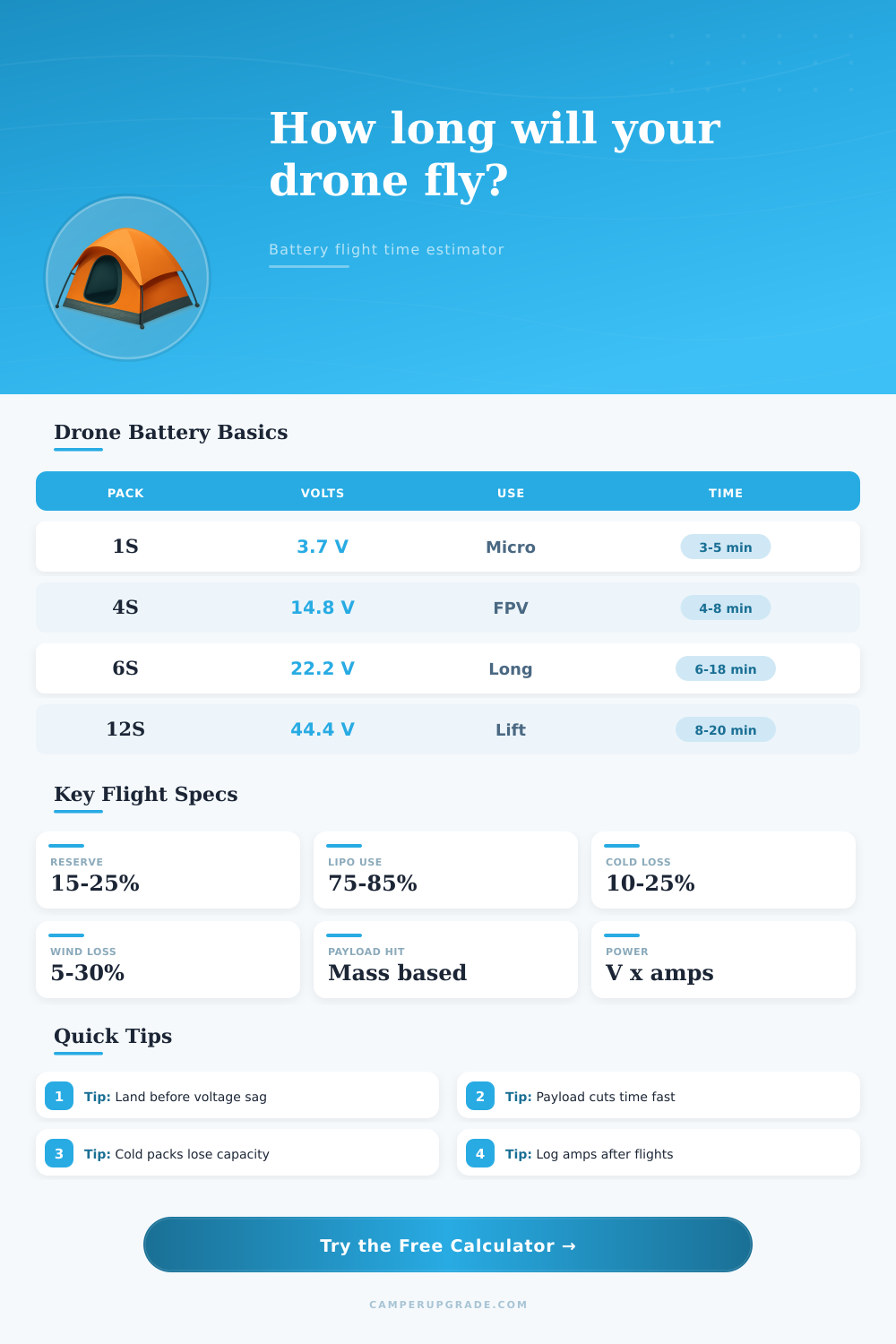
Drone Flight Time By Battery Calculator
Estimate safe flight minutes from battery capacity, pack voltage, current draw, payload, wind, temperature, battery age, and landing reserve.
| Pack | Nominal voltage | Full charge voltage | Common drone use |
|---|---|---|---|
| 1S LiPo | 3.7 V | 4.2 V | TinyWhoop, micro indoor, brushed trainers |
| 2S LiPo | 7.4 V | 8.4 V | Small toothpick quads and light park cruisers |
| 3S LiPo | 11.1 V | 12.6 V | Light 3 inch quads and older camera drones |
| 4S LiPo | 14.8 V | 16.8 V | 5 inch FPV, cinewhoops, compact sport quads |
| 6S LiPo | 22.2 V | 25.2 V | Modern 5 inch FPV, 7 inch cruisers, mapping rigs |
| 12S LiPo | 44.4 V | 50.4 V | Heavy-lift cinema and industrial multirotors |
| Drone type | Typical pack | Average draw range | Usual safe time |
|---|---|---|---|
| 1S TinyWhoop indoor | 300-450 mAh 1S | 4-8 A | 3-5 minutes |
| 3 inch freestyle quad | 450-850 mAh 3S/4S | 10-20 A | 3-6 minutes |
| 5 inch FPV freestyle | 1100-1500 mAh 4S/6S | 18-35 A | 3-7 minutes |
| 5 inch long range | 2500-4000 mAh Li-ion | 8-16 A | 10-25 minutes |
| 7 inch cruiser | 3000-5000 mAh 6S | 10-22 A | 8-20 minutes |
| Cinewhoop with camera | 1300-2200 mAh 4S/6S | 18-32 A | 4-8 minutes |
| Mapping quad | 5000-10000 mAh 6S | 12-28 A | 15-35 minutes |
| Heavy-lift rig | 10000-22000 mAh 6S/12S | 35-90 A | 8-20 minutes |
| Payload share of base weight | Calculator multiplier | Flight behavior | Planning note |
|---|---|---|---|
| 0% | 1.00x | Baseline draw | Best for tune checks and clean logs |
| 10% | About 1.15x | Noticeable extra throttle | Common with action camera and mount |
| 25% | About 1.40x | Shorter punch-out margin | Use conservative reserve and calm wind |
| 50% | About 1.84x | Heavy hover load | Verify motor temperature after landing |
| 100% | About 2.83x | Industrial lift range | Use measured current logs when possible |
| Condition | Calculator adjustment | What changes | Use when |
|---|---|---|---|
| Calm air | 1.00x draw | No wind penalty | Indoor, protected field, still morning flights |
| Moderate wind | 1.14x draw | More correction power | Visible drift correction or tilted hover |
| Gusty wind | 1.25x draw | Higher throttle swings | Tree-line turbulence, ridge lift, gusty parks |
| Cool pack | 0.94x capacity | Less usable energy | Battery is cool to the touch before launch |
| Cold pack | 0.88x capacity | Voltage sag arrives sooner | Cold weather field sessions or winter trails |
| Tired pack | 0.80x capacity | Reduced real capacity | Older packs with sag or shorter recent flights |
| Preset | Battery | Base weight | Starting current |
|---|---|---|---|
| TinyWhoop Indoor | 1S 450 mAh | 32 g | 5.8 A |
| 3 Inch Freestyle | 4S 650 mAh | 170 g | 14 A |
| 5 Inch FPV Freestyle | 6S 1300 mAh | 640 g | 24 A |
| 5 Inch Long Range | 6S 3000 mAh | 710 g | 12 A |
| 7 Inch Cruiser | 6S 4000 mAh | 980 g | 15 A |
| Cinewhoop Camera Rig | 6S 1500 mAh | 720 g | 26 A |
| Mapping Quad | 6S 8000 mAh | 2100 g | 18 A |
| Heavy-Lift Rig | 12S 16000 mAh | 8500 g | 58 A |
While camera specs and top speeds is interesting, flight time is what’s important. A few percentage points of battery left on-screen doesn’t matter if you’re pushing into a headwind that stalls out the motors. If you guess wrong about your available flight time, it’s game over. Your most expensive hardware won’t do you any good after running into a tree.
Because battery life changes based off any variable you throw at it, there isn’t a hard number on the back of the battery label for flight time. Once you put in your configuration, calculator crunches the numbers, but knowing how to get these numbers will make you a smarter flyer. Because we only have so much juice stored up in our cells, endurance is all about energy management. You’re burning through whatever you’ve got from here on out.
How to Save Battery Life on Your Drone
Power consumption equal current times voltage. That means smooth cruising consumes fewer battery than aggressive flying. You are pulling thirty amps at twenty-two volts. You’re burning off watts quick. A high speed dive instead of a hover makes all the difference between a four-minute emergency return and an eight minute flight.
They also don’t realize that payload add complexity. Lift doesn’t scale linearly with weight. A few grams here and there (like adding an LED light or small camera) isn’t a big deal, but when you add twice as much weight, you need twice as much power just to get into the air. It multiplies your existing draw by however much additional weight you’re packing over your basic frame. If you’re mounting something heavier (a bigger sensor/lens), this is crucial. While you might feel like you have plenty of safety margin, an additional hundred grams can cut minutes off your window and leave you dangerously close to falling short.
If it’s windy, environmental conditions suck up more power than anticipated as the flight controller fights to keep the craft balanced. Even if you’re not actively flying, the motors has to work harder. If the chemistry is Lithium based (as most drones are), cold temperatures make things worse; the ions within the cell don’t move as fast. That causes increased internal resistance, reducing available capacity. What may last 10 minutes in a warm summer breeze may provide just seven minutes of life in the cold winter air. To compensate, tool adjusts for wind and temperature to bring theoretical maximum down to something you can expect in the field.
The other variable that impacts performance is battery age. Batteries don’t last forever and lose their ability to carry a full load over time as they are used and charged. On a brand new pack, your batteries may achieve their rated capacity on every charge. With an old pack that’s sagging when under load, you’ll shut down sooner. Most pilots won’t pay attention to this until it bites them in the ass.
The best insurance against these variables is to set aside a landing reserve. If you keep 15-20% back you have some wiggle room for navigation errors or unexpected wind gusts.
If you’re building a new drone, this table of reference help calibrate your expectations for what is typical voltage/amp draw in each class of drone. It becomes very clear how different a long-range explorer is from a five inch freestyle quad. A freestyle quad require more burst power for tricks, whereas a long-range explorer needs more efficient flight for distance. Choosing the right battery based on your flying style will keep you out of unnecessary trouble.
There’s a big difference between collecting crash videos and being a good pilot: planning. Not a lot of pilots memorise formulas or carry laptops into the field. Respect the limits of your energy source. Learn about how weight, wind, and wear affect things so that you know instead of guessing. Then trust it and go after the better shots instead of constantly checking your battery level every thirty seconds. Land with gas to burn and you’ll be able to fly again tomorrow.