Dried Bean Rehydrate Volume Calculator
Estimate cooked volume, soaking swell, water needs, pot capacity, and servings before packing dry beans for camp meals.
🏕Named camp meal presets
🥘Bean and water inputs
⚖Material and spec comparison grid
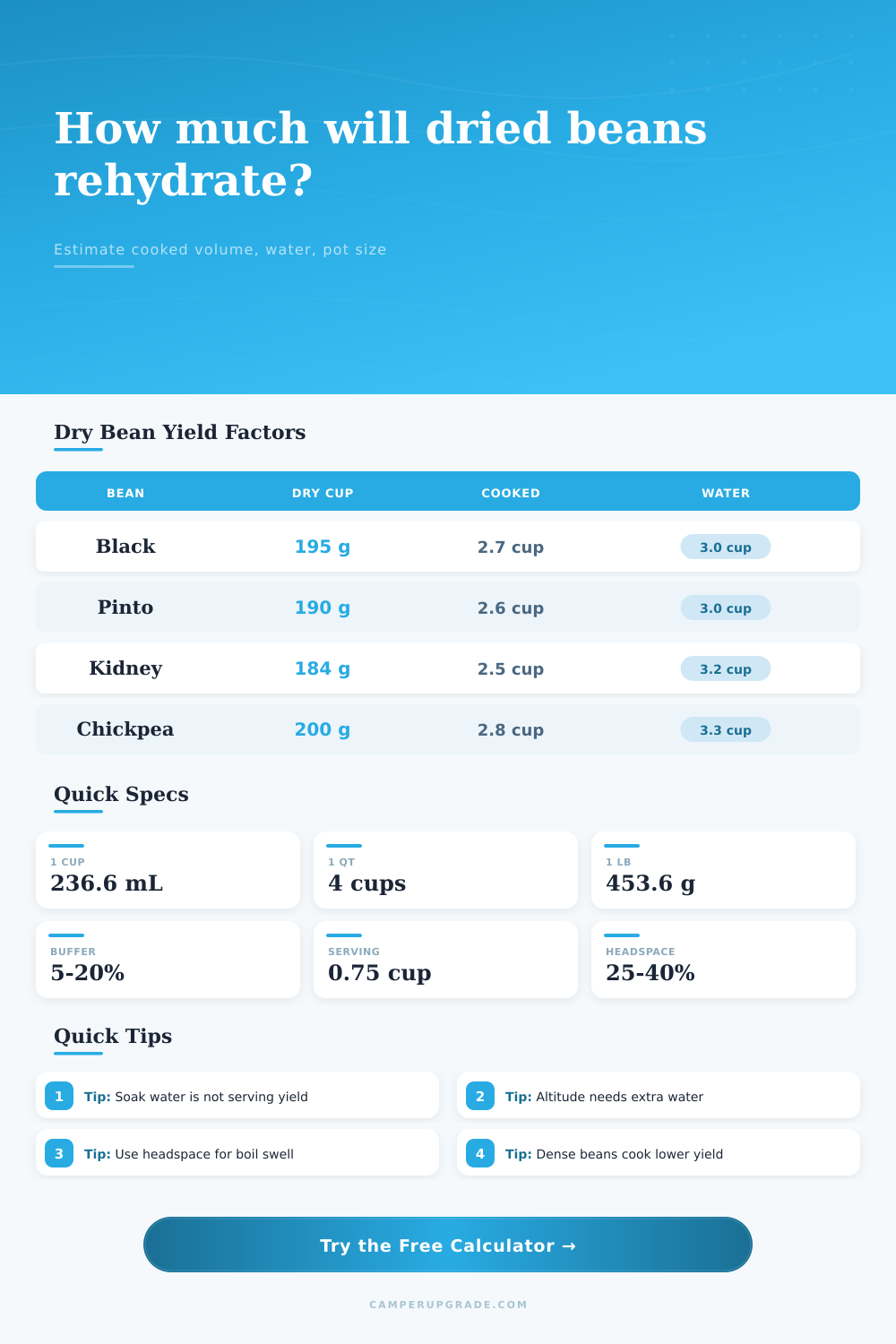
📊Dry bean yield table
| Bean type | Grams per dry cup | Cooked cups per dry cup | Soaked cups per dry cup | Cooking water per dry cup |
|---|---|---|---|---|
| Black beans | 195 g | 2.7 cups | 2.25 cups | 3.0 cups |
| Pinto beans | 190 g | 2.6 cups | 2.20 cups | 3.0 cups |
| Red kidney beans | 184 g | 2.5 cups | 2.15 cups | 3.2 cups |
| Navy beans | 208 g | 2.55 cups | 2.20 cups | 3.0 cups |
| Chickpeas | 200 g | 2.8 cups | 2.45 cups | 3.3 cups |
| Brown lentils | 192 g | 2.35 cups | 1.65 cups | 2.8 cups |
| Great northern beans | 185 g | 2.7 cups | 2.30 cups | 3.1 cups |
| Black-eyed peas | 178 g | 2.45 cups | 2.00 cups | 2.9 cups |
| Split peas | 197 g | 2.25 cups | 1.50 cups | 2.8 cups |
| Aduki beans | 192 g | 2.55 cups | 2.10 cups | 3.0 cups |
💧Water and soak reference table
| Method | Soak water multiplier | Cook water change | Best use | Planning note |
|---|---|---|---|---|
| No soak | 0.0x | +20% | Same-day cooking | Carry more simmer water |
| Quick soak | 3.0x dry cups | +8% | Evening prep | Boil then rest before cooking |
| Overnight soak | 3.5x dry cups | Base factor | Lowest fuel plan | Drain before cooking |
| Long soak, drained well | 3.5x dry cups | -6% | Soft beans | Best when water is easy to get |
🫙Common camp batch sizes
| Batch name | Dry amount | Expected cooked yield | Normal servings | Pot size target |
|---|---|---|---|---|
| Solo side bowl | 0.5 cup | 1.2-1.4 cups | 1-2 | 1.5 qt |
| Two-person burrito filling | 1 cup | 2.4-2.8 cups | 3-4 | 2 qt |
| Family chili add-in | 2 cups | 4.8-5.6 cups | 6-8 | 4 qt |
| Group soup base | 3 cups | 7.0-8.4 cups | 9-11 | 6 qt |
| Potluck bean bowl | 1 lb | 5.8-6.8 cups | 7-9 | 5 qt |
🧪Formula and conversion table
| Formula item | Calculation | Imperial result | Metric equivalent |
|---|---|---|---|
| Dry cups from weight | dry grams / grams per cup | cups dry beans | same cup basis |
| Cooked yield | dry cups x yield x texture | cups and quarts | liters |
| Water to carry | soak water + cook water + reserve | cups and quarts | liters |
| Pot capacity | (beans + active water) / fill limit | quarts | liters |
| Cooked weight | dry grams x cooked multiplier | pounds | kilograms |
⚠Camp calculation tips
Dry beans are lightweight, long-lasting, and therefore good for packing. But the one thing your brain likely forgot on your way out the door was that these things require a bunch of water in order to cook. When you go to add them to a partially filled pot containing the rest of your meal’s parts, this can be problematic. Suddenly you’re running low on your precious H2O and haven’t even had dinner yet!
It’s not merely a crummy camping anecdote; it’s a physics lesson pretending to be an adventure recipe. In truth, dry beans are dense, dehydrated sponges: They’ll swell up until they reach capacity (or until there’s nothing left for them to soak up). Know the swelling factor prior to setting off, and you’ll enjoy a satisfying stew rather then a bowl of rocks.
How to Cook Dry Beans When Camping
Plug in your soak method, your bean type, and let the calculator do the math. No need to guess the conversions and coefficients. It takes into account things most people neglect until it’s too late (altitude). The higher your elevation, the lower the water boiling point, which means it will take longer for beans to simmer and suck up more moisture before softening. At five thousand feet, you want to have a lot more reserve water than what sea level recipe calls for. Sometimes, the difference between a washout and meal is that extra cup or two.
What happened? Soaking method matters completely because of the change in starches from the soaking water. Overnight soaks makes your beans softer and larger, meaning less cooking fuel required (and quicker cooking). But the soak water becomes clouded with the dissolved sugars and starches. You can drain it off for a clearer end-dish, losing a bit of nutrition but gaining clarity. Or you can keep it and avoid having to carry extra fresh water for the rest of your trip (saving weight), but at the expense of a denser meal. The tool shows you that tradeoff by letting you choose whether to include or exclude that soak water from your total yield.
The other variable that influences camp morale is pot size. As everyone knows, beans gets really, really big when you cook ‘em. They get like twice as big. So if you pack an entire bag of dry beans into a tiny pot (and top them off with only enough water to cover), be prepared to clean up a mess in short order. You’ll want some headroom… Something on the order of 30%, to account for expansion and foaming. But do not leave so much headroom that you are wasting precious packing space. It might seem wasteful, especially if you’re traveling light, but trust me (it’s essential). The calculator will tell you how big a pot you should of used to accommodate your beans, water, and foam.
Beans also act differently. Some maintain their shape, like chickpeas, while others get plump enough in a predictable way for stews or even salads, like chickpeas. Other beans are dense: red kidney beans will need longer cooking time and sometimes more liquid, so there’s a greater danger of running out before they’re tender. Then there are split peas that break down completely and turn into a creamy soup. They need only a small amount of water, but they requires constant attention to avoid scorching on the bottom. Not only do your tastes determine your strategy, but also the type of bean.
This also includes weight. It sounds like a pound of dry beans would provide plenty of food for a big crowd. Once they are hydrated, you have a lot more food by weight because water adds to their bulk. In other words, you’re lugging around potential water in solid form. Cook them up, and then you’ve got a bunch of liquid mass, which makes your pack feel heavier on the trail than it did at home where every ounce matters.
Don’t forget the buffer. Reality doesn’t always match what the recipes say. You have many variables like cold start time, wind chill, and hungry friends that you don’t deal with when planning a meal at home. Including an additional 10% for both your water and your yield is inexpensive protection from being stuck in camp halfway through dinner without any water left. A bit more water is always better than burnt food scraped from the bottom of a pot. This margin is adjustable in the tool to help you plan confidently instead of hoping it will turn out alright.
Ultimately, cooking dried beans along a thru hike isn’t so much about recipes as it is about learning to manage resources. It’s about weighing out volume vs. Weight, fuel efficiency vs. Water availability, and figuring out the most efficient way to cook them with what you’ve got. Spend some time beforehand doing that math and you eliminate the guess work in your backcountry kitchen. You’ll walk into the woods knowing just how large of a pot to pack and how much water to lug, freeing up space to have fun instead of worry. The beans will still get bigger… but at least you won’t be caught off guard.