Drainage Slope Tent Calculator
Size the fall across your tent pad, estimate storm runoff, and check whether a shallow side swale has enough reserve before you stake the fly.
💧 Drainage Results
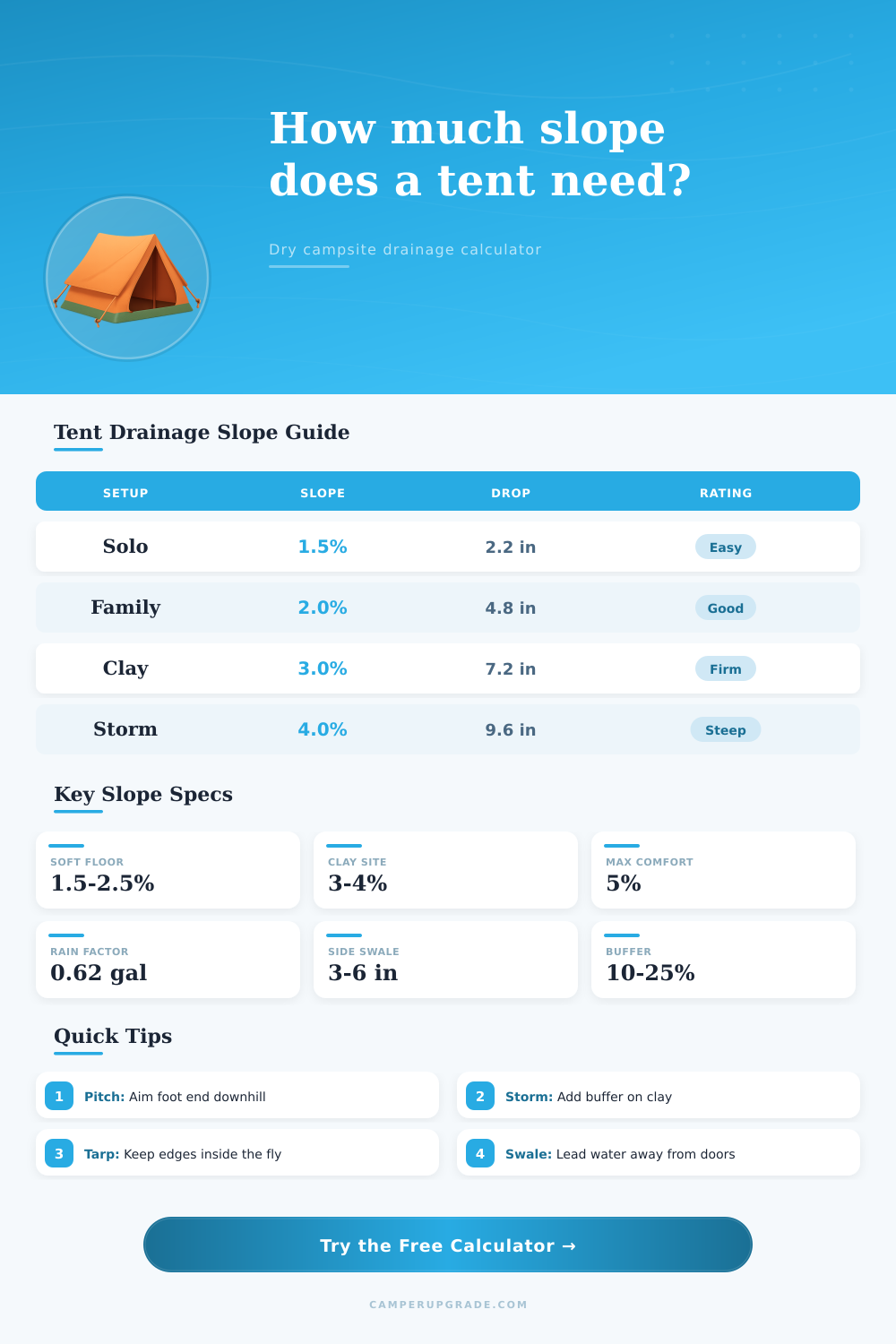
| Pitch Situation | Suggested Slope | Drop Over 8 ft | Comfort Note |
|---|---|---|---|
| Small backpacking tent on permeable sand | 1.0% to 1.5% | 1.0 to 1.4 in | Barely felt while sleeping |
| Typical dome tent on turf or loam | 1.5% to 2.5% | 1.4 to 2.4 in | Good balance of dry floor and comfort |
| Large cabin tent with broad roof runoff | 2.0% to 3.0% | 1.9 to 2.9 in | Use diagonal or foot-end fall |
| Clay, hardpan, or compacted festival field | 3.0% to 4.0% | 2.9 to 3.8 in | Expect more noticeable sleeping slope |
| Emergency storm pitch for short stay | 4.0% to 5.0% | 3.8 to 4.8 in | Dryness takes priority over comfort |
| Surface | Runoff Factor | Drainage Behavior | Calculator Use |
|---|---|---|---|
| Clean sand or beach bench | 0.20 | Most rain infiltrates quickly unless already saturated | Lower swale reserve need |
| Packed gravel tent pad | 0.35 | Fast surface shedding with some void storage | Good for RV park tent pads |
| Loam turf campsite | 0.45 | Moderate infiltration, grass slows sheet flow | Default general campsite setting |
| Forest duff or pine needle mat | 0.50 | Absorbs early rain, sheds when compacted | Check overhang and side flow |
| Compacted clay field | 0.75 | Water sheets across the surface quickly | Use steeper slope and buffer |
| Rock slab or slick hardpan | 0.90 | Almost all rainfall becomes surface runoff | Avoid uphill entry doors |
| Slope Percent | Ratio | Drop per 10 ft | Use Case |
|---|---|---|---|
| 1.0% | 1:100 | 1.2 in | Minimal drainage on porous ground |
| 1.5% | 1:67 | 1.8 in | Comfort-focused backpacking pitch |
| 2.0% | 1:50 | 2.4 in | Standard tent pad drainage |
| 3.0% | 1:33 | 3.6 in | Wet grass or broad cabin tent |
| 4.0% | 1:25 | 4.8 in | Clay, hardpan, or storm pitch |
| 5.0% | 1:20 | 6.0 in | Short storm stay, less sleeping comfort |
| Tent Type | Typical Floor | 2% Drop on Long Run | 1 in/hr Runoff on Loam |
|---|---|---|---|
| Solo backpacking tent | 7 ft × 3 ft | 1.7 in | 0.10 gal/min |
| Two-person dome tent | 7.5 ft × 5 ft | 1.8 in | 0.18 gal/min |
| Four-person family tent | 9 ft × 7 ft | 2.2 in | 0.29 gal/min |
| Six-person cabin tent | 10 ft × 10 ft | 2.4 in | 0.47 gal/min |
| Canvas wall tent | 12 ft × 14 ft | 3.4 in | 0.79 gal/min |
| Bell tent footprint | 16 ft diameter | 3.8 in across diameter | 0.94 gal/min |
Plan ahead: You don’t want luck to dictate whether your tent stay dry. The route of least resistance will be down; make sure it doesn’t lead into your tent. Most rain will run off before pooling if you set up with a small incline. If the door is facing uphill then you’re going to have issues. An uphill door create its own small catchment which leads to trouble.
These variables plug into calculator. Put in your tent footprint, pick your drain direction, pick your rainfall rate, and pick your ground type. It spit out how much drop is required across the pad. It shows how much water flow off in a storm. It also tells you if there’s space to catch it with a side swale.
How to Keep Your Tent Dry in Rain
That’s important because these are answers to very particular questions: Will the tent feel tilted? Will water stay on surface? Is my margin long enough for a longer rain? That makes big difference in soil types. In clean sand, water will soak into ground fast and you’ll see less surface runoff during a storm than you do on clay. To account for this, the calculator include a runoff factor. For example, that number jump dramatically on clay, meaning you need more grade (which is why more slope is recommended). That added grade isn’t for your benefit. It reduce the amount of time the water stay on the groundsheet before leaving.
Width and depth of swale works the same. If calculations show a positive reserve, then roof runoff will be captured in a shallow ditch along low side and carried around the doors. If not, the channel is insufficient, or the storm is excessive for that particular pitch, so you dig out deeper, put in an outlet further downhill, or relocate entire tent.
Until it’s time for a puddle at the vestibule, it’s easy to miss how much door orientation matter. Because water loves to pool up at the point where the fly meets the ground at the door, uphill doors gets flagged on the calculator. Often all that’s needed is an extra inch or two of overhang or a slight adjustment of placement, so there is no need to adjust the slope.
But in real life, there are no clean rectangles. Nature makes changes: roots, little depressions, existing ruts, etc. Affects water flow. The calculator is meant as a baseline, not a promise. What happens after sizing the swale and the grade? If at all possible, test-walk the low side in a gentle rain. Where does initial trickle flow? More often than not, that little test will tell you if calculation matches what’s happening in the dirt.
You don’t want perfect dryness in theory; you just want to stay ahead of reality. A set-up that outpaces the water. When the site and numbers jive, you won’t hear drips dripping when your head hit the pillow. You’ll be sleeping soundly through the night.