Down Fill Power Calculator
Estimate loft performance, effective insulation thickness, and temperature comfort range from real down specs.
🛌Scenario Presets
⚙Down Insulation Inputs
📊Performance Snapshot
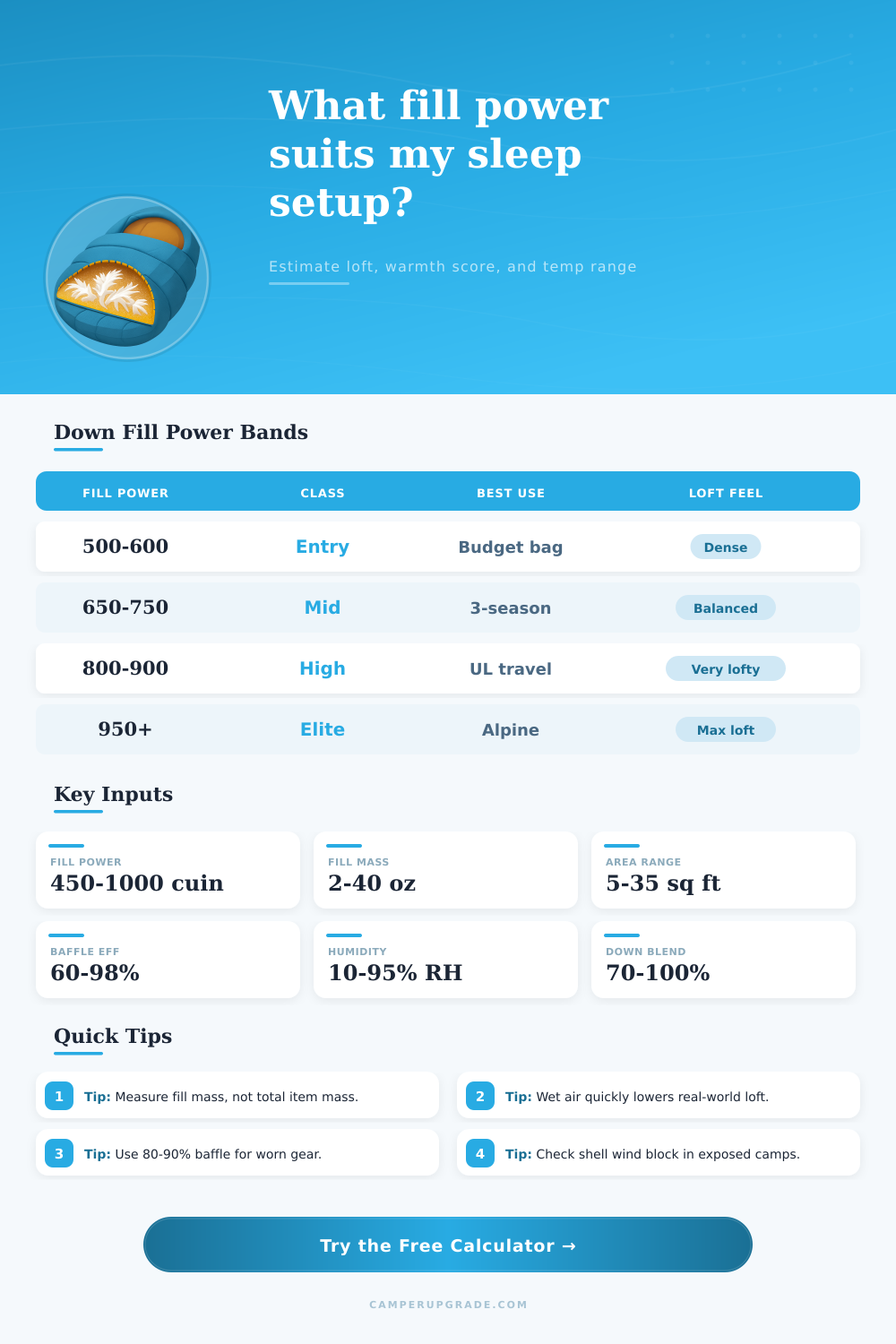
| Fill Power Band | Typical Use | Loft Efficiency | Packability |
|---|---|---|---|
| 500 to 600 | Budget sleeping bags | Lower volume per oz | Bulkier packs |
| 650 to 750 | Most 3-season kits | Balanced warmth and value | Moderate pack size |
| 800 to 900 | Ultralight and alpine use | High warmth-to-weight | Very compact |
| 950 and above | Expedition-grade builds | Maximum loft per oz | Smallest packed size |
| Humidity Range | Loft Retention Factor | Expected Field Impact | Best Practice |
|---|---|---|---|
| 10 to 30% RH | 0.96 to 0.99 | Minimal loft collapse | Air out once daily |
| 31 to 55% RH | 0.88 to 0.95 | Moderate loft drop | Use dry bag storage |
| 56 to 75% RH | 0.77 to 0.87 | Noticeable thermal loss | Vent and sun dry often |
| 76 to 95% RH | 0.65 to 0.76 | Strong performance drop | Pair with vapor strategy |
| Preset Scenario | Fill Spec | Loft Thickness | Comfort Target |
|---|---|---|---|
| UL Jacket Hike | 850 FP / 4.2 oz | 0.55 in | Cool active |
| 3-Season Bag | 800 FP / 15 oz | 1.80 in | Near freezing |
| Winter Bivy Bag | 850 FP / 23 oz | 2.65 in | Deep winter |
| Alpine Expedition | 900 FP / 28 oz | 3.10 in | Sub-zero |
Fill power is a measurement of an quality of down insulation, but it does not account for the total amount of down insulation within a piece of clothing. Fill power measure how much air one ounce of down can trap in a lab setting. Additionally, the fill power of down insulation indicates the loft or the puffiness of the down cluster.
A person may purchase a down product with a high fill power, but if the total amount of down within the product is low, it will not provide the individual with sufficient warmth. For example, a down product with 900 fill power and only three ounce of down will provide less warmth than a down product with 650 fill power but with six ounce of down. To determine the warmth provided by down insulation, both fill power and total fill weight must be considered.
How Fill Power and Fill Weight Make Down Warm
Warmth is created by the still air within the down cluster. A persons body heat creates warmth that the down insulation trap within the clusters to keep it from escaping the body. Humidity can also affect the performance of down insulation.
Moisture within the down clusters will make the down clump together, reducing the downs loft. Down cluster that clump together will no longer be able to trap air within the clusters, and the down will lose its insulating properties. High humidity, like the 80% humidity within the rainforest, will cause the down clusters to lose their loft more quickly than if the down insulation was exposed to low humidity levels.
A person can maintain the loft of their down insulation by using specific routine. For instance, they can unzip their down product to allow the down to vent, or they can store their down product within a breathable bag. Additionally, they can air these products out under the midday sun to allow the down to dry and regain its loft.
The baffles within down products impact how the down insulation stay distributed within the garment. One construction method for baffles is the sewn through construction of the baffles. However, sewn-through construction often creates spots within the down product where it is too cold because the down gets compressed within those spots.
Two other alternatives to sewn-through construction are box baffles and welded chambers. Box baffles and welded chambers create separate compartment for the down clusters, which helps to preserve the volume of the down. However, the down within these compartments may shift over time, which creates even distribution of the down clusters within the product.
The fabric that line the down product can also impact the warmth of the down product. For instance, if the shell fabric is thin, it may allow the wind to pass through the down product. This movement of the air within the down product can lead to the loss of heat from the body.
The shape of a piece of gear can impact the warmth that it provide to the body. For instance, because jackets cover the torso of the person, they may be effective in retaining warmth for active individuals. However, they may not provide enough warmth for individuals who are resting.
Quilts are lighter in weight than sleeping bags, but they may not cover the feet of the sleeping individual. Parkas can retain a high level of warmth because they often contain hoods and zippers that keep the warmth of the body from escaping. However, vests will provide less warmth to the body because they leave the arms of the individual uncovered.
The activity level of an individual can change the amount of down insulation that they need. For instance, individuals who are active and moving around will create more body heat, therefore they will not need as much insulation as individuals who are not moving. However, individuals who is stationary will need more down insulation to retain their body heat.
Warmth is primarily created by the thickness of the insulation itself. One inch of loft in the insulation may be enough for an individual to wear during cool weather seasons. However, two or three inches of loft can provide enough insulation for an individual during the winter months.
The thickness of the insulation can be expressed in clo values. Clo values are a standard unit of measurement for the amount of heat that an insulation layer will retain. Many factors will impact the clo value of an item of clothing.
Comfort ratings for clothing will help to guide the individual as to what the insulation level of the clothing should be. However, the comfort ratings are not a guarantee as to the warmth that an individual will feel while wearing the clothing. There are many mistakes that individuals make when purchasing down insulation.
For instance, individuals may try to find down insulation products with the highest possible fill power; however, this could lead to purchasing a product that will not retain enough warmth for the individual. The total weight of a jacket may seem low, but the weight of the shell of the jacket contribute to the total weight of the product. Additionally, individuals may not be aware that down insulation that has been compressed within stuff sacks for long periods of time will degrade over time and provide less insulation than when it was newly purchased.
Many down insulation products are a blend of down and feathers. Products that contain feathers will have less loft than products that contain 100% down cluster. Down is a preferred insulation material for many individuals.
One reason that down is preferred over other insulation materials is due to its compressibility and breathability. Down can be compressed into a small size, especially when the down is dry. Additionally, down is often lighter than other form of insulation.
However, down requires maintenance because it must be dried completely to maintain its loft. An alternative to down is synthetic insulation. Synthetic insulation products are useful in wet environments because the synthetic insulation will maintain its loft even when it is soaked in water.
Additionally, some garments use a hybrid insulation system, where synthetic insulation is used in areas where moisture is likely to collect.