Double Sleeping Bag Width Calculator
Estimate the listed shoulder width, usable inside width, footbox room, pad fit, and comfort margin for a shared two-person sleeping bag.
🏕Named camping presets
📏Width inputs
Metric entries are converted internally with 1 in = 2.54 cm.
Measure relaxed shoulder breadth across the widest point.
Use the same measuring method for both campers.
Applied once on each outside edge of the shared bag.
Use a higher value when sleepers dislike shoulder contact.
Two regular pads are often 40 in; two wide pads are often 50 in.
Use the manufacturer's widest listed shoulder or top width.
If no foot width is published, estimate from the taper table below.
Calculated shared sleeping-bag width
⚙Bag cut comparison grid
📊Reference tables
| Camper pair | Body shoulder total | Suggested listed width | Best-fit platform |
|---|---|---|---|
| Smaller close-sleeping pair | 30-33 in | 48-54 in | 40-48 in pads |
| Average mixed-size pair | 34-37 in | 54-60 in | 48-50 in pads |
| Broad-shoulder pair | 38-41 in | 60-66 in | 50-60 in pads |
| Winter or restless pair | 38-42 in plus layers | 64-72 in | 60 in mattress |
| Pad setup | Common width | Use with bag width | Fit note |
|---|---|---|---|
| Two regular backpacking pads | 40 in / 102 cm | 48-54 in listed | Bag sidewalls may overhang |
| Two wide sleeping pads | 50 in / 127 cm | 54-60 in listed | Good for most rectangular doubles |
| Double camping mattress | 52 in / 132 cm | 56-64 in listed | Works well for car camping |
| Queen air mattress | 60 in / 152 cm | 60-72 in listed | Best for broad or restless sleepers |
| Bag cut | Shoulder efficiency | Foot efficiency | When to add width |
|---|---|---|---|
| Rectangular double bag | 100% | 100% | Only for layers and movement |
| Relaxed rectangular sidewall | 97% | 92% | Add 1-2 in for puffy sidewalls |
| Semi-rectangular camping bag | 92% | 82% | Add width for side sleepers |
| Double mummy or tapered quilt | 88-90% | 68-75% | Check footbox specs carefully |
| Named setup | Typical inputs | Calculated shoulder range | Practical result |
|---|---|---|---|
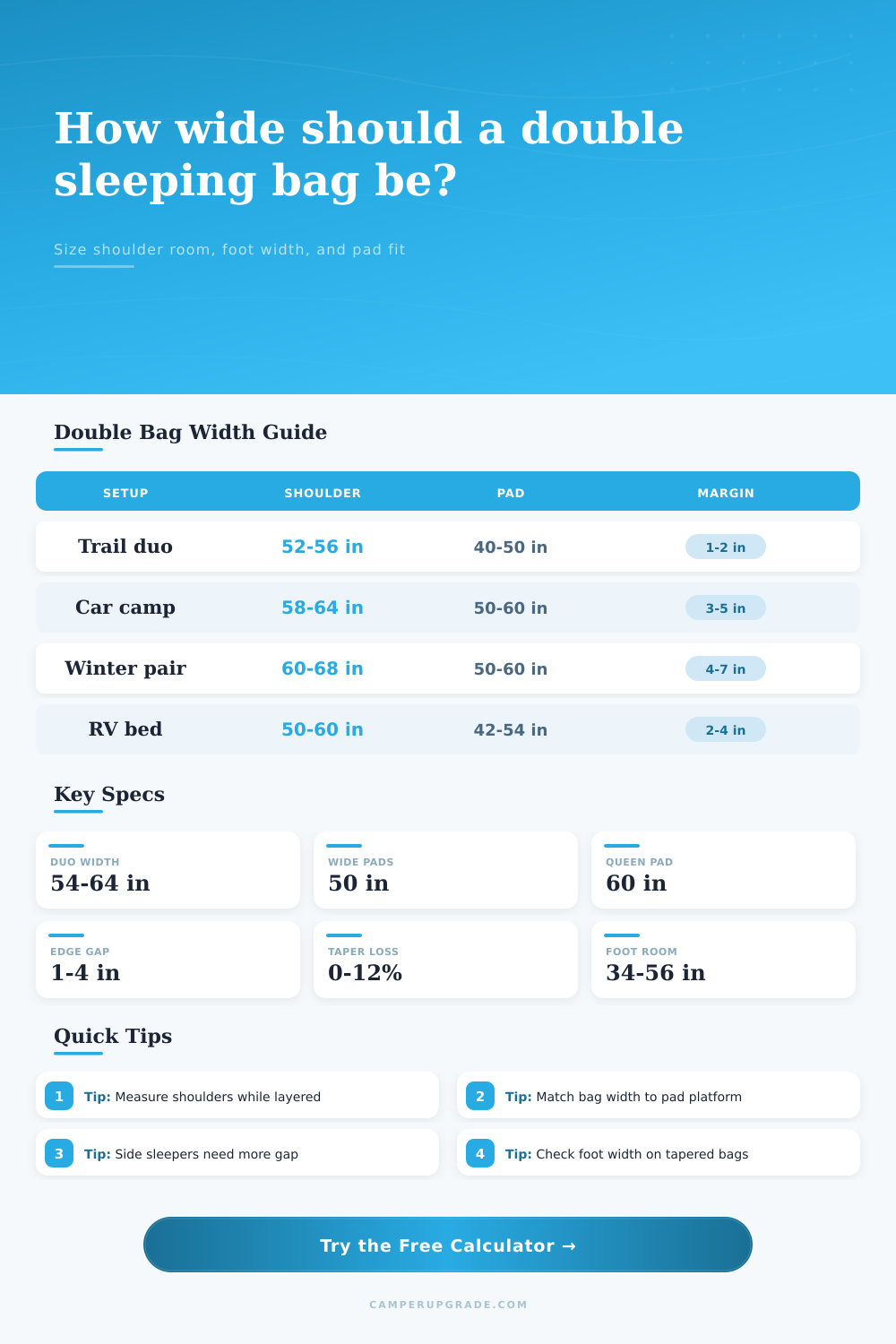
| Backcountry quilt pair | 35 in shoulders, light layers, 50 in pads | 54-58 in listed | Choose a wider quilt if both turn often |
| RV dinette bed | 33 in shoulders, close sleep, 42 in bed | 50-55 in listed | Watch sidewall overhang on narrow cushions |
| Winter double mummy | 36 in shoulders, puffy layers, 50 in pads | 60-68 in listed | Foot width often becomes the limiting spec |
| Queen air mattress cabin | 37 in shoulders, active sleep, 60 in pad | 62-68 in listed | Roomy rectangular bags fit this use best |
💡Width calculation tips
Formula basis: required inside shoulder room = Camper A shoulders + Camper B shoulders + pair movement allowance + both sleepwear allowances + two outside edge clearances + center gap. Listed width adjusts that value for bag-cut efficiency and seam or loft loss.
For double bag campers, however, there are special considerations. As soon as you get a sleeping bag, you realize it doesn’t reach both of your feet. Then you wake up in the middle of the night with half your leg hanging off the other person because a drafty seam lets chilly air in. Sleeping bags seem like a romantic thing when you’re looking at brochures, but then there’s only so much space on the ground, and it turns into a geometry issue. It’s about knowing what exactly you’re measuring before you zip up for the night.
When most manufacturers states their shoulder width, that’s typically the maximum dimension across the top of the shell. And that doesn’t tell you if two people can fit in the bag without one of them sleeping in the footbox. Other variables are also involved: the taper of the bag (a mummy shape cuts away excess space around the hips and feet to save warmth; a rectangular bag wastes less material at the shoulders, but it retains more heat loss overall), the bulk of your layers, and movement allowance for restless sleepers. When the temperature does drop, that tradeoff help dictate just how much room you’ve got.
How to Choose the Right Size Double Sleeping Bag
Once you input your measurements (shoulder widths and layer thickness) into the calculator above, it do all the math for you, without guesswork of coefficients and interior clearances. It begins with the fundamentals of measuring your body. Measure yourself across the back at the widest part of the shoulders, fully dressed in heaviest clothes you intend to wear at night time. A puffy coat/jacket/fleece adds several inches to your body shape, as opposed to a base layer which doesn’t add much volume at all. Failure to account for this additional bulk results in feeling cramped immediately; there is simply not enough slack within the bag to fit the girth of the added insulation.
Depending on how you like to move around at night, the calculator includes an additional wiggle-room allowance, and side sleepers needs more width than someone who sleeps tightly on their back. This slight difference can mean the difference between snagging the middle zips or having the fabric pull tightly over the center of your chest throughout your deepest sleep stages.
While the cut of the bag is important, pad compatibility is equally important. The kind of insulation support underneath also contributes to comfortly. For example, if I sleep on two narrow backpacking pads and use a nice wide double bag, it’s going to feel cramped when sitting on top of those pads because it will extend past the sides of insulating surface. You’ll be exposed to the cold in those spots. You want to make sure you match the size of the bag with your platform so that heat is getting to each corner of your body. A queen sized air mattress gives you a bit more flexibility. However, make sure you still have enough room inside the edge of the mattress so the bag doesn’t get dragged around when you toss and turn at night.
The issues here are that tapered bags gets really skinny near the feet. So while you can fit in a larger bag near the shoulder, it may be too small near the feet, enter foot efficiency. For example, if you and your camping partner have broad shoulders and long legs, you’ll find that a very tapered sleeping bag will cause your knees to be pressed uncomfortably close together halfway through the night, since neither person have any wiggle room. This is shown in the reference table found on the page which shows what cut will provide the most usable space at each point down the bag. You’ll notice that a rectangular shape tend to keep your widest part constant, but is less thermally efficient. Spoon shapes/semi-rectangular attempt to blend comfort with efficiency for an average sized couple.
So how do you know what size to get? Don’t pick the biggest bag you can find: Oversized bags holds excess air and take longer to warm up with your body heat. They’re also bulky and difficult to use in a smaller tent, creating different issues rather than solving your previous ones. You should of checked this first. You want to be able to move around within the bag while still having just enough space that cold air doesn’t collect on either side of you. Basically you want a perfect fit.
Once you know how your body fits in the bag and how your insulation changes that fit, it’s easier to figure out. A proper fitting bag eliminates a night of fighting, shifting, and chaos, allowing you to drift off peacefully into a warm sleep with both people staying off the edge. And this harmony is worth knowing prior to packing your trunk.