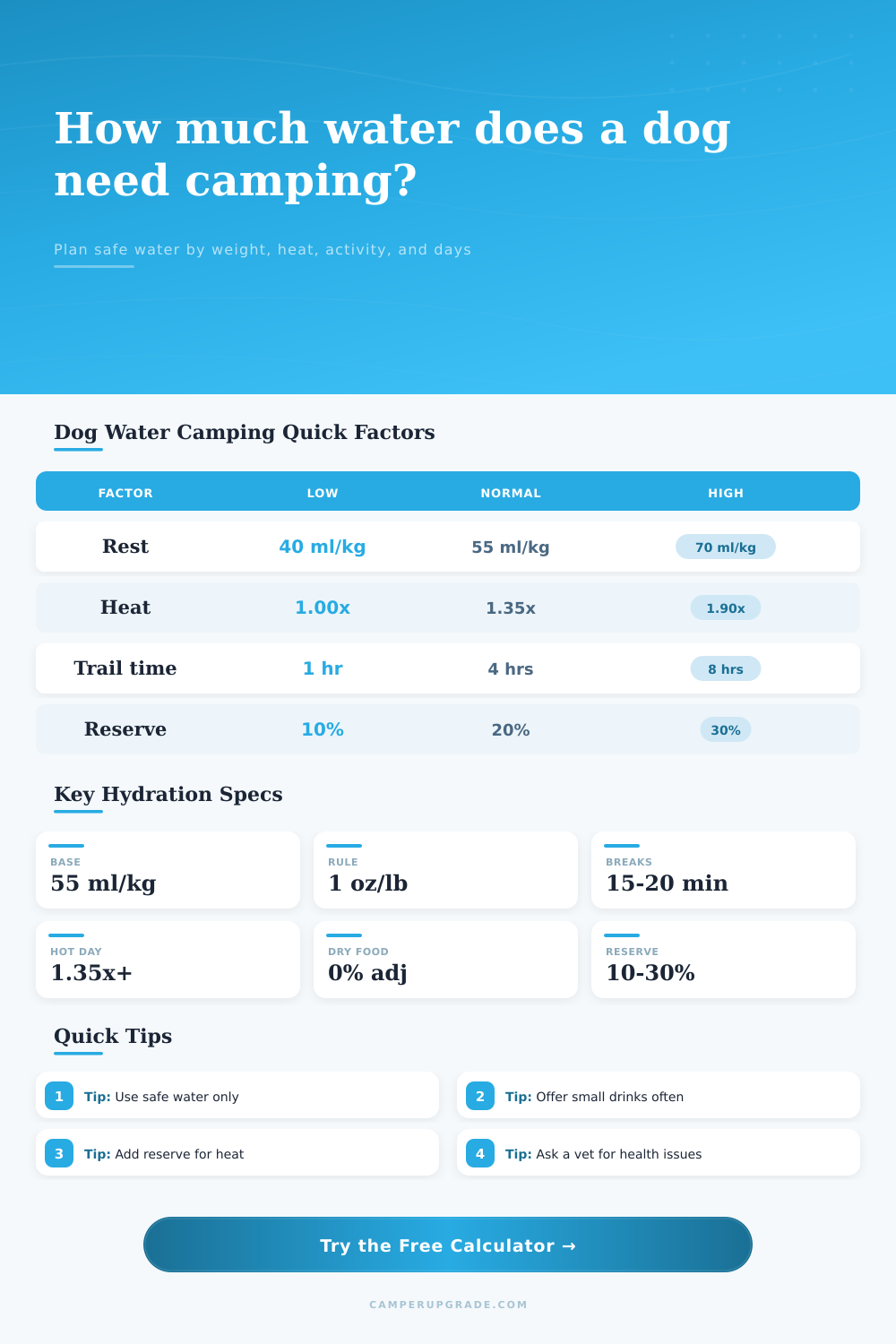
Dog Water Needs Camping Calculator
Estimate drinking water for camp days, trail hours, heat, food type, safe refills, and emergency reserve.
Full Hydration Breakdown
| Dog size | Example weight | Resting daily water | Camping planning note |
|---|---|---|---|
| Toy trail companion | 8 lb / 3.6 kg | 7 to 10 fl oz / 0.2 to 0.3 L | Small dogs can underdrink when bowls are too deep or shared. |
| Small campsite dog | 20 lb / 9.1 kg | 17 to 25 fl oz / 0.5 to 0.7 L | Add margin for sun, dry kibble, or sandy camp walks. |
| Medium hiking dog | 45 lb / 20.4 kg | 38 to 56 fl oz / 1.1 to 1.7 L | Trail hours can push the real need well above rest. |
| Large RV dog | 75 lb / 34.0 kg | 63 to 94 fl oz / 1.9 to 2.8 L | Pack a separate dog allowance instead of sharing human reserve. |
| Giant campsite dog | 110 lb / 49.9 kg | 93 to 137 fl oz / 2.7 to 4.1 L | Use jug planning; single bottles vanish fast with big dogs. |
| Day condition | Temperature guide | Multiplier used | How the calculator applies it |
|---|---|---|---|
| Cool shaded camp | Below 50°F / 10°C | 1.05x | Cold dry air and movement can still raise water need. |
| Mild campground day | 50 to 69°F / 10 to 21°C | 1.00x | Base requirement is adjusted mainly by activity and food. |
| Warm trail day | 70 to 79°F / 21 to 26°C | 1.15x | Useful for shaded hikes, lakeside camps, and moderate play. |
| Hot exposed day | 80 to 89°F / 27 to 32°C | 1.35x | Plan extra stops, less mileage, and cooler resting periods. |
| Very hot route | 90 to 99°F / 32 to 37°C | 1.65x | The calculator also shows a visible heat warning. |
| Extreme heat | 100°F+ / 38°C+ | 1.90x | Use for emergency planning, not as permission to hike hard. |
| Food and condition | Adjustment | Why it matters | Best calculator choice |
|---|---|---|---|
| Mostly wet food | -20% | Some daily fluid comes from the meal itself. | Select this for canned food at most meals. |
| Mixed wet and dry | -10% | Moisture is present, but drinking water still matters. | Use when camp meals alternate wet toppers and kibble. |
| Dry kibble | 0% | The base rule assumes ordinary drinking water access. | Use this for most campground and RV dog meals. |
| Freeze-dried meals | +12% | Dry trail meals can increase water demand. | Use if meals are not fully rehydrated before serving. |
| Common camping setup | Dog profile | Planning total | Container equivalent |
|---|---|---|---|
| One-night serviced campground | 25 lb dog, mild weather | About 32 to 45 fl oz | One to two 1 L bottles |
| Two-day RV park weekend | 70 lb dog, warm walks | About 180 to 230 fl oz | Two gallon jugs with margin |
| Backcountry overnight | 35 lb dog, 5 trail hrs/day | About 95 to 140 fl oz | Three to four 1 L bottles |
| Hot desert boondock | 55 lb dog, dry meals | About 350 to 480 fl oz | Three to four gallon jugs |
The most important thing you can bring on a dog camping trip: water. It weigh more than food or a tent, and it is much heavier then both of those combined.
As the calculator above will show you, you’ll stop guessing how much to pack and start carrying what you actualy need. It removes the guesswork from packing; no longer do you wonder if you brought enough. Instead, you carry amount that you should.
Why You Need a Water Calculator
It all starts with weight, but then there’s weight… But what about heat? What about how much you’re exerting yourself? What about the moisture content of your food? For instance, a fifty-pound Labrador lying around under some shade will have a certain base-level need. That same Lab hiking through a forest on an eighty-degree day will require quite a bit more.
This tool layers multipliers atop this baseline based off the factors you choose: How hard are you exercising? What’s the temperature like? Is your food a mix of dry kibble and something else, like wet food or freeze-dried? Dry kibble requires more drinking water than a mixed diet that includes wet food or freeze-dried meals rehydrated on site. Or you can throw it in with dry kibble. These is small differences, but they add up fast when each ounce matters.
Age and coat matter much more than many owners realize. Panting removes heat very effectively from a short haired Boxer. It does not from a husky with a double coat. Because a dog’s rate of dehydration depends upon these variables the calculator prompts you to consider them. Maybe in your head you think all dogs require the same water/lb. Physiology says no. Puppies, seniors, and those who don’t regulate their temperatures as well requires a larger safety buffer.
That’s what the reserve percentage factors into the tool. If you are on a trip at a campground where it is easy to refill, a ten percent reserve may be enough. For an off-grid desert expedition, the next water source is suspect so you go with a bigger thirty percent reserve. That reserve is your insurance policy against bad decisions.
This is where most trips fail: planning for refill. Unless you treat or filter creek water, don’t assume it’s safe. The calculator divides what you need and what you plan to safely refill with. In other words, if all you bring is water for the initial day and run out halfway through day two because there’s no option but that stagnant pond, you’re screwed.
Enter in the amount of water you know is safe to drink. From this point, the tool calculates how many container of water you will need to carry to fill those gaps. It will break up stops along the trail as well. For instance, if you’ll be hiking for four hours, provide water every twenty minutes or so. Small more frequent sips are easier to manage than allowing a dog to gulp down a bowl at the end of a section. This is laid out well in the reference tables on the page.
For everyday situations, it’s clear: Backcountry overnight with little dog? Pack bottles precisely. You are spending a weekend at an RV park with a big dog. Heavy jugs are okay; you’ll be topping off a lot. Know what suits your trip so you select the proper gear.
Want to pack a collapsible bowl for camp but something light and small for the trail? Go for it. Prefer reusing bottles versus jugs? Carry both into the car but only fill the bottles going up the trail. Match your water plan with your container plan.
Dogs gets heat exhausted quickly. Stumbling? Thick saliva? Bright red gums? Stop. Offer them small amounts of water and cool them down. Don’t let them drink deeply and too quickly. There are alerts for extreme heat on the calculator as well to remind you that no plan replaces good judgement. You know that if it’s one hundred degrees outside and the numbers say you need to bring four gallons, maybe you rethink hiking.
Safety isn’t something you can optimize away. It’s the constraint that defines the trip. Carrying water is a commitment. It is a physical one. It weighs about 2 pounds per liter. It is a significant amount for extended mileage. Even worse, you becomes dehydrated.
The calculator can help you determine where to draw that line, how much to carry without carrying too much. How to make a plan out of your anxiousness. It shows what is in your pack and why it is there. You’re prepared when the panting begins. The peace that comes with the quiet of the woods isn’t interrupted by a thirsty and unhappy dog.