Dog Hiking Pack Weight Calculator
Estimate a trail-safe dog pack load by combining body weight, experience, terrain, heat, water, food, empty pack weight, side balance, and reserve room.
🐾Trail Dog Presets
Dog Pack Weight Snapshot
⚙Dog, Trail, And Pack Inputs
🧵Pack Material And Spec Comparison
📊Dog Pack Reference Tables
| Dog Profile | Starting Load Range | Use For | Calculator Base |
|---|---|---|---|
| Puppy or still growing | 0% to 3% of body weight | Fit practice with nearly empty pack only | 3% before deductions |
| New pack dog | 5% to 8% of body weight | Short hikes while learning pack movement | 8% before deductions |
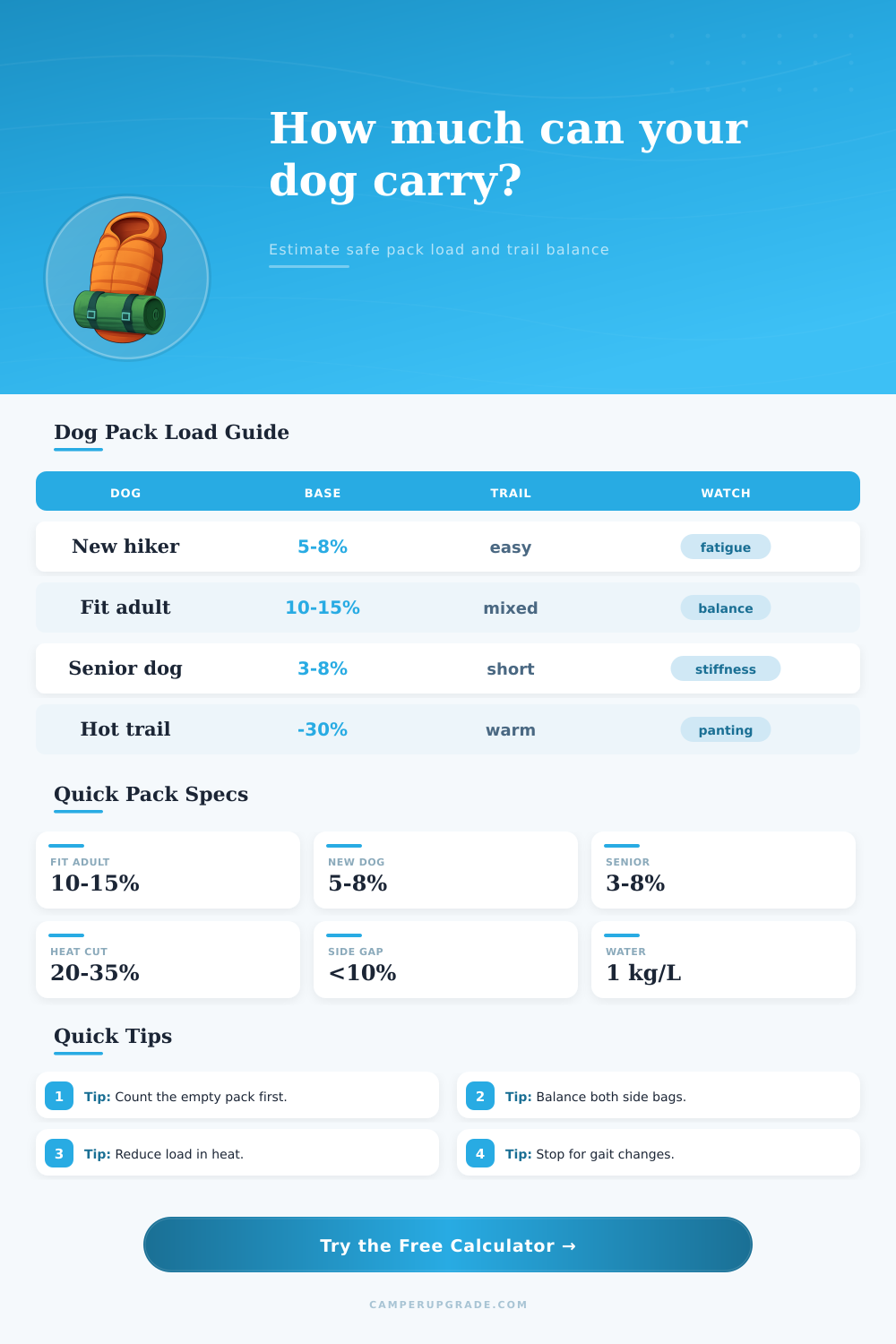
| Fit adult hiker | 10% to 15% of body weight | Most day hikes and mellow overnights | 12% before deductions |
| Conditioned working or sport dog | 15% to 20% of body weight | Strong adult dogs with progressive conditioning | 16% before deductions |
| Senior, stiff, or recovering dog | 3% to 8% of body weight | Gentle terrain with extra rest stops | 6% before deductions |
| Pack Style | Typical Empty Weight | Best Load | Watch Point |
|---|---|---|---|
| Hydration vest or tiny day pack | 0.3 to 0.8 lb | Snacks, small bowl, ID, light soft goods | Limited volume can crowd shoulders |
| Padded day-hike saddlebag | 1.0 to 2.0 lb | Water, food, leash, booties, small first aid | Balance side bags before each climb |
| Rugged multi-day pack | 2.0 to 4.0 lb | Overnight food, collapsible bowl, layers | Heavy empty pack uses safe load quickly |
| Cold-weather harness pack | 1.5 to 3.5 lb | Insulated layers, booties, wax, water | Bulk can rub behind elbows |
| Trail Factor | Adjustment | Why It Matters | Load Planning Move |
|---|---|---|---|
| Smooth park path | No terrain reduction | Stable footing and short recovery demands | Use normal profile limit |
| Rocky or rooty trail | Reduce about 12% | Pack swing and paw placement get harder | Carry dense items yourself |
| Steep climb or descent | Reduce about 18% | Shoulders, elbows, and braking forces rise | Move water to human pack |
| Hot or humid weather | Reduce about 30% | Heat load increases panting and fatigue | Start lighter and refill often |
| Common Dog Size | Body Weight | 10% Pack | 15% Pack |
|---|---|---|---|
| Small trail dog | 20 lb / 9.1 kg | 2.0 lb / 0.9 kg | 3.0 lb / 1.4 kg |
| Medium hiker | 40 lb / 18.1 kg | 4.0 lb / 1.8 kg | 6.0 lb / 2.7 kg |
| Large retriever | 70 lb / 31.8 kg | 7.0 lb / 3.2 kg | 10.5 lb / 4.8 kg |
| Very large dog | 100 lb / 45.4 kg | 10.0 lb / 4.5 kg | 15.0 lb / 6.8 kg |
💧Water And Food Allowance Table
| Need | Planning Rule | Weight Added | Pack Strategy |
|---|---|---|---|
| Water in bottles | 1 liter weighs 2.205 lb / 1 kg | Heavy and dense | Split between sides or carry some yourself |
| Warm hiking day | Plan extra water stops and lower load | May exceed safe pack room | Prioritize shade, refill points, and lighter cargo |
| Food and treats | Use actual package or meal weight | Usually lighter than water | Use soft bags to pad hard items |
| Overnight dog gear | Include bowl, booties, layer, and first aid | Small items add up | Keep hard items away from ribs and elbows |
✅Trail Pack Tips
Every hike there’s that magic moment when your dog no longer wants to be on the trail. Typically, it occurs somewhere between miles two and three, when sun breaks through canopy. Ears go flat against head. The wagging of the tail slow down. The pack becomes an anchor.
Most assume it’s endurance related. In truth, it’s nearly always a combination of thermal load and weight distribution. You’re asking your dog to maintain their own body heat and balance themself over uneven terrain. Plug in your conditions and calculator does all the math for you. You no longer have to guess what level of stress joints endure under a heavy pack. It’s pretty basic math, but difficult to apply in real life.
How to Pack Your Dog Safely for Hiking
Most dogs, even healthy adults, can comfortabley carry 10 to 15% of their own bodyweight. On paper, that sound like PLENTY of space. But when you add up all your gear? Not so much. There are the packs themselves (a couple of pounds for the empty pack). Water (heavy stuff: more than two pounds/liter). Food, treats, and other gear items starts to stack up fast. Treats (calories again). Booties and other extras (the little things adds up quickly). Oh, and don’t forget a collapsible bowl! Then toss on an extra layer or two.
Now think about how much of your dog’s body that is. Because what you’re really measuring isn’t the TOTAL weight, it’s the location of that weight in relation to dog’s center of gravity. But weight isn’t everything. More important is balance. Put all your kibble in one side (three liters) and nothing but water on the other. Now swing it around and pack will do so too. Why? Because that uneven distribution cause side-to-side twisting; and that twists shoulders and spine. The tool addresses that by measuring the difference between what’s on your right versus left. If it’s under ten percent, you’ll get a green-light balance check. That percentage exists as there are small asymmetries that our eyes can’t see, but dog’s body awareness senses instantly. He feels the “list” at once and he responds with an awkward gait pattern and fast-starting fatigue.
Load is only part of equation. Terrain matters equally. Smooth surfaces like a park trail allow calculation of higher percentages since you know what the dog will be standing on. If the terrain are rough, they has to micro-adjust each time they put a foot down. That takes a lot of energy out of stabilizing muscles already working hard to carry load on their back. The calculator accounts for this with a set of deductions depending on trail difficulty. It is not conservative; it accounts for physics.
Panting is also an inefficient way to cool off so heat brings yet another wrinkle into the mix. In warm weather, a dog’s heart has to increase its rate even more to support both its cooling system and muscle movement while carrying a load. Seniors have an entirely different requirement from puppies. What appears to be a light load on paper can cause compression that compounds in growing joints over time. The aim is to get them used to it, not to use it. You don’t want them carrying gear; you just want them to know how to move with a pack. On the other hand, the senior’s issue is reduced range of motion due to stiffness and compromised balance. This results in a greatly reduced safe load, frequently to as little as three or eight percent if they’re mobile.
This is shown in reference table on page. It makes it easy to see that it is all about the profile first. Then comes adjustment for the terrain. The number one error made by most new hikers: packing too heavy, for too long, too soon. A husky hauls fifty pounds in a video you’ve seen? Guess what? Your Labrador isn’t a husky. This is rarely the case unless he has been specifically trained over the years.
Introduce your dog to wearing a pack first by starting out empty. Then add a few ounces per week. Do this as long as the dog doesn’t hesitate going downhill and recovers completly from the hike. If there’s no easing off of the panting at rest stops or hesitancy going downhill, then you know either you need to adjust the fit of pack or reduce weight.
So my last bit of wisdom: Believe what you see, not what the spreadsheet says. The spreadsheet will give you a reasonable place to start. However, it won’t tell you if the pack is rubbing something raw between the elbow or if your dog suddenly get tired on rocky terrain. If your dog doesn’t look happy, remove some weight. Tomorrow the trail will be there waiting for you. A happy dog is worth so much more then another liter of water in their pack. Balance out the side, get the fit dialed in, then keep it light enough they can still chase squirrels when they spot one.