Disc Golf Rating Calculator
Estimate a disc golf round rating from layout SSA, final score, holes played, weather difficulty, course style, and penalty strokes.
🎯Round presets
📝Round inputs
This is an estimator. Official disc golf ratings depend on sanctioned propagator data, round conditions, and event processing.
Estimated rating results
⚙Rating factor grid
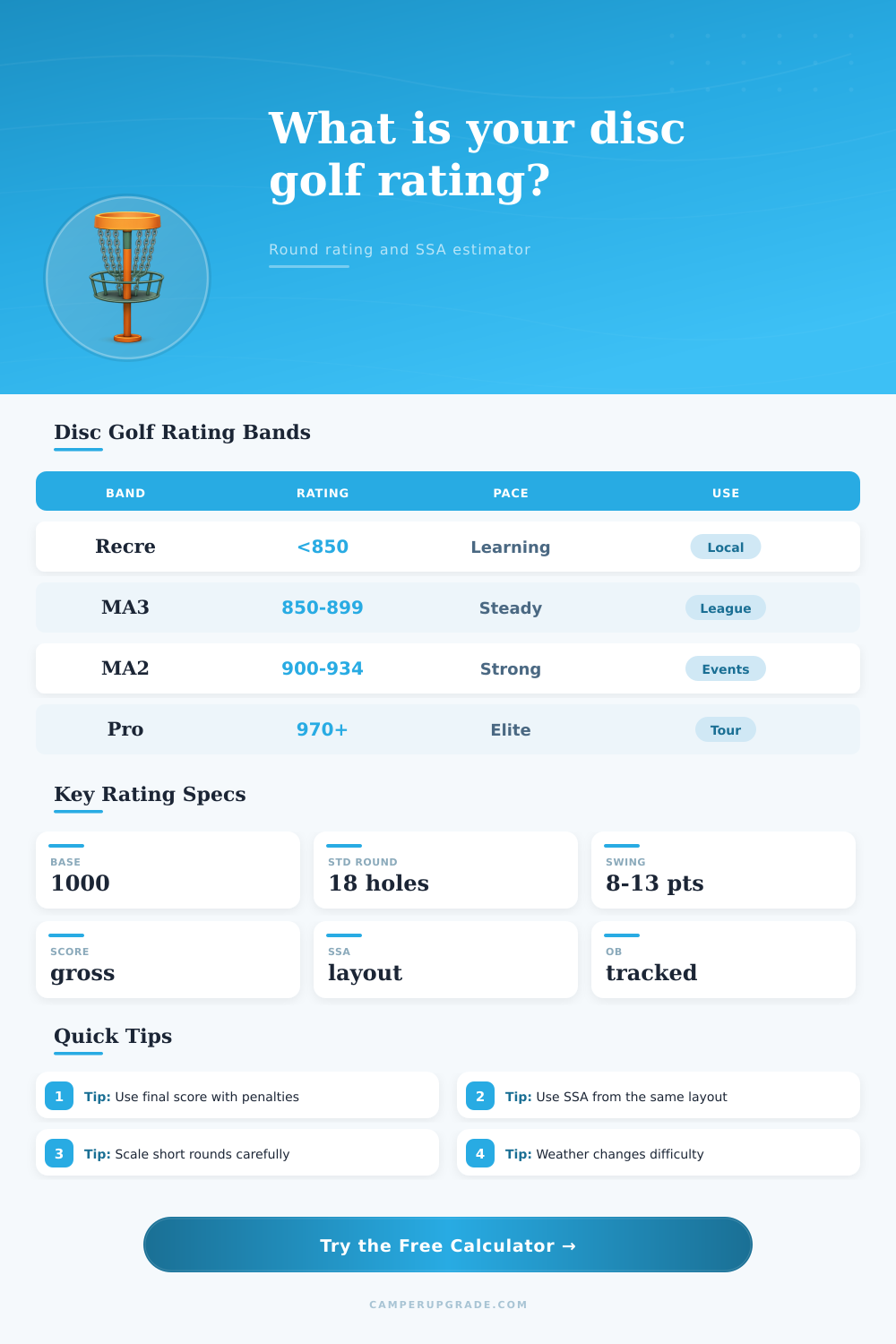
📊Rating bands reference
| Player band | Typical rating | Round meaning | Common field |
|---|---|---|---|
| Recreational | Under 850 | Learning scoring control | Local casual rounds |
| Intermediate / MA3 | 850 to 899 | Pars are common, errors still matter | League and C-tier cards |
| Advanced / MA2 | 900 to 934 | Birdies offset bogeys on standard layouts | Regional amateur fields |
| MA1 / FPO level | 935 to 969 | Strong control on technical layouts | Top amateur or pro divisions |
| Open professional | 970 and up | Scores beat SSA by multiple strokes | Elite local and tour fields |
📏SSA and points-per-stroke guide
| Adjusted SSA range | Approx. points per stroke | Course profile | Example pace |
|---|---|---|---|
| Under 45 | 13 points | Very short or easy layout | Birdie-heavy pitch-and-putt |
| 45 to 49.9 | 12 points | Short competitive layout | Local white or red tees |
| 50 to 54.9 | 11 points | Standard par-54 course | Most league layouts |
| 55 to 59.9 | 10 points | Longer blue tee layout | Advanced tournament round |
| 60 and up | 9 points | Gold, long, or championship setup | Pro-level scoring spread |
🌬Condition and layout modifiers
| Modifier type | Calculator setting | SSA add | When to use it |
|---|---|---|---|
| Weather | Light wind or damp | +0.4 | Minor footing or putting disruption |
| Weather | Strong wind | +1.4 | Drives and putts require disc-down control |
| Layout | Wooded technical | +0.7 | Tight gaps or punishing scramble angles |
| Layout | Championship rough/OB | +1.4 | Roped OB, long carries, and dense rough |
🔄Score swing examples
| 18-hole result vs SSA | At 11 pts/stroke | Estimated rating | Plain meaning |
|---|---|---|---|
| 5 strokes better | +55 points | 1055 | Elite hot round |
| 2 strokes better | +22 points | 1022 | Strong rated round |
| Even with SSA | 0 points | 1000 | Scratch scoring pace |
| 4 strokes worse | -44 points | 956 | Solid amateur score |
💡Rating notes
Often times, raw numbers don’t tell the whole story. They lack context. One day, you think you shot realy well, yet the number posted doesn’t seem to match how you felt about it. But why? That’s because a low number on an easy course isn’t quite as impressive than a low number on a tough course; and vice versa. A fifty-eight on a techy wooded course is tougher then a fifty-eight on a wide-open parkland track for instance.
So what do we use to evaluate our days in relation to how hard or easy they were? That’s because a high number on an easy course isn’t quite as good as a high number on a tough course; and vice versa. A fifty-eight on a techy wooded course is tougher then a fifty-eight on a wide-open parkland track for instance. So what do we use to evaluate our days in relation to how hard or easy they were?
How This Tool Helps You Score Better
To do this, the calculator bases your score against the Scratch Scoring Average of the layout (SSA), which are more important than par since it represents how scratch players is shooting from that set up. While par indicates how many shots an ideal round would require, SSA show how difficult the course play today. Plug in your finishing score and the SSA for each hole. The tool will then use your score relative to a baseline scratch player to calculate your rating.
In other words, it levels difficulty so you can run through a weekend tournament card and compare it to a casual throwaround on Thursday. No more apples and oranges. When we track our own performance, most of us forget to consider the conditions. Every time we hit a drive or an approach shot there are extra strokes added invisibly by a gusty day. The estimator allow you to adjust for these factors in both layout and weather.
This way, you can keep an accurate score and not let a windy round ruin your perceived skill level. If you didn’t get worse, it simply means the course got harder. This will keep your morale high and your data accurate, while helping you see where true outliers occurs in your game. There’s also the issue of penalty strokes, which I think golfers often mistake for poor play instead of bad luck.
The tool separate your actual posted score from a clean round metric. It is a good way to find problems with consistency. So if your clean rating holds up well and your actual rating takes a big dip, then you know it’s not about your accuracy/distance; it’s your club selection/decision making around trouble. You’re hitting the fairway but paying dearly when you do miss them.
Over time, those penalty strokes show patterns that a raw total score doesn’t reveal at all. Knowing where you fit on the rating scale allow you to set realistic goals. The reference bands illustrate that, for example, going from an 850 to a 900 isn’t all about making longer throws. It’s about eliminating odd results and minimizing those big numbers. Being an advanced player doesn’t mean you necessarily make more birdies than an intermediate player.
Rather they is able to minimize the number of double bogeys that derail their round. That mental switch changes your approach to preparing for a round. If I know that a single penalty stroke can knock me ten (or even more) rating points depending upon the difficulty of the course, I begin to prioritize safety throws over flashy lines. There’s also the matter of partial rounds or short courses, which further complicates self-assessing.
One round is inherently more volatile than eighteen, and a nine-hole score obviously carries less statistical weight. The estimator factor in the number of holes played to provide a more balanced view. Even so, remember that any given card is just a snapshot and not necessarily the absolute truth about your playing strength. Instead, look for patterns over several rounds; don’t get hung up if you’ve had a lousy day.
Remember: This is a game that severely penalizes mistakes. It rarely rewards heroics unless you’re already at the elite level, so consistency matter more than brilliance. But in the end, these ratings provide us with a common language through which we can judge our performances. We can use them to compare our score on one course against another.
We can even compare scores on similar courses under different conditions or at different skill levels. And we can do so with some level of fairness. Do you have to be a statistician? No. Does it help if you record the information truthfully and trust the process as you go? Yes.
The point isn’t to get a certain score, but to know what your scores say about you and your game. When you know that, you stop guessing and start strategizing…which means playing smarter instead of simply working harder. Knowing where you stand helps whether you’re chasing a personal best or simply looking to make a better round more enjoyable. You should of seen how much this helps.