Diesel vs Gas Towing Cost Calculator
Compare gas and diesel towing costs with miles, towing MPG, fuel prices, DEF, maintenance adders, payload and terrain factor, annual miles, and optional resale offset.
🚚Truck presets
⚙Inputs
📊Comparison grid
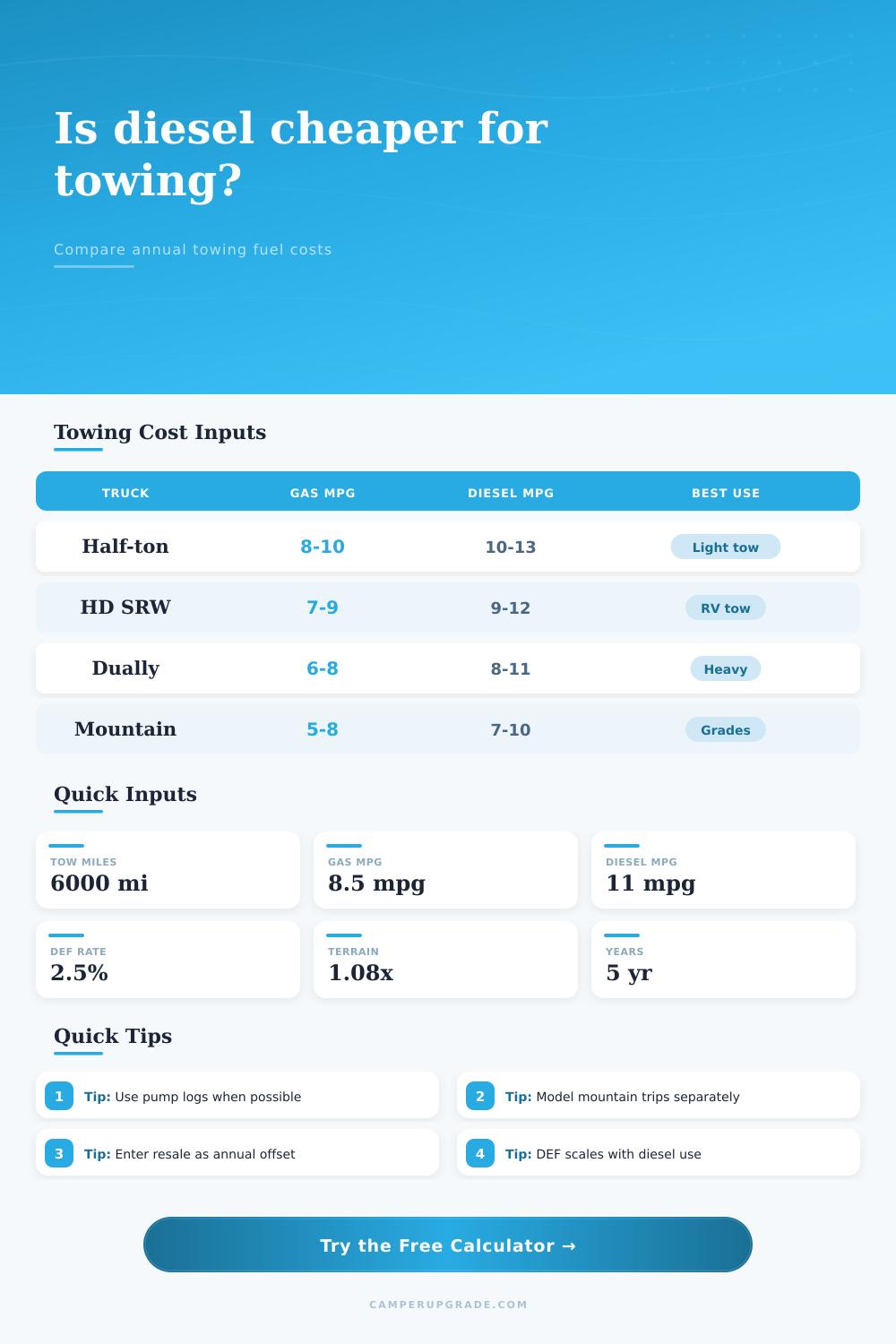
📘Towing MPG planning table
| Truck and trailer setup | Gas towing MPG | Diesel towing MPG | When to use |
|---|---|---|---|
| Half-ton with compact camper | 9 to 12 mpg | 11 to 14 mpg | Lower frontal area and moderate speed |
| Half-ton with tall travel trailer | 7 to 10 mpg | 9 to 12 mpg | Common family camper range |
| Three-quarter-ton bumper pull | 7 to 9 mpg | 9 to 12 mpg | Heavy conventional travel trailer |
| One-ton fifth wheel | 6 to 8 mpg | 8 to 11 mpg | Tall, heavy RV with more axle load |
| Toy hauler or high-profile RV | 5 to 8 mpg | 7 to 10 mpg | Large frontal area, high cargo load |
⛽Fuel and fluid cost table
| Cost item | Applies to | Input used | Calculator treatment |
|---|---|---|---|
| Gasoline | Gas truck | Gas price and gas MPG | Gallons times price, terrain adjusted |
| Diesel fuel | Diesel truck | Diesel price and diesel MPG | Gallons times price, terrain adjusted |
| Diesel exhaust fluid | Modern diesel | DEF price and DEF rate | Diesel gallons times DEF percent |
| Maintenance adder | Both trucks | Cents per mile | Added to trip and annual towing miles |
| Resale offset | Optional diesel credit | End value estimate | Reduces diesel premium for break-even |
⛰Payload and terrain factor table
| Factor | Use when | Fuel effect | Example route |
|---|---|---|---|
| 0.94x | Light trailer, flat route | Reduces gallons 6% | Low camper across plains |
| 1.00x | Moderate trailer, mixed route | Baseline gallons | Weekend campground drive |
| 1.08x | Heavy payload or rolling hills | Adds gallons 8% | Family RV with cargo |
| 1.16x | Mountain grades or headwinds | Adds gallons 16% | Western pass or windy interstate |
| 1.25x | Max payload, steep terrain | Adds gallons 25% | High-profile rig on steep grades |
🧮Break-even reference table
| Diesel net premium | Annual savings | Break-even years | Planning note |
|---|---|---|---|
| $2,500 | $500 per year | 5.0 years | Low premium, frequent towing |
| $4,000 | $800 per year | 5.0 years | Resale helps the math |
| $6,000 | $750 per year | 8.0 years | Longer ownership needed |
| $8,500 | $500 per year | 17.0 years | Fuel savings alone may not carry it |
Fuel economy varies with speed, wind, trailer frontal area, elevation, engine tune, tires, axle ratio, and real payload. Use recent pump receipts whenever possible.
💡Two towing cost tips
But then you get into it and realize how much less gas mileage there is with a big ol’ trailer on the back of your truck going down the interstate the first time…and all hell breaks loose…diesel vs. Gas. Diesel saves me money they say. No, diesel maintenance eats up my savings they say. Enter a calculator that takes out all the emotions and lets you know what is good for your wallet.
Now, this isn’t about which engine is best in a vacuum. This is about which one is right for you, your load, your bank account and route. The majority of folks begins their research by looking at the price per gallon. They observe that gas costs less and therefore conclude that gas must be superior. They also notice that diesel has improved fuel economy and thus presume that diesel must be superior too. Neither perspective is complete as it fails to consider total amount of fuel you consume.
Diesel or Gas: Which Is Better?
For example, a tow vehicle equipped with a diesel engine might have an MPG rating of eleven pulling a large fifth wheel while a similar gas vehicle could achieve eight MPG. That means the diesel are saving you three MPG. This sounds pretty good until you consider you will pay more per gallon plus addition cost of DEF (Diesel Exhaust Fluid). You can’t overlook DEF. If you use a newer diesel truck, you’re required to use it. On average, DEF is roughly two to four percent of your fuel usage. That’s not much but it accumulates when logging thousands of mile. And that little price tag translates into significant annual cost.
The terrain makes a big difference here. For that reason, the tool includes a terrain and payload factor. Driving with a light camper across flat plains will give you good fuel economy. Pulling a loaded toy hauler up a mountain into the wind won’t. It will ding your gas mileage. The calculator adjust your fuel usage to match.
Extreme load is where diesel engines does better than gas engines. When it’s time to go uphill, a gas engine has to rev high and downshift to keep pace. That burns a lot of fuel. Diesel engines can absorbs their torque to climb the same hill without shifting gears nearly as much. That makes a difference between breaking even or saving some coin.
The other hidden variable is maintenance. Sure, the purchase price for diesel is more. So is the maintenance. Yes, oil changes is more and cost more. And yes, filters cost more as well. You can also add an “add-er” for maintenance per mile in the calculator. That allows you to see true cost of ownership over time. Two different mechanical systems wears out at two different rates. Will fuel savings outweighs higher maintenance? It is probably not worth it for light towing (a couple thousand miles a year). But if you are logging heavy miles, a diesel’s fuel economy might eventually payback that initial premium.
Last but certainly not least, we have resale value. Generally speaking, diesel trucks retains their resale value more than gas trucks. And it’s particularly true with heavy duty trucks. This isn’t just my opinion; it is based off market realities and the demand for used work trucks. You can plug-in what offset you expect when reselling your truck. That offsets the initial cash cost of purchasing a diesel up front. That has a huge impact on the break even point. What might be an unaffordable diesel at the beginning of its lifecycle may be affordable after you consider resale value over a five year period.
Here’s the secret. What do you think it’s measuring? You’re not purchasing an engine. You’re purchasing a specific number of miles. Is that towing? Not much at all? Gas is probably going to be cheaper. Do you tow a lot and it’s heavy? Diesel will pay off. Use the reference table from their page to help base your MPG expectations in reality. Let the numbers speak. Most of the time it’s not about which engine is right. It’s about how many miles you want to put on them.