Diesel Heater Fuel Consumption Calculator
Estimate diesel use for parking heaters by model burn rate, heat setting, run time, starts, altitude correction, reserve margin, and usable tank fuel.
Full Calculation Breakdown
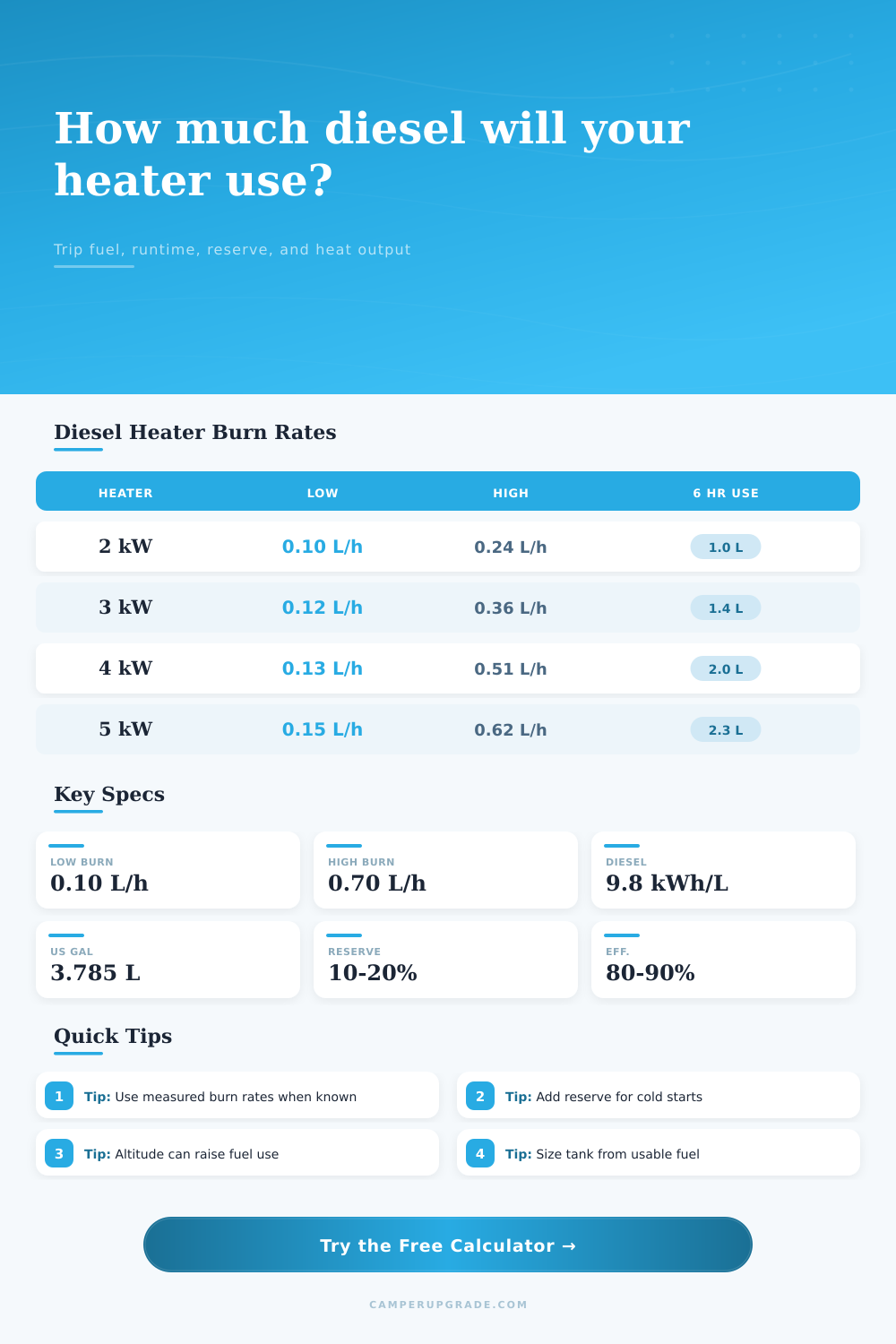
| Named heater preset | Rated output | Low burn | High burn | Typical use note |
|---|---|---|---|---|
| Webasto Air Top 2000 STC | 2.0 kW | 0.12 L/hr | 0.24 L/hr | Small van or truck camper |
| Espar Airtronic S2 D2L | 2.2 kW | 0.10 L/hr | 0.28 L/hr | Efficient van cabin heat |
| Autoterm Air 2D | 2.0 kW | 0.10 L/hr | 0.24 L/hr | Compact camper install |
| Lavaner Pro 2kW | 2.0 kW | 0.11 L/hr | 0.25 L/hr | Small diesel air heater |
| Webasto Air Top Evo 40 | 4.0 kW | 0.18 L/hr | 0.49 L/hr | Large van or RV zone |
| Espar Airtronic M2 D4L | 4.0 kW | 0.13 L/hr | 0.51 L/hr | High-output camper heat |
| Autoterm Air 4D | 4.0 kW | 0.12 L/hr | 0.51 L/hr | Cold-weather cabin load |
| VEVOR 5kW Diesel Heater | 5.0 kW | 0.16 L/hr | 0.62 L/hr | Large all-in-one style kit |
| Average burn rate | 6 heater hours | 8 heater hours | 10 heater hours | 12 heater hours |
|---|---|---|---|---|
| 0.12 L/hr | 0.72 L | 0.96 L | 1.20 L | 1.44 L |
| 0.18 L/hr | 1.08 L | 1.44 L | 1.80 L | 2.16 L |
| 0.25 L/hr | 1.50 L | 2.00 L | 2.50 L | 3.00 L |
| 0.35 L/hr | 2.10 L | 2.80 L | 3.50 L | 4.20 L |
| 0.50 L/hr | 3.00 L | 4.00 L | 5.00 L | 6.00 L |
| Usable tank fuel | At 0.15 L/hr | At 0.25 L/hr | At 0.40 L/hr | At 0.60 L/hr |
|---|---|---|---|---|
| 5 L tank | 33.3 hr | 20.0 hr | 12.5 hr | 8.3 hr |
| 10 L tank | 66.7 hr | 40.0 hr | 25.0 hr | 16.7 hr |
| 15 L tank | 100.0 hr | 60.0 hr | 37.5 hr | 25.0 hr |
| 20 L tank | 133.3 hr | 80.0 hr | 50.0 hr | 33.3 hr |
| 5 gal tank | 126.2 hr | 75.7 hr | 47.3 hr | 31.5 hr |
| Planning condition | Correction to add | Why it matters | Reserve suggestion |
|---|---|---|---|
| Mild overnight parking | 0% | Stable cabin load and short runs | 5% to 10% |
| Cool shoulder-season camping | 5% | Longer duty cycle after sunset | 10% |
| Mountain campsite | 10% | Altitude tuning and colder air | 15% |
| Freezing winter travel | 15% | More high-fire operation | 15% to 20% |
| Remote deep-winter trip | 20% | Fuel buffer protects trip range | 20% to 25% |
Fuel estimates assume clean diesel, normal metering-pump operation, and an air heater that modulates between the entered low and high burn rates.
It gets chilly at a camp site on side of road in November. It doesn’t take long for the sun to drop behind trees and temperatures fall. Fortunately, small diesel heater beneath your seat keeps your van warm.
To feel comfortabley, you need warmth. You also need enough diesel to provide that warmth to you over multiple days. Being without heat would be inconvenient. Being stranded with no more diesel for your car engine are a very real problem. This is why planning is essential.
Plan Your Fuel Needs
Fuel consumption is not a static value. Many folks think if they see 0.15 liters/hour written in a brochure, this value must be correct. Unfortunately, things is rarely so simple. Heaters adjust their output. When they heat up, they uses more fuel. To sustain the setpoint temperature, heaters consume less.
The heater calculator on the page does all this math for you. Simply enter your settings and runtimes and you’re done. No need to guess around with various conversions anymore.
Think in terms of ranges rather then points. An aquarium heater operating on low fire for eight hours consumes much less fuel than an identical heater operating on full blast for only two hours. It’s more important what the heater is doing during its time ON, rather than what it do at its peak.
Consider what you actualy do. If you are camping at sea level in mild weather, your heater will spend most of its time in low burn mode. It is efficient. When I take that heater to the mountains, it has to work harder. Nights are colder and the air is thinner. Your van walls is losing heat. And combustion efficiency are affected by altitude too.
To adjust for high elevation or cold weather, you can add a percent correction using the tool. It is a small adjustment to the input. Over the course of a week long trip it adds up. If you ignore this factor, you’ll find yourself calculating how many miles you can drive on your remaining tank. How far will your tank get you? You’ll be figuring that out.
The first mistake people make is with tank size. Because they can fit one behind a seat, many van converters goes with a ten liter auxiliary tank. That sounds like a lot of fuel. At a modest burn rate of 0.2 liters per hour, a 10-liter tank will last you just 50 hours. If you run your heater for eight hours each night, that means you’re running out of gas in six days.
Starting the cold engine use up additional fuel as it goes through its ignition sequence. This decreases your run time even more. To be safe, you should of always maintain a fuel reserve of no less than 15 percent. Not only does it give you peace of mind but it gives you safety too. Who wants to have to ration their fuel drops when trying to fall asleep?
How do heater outputs relate to burner rates? Here’s what they look like in a reference table:
For example, a 2-kilowatt heater suits a small Sprinter van nicely. It doesn’t suit a large box truck well. An old poorly-insulated motorhome require something beefier. Getting the right size heater is half the battle.
If it’s too big, it will cycle on and off frequently. That means it comes on and goes off a lot. It burns a bunch of fuel while starting up but never gets where you want to go. If it’s too little then it’ll run constantly at max capacity. That means it will never hit the desired temp and it will use a ton of fuel running full bore all night long.
You want a heater that hits your target temperature and settles down into some kind of gentle low-fire maintenance mode.
The energy density of diesel. It has almost 10 kilowatt hours of energy per liter. That’s significantly higher than an equivalent-weight battery. The appeal of diesel heaters persists into the winter. They are compact and reliable.
Not free though. Every liter used is a liter you didn’t use to drive. It’s a trade-off between how much you like to be cozy vs. Your mobility. It is about how fast you want to go.
If you have a small tank, fill it up at bedtime. If you’re on remote roads, bring backup fuel in certified containers. It’s not about conserving fuel for fuel’s sake, either. You don’t want to run out of what you’ve got. You want to learn how much you’re burning. You want to treat the reserve with respect. You want to keep the dog warm.
When the first frost comes, you’ll thank yourself that you did the math.