Dew Point Conversion Calculator
Convert dew point between °C, °F, and K, then validate humidity and condensation thresholds in one workflow.
📍Dew Point Scenario Presets
⚙Conversion Inputs
📊Conversion Spec Grid
📘Dew Point Reference Tables
| Dew Point Band | Range (°C) | Range (°F) | Moisture Feel |
|---|---|---|---|
| Very Dry | < 5 | < 41 | Dry air, fast evaporation |
| Comfort | 10 to 16 | 50 to 61 | Balanced indoor comfort |
| Humid | 17 to 21 | 63 to 70 | Sticky and slower drying |
| Oppressive | > 22 | > 72 | High condensation potential |
| Dry-Bulb at 25°C | RH (%) | Dew Point (°C) | Spread (°C) |
|---|---|---|---|
| Fixed 25°C | 30 | 6.2 | 18.8 |
| Fixed 25°C | 50 | 13.9 | 11.1 |
| Fixed 25°C | 70 | 19.1 | 5.9 |
| Fixed 25°C | 90 | 23.2 | 1.8 |
| Dew Point (°C) | Dew Point (°F) | Dew Point (K) | Reference Use |
|---|---|---|---|
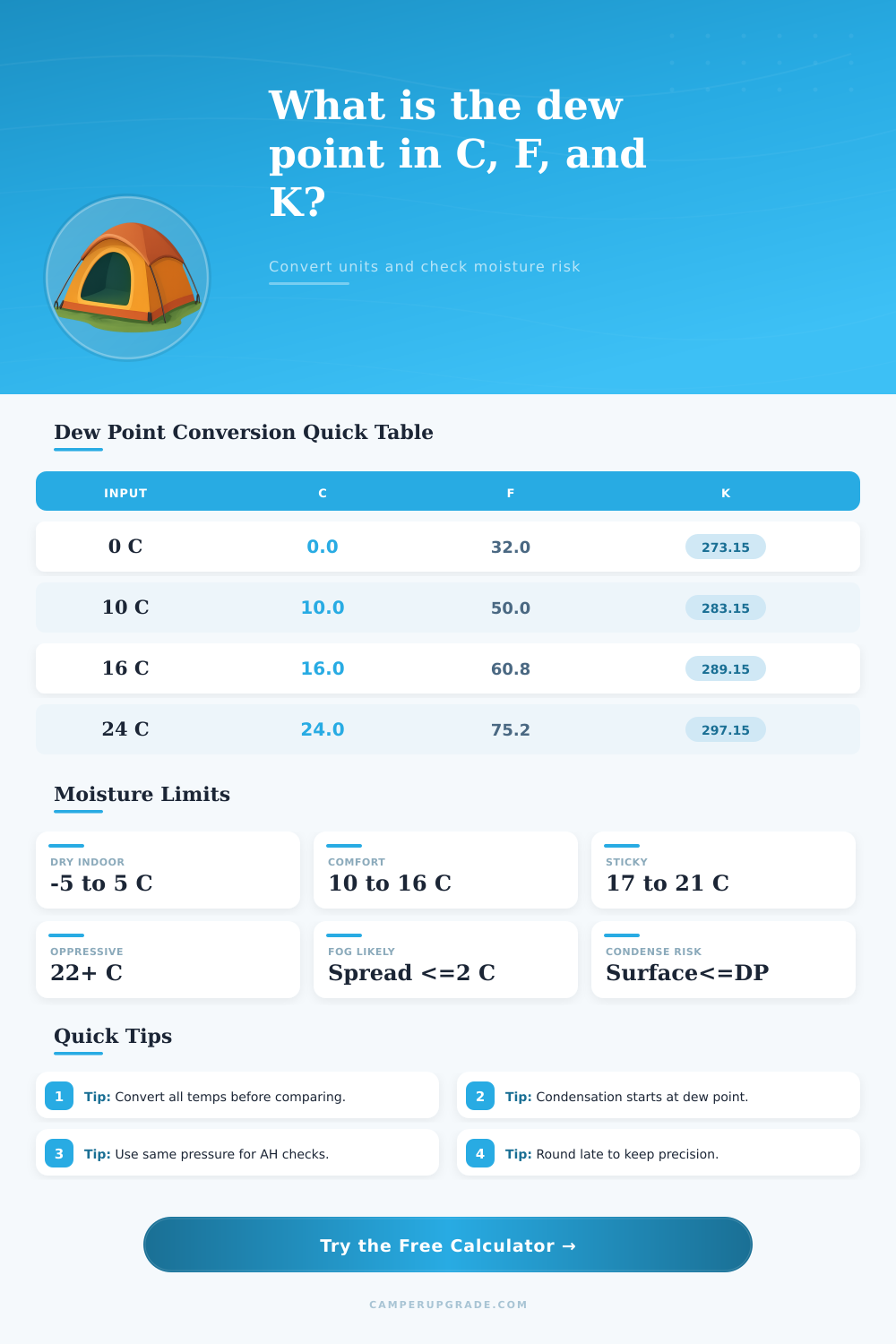
| 0.0 | 32.0 | 273.15 | Freezing moisture threshold |
| 10.0 | 50.0 | 283.15 | Cool and dry indoor range |
| 16.0 | 60.8 | 289.15 | Comfort benchmark point |
| 24.0 | 75.2 | 297.15 | High-moisture warning band |
| Surface Condition | Surface Temp | Dew Point Trigger | Condensation Outcome |
|---|---|---|---|
| Metal panel | 12°C | ≥ 12°C | Immediate condensation |
| Insulated wall | 16°C | ≥ 16°C | Moisture film begins |
| Single-pane glass | 8°C | ≥ 8°C | Window fog risk |
| Air duct exterior | 14°C | ≥ 14°C | Sweating likely |
The dew point is the temperature at which the air becomes saturate with water vapor. At this temperature, the water vapor starts to condense into a liquid form of water. At the dew point, the air cant hold any more water vapor and the excess water vapor condenses into the liquid form of water.
The dew point is a more accurate figure of the moisture in the air as compared to the relative humidity because the relative humidity change with changes in the temperature of the air, but the dew point remains the same with the same amount of water vapor in the air. The relative humidity of the air determine the amount of water vapor that is present in the air in comparison to the amount of water vapor that the air can hold at a specific temperature. Relative humidity will drop if the temperature of the air increase because warm air can hold more water vapor than the cool air.
What Is the Dew Point and Why It Matters
The dew point, however, will remain the same. For instance, if there is a specific amount of water vapor in a room, the dew point will remain the same even if the heat increases in that room. The relative humidity, however, will drop as the temperature increase in that room.
The dew point can be found in two different way. In the first way, if the air contains a sensor that measure the dew point of the air, the system can enter the dew point directly. In the other situation, the dew point can be calculated with the dry bulb temperature and the relative humidity.
The dry-bulb temperature is the normal temperature of the air and the relative humidity is the percentage of the moisture that is in the air. The two number can be entered into a formula to calculate the dew point of the air. The Magnus formula use specific coefficients in the formula to calculate the dew point of the air, and this is the formula that is used most often.
The difference between the dry-bulb temperature and the dew point is referred to as the dew point depression. A large dew point depression indicate that the air is dry and water is evaporating quick from the body. A small dew point depression, such as two degrees Celsius or less, indicates that fog or frost can easily form.
For instance, if the dry-bulb temperature is twenty degrees Celsius and the dew point is nineteen degrees Celsius, the dew point depression is only one degree Celsius, meaning that fog can easily form in this environment. Condensation will occur on any surface that reaches a temperature that is at or below the dew point of the air. For this reason, it is necesary to monitor the temperature of any surface to ensure that it does not drop to a temperature that is below the dew point of the air.
If the temperature of the surface drops to a level that is below the dew point of the air, moisture will condense on that surface and possibly lead to mold growth on that object. Metal and glass objects will cool quickly to the temperature of the environment. For this reason, metal and glass objects are more likely to experience condensation than wooden or insulated walls.
The different environment require different dew point level. For instance, the dew point of the air in a server room must be maintained to ensure that the computers do not overheat and the moisture in the air does not damage the servers. In greenhouses, the growers allow for the air to contain more moisture which allow the plants to grow.
However, the dew point must be monitored to ensure that the water in the air does not drip from the leaf of the plants. In an RV or in a basement, the dew point must be continuously monitored to ensure that moisture does not condense on the walls or windows of the structure. When using these formulas to calculate the dew point, care must be taken to ensure that the proper unit are used.
For instance, if the dew point is in Celsius but the temperature of the surface is in Fahrenheit, the results will be inaccurate. Additionally, you should of taken care when calculating the number with precise calculation. Rounding the number too soon will reduce the accuracy of the calculated dew point.
By understanding the concept of the dew point in the air, it is possible to understand the amount of moisture that is in the air and prevent any condensation from forming on the surface of objects in the air. Its also important to check there humidity levels.