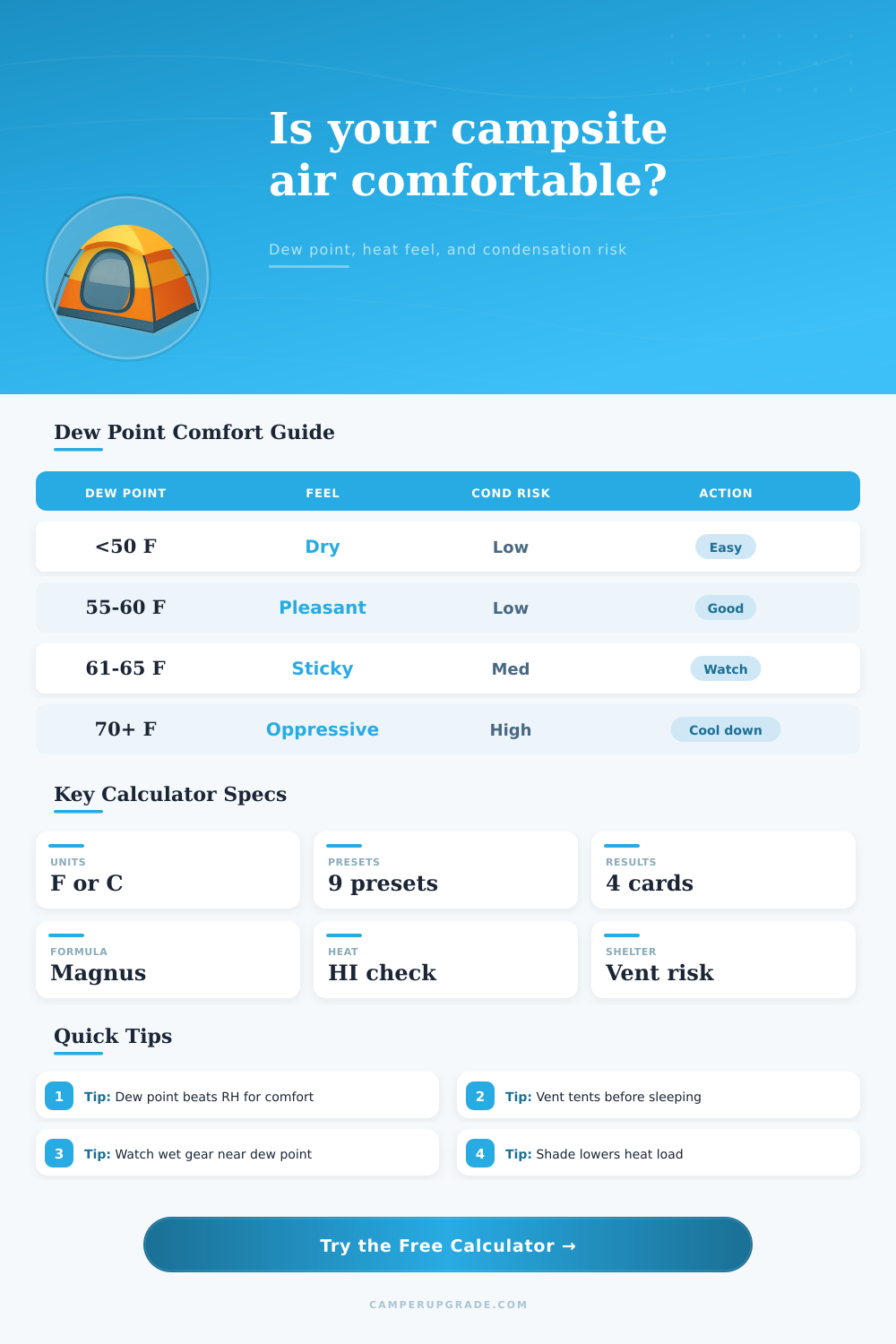
Dew Point Comfort Calculator
Estimate dew point, heat feel, campsite comfort, and tent or RV condensation risk from air temperature, relative humidity, wind, shade, shelter type, ventilation, and activity level.
🏕Campsite Weather Labels
⚙Weather and Shelter Inputs
📋Full Breakdown
🛖Shelter and Material Comparison Grid
📊Reference Tables
| Dew point | Comfort feel | Camping note | Sleeping impact |
|---|---|---|---|
| Under 50 F | Dry or crisp | Great for hiking and drying gear. | Little humidity stress. |
| 50-55 F | Comfortable | Most campers find this pleasant. | Good sleeping air. |
| 56-60 F | Mildly humid | Noticeable moisture after exertion. | Vent shelter normally. |
| 61-65 F | Sticky | Gear dries slowly in shade. | Open vents before bedtime. |
| 66-70 F | Muggy | Heat stress rises with sun exposure. | Expect damp fabrics. |
| Over 70 F | Oppressive | Use shade, airflow, and cooling breaks. | Sleeping comfort is poor. |
| Relative humidity | Why it changes | Dew point check | Best use |
|---|---|---|---|
| 30-45% | Often dry air | Dew point usually low. | Desert, mountain, and dry RV air. |
| 45-65% | Moderate range | Comfort depends on temperature. | General campsite planning. |
| 65-80% | Moist air or cooling evening | Check dew point before sleep. | Tent and window condensation review. |
| 80-100% | Fog, rain, or nighttime cooling | Dew point is close to air temp. | High condensation watch. |
| Heat feel | Planning band | Camp action | Watch for |
|---|---|---|---|
| Under 80 F | Easy | Normal hydration and shade. | Sunburn and exertion. |
| 80-89 F | Warm | Use shade during chores. | Sticky clothing and slower cooling. |
| 90-102 F | Hot | Schedule breaks and use airflow. | Fatigue, cramps, and poor sleep. |
| 103-124 F | Very hot | Limit exertion and cool the shelter. | Heat illness risk. |
| 125 F plus | Extreme | Seek cooled space and stop exertion. | Dangerous heat stress. |
| Dew point margin | Condensation risk | Typical surface | Ventilation response |
|---|---|---|---|
| 10 F or more | Low | Warm RV wall or insulated window. | Normal venting is enough. |
| 5-10 F | Moderate | Rainfly, car glass, or cool wall. | Crack high and low vents. |
| 0-5 F | High | Cold fabric, glass, or metal frame. | Increase airflow before sleep. |
| Below 0 F | Condensing | Surface is at or below dew point. | Expect water or frost on surfaces. |
💡Comfort Calculation Tips
So you checked the weather report. There’s no rain in sight, and packed up your trusty sleeping bag, only to come to your camp site and find it’s a real swamp, with thick air, wet clothing that stick immediately upon removal, and droplets beading on inner wall of your tent before you’ve unzipped the flap.
What makes for such an unpleasant scenario? Turns out, it’s not necessarily the temperature. It’s all about dew point, the real amount of moisture in the air, not just how much it can potentially contain.
How to Stay Dry When Camping in Humid Weather
Relative humidity (what most folks are concerned with) fluctuate dramatically with changing temperatures during course of a single day. On the other hand, dew point stay constant, providing a far better indicator of how damp and muggy things will realy feel after sun retreats and the heat leaves the earth’s surface. This distinction has a huge impact on planning for comfort.
Whether it’s a warm summer night or a cool spring one, if the dew point is below 50 degrees Fahrenheit, the air will be relatively comfortable and dry. Moisture will evaporate rapidly, your gear will stay relatively dry overnight, and your sleeping bag won’t lose its loft.
Many campers go wrong with their pack list when preparing for changing conditions. Once the dew point climbs toward the mid-sixties, everything change significantly. You’ll sweat but it won’t evaporate as effectively, so your efforts will seem far more strenuous then they really are.
With a few clicks of the mouse, you can enter your current temperature and humidity reading and let the calculator do all of the math, it’ll spare you from attempting to decipher fluctuating percentage values yourself. From there, it convert that data into an overall comfort rating based off your chosen shelter style and ventilation setup.
And surprisingly enough, it all depends quite a bit on the structure of your shelter. Thin, nylon tent fabric cools fast against the nighttime air. As soon as its surface temperature drop below the dew point, the water vapor turn into liquid droplets. Condensation forms right away on inside layer of your flysheet or rainfly.
Thicker materials like canvas walls will do better due to slower cooling, keeping their interior surface temperature above the critical level longer. But again, good airflow is essential for canvas so that body heat and breath doesn’t build up internal humidity.
Single-pane windows in your RV tend to be the first surfaces to trap dew in the morning. The closer the dew point are to the temperature of the window glass, the more likely you’ll wake up to find yourself staring at a foggy encasement that’s going to need wiping before you can see through.
The main thing you can change for this process is ventilation. If you open your vent(s), it establishes a crossflow and pushes out moist air from the inside and sucks in fresher, dryer air from the outside (assuming that outside air isn’t oppressively wet).
Venting won’t cool you as much on muggy nights when the outside air is already full of moisture. However, it will still decrease the humidity created by your body’s heat and breathing inside an enclosed space.
Keep in mind how many people are in the shelter at night. Each person create moisture through their sweat and breath while they sleep. This raises the internal dew point and increases the chances of condensation forming on surfaces like gear loops or sleeping pads. A single person in a small tent produce far less water vapor than two do.
The apparent temperature and the stressfulness of the surrounding environment (how much it’s going to stress your body) are also factors. Humidity combined with apparent temperature gives you a sense of what the heat feels like: does it feel mild, muggy, or oppressive? Wind speed and shade further adjust this. On a shelter in bright sun, the radiant heat load makes even mild humidity feel stifling by afternoon. But partial shade greatly reduces this heat load so you can sweat and evaporate it off even if the air is still a bit moist.
The tool comes with some reference tables that outline these comfort bands nicely. It shows when mild humidity starts to make things muggy. Oppressive conditions begins to affect your ability to hike, perform at peak levels, or get good sleep.
Humid weather camping is all about adapting and making sure you’re set up for success. Open the mesh panels all the way if you expect high dew points. Go with darker, breathable fabrics that resist moisture retention. Skip stuffing wet clothes into stuff sacks and just let them hang dry at night. Windproofing is sacrificed for good airflow.
You might still crawl out feeling sticky under your arms and find a soaking wet tent wall, but knowing what causes it makes it easier to fix. This makes the situation more manageable than a complete surprise.
Thick as the air may be, it doesn’t mean your pack needs to be heavy and cumbersome, you’ll still be able to keep your head above water (so to speak) even on an unfavorable forecast. You should of prepared for this.