Desert Day Water Requirement Calculator
Estimate water for a hot dry day by group size, route hours, exertion, heat, sun, dryness, load, elevation, reserve margin, and water already carried.
Formula Breakdown
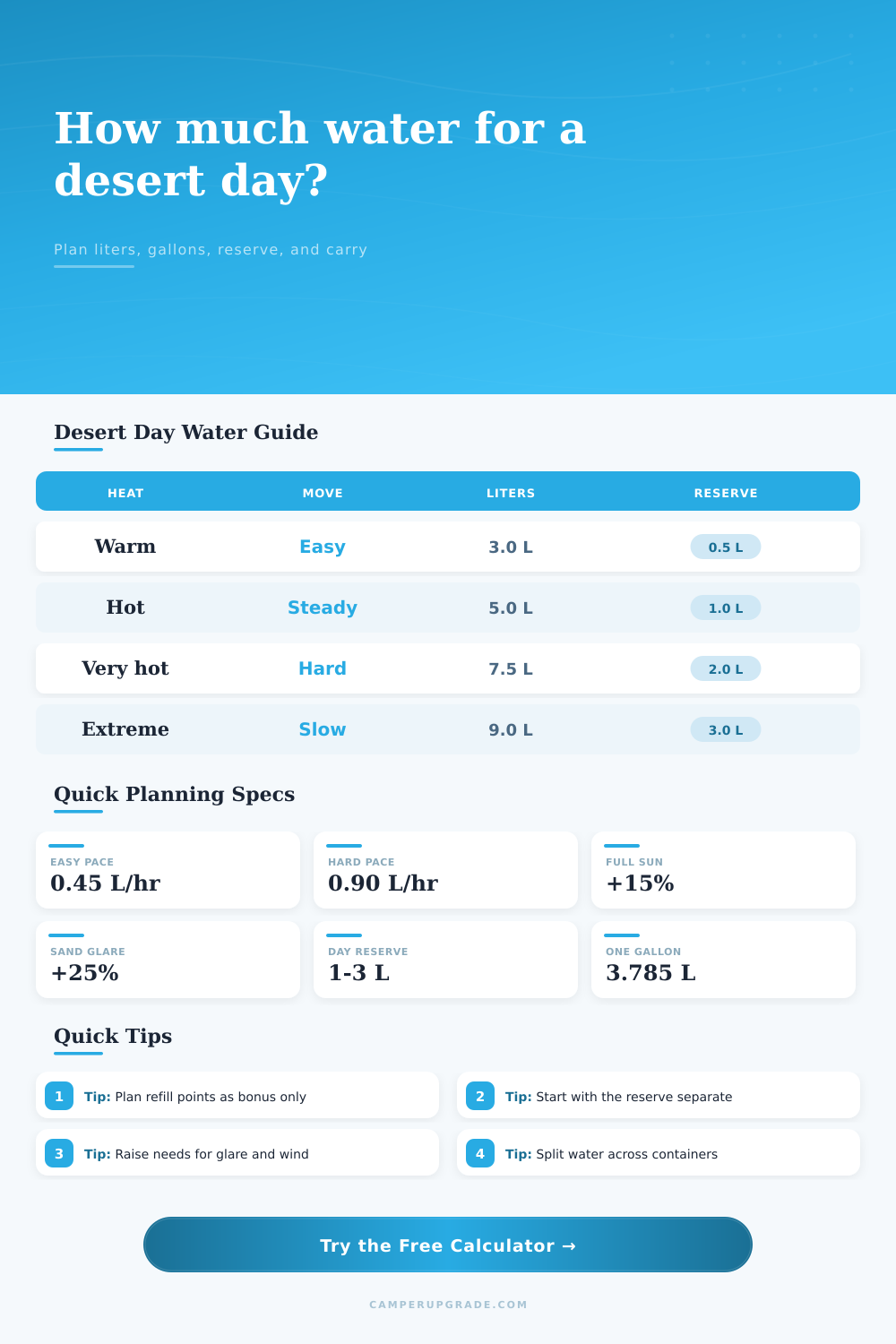
| Intensity | Baseline Liters Per Person Hour | Best Use | Formula Role |
|---|---|---|---|
| Stationary camp checks | 0.30 L/hr | Vehicle sorting, short stops, shaded rest | Low movement base rate |
| Easy walk | 0.45 L/hr | Viewpoint trail, flat wash, photo stops | Light activity base rate |
| Steady trail pace | 0.65 L/hr | Typical desert hiking pace | Default moving rate |
| Hard climb or sand | 0.90 L/hr | Soft sand, route finding, climbs, scrambling | High sweat planning rate |
| Emergency work pace | 1.10 L/hr | Digging, recovery, carrying shared gear | Upper planning rate |
| Heat Band | Temperature | Multiplier | Planning Meaning |
|---|---|---|---|
| Warm desert day | Below 80°F / 27°C | 0.90x | Use lower heat adjustment only if shade is reliable |
| Hot day | 80 to 89°F / 27 to 32°C | 1.00x | Standard dry-day planning baseline |
| Very hot day | 90 to 99°F / 32 to 37°C | 1.15x | Add margin for higher sweat loss |
| Severe heat | 100 to 109°F / 38 to 43°C | 1.35x | Plan shorter movement blocks and more water |
| Extreme heat | 110°F+ / 43°C+ | 1.60x | Use conservative reserve and reconsider exposure |
| Container Type | Volume | Gallon Equivalent | Use In Carry Plan |
|---|---|---|---|
| One liter bottle | 1.0 L | 0.26 gal | Easy counting and sharing |
| Hydration bladder | 2.0 L | 0.53 gal | Primary moving water |
| Large hydration bladder | 3.0 L | 0.79 gal | Longer route or hot day core carry |
| US gallon jug | 3.785 L | 1.00 gal | Vehicle, cache, or group split water |
| Five gallon carrier | 18.9 L | 5.00 gal | Base camp and refill staging |
| Common Desert Day | Typical Inputs | Per Person Start | Planning Note |
|---|---|---|---|
| Viewpoint loop | 2 hr easy, 85°F, mixed sun | 2.0 to 3.0 L | Short route with normal reserve |
| Half-day wash hike | 4 hr steady, 95°F, full sun | 4.5 to 6.0 L | Glare and dry wind raise total |
| Sand or slickrock route | 6 hr hard, 100°F, open sun | 7.0 to 9.0 L | Pack volume and weight become limiting |
| Vehicle base day | 3 hr light work, 98°F, shade breaks | 3.5 to 5.0 L | Separate reserve from cooler water |
The model uses liters internally, converts gallons with 1 US gal = 3.78541 L, and estimates water weight with 1 gal = 8.34 lb.
Bad math doesn’t play well with the desert. Strongest knees, best boots, most ambitious route in your head? It won’t matter if your body lose too much water to the constant sun and dry heat. Your margin of a couple of liters makes all the difference between a memorable day hike and medical emergency. Let this calculator help close that gap, taking your vague feelings about the weather and turning them into some concrete volume targets for your pack.
But where folks mess up most is with that number: The temperature input. This is perhaps the most important parameter for the calculator, and we will start there. What happens? It assigns “multipliers” based on heat bands, and this is also where our intuition go wrong. Yes, 90 degrees is hot. But the calculator consider that a base level of severe stress. As temperatures rise above 100 degrees, sweat loss doesn’t increase linearly… It accelerates. The more extreme the heat, the higher the multiplier.
Why You Need This Water Calculator
Why? Because you’re losing water faster then you can sip. Your body’s trying to cool down, and it’s dumping water on itself faster than you can keep pace. And that’s where folks go astray. They wait until they’re thirsty. By then, its too late out here in a dry climate.
The level of activity is just as important as the ambient air. It’s one thing to walk across a slick rock; it’s another to slog through soft sand. Depending on whether you’re strolling towards a vista or struggling against gravity on a steep incline, the calories burned, and therefore the liters required, adjust to match. While strolling at a consistent pace along a trail may only burn six-tenths of a liter an hour, throw in some sand and that number jump toward nine-tenths. Because your body moves differently over sand than it does over a rocky surface, metabolic cost changes, which alters the amount of water you need. The tool makes those calculations for you, sparing you having to tote around a spreadsheet in your brain.
Finally, don’t overlook the “setting” of sunlight. Reflective surfaces like salt flats or other white sandy surfaces amplify radiation hitting your skin; that’s just bad. If you’re in full sun, add a percentage buffer to account for glare, which also heats your core (even though the air may be cooler).
That complication doesn’t stop with wind. Even though a dry breeze feels cool initially, it quickly steals moisture from inside your mouth and skin surface, making insensible water loss worse. It’s what you can’t feel, but your body will pay dearly for. The dryness input factors in this hidden water drain.
The difference between pros and amateurs is that we know how to set aside water. When using the calculator, it has a place for reserving water, different than the water you intend to sip on during the day. Reserve water is like an insurance policy. It’s there if things go south. You fall down. You get lost. You don’t move as fast as expected. Whatever happens to change the plan, your reserve is your insurance against disaster.
And it should of been kept separately from the water you drink during the day. If you keep it all together, you’ll drink it before you know it.
The output includes the number of gallons and liters of total volume, a recommendation of which containers to use (hydration bladders vs gallon jug), and the precise amount you are short. It will even take into account if you have two gallons stashed in your cooler and tell you precisely how much you lack. Because there’s no point in carrying heavy water you don’t need (mistake of the past), nor is there any reason to carry less than you think you has enough of (mistake of the present). In the desert, weight is your enemy. An additional pound requires more energy to carry and causes you to sweat more. Being precise saves your shoulders.
If you’re familiar with local trails, use the presets on the buttons to get a quick estimate of what you’ll need; but tweak the inputs for your particular conditions. The reference tables on the page explain the reason behind the multipliers, so you can see why shade on a warm day differs from an open-rock scorching afternoon.
Having said that: it’s not just about survival. This is about enjoying the landscape while not being constantly anxious about it. Once you know your numbers, you won’t wonder whether or not you’ve got enough… You’ll be looking around at the scenery. The desert will still look beautiful when you’re hydrated.
Plan for the worst and hope for the best. Carry the extra liter just in case.