Density Altitude Calculator
Estimate pressure altitude, exact density altitude, and air density from airport conditions, moisture, and ISA deviation.
✈️Flight Condition Presets
⚙Atmospheric Inputs
📊Atmospheric Spec Grid
📘Reference Tables
| ISA Temp Deviation | Pressure Altitude | Rule-of-Thumb DA | Use |
|---|---|---|---|
| +5 C | 5000 ft | 5600 ft | Warm and thin |
| +10 C | 5000 ft | 6200 ft | Major lift loss |
| +15 C | 5000 ft | 6800 ft | High takeoff load |
| +20 C | 5000 ft | 7400 ft | Serious penalty |
| Altimeter | Correction | Field Elevation | Pressure Altitude |
|---|---|---|---|
| 30.92 inHg | -1000 ft | 1000 ft | 0 ft |
| 29.92 inHg | 0 ft | 2500 ft | 2500 ft |
| 29.42 inHg | +500 ft | 4000 ft | 4500 ft |
| 28.92 inHg | +1000 ft | 7000 ft | 8000 ft |
| Moisture State | Dew Point Gap | Humidity Effect | DA Shift |
|---|---|---|---|
| Dry | 15 C+ | Very small | 0 to 100 ft |
| Moderate | 8 to 14 C | Small | 100 to 250 ft |
| Humid | 3 to 7 C | Noticeable | 250 to 500 ft |
| Saturated | 0 to 2 C | Largest | 500+ ft |
| Airport Scenario | Field Elevation | Hot-Day DA | Outcome |
|---|---|---|---|
| Coastal strip | 20 ft | 1200 ft | Good margin |
| Foothill base | 1800 ft | 3600 ft | Climb rate fades |
| Desert outpost | 3200 ft | 6200 ft | Heavy penalty |
| Mountain ramp | 6000 ft | 9800 ft | Performance critical |
Density altitude is a measurement of how thin the air is for an aircraft and how that affects the aircrafts performance. Density altitude determine the amount of lift and thrust that the aircraft will produce. When the density altitude is high, the air is thin and the aircraft will have decreased performance.
High density altitude will cause the aircraft to require longer rolls to take off and will climbs at a slower rate. Three main factor affect density altitude: pressure altitude, temperature, and moisture. Pressure altitude is the measurement of the elevation of the field adjusted for the altimeter setting.
How Density Altitude Affects Plane Performance
Temperature is one of the primary factor in density altitude; hot air is less dense than cold air. Therefore, as the temperature increases, density altitude will increase, leading to decreased performance. The third main factor to consider is moisture; water vapor is lighter than the air in the atmosphere.
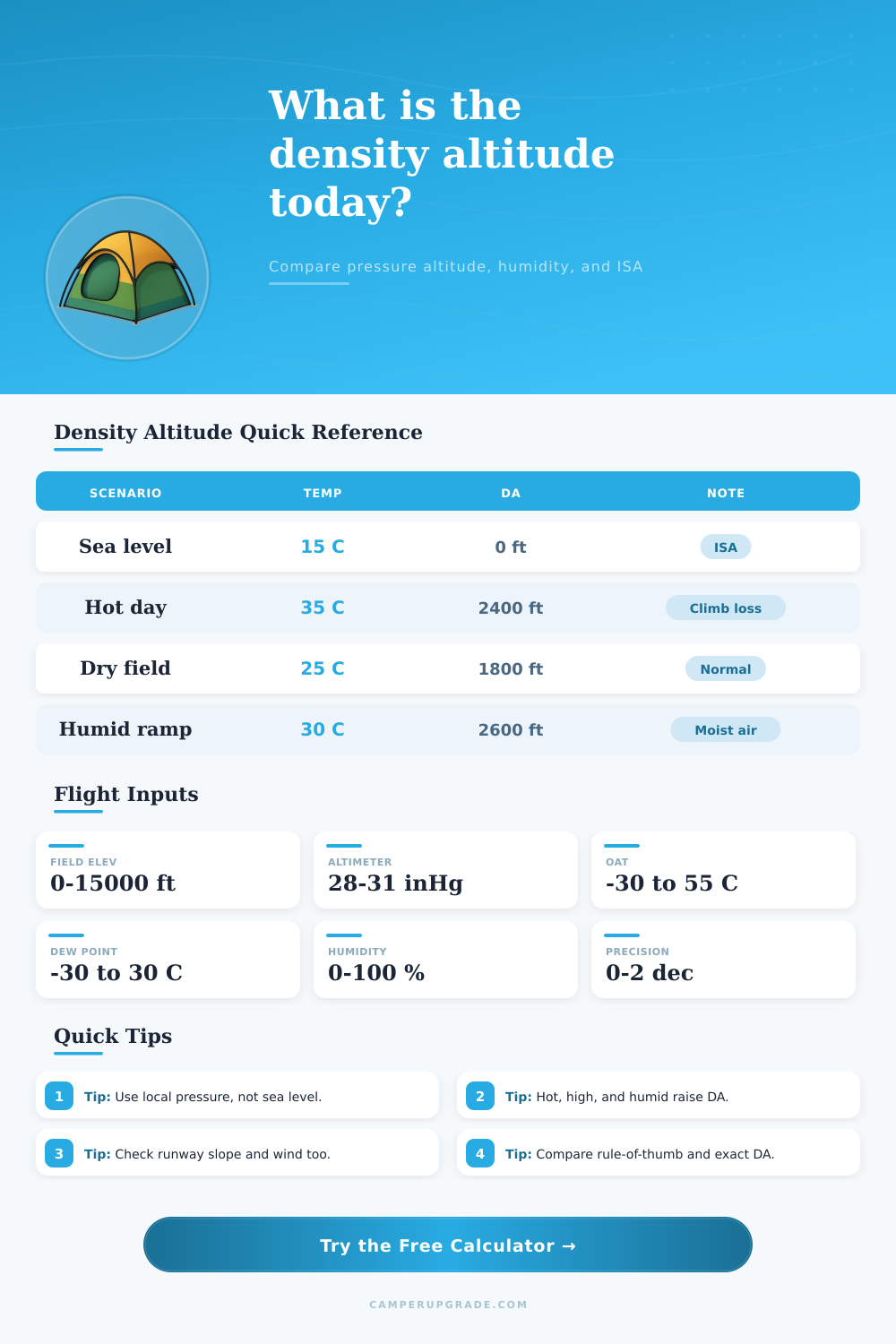
High level of moisture in the air will make the air thinner and lead to increased density altitude. A person can use a rule of thumb to estimate density altitude. For every degree that the temperature rise above the standard temperature of the atmosphere at sea level (15 degrees Celsius), the density altitude will increase 120 feet.
This rule of thumb, however, isnt completely accurate in that it does not account for moisture in the air. Moisture in the air will increase the density altitude of the air. For these reason, a person may find themselfs at a higher density altitude with humid conditions versus dry conditions at the same temperature.
To find the pressure altitude, a person must account for the field elevation and the altimeter setting of the field. Once a person finds the pressure altitude, the outside air temperature and the dew point can be accounted for to find the density altitude. The dew point is important in finding density altitude because the difference between the air temperature and the dew point indicates the amount of moisture in the air.
If the temperature and the dew point are close to each other, there is a high level of moisture in the air. Another factor that can impact the temperature of the air is the runway offset. The sun shining on the aircraft can make the runway hotter than the surrounding area.
This hot runway can increase the temperature of the air around the aircraft. Density ratio can be used as a measurement of the relationship between the air mass of the area and the standard air mass at sea level. If the density ratio is around 0.95, the air density is near normal for that area and the aircraft will have normal performance.
If the density ratio decreases to around 0.82, the air is thin and the performance of the aircraft will be reduced. Due to the relationship between density and performance, a pilot can use the density ratio to determine if the load of the aircraft is appropriate for the length of the runway that is available. Pilots can encounter certain traps when calculating the density altitude of the area.
One trap is assuming the outside air temperature is standard; if the outside air temperature is above standard, the density altitude will increase significant. Another trap is to ignore the settings of the altimeter when calculating the pressure altitude; if the pressure altitude is set to a low number, the pressure altitude will be higher than if the altimeter was set to a higher number. Furthermore, high temperature, high pressure altitude, and high humidity all combine to create the most difficult conditions for the aircraft.
In addition to the factors that relate to density altitude, there is also other factors that can impact an aircraft during takeoff. For instance, the slope of the runway and the wind direction will impact the takeoff roll of the aircraft; these factors are separate from the density altitude calculation. Additionally, another factor to consider is the obstacles that must be cleared during takeoff; if the air is thin, the aircraft will have a lower climb rate.
Another factor that is related to density altitude is fuel; if the density altitude is high, the true airspeed of the aircraft will increase; true airspeed impacts the fuel consumption of the aircraft. Finally, a pilot should of cross-check true density altitude with the performance charts of the aircraft; these charts will provide the most accurate data regarding the performance of that aircraft.