Denier to Weight Calculator
Estimate GSM, oz/yd², cut weight, and roll weight from denier, thread count, coating, and camping fabric dimensions.
🏕Outdoor Fabric Presets
🧵Fabric Inputs
📏Material Spec Comparison Grid
🔢Denier Formulas Used
| Formula | Calculation | Use | Notes |
|---|---|---|---|
| Denier | grams per 9,000 m | Yarn size | Higher D means heavier yarn |
| Warp GSM | D x EPI / 228.6 | Length yarn mass | 228.6 = 9000 x 0.0254 |
| Weft GSM | D x PPI / 228.6 | Cross yarn mass | Same conversion as warp |
| oz/yd² | GSM / 33.9057 | Outdoor fabric label | Common tarp and pack spec |
| Panel kg | GSM x m² / 1000 | Cut fabric weight | Buffer is added after area |
📚Common Camping Fabric Specs
| Fabric class | Typical denier | Typical weight | Common RV or camping use |
|---|---|---|---|
| Ultralight coated polyester | 15D-20D | 30-60 GSM | Tarp, fly, small awning panel |
| Light ripstop nylon | 30D-40D | 45-90 GSM | Stuff sacks, rainfly, gear covers |
| Coated floor nylon | 68D-75D | 95-160 GSM | Tent floor, ground cloth, bivy base |
| Pack-weight nylon | 100D-210D | 120-310 GSM | Day pack, organizer, storage pocket |
| Heavy polyester oxford | 420D-600D | 300-520 GSM | Chair bag, cover, soft storage bin |
| Ballistic-style nylon | 840D-1680D | 480-900 GSM | Duffel bottom, abrasion patch, tool roll |
🧮Width and Yardage Reference
| Fabric width | Area per linear yard | Area per linear meter | Best for |
|---|---|---|---|
| 45 in / 114 cm | 1.25 yd² | 1.14 m² | Small sacks, liners, narrow panels |
| 54 in / 137 cm | 1.50 yd² | 1.37 m² | Pack cloth, upholstery, covers |
| 58 in / 147 cm | 1.61 yd² | 1.47 m² | Tent floors, tarps, awning repairs |
| 60 in / 152 cm | 1.67 yd² | 1.52 m² | Common outdoor fabric rolls |
| 72 in / 183 cm | 2.00 yd² | 1.83 m² | Wide covers and larger shade panels |
⚖Coating and Finish Adders
| Finish type | Typical added GSM | Weight effect | Use in calculator |
|---|---|---|---|
| DWR or light calendaring | 0-8 GSM | Small mass change | Enter 0-8 in coating |
| Silicone both sides | 15-45 GSM | Moderate tarp weight | Enter total silicone add-on |
| PU coating | 25-80 GSM | Raises floor and pack weight | Enter coating from spec sheet |
| TPU film laminate | 60-180 GSM | Large weight increase | Add full film mass |
| PVC-coated fabric | 200+ GSM | Dominates finished weight | Use measured GSM if possible |
💡Calculation Tips
Stand in a camp store with a tarp in each hand. They might look identical but weigh half a pound apart. They’re both marked “denier” on their tag, but they feel like canvas and parchment.
Denier is not a measure of fabric weight, it’s a measure of yarn thickness. It’s recorded in grams per nine thousand meters of yarn. This do not tell you anything about the number of fibers packed into an inch of fabric. Thin yarn woven tightly together makes an airy fabric; thick yarn woven tightly together make durable fabric. The difference in final weight can be huge.
How to Calculate the True Weight of Your Fabric
When you enter your roof size and rainfall, the calculator does the math. No more conversions or coefficients to guess at. No more guessing how much the yarn says it’s gonna weigh; no more guessing how much that translates on your back. Denier isn’t enough of a predictor to know how much your stuff weighs. Weave density, such as ends per inch and picks per inch, determine that. The calculator asks for all of that information.
Increase the thread count while leaving the yarn thickness constant. You’re adding more fiber in the same amount of space. This add weight directly. It also adds strength and water resistance, which is typicaly why they are doing it anyway.
The other thing that gets folks tripped up is the amount of crimp there is. In a woven fabric the yarns aren’t straight lines. They’re bent one over the other to form structure. That bend increases the path length of those yarns as compared to if they were all laid out straight across the panel. To account for that additional material required to make the weave, you can adjust for crimp percentage with the calculator. It’s a little thing but when you’re saving ounces on an ultralight tent it matters. If you ignore it, then your final weight estimate will always be too optimistic.
Denier is one thing, but coatings weigh significantly and add additional material to the fabric. From thirty to eighty grams per square meter of Silicone or Polyurethane finish are common. This is totally independent of yarn weight. Adding this extra layer above the weave calculation is done in the coating input field. Why two different fabrics both made of nylon could be different weights? One may be coated with a heavy waterproof laminate, while another might only be lightly sprayed with a water repellent. Both must be accounted for if you want an accurate representation of how much you’re carrying.
Yards and width: converts area weights to actual panel weights in kilograms. Grams per square meter is an abstract measure of fabric density from its spec sheet. How many kilograms does it weigh for this tent floor or that tarp? The tool calculates that. Then it multiples those grams x the size of your cuts. Also, it can factor in a waste percentage (10%) for hems and seams. That’s good advice that gets baked right into the calculation. There are no such things as panels of fabric that you use 100% of gram weight on; some has to be sewn away or folded over. So add in a bit extra, just in case.
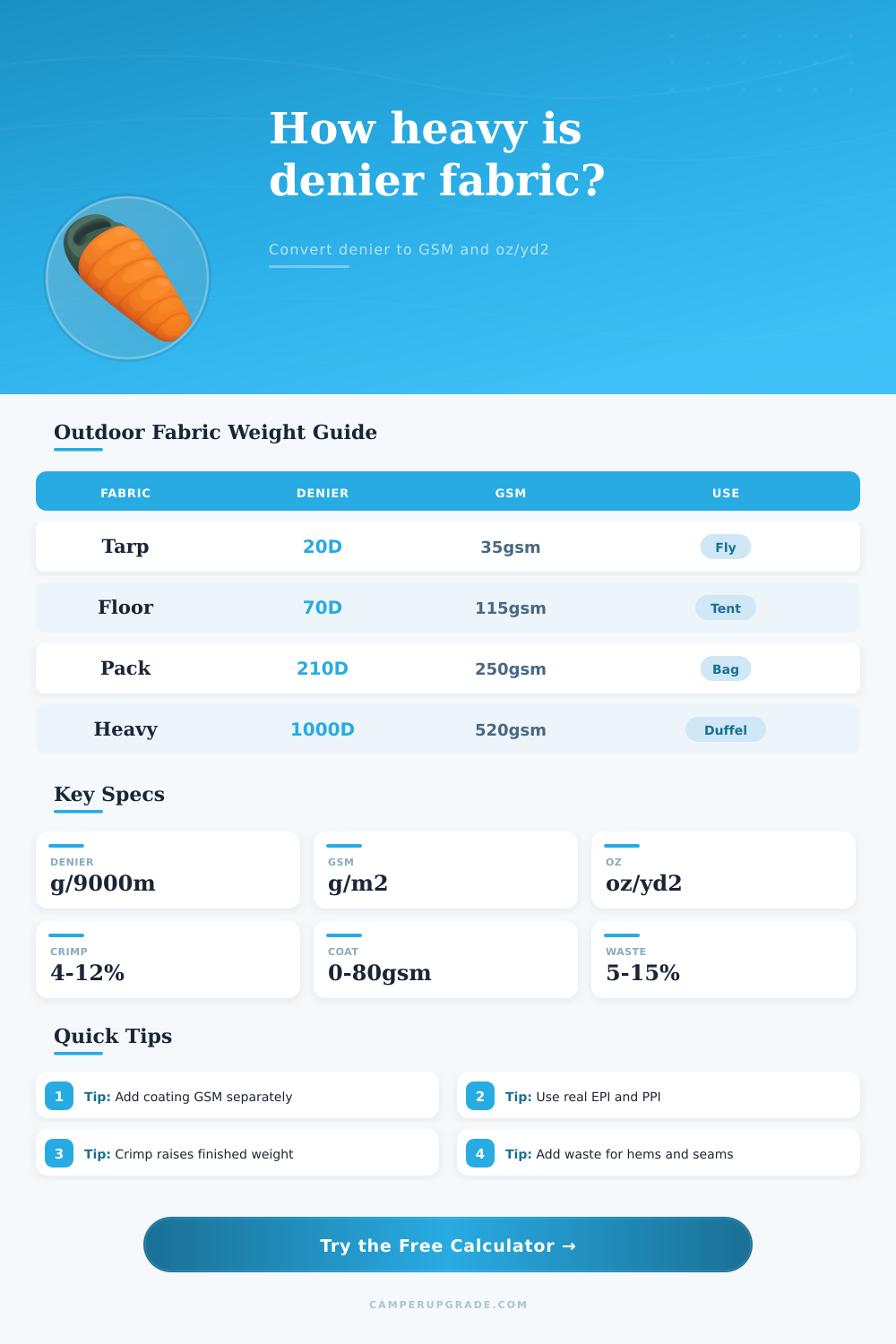
This is nicely diagrammed in the reference table on the page (above) for popular camping materials. A one thousand denier ballistic nylon may weigh upwards of five hundred grams per square meter; a twenty denier silpoly fly will be around thirty-five. That’s a spectrum spanning everything from the heaviest duty duffels to the lightest-weight storm shelter. Knowing which direction your project will fall on that scale enables you to select appropriate material. For example, a weight penalty is worth it if you’re creating a ground cloth intended for use in wet campsites; you may want to go with the heavier floor fabric here. Conversely, if you’re sewing up a stuff sack, going light here saves even more. And there’s really no trick, other than knowing what the heck is being measured in the first place.
The thing to understand: Denier is merely the beginning. It’s the unaltered raw ingredient before it’s woven, coated, finished into anything that could possibly be used as gear. Suddenly, two hundred (GSM) is a result. And you know it includes weave density, mass of the yarn, allowance for crimp, and the waterproof coating. Now, when you look at that figure, you’re not guessing. You have confidence that it reflects the actual, physical process behind making fabric. That becomes a spec, not a guess.
Fabric weight affects your comfort on the trail just as much as it affects your durability in storms. Miles of walking or rock scrambling require each ounce to count. Yet each ounce must do something. Heavier fabrics may be more durable against tearing from an unexpected wind gust or abrasions from sharp branches. There’s no such thing as a free lunch in gear design… It’s all a trade-off between longevity and weight. You want that trade-off to be a conscious choice rather than an accident.
To make informed decisions you should of had accurate numbers. In the end, understanding what your stuff weighs helps you make more effective gear. No longer do you buy some supposed ultralight fabric only to find it’s heavier then expected. Or you might throw together a tarp that falls apart in the next storm. With the correct variables, the rest is just math: plug them into the equation, check out the number, and go enjoy the outdoors knowing your pack will do everything you hoped it would. And that confidence is worth the few minutes it takes to do the math.