🍲 Dehydrated Food Rehydration Calculator
Estimate water, stand time, finished yield, and servings for trail meals
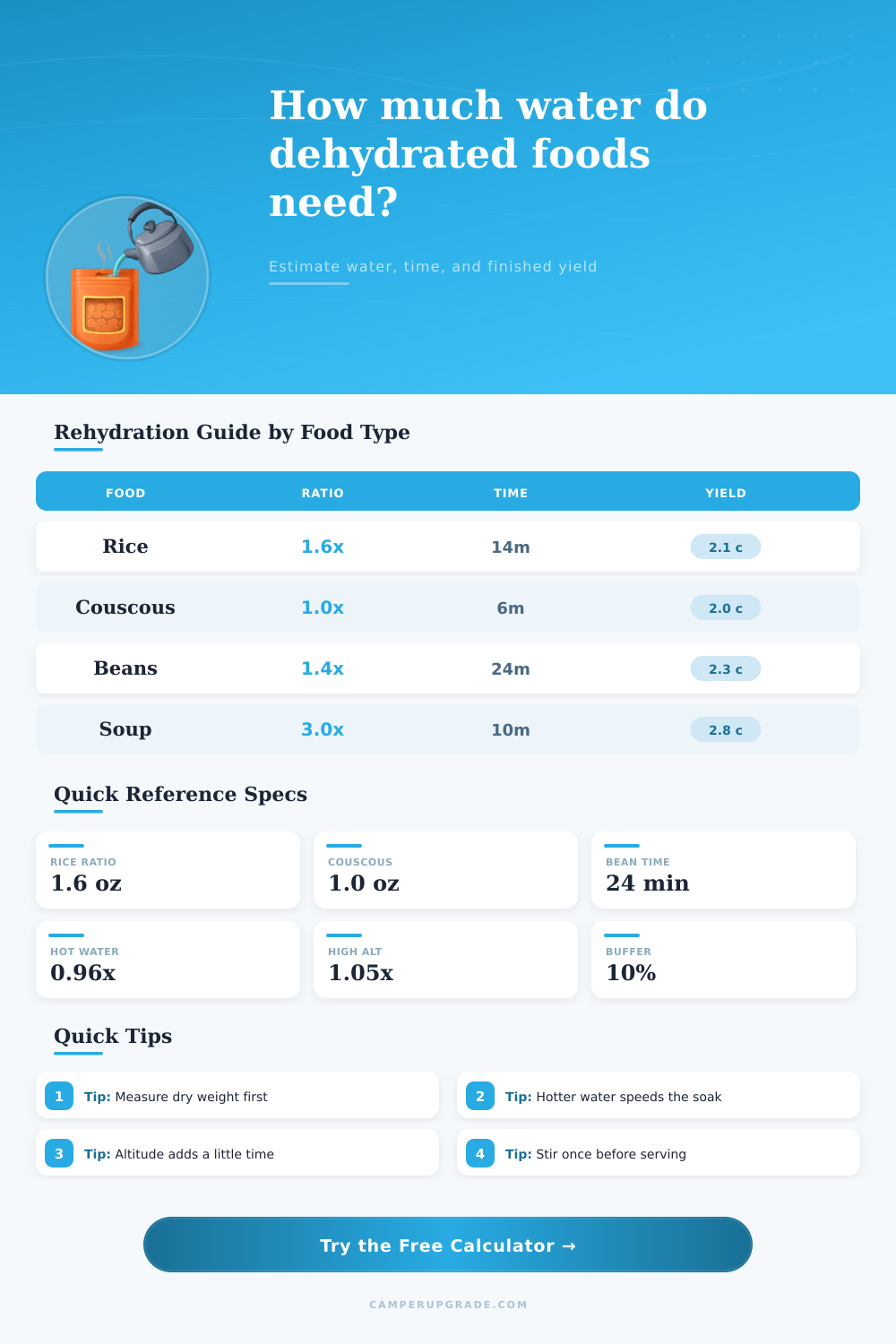
| Food | Base water | Base time | Yield |
|---|---|---|---|
| Rice blend | 1.6 oz/oz | 14 min | 2.1 c |
| Couscous | 1.0 oz/oz | 6 min | 2.0 c |
| Short pasta | 1.7 oz/oz | 18 min | 2.4 c |
| Beans | 1.4 oz/oz | 24 min | 2.3 c |
| Oatmeal | 2.1 oz/oz | 7 min | 2.5 c |
| Potato flake | 0.9 oz/oz | 5 min | 1.8 c |
| Vegetables | 0.9 oz/oz | 8 min | 1.7 c |
| Soup mix | 3.0 oz/oz | 10 min | 2.8 c |
| Fruit blend | 1.1 oz/oz | 12 min | 2.0 c |
| Temp | Water | Time | Best use |
|---|---|---|---|
| Cold | 1.04x | 1.35x | Cold soak |
| Room | 1.00x | 1.10x | Base soak |
| Warm | 0.98x | 0.90x | Trail dinner |
| Hot | 0.96x | 0.72x | Fast meal |
| Band | Water | Time | Note |
|---|---|---|---|
| Sea level | 1.00x | 1.00x | Baseline |
| 2k-5k ft | 1.02x | 1.10x | Light adjust |
| 5k-8k ft | 1.05x | 1.20x | Longer soak |
| 8k+ ft | 1.08x | 1.30x | Add reserve |
| Food | Dry oz | Yield c | Servings |
|---|---|---|---|
| Rice blend | 4 oz | 2.1 c | 2 |
| Couscous | 4 oz | 2.0 c | 2 |
| Short pasta | 5 oz | 2.4 c | 2 |
| Beans | 5 oz | 2.3 c | 2 |
| Oatmeal | 3 oz | 2.5 c | 2 |
| Potato flake | 3 oz | 1.8 c | 1 |
| Vegetables | 2 oz | 1.7 c | 1 |
| Soup mix | 3 oz | 2.8 c | 2 |
When you rehydrate dehydrated food, there are specific factors to account for the food and the environment. To rehydrate dehydrated food proper, you must account for the amount of waters, the temperature of the water, and the altitude where the food will be rehydrated. Failure to account for these factor may result in the food being too dry or too wet after rehydration.
The amount of water that each type of dehydrated foods absorbs from water may differ. For instance, rice absorbs 1.6 times it’s weight in water. However, couscous absorbs only 1.0 times its weight in water.
How to Rehydrate Food
Beans and lentil require specific amounts of water when rehydrating. Additionally, lentils take longer to absorb the water than other ingredient. The amount of water that soups and stews requires is three times their dry weight.
You must account for the type of food that will be rehydrated prior to an rehydration process. The type of food will determine the amount of water that will be required for rehydration. Another factor to consider is the texture of the food that will be rehydrated.
If the food is supposed to be a loose texture, it will require less water than food that requires a thick texture. The temperature of the water will determine how fast the food will absorb the water. Using water near the boiling point will rehydrate the food more faster than using room-temperature water.
Using hot water will reduce the rehydration time by nearly one-quarter of the time it would take with room temperature water. However, using cold water will take the longest to rehydrate the food. The temperature of the water must be accounted for prior to the rehydration process.
The water temperature will dictate how long the food will have to sit out to reach the desired temperature for eating. The altitude of the area where the food will be rehydrated will affect the rehydration process of the food. At altitudes above 5,000 feet, the air pressure are lower.
This lower air pressure causes the water to evaporate at a faster rate. Additionally, the food will absorb the water at a slower rate. Because of this slow rate of absorption of water by the food, 20 percent more water will be required for the same amount of rehydrated food.
The amount of water and the length of time for rehydration must be accounted for when the altitude is above 5,000 feet. A buffer should be used when measuring the water for the rehydrated food. A buffer is an extra 10 or 15 percent of water to the food to make sure that the food is not too dry once rehydrated.
You should measure the amount of dry food by weight rather then volume. This is because a cup of beans will weigh more than a cup of oatmeal. Therefore, the weight will provide a more accurate measurement for rehydration.
Once you add the amount of water to the food, the food should be left undisturbed so that the steam from the food will assist in the rehydration process of the food. The yield of the rehydrated food depends on how much water the food absorb during the rehydration process. Foods such as oatmeal will absorb a significant amount of water.
However, foods such as couscous will yield a different volume of food relative to the amount of dry food that was initially used. The amount of yield that will be produced must be accounted for prior to rehydration. This will allow the individual to determine if there will be enough serving of rehydrated food to feed each person in the group.
If the yield is not calculated prior to the rehydration process, there may not be enough food to feed each individual in the group. Finally, you should practice this entire rehydration process at home prior to going on a trip. If the food is to be rehydrated while on a trip, it is essential to understand how the stove and the food will react to different amounts of water and different temperatures of water.
By practicing rehydrating food at home, an individual will better understand the process and be able to prepare the same type of meals while on a trip.