DEET Protection Time Calculator
Estimate when to check or reapply DEET repellent from concentration, target insect, formulation, sweat, rain, exposed-skin coverage, activity level, temperature, and vegetation exposure.
🏕Outdoor DEET Presets
⚙DEET Concentration, Sweat, Rain, and Exposure Inputs
Use this as an estimate only. Always follow the product label, avoid over-application, wash treated skin after the trip, and use EPA-registered repellents for disease-vector areas.
📐Four Formula Cards
DEET Baseline
time curve by %The curve rises quickly from 5% to 30%, then tapers because added concentration gives smaller timing gains.
Condition Multiplier
sweat x rain x rubSweat, water, activity, heat, and brush contact multiply the label-like baseline downward.
Coverage Penalty
0.75 + coverage/400Missed skin lowers the practical protection window even when treated areas still repel insects.
Check Reminder
time x (1 - buffer)The recheck time is earlier than the estimated endpoint so you can inspect skin before bites resume.
🧴Repellent and Exposure Spec Grid
📊DEET Protection Time Reference Tables
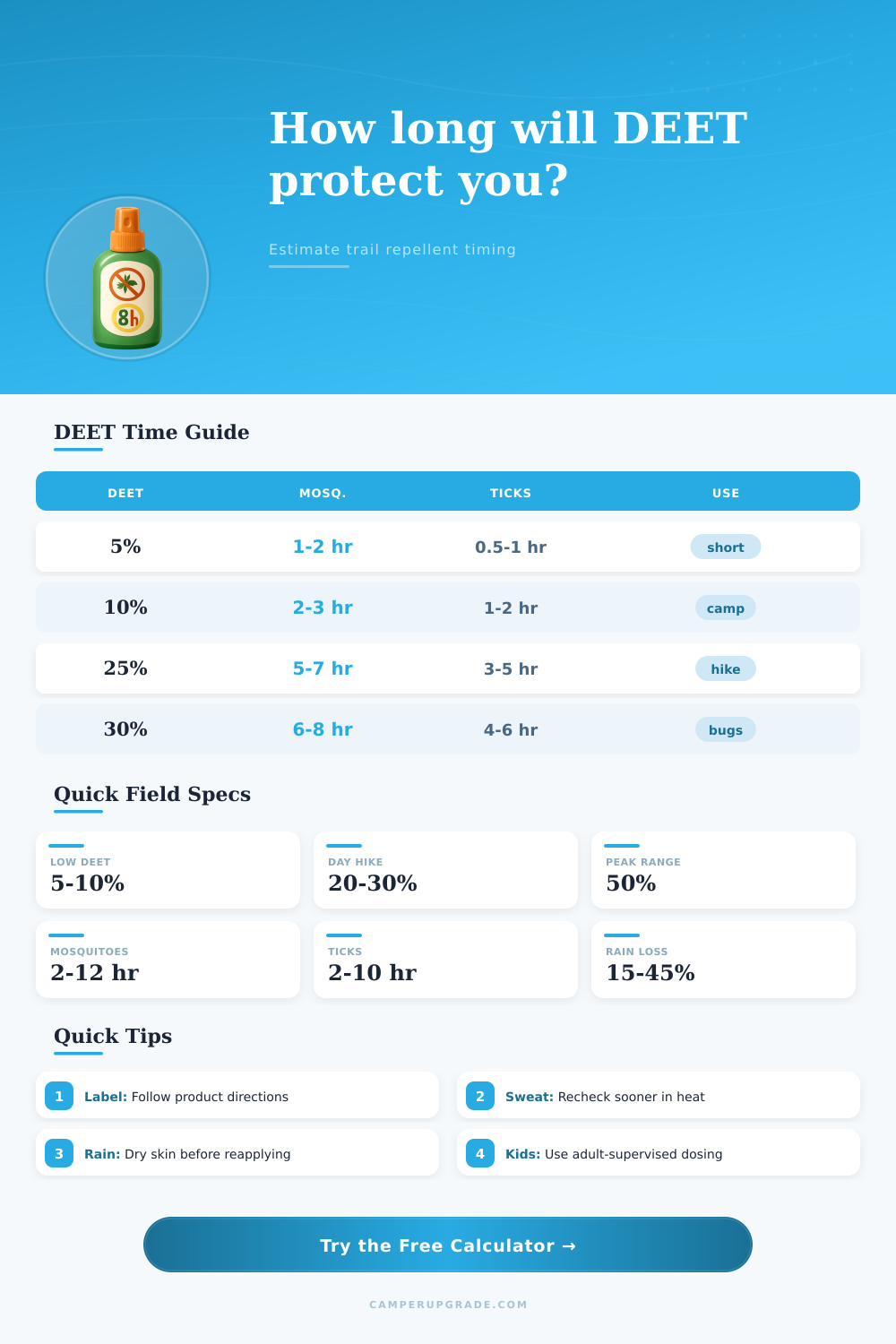
| DEET Level | Mosquito Estimate | Tick Estimate | Typical Use |
|---|---|---|---|
| 5% | 1-2 hours | 0.5-1.5 hours | short stop |
| 10% | 2-3 hours | 1-2.5 hours | camp chores |
| 15% | 3-5 hours | 2-3.5 hours | easy outing |
| 25% | 5-7 hours | 3-5 hours | day hike |
| 30% | 6-8 hours | 4-6 hours | heavy bugs |
| 50% | 8-10 hours | 6-8 hours | long day |
| Condition | Multiplier | Why It Changes | Field Check |
|---|---|---|---|
| Light sweat | 0.92x | thin film loss | normal check |
| Moderate sweat | 0.78x | film moves | check early |
| Heavy sweat | 0.62x | wiping loss | check often |
| Steady rain | 0.70x | water removal | dry first |
| Soaked skin | 0.48x | film washed | label reapply |
| Formulation | Timing Effect | Best Fit | Watch Point |
|---|---|---|---|
| Alcohol spray | 1.00x | quick skin cover | missed areas |
| Pump spray | 0.96x | targeted use | uneven film |
| Lotion | 1.12x | sweaty hikes | hands after use |
| Wipe | 0.90x | face and neck | thin coverage |
| Controlled-release | 1.25x | long outings | label timing |
| Exposure Pattern | DEET Range | Check Window | Extra Barrier |
|---|---|---|---|
| Evening campsite | 10-20% | 2-5 hours | long sleeves |
| Forest trail | 20-30% | 4-7 hours | treated socks |
| Wet portage | 25-30% | 2-5 hours | rain shell |
| Tropical dusk | 30-50% | 5-9 hours | netting |
| Tick grass | 20-30% | 3-6 hours | tick checks |
💡DEET Timing Tips
DEET is a chemical that prevents insect from biting you’re skin. However, DEET will not last indefinitely on your skin. Various factor will remove the DEET from your skin.
For instance, DEET will evaporate from your skin. Additionally, physical friction from your backpack straps, rain, and your sweat will rub DEET off your skin. All these factor will thin the layer of DEET on your skin, which will make the DEET less effective at preventing insects from biting you.
How Long Does DEET Last?
People may believe that a higher percentage of DEET will provide longer protection from insect. However, the higher the percentage of DEET, the less additional time it will provide for protection. Eventually, there will be a point where increasing the percentage of DEET will only provide a short period of extra time for protection.
This is due to the law of diminishing return. A higher percentage of DEET is needed for those with high activity level compared to those with lower activity levels. People who are to be actively engage in outdoor activities for long periods of time will require a higher percentage of DEET then those who are to undertake short activity only.
The tool that is available will provide an individual with a baseline of the length of time that there DEET will last. However, the baseline may not be the length of time that their DEET will last while in the woods. The baseline can be adjusted for individual environmental factor that may impact the length of time that the DEET last.
For instance, dry environments will allow the DEET to last longer on the skin. In contrast, in humid environment or the swamp environments that are common in the woods, the DEET will fail more quick. One of the reason for which the DEET will fail is due to the presence of sweat on the skin.
The presence of sweat will shift the DEET film on the skin and create gap in the coverage of DEET on the skin. Additionally, water will act as a solvent to the DEET on your skin, which will strip the DEET from your skin. Another reason for which DEET may fail is due to physical abrasion.
For instance, if an individual has a heavy backpack, the straps may rub against the individuals skin and strip the DEET from their skin. Additionally, if an individual walk through dense brush, the plants may rub against the individuals ankles or wrists, which will strip the DEET from their skin. These area without DEET on the skin is referred to as high-risk zone for being bitten by insects.
The tool can calculate the length of time that the DEET will last by taking into consideration these factors that relate to the individuals activities and vegetation. Another factor that may impact the length of time that DEET will last is the formulation of the DEET. For instance, if an individual uses an alcohol-based spray containing DEET, it will dry quick on the skin.
However, if an individual use lotion or a DEET-based controlled-release formula, the DEET will remain on the skin for a longer length of time. The lotion-based DEET will contain a thicker barrier of DEET than sprays; this thicker barrier will help DEET resist both sweat and rubbing on the skin. Some individual will not like the greasy feeling that lotions provide when applied to the skin.
However, this greasy feeling will help the DEET on the lotion to remain on the skin. Another factor that will impact DEET is the amount of your skin that is cover. Using a high percentage of DEET is useless if not all of your skin is covered.
Insects will find your skin that is not cover in DEET. You can use the tool to determine your percentage of skin coverage. Your percentage of skin coverage will determine your level of risk for being bitten by insects.
The length of time that the tool will calculate for you is not the length of time that you should expect for your DEET to fail. However, you should use this length of time to determine when to check your skin. You should check your skin prior to the insects biting you.
Waiting until you feel an insect bite your skin indicate that the DEET has failed. You should reapply DEET while you are still protected from insects. Using physical barrier like long sleeves or treated socks will also make your skin less vulnerable to insects.
Using both physical barriers and DEET will provide a secondary line of defense. Additionally, DEET will react to the element as mentioned earlier. Therefore, you must monitor your skin for the presence of insect bites.