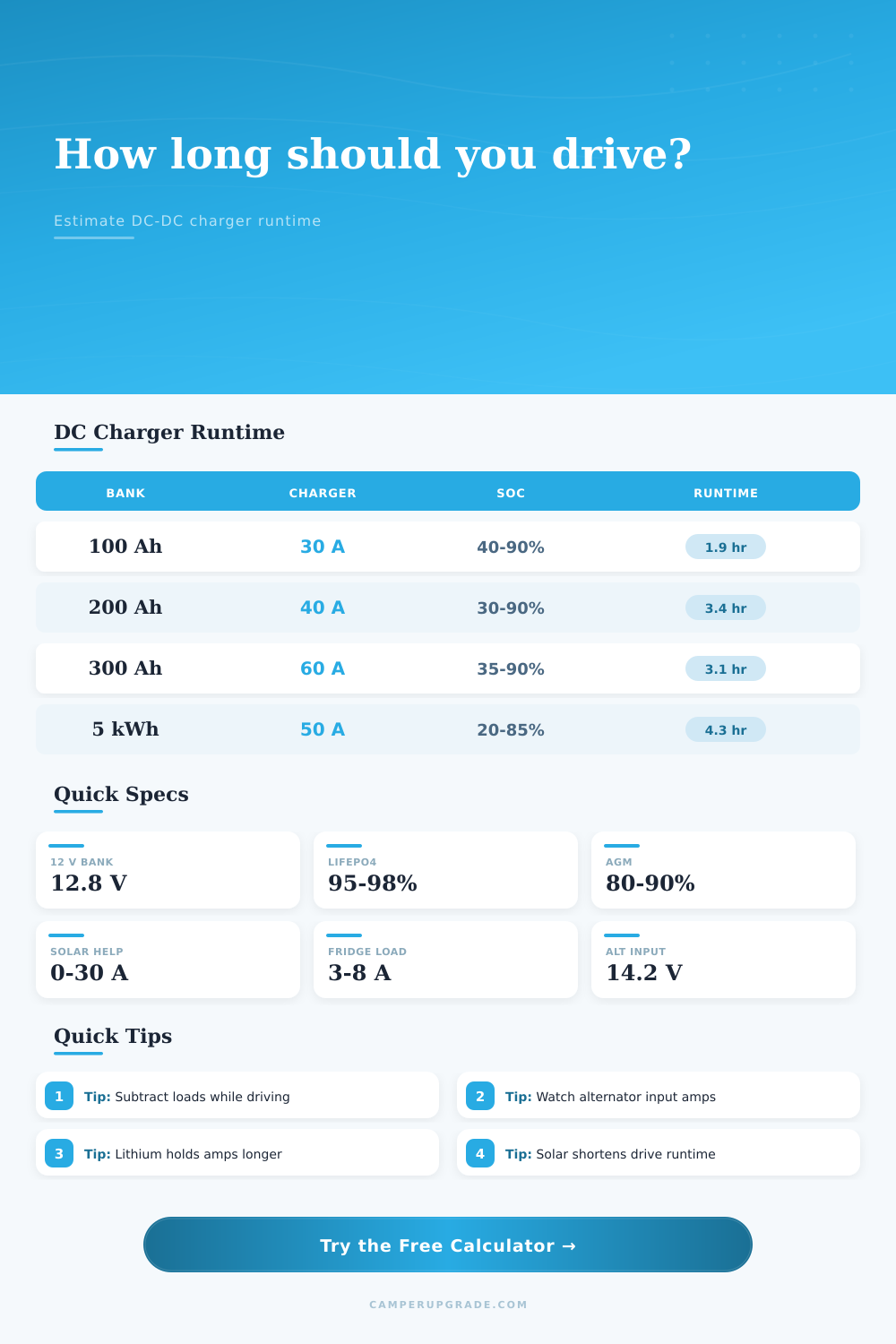
DC to DC Charger Runtime Calculator
Estimate how many drive hours your camper needs to recover a battery bank through a DC-DC charger while accounting for SOC window, charger amps, efficiency, alternator voltage, solar assist, and loads running on the road.
Full charging breakdown
| Battery bank | SOC window | 30 A net charge | 50 A net charge |
|---|---|---|---|
| 100 Ah / 1.28 kWh | 40% to 90% | 1.7 hr | 1.0 hr |
| 200 Ah / 2.56 kWh | 30% to 90% | 4.0 hr | 2.4 hr |
| 300 Ah / 3.84 kWh | 35% to 90% | 5.5 hr | 3.3 hr |
| 400 Ah / 5.12 kWh | 20% to 85% | 8.7 hr | 5.2 hr |
| 600 Ah / 7.68 kWh | 30% to 90% | 12.0 hr | 7.2 hr |
| Battery type | Usual acceptance | Taper behavior | Planning note |
|---|---|---|---|
| LiFePO4 lithium | High until upper SOC | Often late taper above about 90% | Good match for DC-DC charging on short drive days. |
| AGM lead acid | Moderate | Absorption taper can begin around 80% to 85% | Runtime to full is longer than the simple Ah gap suggests. |
| Flooded lead acid | Moderate to low | Earlier and stronger taper near high SOC | Use conservative net amps for upper-SOC charging. |
| Gel lead acid | Lower charge rate | Voltage-sensitive absorption taper | Keep charger settings matched to the battery profile. |
| Adjustment | Typical amps | Runtime effect | Example |
|---|---|---|---|
| Fridge running | 3 to 8 A | Adds runtime | 40 A charger minus 5 A fridge equals 35 A net. |
| Small inverter load | 5 to 20 A | Adds runtime quickly | Laptop charging can erase much of a small solar gain. |
| Flat-mounted solar | 0 to 25 A | Shortens runtime | 8 A average solar plus 40 A charger gives 48 A gross. |
| Cloudy winter solar | 0 to 6 A | Small runtime help | Use a low average instead of panel nameplate amps. |
Weekend Van
100 Ah lithium, 30 A charger, light fridge load, and short daily drives. Runtime is usually limited by available drive time, not charger size.
Family Camper
200 to 300 Ah bank with a 40 to 50 A charger. Solar assist can meaningfully reduce the drive time needed after two nights parked.
Lead-Acid Rig
AGM or flooded banks need more time near the top of charge because output current tapers before the battery is fully recovered.
Large Lithium
400 Ah and larger banks can accept high charger current, but alternator limits and cable sizing become the main runtime checks.
amp-hour deficit = battery Ah x (target SOC - starting SOC) / 100.effective charger amps = charger output amps x battery acceptance factor; net amps = effective charger amps + solar assist amps - driving load amps.runtime hours = amp-hour deficit / net amps. Alternator input amps = charger output watts / efficiency / alternator voltage.
After a day of driving around, you pull into an area, look at your battery, and see it’s still at thirty percent. Now you’d like to run the lights and start cooking dinner, but solar isn’t getting any sun and the alternator no longer spin.
That’s when many van dwellers wishes they had planned out their charging strategy. They realize that the distance between charging and consumption is greater then they believed. It isn’t just about needing a fast charger or a large battery; it is also about the balance between time and current… The math of power usage.
Plan Your Charging Strategy
After plugging in your anticipated load, charger rating, and bank size into the calculator above, the math are done for you. There’s no need to figure out your amp-hour deficit. You don’t have to worry about charger inefficiencies. Just plug them in, click “calculate,” and the answer pop up: How long in hours will it take to charge from where you are now down to where you want to be?
It also shows you the cost of lifestyle choices that you might not have even realized existed. Running that fridge on the road? Yeah, you’re draining that charging current that could otherwise be going into your battery.
Even if your charger output forty amps, your alternator and electrical loads limit what actualy reaches your battery to only forty amps. So now you’ll need double the amount of drive time to cover that. That’s where folks screw up. They buy a larger charger without knowing they have a bottleneck with their alternator or their power consumption.
The equation include one huge factor: battery chemistry. Lithium iron phosphate batteries accept charge current steadily until they are nearly full; lead acid batteries, especially AGM types, taper off much earlier as voltage rise.
So you’re not really charging for as long as you think. Twenty percent can be done quickly, but the final twenty percent take disproportionately longer as battery gets close. In fact, chart on the page makes it clear that even with 300 amps in your bank, what appears to be a five-hour charge time could actualy become a half-day drive because of tapering current. It’s just the nature of physics, and it foils more travel plans then you’d imagine.
Also keep in mind the alternator in your car. Stock alternators aren’t made to be run hard for hours on end. They heat up and the calculator let you know if what you’re drawing from it exceeds its safe limit. If that’s the case, you’ll burn out the fuse and you’ll fry an already fried alternator with a dead vehicle sitting by side of road.
Most people think there’s a lot more wiggle room than there really is, but the line between charging too quickly and frying your alternator are thin.
What solar assist realy does is change the way things work, but in a good way. A few amps of solar input during a drive doesn’t seem like much; eight maybe? But that’s eight fewer amps the alternator need to provide. That’s free energy that reduces stress on your car’s electrical system. It also shortens your charging time.
If you’re driving around in the winter when the sun isn’t strong, that assistance is gone. In the summer, it can mean going from having enough juice for lunch to having enough juice for dinner.
In conclusion: It makes more sense to plan based off both battery capacity AND drive time. Don’t know how far you’ll have to drive? Don’t worry about it; that’s outside your control. Don’t know your charge rate? That’s inside your control, and once you do know it, then you also know exactly how much driving you must do for a full day of battery charge.
Stop guessing. Start planning. Stop pulling over with empty batteries. And when you are ready to pull over with confidence, because you know your battery have enough charge to last long after the engine stops ticking, you’re going to be very happy.