Daypack Size Calculator
Estimate recommended daypack liters, remaining volume, load weight, and pack class from hike hours, water, food, clothing layers, weather gear, optics, and shared equipment.
🏔Day Hike Presets
⚙Hike Load Inputs
🎒Daypack Spec Grid
🧭Pack Class Reference
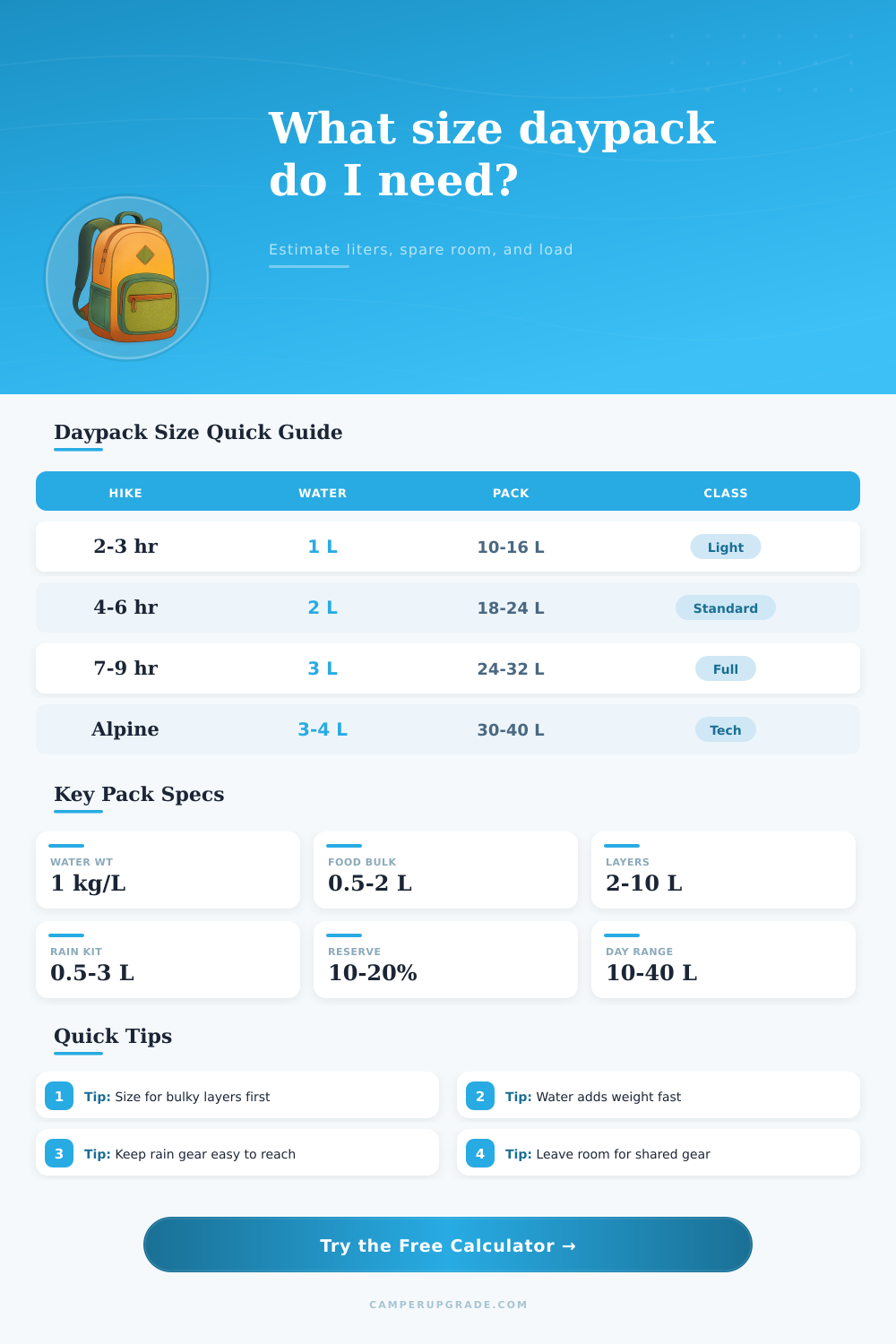
Light Daypack
10-16 LBest for short local trails, warm weather, one bottle, and minimal spare clothing.
Standard Daypack
18-24 LMost flexible size for lunch, two liters of water, first aid, shell, and a light layer.
Full Daypack
25-32 LUseful for longer days, cool starts, extra food, camera gear, or carrying some group gear.
Technical Daypack
33-40 LFor winter layers, alpine starts, helmets, rope-adjacent gear, or leader emergency kits.
📊Reference Tables
| Hike hours | Typical water | Food bulk | Pack range |
|---|---|---|---|
| 1-3 hours | 0.5-1.5 L | 0.2-0.6 L | 8-16 L |
| 3-5 hours | 1.5-2.5 L | 0.5-1.2 L | 16-24 L |
| 5-8 hours | 2-3 L | 1-2 L | 22-32 L |
| 8-12 hours | 3-4 L | 1.5-3 L | 28-40 L |
| Item | Compact | Normal | Bulky |
|---|---|---|---|
| Insulating layer | 1.5 L | 3 L | 6 L |
| Rain shell | 0.5 L | 1 L | 1.8 L |
| Food for day | 0.5 L | 1.2 L | 2.5 L |
| Emergency kit | 0.4 L | 1 L | 2.5 L |
| Pack size | Best load | Usual weight | Notes |
|---|---|---|---|
| 12 L | Fast short hike | 4-8 lb | Little layer room |
| 20 L | Normal day hike | 8-14 lb | Common all-rounder |
| 28 L | Long cool day | 12-20 lb | Room for layers |
| 36 L | Winter / group | 16-28 lb | Needs good support |
| Gear profile | Volume add | Weight add | Pack note |
|---|---|---|---|
| Binoculars | 1.2 L | 1.5 lb | Use quick access |
| Mirrorless kit | 3 L | 3.5 lb | Rigid cube space |
| Shared filter | 0.7 L | 0.8 lb | Small but important |
| Leader kit | 3 L | 3.4 lb | Needs reserve room |
💡Daypack Sizing Tips
When choosing a daypack, there are two main considerations: the volume of the gear that you will carry in the daypack and the weight of the gear that you will carry in the daypack. A daypack size calculator can help to determine the volume of an daypack that will be appropriate for the items that you plan to carry in your daypack. A daypack size calculator consider the various types of equipment that you will be carrying, and outputs a volume recommendation for the daypack that will be appropriate for that type of gear.
This volume recommendation will help you to determine if the daypack will be large enough for your gear. To determine the appropriate size of a daypack for a particular individual, the daypack size calculator asks for various inputs from the individual. These inputs may include the number of hour that the individual will be hiking, the amount of clothing that will be worn during these hikes, the amount of water that will be carried, the amount of food that will be carried, and the number of other items that will be carried (items like first aid kits, camera gear, and binoculars).
How to Choose the Right Daypack Size
Each of these items will add to the volume and weight of the daypack. The calculator output three different amounts for each individual: a recommended volume for the daypack, the remaining space within the daypack for any additional items, the load weight of the daypack, and a pack class label for the daypack. The recommended volume will tell the individual about the smallest size of daypack that will contain all of their gear.
The remaining space will indicate whether there will be extra room in the daypack for any additional items or whether the daypack will be too full. The load weight will indicate the total weight that the individual will have to bear with their daypack, as it calculates the total weight of the gear the individual will carry plus their daypack. Finally, the pack class label will indicate the size category to which the daypack belong.
Many individuals will mistakenly believe that the items that they will carry will take up less space within the daypack then the items actualy do. For instance, individuals often do not anticipate how much of the daypack space that bulky items like puffy jackets will take up. Items like puffy jackets may push other items within the daypack to the corners of the daypack, or may prevent the daypack from being able to completely close its lid.
Additionally, items that are rigid in their structure, like a camera case, may create dead space within the daypack. Therefore, it is important for individuals to always allow for extra space within their daypack for unexpected items, extra layer, or items for others that may be going on the hike as well. One common mistake that an individual can make when using the daypack size calculator is to select the daypack according only to the liter capacity that is advertised for that daypack.
While the liter capacity of a daypack may be high, the daypack may still be too small for the individual if the items to be carried are very bulky. For instance, a twenty liter daypack may be sufficient for an individual and their gear for a day hike, but the same daypack may be too small for an individual that must also carry heavy rain pants and insulation. Another mistake is to potentially ignore the distribution of the weight of the gear within the daypack; the daypack may have the appropriate size for an individual, but if the weight is not distributed appropriate along the individuals body, they may experience discomfort while wearing the daypack.
If an individual is going on a hike with other individuals, that individual will have to account for the gear that those individuals will share between them in the daypack size calculator. Any gear that will be shared between individuals will both add to the volume that will be calculated for the daypack, as well as the total weight of the daypack. For instance, if the individual is hiking with children, they will need to account for the snacks and clothing for those children.
These items will increase the total volume and weight of the daypack that will be required for that individual to carry. Finally, after determining the size of the daypack with the daypack size calculator, the individual should of test the daypack with their gear. The individual can fill the daypack with the gear that is to be used on the hike, and the individual can walk around with the daypack filled with gear to ensure that the weight is distributed appropriate across the individuals body.