Daylight Hours Calculator
Estimate sunrise, sunset, day length, and twilight windows for campsite planning by latitude, date, longitude, timezone, horizon, elevation, and refraction setting.
📍Real Location And Date Presets
☀️Sun And Twilight Inputs
Calculation Breakdown
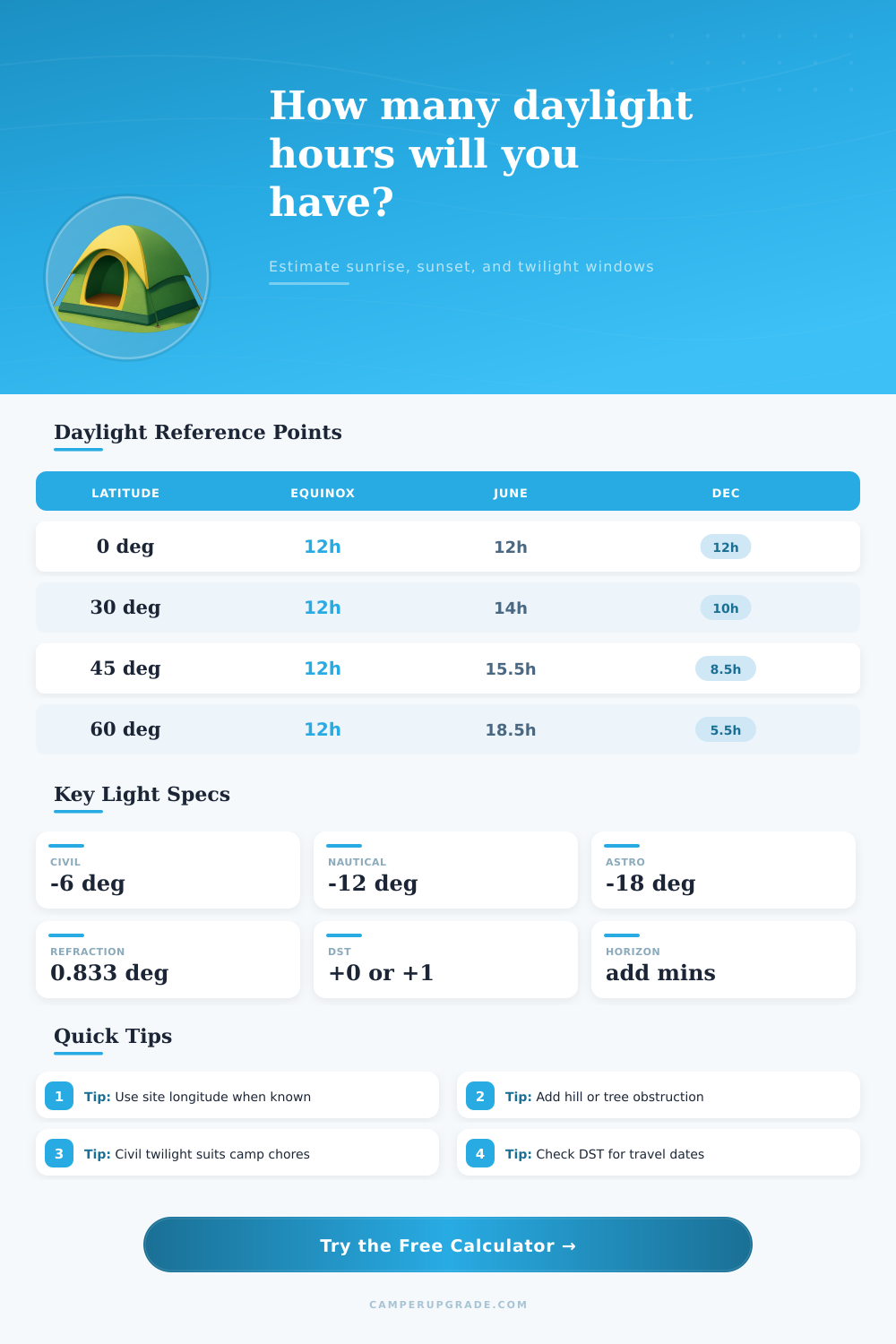
🧭Twilight And Refraction Spec Grid
📊Latitude And Season Reference
| Latitude | March/Sept Equinox | June Solstice | December Solstice |
|---|---|---|---|
| 0° Equator | About 12 hr | About 12 hr | About 12 hr |
| 25° Desert Southwest | About 12 hr | About 13 hr 40 min | About 10 hr 35 min |
| 40° Central U.S. | About 12 hr | About 14 hr 50 min | About 9 hr 20 min |
| 50° Southern Canada | About 12 hr | About 16 hr 15 min | About 8 hr 05 min |
| 60° Alaska/Scandinavia | About 12 hr | About 18 hr 30 min | About 5 hr 50 min |
🌅Twilight Type Reference
| Twilight Type | Sun Altitude | Typical Use | Camping Planning Note |
|---|---|---|---|
| Civil twilight | 0° to -6° | General outdoor visibility | Good estimate for camp chores and packing. |
| Nautical twilight | -6° to -12° | Dim horizon light | Useful for early starts with headlamps ready. |
| Astronomical twilight | -12° to -18° | Dark-sky transition | Use for stargazing or night-sky timing. |
| Apparent sunrise | About -0.833° | Visible upper Sun edge | Includes standard refraction and Sun radius. |
⛰️Horizon Obstruction Quick Table
| Obstruction Angle | What It Feels Like | Sunrise Effect | Sunset Effect |
|---|---|---|---|
| 0° | Open water, flat desert, open plain | No delay | No early cutoff |
| 1° to 2° | Low ridge, distant tree line, mild campsite slope | Often 4 to 10 min later | Often 4 to 10 min earlier |
| 3° to 5° | Nearby forest edge, canyon rim, rolling hills | Often 12 to 25 min later | Often 12 to 25 min earlier |
| 8° plus | Deep valley, canyon wall, steep mountain side | Can be 30 min plus later | Can be 30 min plus earlier |
🗺️Real Preset Details
| Preset | Latitude | Longitude | Timezone Setup |
|---|---|---|---|
| Yosemite Valley, California | 37.8651° N | 119.5383° W | Pacific standard + DST |
| Arches National Park, Utah | 38.7331° N | 109.5925° W | Mountain standard + DST |
| Denali National Park, Alaska | 63.1148° N | 151.1926° W | Alaska standard + DST |
| Everglades, Florida | 25.2866° N | 80.8987° W | Eastern standard, winter no DST |
| Banff, Alberta | 51.1784° N | 115.5708° W | Mountain standard + DST |
💡Planning Tips
When planning a camping trip, it is important to understand the amount of usable light that will be available at the campsite. The amount of usable light that will be available at a campsite is dependent upon a variety of factors, such as the latitude of the location, the date of travel, the elevation of the location, and the angle of the horizon at the campsite. Factors like these can be calculated with a daylight hours calculator, which allows the person to plan there camping trip based off these variable.
Inputs for a daylight hours calculator include the location of the campsite (which includes both latitude and longitude), the angle of the horizon at the campsite, the elevation of the campsite, and the twilight setting that the person will utilize during the camping trip. The latitude of the location will have an impact upon the length of the day that will occur at different times of the year. Similarly, the longitude will impact the sunrise at the campsite; two locations within the same time zone may experience different sunrise times due to the difference in their longitude.
Use a Daylight Hours Calculator to Plan Your Camping Trip
The elevation and the horizon angle of the campsite will impact the sunrise and sunset times of that particular location; trees or ridges may impact those times. The third group of inputs for the daylight hours calculator is the twilight setting. Twilight is the period of time after sunset or before sunrise when the sky isnt completely dark yet.
Civil twilight is the time period after sunset or before sunrise when the sky is bright enough to complete camping tasks without the use of a headlamp. Nautical twilight is a time period that is darker than civil twilight, yet still bright enough to see the ground while walking. Astronomical twilight is a period of time that is essentially dark.
The individual can select the type of twilight that will be used during the camping trip with the daylight hours calculator. The daylight hours calculator use geometry and variables like solar declination, the equation of time, and atmospheric refraction to calculate the length of daylight, the time of sunrise, the time of sunset, the length of the twilight period, and to provide a breakdown of the length of daylight to determine if the length is due to the time of year or local obstructions of the setting. This calculation can help individuals to compare different campsites and different dates for camping trips.
Many individuals tend to overlook the potential impact of small angles for the horizon. An obstruction of only two degree of the horizon may impact the sunrise or sunset by as much as ten or fifteen minutes. The same is true of ridges that may block the view of the sunrise or sunset.
Campsites located at higher elevations will experience more minutes of light during the camping trip than those located at sea level. Many individuals, however, forget that these elevations provides more light to those camping at such locations. The daylight hours calculator can assist in planning trips during different seasons.
For instance, a camping trip during the month of June at 45 degrees latitude will experience approximately 15.5 hours of daylight, yet during the same location during December will experience less than 9 hours of daylight. Such a calculator will allow individuals to plan for twilight or full daylight during camping trips. The calculator will also display the impact of daylight saving time; while daylight saving time will impact the time on the clock, it will not impact the actual daylight calculations for the location.
Most camping trip locations are not located on flat and open ground. Campsites that are located on ridgelines may not be able to view the evening sky, and may lose twenty minutes of light viewing during the evening camping trip. Campsites that are exposed to the sunrise may experience more light during the morning than locations that may experience obstruction of the rising sun.
Individuals will need to utilize a map of the area or satellite view of the area to account for local features of the area that may impact the calculation of the daylight hours calculator. Such calculators provides a general idea of the length of daylight for an area, but an individual will need to account for local features to ensure that they are accurately calculating the length of daylight that will be available during their camping trip. Sunrise and sunset times are not typically when camping trips begin or end.
After sunset, the tasks that an individual performs may be difficult to complete until civil twilight; the time between sunset and the moment when the sky becomes bright enough to complete camping tasks without headlamps. Similarly, after sunrise, the light may fade rapid after the sun dips below the horizon; tasks after sunrise may need to be completed during civil twilight. The daylight hours calculator accounts for these times so that individuals are not required to perform tasks that may be difficult to see after sunrise or before sunset.
By utilizing the daylight hours calculator, individuals may be able to notice patterns in the amount of light during the camping trip. Locations at northern latitudes will experience long evenings during the summer months, but those long evenings may not be useful if the sun is hidden behind a ridge. Deserts may experience many minutes of twilight, which may be useful for camping trips that require individuals to warm up after waking.
Coastal areas may experience darkness during the morning due to the marine layer or hills that may block the view of the rising sun. These variables can be accounted for in advance of camping trips to ensure that the individuals do not discover these variables upon their arrival at the campsite. In addition to calculating the length of daylight, the time of sunrise, sunset, and twilight, and providing a breakdown of those calculations, the calculator may also include a calculation of the difference between geometric sunrise and apparent sunrise.
Apparent sunrise is the time that the upper edge of the sun becomes visible above the horizon, even when the center of the sun is below the horizon. This is due to the refraction of sunlight as it enters the earth’s atmosphere, as well as the angular size of the sun itself. The inclusion of this calculation in the daylight hours calculator can help ensure that the sunrise times are accurately calculated for the trip.
In addition to planning camping trips, the daylight hours calculator may also allow for individuals to compare the different itineraries for trip. For instance, route A may provide an extra hour of light for camping tasks during the trip, or route B may require different batteries for headlamps due to the later time of twilight. These calculations will allow individuals to plan their trips in such a way as to account for the length of time during which they must complete their tasks.
While the geometry of the sun is consistent during any given period, variables like solar declination and the equation of time will impact the length of daylight during that period. Thus, after learning of the variables for the daylight hours calculator, individuals can understand the length of daylight that will be available during their camping trip. Using a daylight hours calculator allows individuals to plan their camping trip around daylight saving time as opposed to simply allowing daylight to happen to them during their trip.