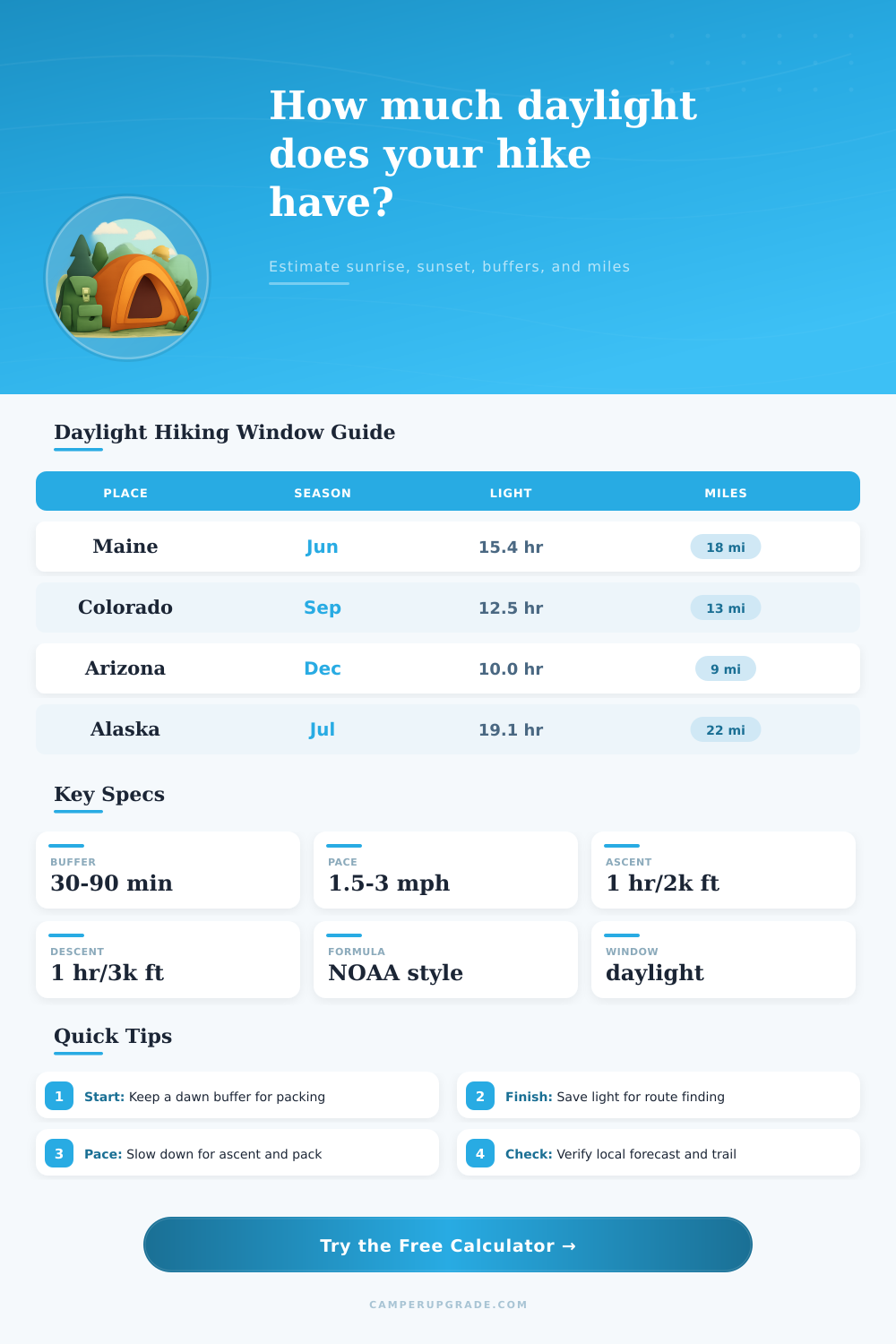
Daylight Hiking Window Calculator
Estimate local sunrise, sunset, usable daylight, hiking buffer, pace-adjusted route time, latest safe start, and mileage range from season, latitude, terrain, elevation, and route inputs.
🌅Season and Latitude Hiking Presets
🧮Sun, Route, Pace, and Buffer Inputs
Formula basis: sunrise and sunset are approximated from solar declination, equation of time, latitude, longitude, time zone, and atmospheric refraction. Always verify official local sunrise, weather, trail closures, and navigation needs.
📐Daylight Planning Spec Grid
📊Sunlight, Pace, and Buffer Reference Tables
| Latitude | June Light | Equinox Light | December Light |
|---|---|---|---|
| 25° N | 13.7 hr | 12.1 hr | 10.6 hr |
| 35° N | 14.4 hr | 12.1 hr | 9.9 hr |
| 45° N | 15.4 hr | 12.1 hr | 8.7 hr |
| 55° N | 17.3 hr | 12.1 hr | 7.2 hr |
| Terrain | Time Add | Use Case | Watch Item |
|---|---|---|---|
| Smooth signed trail | 0% | Maintained paths | Easy miles |
| Normal mountain trail | 10% | Typical hiking | Steady ascent |
| Rough rocks or sand | 25% | Talus, roots, dunes | Footing |
| Off-trail or snow | 45% | Route finding | Slow exits |
| Formula Step | Calculation | Output | Reason |
|---|---|---|---|
| Day number | month plus day | N | Season angle |
| Declination | 23.44 sin season | solar tilt | Day length |
| Hour angle | acos sun altitude | degrees | Rise or set |
| Solar noon | 12 + zone adjust | clock time | Local offset |
| Window | sunset - sunrise - buffers | usable hrs | Hike planning |
| Buffer Plan | Start Add | Finish Hold | Best For |
|---|---|---|---|
| Fast summer | 15 min | 30 min | Clear trail |
| Normal day hike | 30 min | 60 min | Most routes |
| Cold shoulder | 45 min | 75 min | Frost or mud |
| Route finding | 60 min | 90 min | Rough exits |
💡Two Practical Daylight Tips
The daylight window for a hike is the amount of time that exist between the beginning of useful light and the end of useful light. Many peoples assume that the daylight window is the same as the time between sunrise and sunset. However, the daylight window for a hike is actualy shorter than the time between sunrise and sunset due to the time it takes to pack gear, travel to the trailhead and find the route to the hike.
Furthermore, people must also finish hike before the sunlight fully dissapears over the horizon. People may find themselves misjudging the daylight window for there hike if they often use the time between sunrise and sunset as the daylight window. The length of the daylight window for a hike is determined by both the latitude at which the person intends to hike and the season.
Plan Your Hike by the Daylight Window
For example, during the summer at latitudes north of the Tropic of Cancer, the daylight window may be fifteen hour or more of sunlight. During these same months at latitudes in the northern hemisphere, however, the daylight window may feel shorter due to the time it may take to hike at a slower pace with rough ground and at a slower rate by all of the people on the hike. During the winter months, such as December, the daylight window may only be nine hours of sunlight.
Furthermore, the usable daylight window may be even more shorter if the time necessary to begin hiking after sunrise and time necessary to finish hiking before sunset must also be accounted for. Calculators is available that may allow an individual to determine the daylight window for their hike by inputting variables about the hike into the calculator. Some of the variables that may be entered into the daylight window calculator for a hike may include the start buffer, the finish buffer, the terrain for the hike and the elevation of the route.
A start buffer may be used to account for time necessary to warm up the car or hike to the trailhead. Additionally, a start buffer may be used to provide time for the individual to hike after sunrise when it may be too dim to see the trail. A finish buffer may be used to account for the fact that an individual may be tired at the end of the hike and may struggle with navigation at that time of day.
Terrain may be an important factor in that it may take more time to hike on a maintained trail than on talus, for example. Furthermore, the individual may have to account for time to hike up mountains or hills because every two thousand feet of elevation typically requires one hour of hiking time. These times are factors that may be included in the calculator to arrive at the total daylight window for the hike.
The calculator may produce several different figures regarding the daylight window for the hike. For example, the calculator may produce a figure that calculates the total daylight that falls between sunrise and sunset on that particular date. The calculator may produce a figure that calculates the usable daylight window for the hike after accounting for the start and finish buffer times.
Furthermore, the calculator may also calculate the total time necessary to complete the hike of the planned distance, the latest start time for when the hike will still occur within the daylight window, and a mileage range. The latest start time for the hike is one of the most useful figures that the calculator may produce because it will force the individual to make a decision about when to start the hike before they leave for the hike. If the individual calculates that they only have time to complete the hike if they begin at the latest time that the calculator indicated, then the individual has no margin for error.
Should they make a mistake while hiking or encounter an obstacle that prevents them from hiking at their typical rate, they may end up on the trail at dusk. Many individuals make mistakes with daylight because they dont recognize the variables of daylight. Daylight is not a fixed value for all individuals but instead is a variable that is based off the date of the individual’s hike, the latitude at which they plan to hike, and the route that they plan to take.
Furthermore, most individuals undercount the time required to hike. For example, an individual may be able to hike at a fast rate on a flat trail but may be slower on a trail with a loaded pack or with route finding required. In these cases, individual may use reference tables to determine the different rates of time for various types of trails.
Weather is another factor in the daylight window that most daylight calculators cannot account for. The weather may be predicted to be good and clear for hiking but may change to include weather variables that may slow the individual while on the trail. In these cases, the daylight calculator may provide the individual with an estimate of the total daylight window for the hike but they must also check the weather on the day of the hike.
Furthermore, they should be willing to shorten their hike if the daylight window is thin. Finally, another useful habit for individuals to employ when planning a hike is to calculate the daylight window for the hike twice. Once calculation can be performed for the original, planned route but a second calculation can be performed for a shorter or easier route.
An individual may wish to plan for a shorter or easier route as a fallback plan in case they begin late or encounter slow traveling on the hike. Furthermore, because the daylight calculator accounts for the various factors that may impact the individuals hike, it is easy to compare the planned route to the shorter or easier version of that hike. Finally, the individual must be willing to accept the result of the calculator if the calculator indicates that their planned hike is too ambitious for the daylight and weather window.