Cycling Calorie Calculator
Estimate calories burned, calories per hour, climbing energy, and fueling targets from rider weight, bike and gear weight, distance, elevation gain, speed, terrain, wind, riding time, and intensity.
Cycling calorie estimate
| Terrain | Planning multiplier | Best use | Energy note |
|---|---|---|---|
| Paved flat | 0.96x | Bike path, flat road, low stops | Lower rolling load once steady |
| Rolling road | 1.00x | Normal mixed road ride | Baseline outdoor cycling condition |
| Hilly road | 1.08x | Repeated rollers and grade changes | Adds surges beyond the climb total |
| Gravel or chipseal | 1.12x | Hardpack gravel, rough chipseal | Higher rolling resistance and vibration |
| MTB singletrack | 1.22x | Technical trails and punchy riding | More braking, accelerations, and body work |
| Sand, snow, or mud | 1.35x | Soft surfaces and heavy rolling load | Use conservative fueling and time estimates |
| Indoor trainer | 0.98x | Stationary bike or smart trainer | Steady output without outdoor handling cost |
| Wind | Multiplier | Ride feel | Use in calculator |
|---|---|---|---|
| Mostly tailwind | 0.94x | Lower effort at the same speed | Use only when the route is mainly assisted |
| Calm or sheltered | 1.00x | Normal steady outdoor ride | Default when wind is unknown |
| Crosswind or exposed | 1.05x | Extra handling and aero cost | Good for open roads and coastal paths |
| Light headwind | 1.10x | Noticeable pressure on the pedals | Use when speed drops slightly at same effort |
| Strong headwind | 1.22x | Hard to hold pace on exposed sections | Use for sustained headwind route segments |
| Gusty mixed wind | 1.12x | Surges, handling, and uneven pacing | Good conservative setting for variable wind |
| Intensity | Base MET | Typical feel | Common speed cue |
|---|---|---|---|
| Recovery spin | 4.5 MET | Very easy, conversational | Often under 12 mph outdoors |
| Endurance | 6.8 MET | Steady aerobic pace | Roughly 12-16 mph for many riders |
| Tempo | 8.5 MET | Purposeful, sustainable work | Roughly 16-19 mph on road setups |
| Threshold | 10.5 MET | Hard but controlled effort | Fast group rides, climbs, time trial work |
| Race or intervals | 12.5 MET | Repeated surges or race effort | Sprints, attacks, hard indoor intervals |
| Ride duration | Carbs per hour | Fluid per hour | Practical target |
|---|---|---|---|
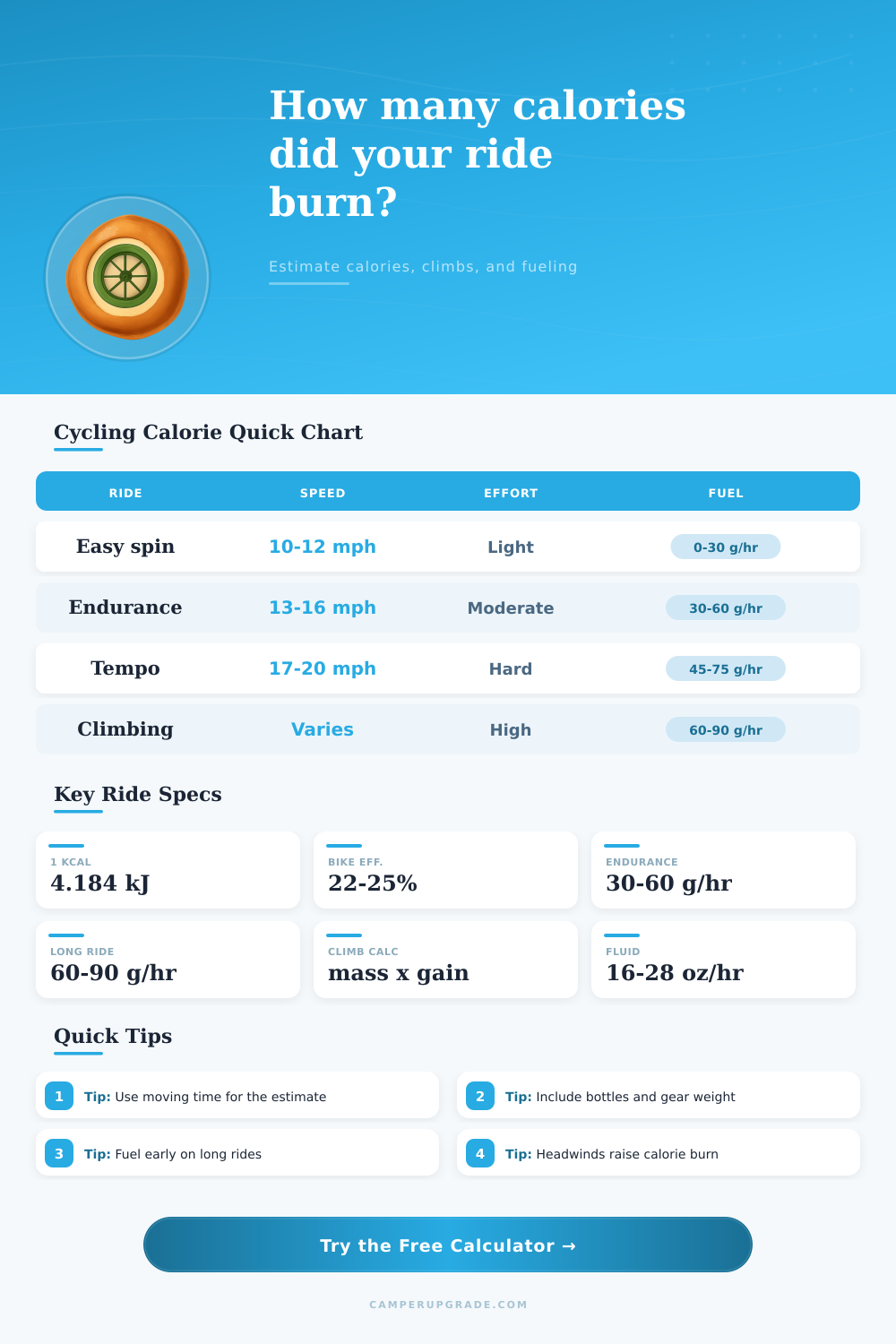
| Under 60 minutes | 0-30 g/hr | 12-20 oz/hr | Water is often enough for easy spins |
| 1-2 hours | 30-45 g/hr | 16-24 oz/hr | Start early if pace is tempo or harder |
| 2-3 hours | 45-60 g/hr | 18-26 oz/hr | Use steady snacks, drink mix, or gels |
| 3-5 hours | 60-90 g/hr | 20-28 oz/hr | Practice high-carb fueling before events |
| Long bikepacking day | 60-80 g/hr | Varies by heat | Plan stores, water stops, and backup food |
| Ride type | Typical time | Common burn rate | Notes |
|---|---|---|---|
| Easy commute | 25-60 min | 250-450 kcal/hr | Stops and low intensity reduce burn rate |
| Endurance road ride | 1.5-4 hr | 450-750 kcal/hr | Weight, wind, and hills drive variation |
| Gravel ride | 2-6 hr | 550-850 kcal/hr | Rolling resistance raises steady effort |
| MTB trail ride | 1-3 hr | 600-900 kcal/hr | Technical work adds surges and body load |
| Hard group ride | 1.5-3 hr | 700-1,000 kcal/hr | Drafting lowers some cost, surges raise it |
| Loaded bikepacking | 4-9 hr | 500-850 kcal/hr | Gear weight matters most on climbs |
Calculating energy expenditure is an important process for a person who ride a bicycle, mainly because calculating energy expenditure allow for the understanding of how much food and water a person need to consume. There is several different inputs that can be used to create an estimate of a persons energy expenditure while cycling. These different inputs includes a persons weight, the weight of the bike and gear, the profile of the route to be taken, and the intensity with which the cyclist intends to ride.
Each of these variables must be entered into the calculator to provide an accurate estimate of energy expenditure for that individual cyclist. The weight of the cyclist is one of the primary factor in calculating energy expenditure. Energy must be expended to move the cyclists body mass; each pound of the cyclists body weight must be moved both uphill and during periods of acceleration.
How to Calculate Calories Burned on a Bike Ride
The cyclist need to enter the weight into the calculator; the cyclists body weight impact the rate at which the cyclists heart beat and the bodys power meter while cycling. Additionally, the calculator also receives the weights of the bike and the gear (such as clothing). The weight of the bike and gear impact only variable related to gravity (such as climbing uphill).
For instance, bike and gear weight has a minimal impact on flat area but a significant impact on mountain passes. The calculator uses distance and time to verify the reality of the cyclists ride. For instance, if distance and time are entered into the calculator, the calculator can verify whether the cyclists speed was true over the total number of minutes that the cyclist move.
The cyclist may have experienced various stops caused by traffic lights, mechanical problems with the bike, or other issues that may not reflect the true average speed for the cyclists ride. Another element of the route that is entered into the calculator is the elevation gain. The calculator calculates the elevation gain as a separate component, as climbing uphill requires a certain amount of energy expenditure from the cyclist to move the body mass against gravity.
Therefore, a flat route and a route that include numerous climbs can be of the same distance but require more energy to ride the route with numerous climbs. Other factor that may impact the amount of energy that is needed for a cyclist to ride includes the terrain of the ride, the presence of wind, and the intensity at which the cyclist intends to ride. For instance, roads that are paved allow for the cyclist to coast while riding, but gravel or sand may require more energy to roll the bike.
Additionally, if there is a headwind, more energy will be required to counteract that headwind. Finally, the intensity component allow for the cyclist to select the intensity of energy expenditure; recovery spins may require minimal energy expenditure, but a race may require significantly more energy. These different variable allow the calculator to provide an accurate number of calories that the cyclist will expend during the ride.
The total number of calories can be determined for the cyclists ride, but the hourly rate of calories may be more important for determining how to fuel the cyclist during the ride. For instance, if the hourly rate indicates that the cyclists efforts are endurance-based, then fueling targets can be established. For rides that are of short distances, fueling from stored glycogen may be all that is required.
However, for long distances, cyclists need carbohydrates to maintain a stable blood sugar level. Additionally, the targets for carbohydrates may need to be adjusted for the bodys response to heat or high intensity. Individuals that have practiced consuming high amounts of carbohydrates can consume at the top of the recommended range, but individuals that have not may need to stay in the middle of the range.
These targets for calories can be used for various reason. The calculator calculates the energy that is used for climbing mountains separately. The calculation begins with the consideration of the energy required to move the cyclists body mass uphill against gravity.
This mechanical energy is calculated and then the calculator converts it to metabolic calories; the human body is known to be efficient in performing this specific conversion. The energy calculations for climbing mountains is added to the base calculation of energy expenditure. However, the calculation account for the overlap of energy that is used for the same effort so that energy is not calculated twice.
This calculation is useful if an individual wishes to compare two different routes by the amount of energy that is required to ride each route. For instance, a 40-mile flat route may require the same amount of energy expenditure as a 30-mile route that includes numerous climbs. The tables that are included in the calculator allow the cyclist to compare the energy calculations performed by the calculator.
These tables include calculations for different terrains, different wind conditions, and energy expenditure calculations for various intensities. Additionally, each table have fueling targets for carbohydrates and fluids based off the length of the cyclists ride. Each of these targets are targets that should be adjusted according to the cyclists experience with the ride.
There are two mistake that cyclists should avoid when using the calculator. The first error is using the number of calories that can be expended during the ride as a means of calculating daily calories expenditure. The energy expenditure that is calculated during the ride is only one component of the cyclists total daily calories.
The other component is the cyclists daily movement and the calories that are consumed by the cyclist that day. The second error is to use the total length of the ride in place of the length of time that the cyclist moved the bike. The cyclist may make numerous stops during the total length of the ride, which would make the total length of the ride longer than the time that the cyclist spent moving the bike at all.
Thus, time should be calculated as the actual number of minutes that the cyclist move while pedaling the bike. Wind is one of the variables that may have an impact upon the energy expenditure of a cyclist. If there is a headwind, energy must be expended to move against that headwind.
A crosswind may also increase the energy that is needed to ride because the cyclist must utilize more control over their body to account for that crosswind. The calculator allow for these variables to be included in the calculation of the energy expenditure by the cyclist. Terrain is another variable.
For instance, if the cyclist intends to ride on a paved path that has many stop signs, there will be energy expenditure for the cyclist to accelerate their bicycle to desired speeds at various points along the route. The terrain multiplier allow the calculator to account for these types of terrain issues. Calculating energy expenditure for each ride over time may reveal some pattern of the cyclist.
For instance, the cyclist may notice that temperature has an impact upon the bodys energy expenditure rate. Additionally, the cyclist may notice that the energy that is needed to ride with a given amount of water has a different energy expenditure rate than when riding without water. These observations may allow for the cyclist to better decide how much food to pack and how much food to consume while cycling.
Thus, the value of the calculator may lie in the habit of thinking about the energy expenditure, terrain, and fueling requirements for a ride prior to ever beginning to ride the bicycle. Once cyclists establish that habit, the calculator can then be used to verify those assumption prior to beginning to ride.