Cross Country Ski Size Calculator
Estimate cross country ski length from skier height, loaded weight, ski type, style, terrain, skill level, flex preference, and control needs.
🎿Skier and Trail Presets
⚙Height, Weight, Style, Terrain, and Skill Inputs
Final ski flex should be checked against the manufacturer weight chart for the exact model. This calculator estimates length and fit direction across common cross country categories.
🔢Cross Country Ski Sizing Formula Cards
Height Base
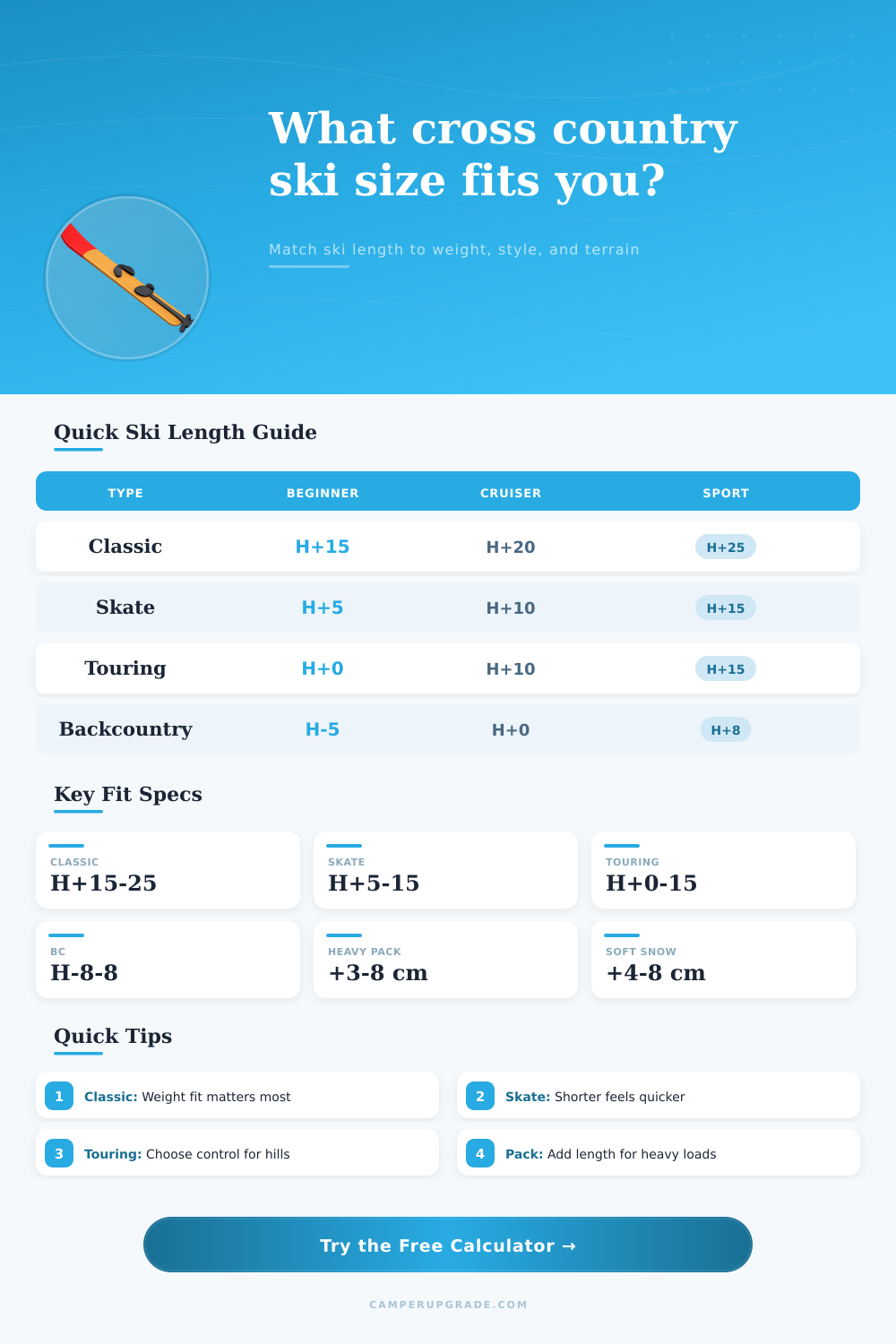
height + typeClassic skis usually start above height, skate skis stay closer to height, and control touring skis shorten for turns.
Loaded Weight
body + packSkier weight plus carried load checks whether the ski needs more support, longer running surface, or stiffer camber.
Terrain Trim
glide vs turnFlat groomed snow rewards length, while hilly tracks, tight woods, and new-skier balance reduce the target length.
Flex Match
kick pocketClassic and waxless skis need enough camber for glide but enough closure for grip; skate skis favor torsional stiffness.
📏Ski Type and Spec Grid
📊Cross Country Ski Size Tables
| Skier Height | Classic | Skate | Touring |
|---|---|---|---|
| 150 cm / 4 ft 11 in | 165-175 cm | 155-165 cm | 150-165 cm |
| 160 cm / 5 ft 3 in | 175-185 cm | 165-175 cm | 160-175 cm |
| 170 cm / 5 ft 7 in | 185-195 cm | 175-185 cm | 170-185 cm |
| 180 cm / 5 ft 11 in | 195-205 cm | 185-195 cm | 180-195 cm |
| 190 cm / 6 ft 3 in | 200-210 cm | 190-200 cm | 190-205 cm |
| Loaded Weight | Classic Flex | Touring Flex | Skate Flex |
|---|---|---|---|
| 45-60 kg / 99-132 lb | Soft to medium | Soft | Soft-medium |
| 60-75 kg / 132-165 lb | Medium | Medium | Medium |
| 75-90 kg / 165-198 lb | Medium-stiff | Medium-stiff | Stiff |
| 90-105 kg / 198-231 lb | Stiff | Stiff | Stiff-plus |
| 105 kg+ / 231 lb+ | Extra stiff | Stiff-plus | Extra stiff |
| Terrain | Length Bias | Why | Best Type |
|---|---|---|---|
| Flat groomed track | +2 to +5 cm | Longer glide | Classic or skate |
| Rolling groomed | 0 cm | Balanced travel | Classic or skate |
| Hilly trails | -3 to -6 cm | Easier turns | Touring |
| Ungroomed mixed | 0 to +4 cm | Support and track | Light touring |
| Tight wooded route | -6 to -10 cm | Quick pivot | Backcountry |
| Ski Type | Width | Camber | Length Note |
|---|---|---|---|
| Classic track | 41-48 mm | Double camber | Longer for glide |
| Skate | 41-45 mm | Single stiff | Shorter than classic |
| Recreation waxless | 48-60 mm | Soft double | Control-friendly |
| Light touring | 55-68 mm | Moderate | Match terrain |
| Backcountry metal-edge | 60-100 mm | Single/half | Short for turns |
💡Ski Fit Tips
This sizing tool is a planning guide. Binding position, ski construction, camber, sidecut, snow temperature, and exact manufacturer flex ranges can move the final choice by one available size.
Choosing the correct length for cross country skis involve several different variable. The length of cross country skis that a person will purchase will depend on more than just a person’s height. Cross country skis that are too long for an individual will be difficult to turn while the individual is traveling on trails with tight spaces or area with trees to cross.
Additionally, cross country skis that are too short for an individual will cause that person to lose the glide necesary for even the most basic form of movement while on the trail. Several different variables will influence the length of cross country skis that a person purchases, including the weight of the individual, the weight of the gear that they will be carrying, the terrain that will be skied, and the skier’s desired balance between control and speed when skiing. Classic cross country skis and skate cross country skis has different rules regarding the length of the skis that should be purchased.
How to Choose the Right Length for Cross Country Skis
Many individuals use the rule that classic cross country skis should be taller than an individual’s height and that skate cross country skis should be closer to their height. However, an individual’s weight can play a significant role in the length of cross country skis that they should select. Classic cross country skis and waxless cross country skis work by utilizing the camber of the ski to provide the individual with both glide and grip zones.
However, if the weight of the individual and the gear that they use to ski cross country is too heavy for the cross country ski, then the grip zone will not be able to engage the skier on there ski. On the other hand, if the weight of the individual and the gear that they use to ski cross country is too light for the cross country ski, then the cross country ski will be too stiff for that individual to be able to achieve the kick with which they need to ski uphill. The terrain that is to be skied can impact the length of cross country skis that an individual should select for purchase.
Terrain can impact the length of cross country skis because different terrain can require different amount of control from cross country skis. For instance, flat and groomed trails will allow an individual to use longer cross country skis, as they will remain in a straight line for longer distances while skiing. Rolling trails may require fewer adjustments in the length of cross country skis that an individual uses, but individuals who encounter hilly or tight trails may find that it is better to purchase cross country skis with more length than those that are sold with less length.
The terrain setting within the calculator allows for these different types of terrain to be accounted for without requiring an individual to remember the rules regarding each type of terrain. Another variable that can impact cross country ski length is the skill level with which the individual manage their cross country skiing. Beginners will find it beneficial to have shorter cross country skis that will find it easier to turn when compared with the longer cross country skis that an individual who has experience skiing cross country may select.
Therefore, the skill level within the calculator will ensure that a beginner does not select a length that they may find too difficult to control, and that an advanced cross country skier does not purchase cross country skis with a length that is too conservative regarding their skiing skill. One of the most critical component of cross country skiing that individuals often overlook is the flex of the cross country skis. Cross country skis with a soft camber will find it easier for an individual to achieve the kick that is required for cross country skiing.
However, soft cross country skis will make it difficult for an individual to maintain control over the ski at high rates of speed. For the same reasons, cross country skis with a stiffer camber will provide an individual with better glide when they are moving on their cross country ski. However, an individual will have to employ specific techniques when skiing to ensure that the cross country ski will engage the grip zone of the ski.
The flex setting within the calculator can adjust the target weight for cross country skis to account for the specific flex of the cross country ski being evaluated. The flex adjustment is important for classic cross country skis and touring cross country skis because the kick zone of classic cross country skis will need to be able to close against the weight of the individual when skiing. However, it is less important for skate cross country skis due to the way that skate cross country skis rely upon the stiffness of the edges of the cross country ski.
The conditions of the snow on the cross country trail can impact the length of cross country skis that an individual should purchase. For instance, for individuals who will be skiing on soft or deep snow, it will be beneficial for them to purchase cross country skis that are both longer and wider to provide more of a surface area for the individual to remain on the snow. For those who will be skiing on firm and fast snow, however, it will not be necessary for them to purchase cross country skis with extra length, and shorter cross country skis will allow for better control for the individual over the trail.
The size of the cross country ski boot in which an individual will be skiing can impact the length of cross country skis that are purchased. For individuals with larger cross country ski boots, there will be more leverage provided to the cross country ski with each turn that they take while cross country skiing. Therefore, an individual with larger boots may prefer cross country skis that have a greater length to that which they will experience with their boot size.
However, the calculator accounts for the impact of boot size on cross country ski length in the form of a small control penalty that can be used to adjust for such a difference in boot size. The reference tables for cross country skis indicate the length of cross country skis within each category, whether it is classic, skate, touring, or backcountry cross country skis. Each cross country ski will have the same length but may have different flex profiles.
Additionally, the calculator will indicate the flex target for the cross country ski that is being evaluated, as well as a score that indicates the level of confidence that the calculator has in the length of the cross country ski as it is recommended by the calculator. Many individuals will make mistake regarding the length of cross country skis that they are considering, and it is essential for them to consider all of the variables regarding length. For instance, an individual might consider adding length to their cross country skis for their height, but they may not be aware that their weight and the type of snow that will be on the trail will require longer cross country skis.
Another common mistake is for an individual to always choose the shortest cross country ski possible because of a sense of safety. However, using a cross country ski that is too short will significantly impact an individual’s ability to maintain the glide necessary for skiing on flat sections of the trail. To avoid such mistakes, an individual should run their inputs in the calculator to determine their recommended cross country ski length, as well as the control-to-glide range that they should use when skiing cross country.
Manufacturer weight charts can be used as a way to verify the length of cross country skis that an individual should purchase because the calculator does not account for the camber curve of every cross country ski model. The calculator can show an individual where to start purchasing cross country skis, as well as the direction in which they should adjust the length of their cross country skis. At this point, an individual can begin to discuss the flex of their cross country skis with a professional at the cross country ski shop.
Overall, an individual should seek to find cross country skis that feel natural when they ski on them and with their feet. This will be achieved if the length, flex, and terrain of the cross country ski are all properly set for that individual.