Cross Country Ski Pace Calculator
Estimate Nordic ski pace, speed, snow adjustment, climbing penalty, moving time, and finish time from distance, target time, ski style, surface, elevation, and stops.
⛷Named Ski Pace Presets
⚙Distance, Time, Style, Snow, and Elevation Inputs
This is a field-planning estimate. Wax, ski flex, pole fit, drafting, altitude, temperature swings, and technique can move real pace outside the calculated range.
📐Four Ski Pace Formula Cards
Moving Time
elapsed / (1 + rest)Target elapsed time is reduced by stop allowance to show the pace needed while actually skiing.
Base Pace
minutes / distanceMoving minutes divided by route distance gives the raw pace before terrain and snow are interpreted.
Terrain Cost
gain x climb rateClimbing adds minutes per 100 meters, while descending gives a smaller capped credit for glide.
Adjusted Time
flat x factors + terrainStyle, snow, track, skill, pack weight, and elevation combine into the route finish estimate.
❄Snow and Style Specification Grid
📊Cross Country Ski Pace and Speed Tables
| Pace | Speed | 5K Time | 10K Time |
|---|---|---|---|
| 4:00/km | 15.0 km/h | 20:00 | 40:00 |
| 5:00/km | 12.0 km/h | 25:00 | 50:00 |
| 6:00/km | 10.0 km/h | 30:00 | 1:00 |
| 7:30/km | 8.0 km/h | 37:30 | 1:15 |
| 10:00/km | 6.0 km/h | 50:00 | 1:40 |
| Style | Easy Pace | Steady Pace | Fast Pace |
|---|---|---|---|
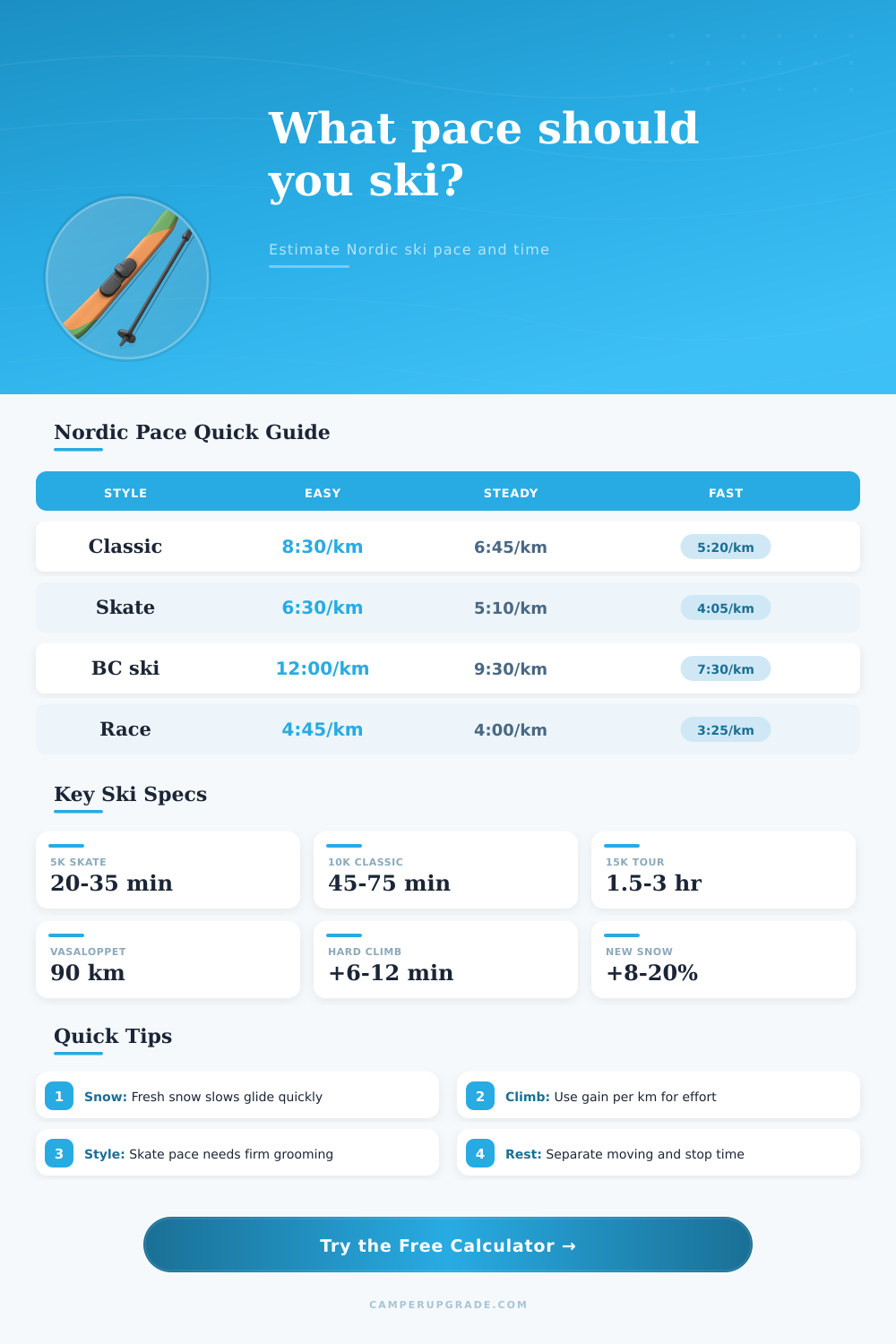
| Classic | 8:30/km | 6:45/km | 5:20/km |
| Skate | 6:30/km | 5:10/km | 4:05/km |
| Double pole | 6:45/km | 5:30/km | 4:30/km |
| Backcountry | 12:00/km | 9:30/km | 7:30/km |
| Race effort | 4:45/km | 4:00/km | 3:25/km |
| Snow | Factor | Use For | Feel |
|---|---|---|---|
| Cold fast | 0.94x | dry groomer | quick glide |
| Firm packed | 1.00x | baseline | predictable |
| Soft groomed | 1.07x | warm track | slower push |
| Fresh snow | 1.14x | light cover | muted glide |
| Wet spring | 1.20x | suction snow | sticky |
| Powder | 1.30x | untracked | touring |
| Gain Per KM | Route Shape | Classic Add | Skate Add |
|---|---|---|---|
| 0-10 m | flat lake | 0-1 min | 0-1 min |
| 10-25 m | rolling trail | 1-3 min | 1-2 min |
| 25-45 m | hilly loop | 3-6 min | 2-5 min |
| 45-70 m | climb-heavy | 6-10 min | 5-9 min |
| 70+ m | mountain course | 10+ min | 9+ min |
💡Ski Pace Planning Tips
A pace calculator for Nordic skiing is a tool that skiers use to plan there days on the snow and to calculate how long their skiing outing will take. Planning a ski day is a challenging task due to the various variable that impact how long a skiing outing will take. These variables include, but are not limited to, the distance to ski, the quality of the snow on the trail, and the degree of elevation gain that the skier will cover on that outing.
The pace calculator take these variables as inputs to calculate two different output: the moving time for the skier and the adjusted finish time for the skiing trip. The variables that are used to calculate moving time and adjusted finish time is costly for the skier. The style of skiing that a skier performs is one of the most important variable for the calculator to understand how to account for the time that a skier will require for the outing.
How to Use a Nordic Ski Pace Calculator
Classic skiing and skate skiing are two different style that require different amounts of time to complete the same trail. Snow condition is another cost for the skier that the calculator can account for. Fresh snow will cost the skier more time than firm snow because the fresh snow will create more friction for the skis.
Cold, groomed snow will provide a benefit to the skier and save them time on the trail compared to soft snow. Track quality is another cost for the skier as it will impact how much effort the skier must use to ski on those tracks. Elevation gain and loss are two of the most important variable to account for in the pace calculator.
Unlike runners who find elevation gain and loss to be the same for all skiers, elevation gain will cost a skier time because of the effort required to climb uphill on ski equipment. The pace calculator will account for this cost by asking for the skier to input the amount of elevation gain they will experience on their skiing outing. The calculator will apply a penalty for every hundred meters of elevation gain that a skier must climb.
Additionally, the same calculator will apply a smaller credit for the time saved when a skier descends in elevation. Pack weight is another cost for a skier that the calculator can account for. The heavier a skier is with their skiing gear, the more time they will require on the trail.
Additionally, the impact of pack weight is most significant on tracks with steady gains in elevation and on tracks with soft snow. The calculator will increase the condition factor if a skier has a heavy pack. Skier level is also a cost for a skier that the calculator can account for.
Beginners apply more time to there skiing than an advanced skier due to the learning curve for beginners. Thus, the calculator will apply a terrain penalty and snow penalty that is more significant for beginners. The rest allowance for a skier is another cost that can be accounted for in the calculator.
Rest allowance is the amount of time a skier takes away from their skiing for other tasks. Tasks like taking photos of the scenery, checking their skiing equipment for wax and sharpness, and taking a snack break will all take time away from skiing. Thus, it is important for a skier to account for this time in their trip plan.
The calculator will produce several different output variable for the skier after the skier accounts for the various cost of skiing for that specific trip. The calculator will display the moving pace and moving speed for a skier. Additionally, the calculator will all be calculated for that skiing trip: the adjusted finish time, the firm-trail equivalent pace, and the firm-trail equivalent pace.
The moving pace and the adjusted finish time are two different variable for skiing trips of longer distances. The distance of 30 kilometer on firm snow will produce a certain moving pace for a skier; however, the same skier will produce a higher adjusted finish time on the same distance on fresh snow. Thus, these two variables allow a skier to account for weather and snow conditions on their skiing trip before they leave the house.
Although the ski trail pace calculator will offer an estimate of a skier’s trip, that calculation will not provide any guarantees about that skier’s pace. The variables outside of the three that the calculator will account for will impact a skier’s ability to stick to the pace that was calculated in the calculator. For instance, the choice of wax for the skiing skis, the flexibility of the skiing skis, and the temperature fluctuations will all impact the pace of a skier.
Additionally, the drafting of other skiers will impact the pacing of that specific skier. Thus, the skier should treat the output of the calculator as the target pace that they should aim for when on the trail. Many skiers focus solely on the total elapsed time for their skiing trips.
However, those skiers may become discouraged when they have to account for the time that they took for breaks during their trip. Separating the moving pace from the rest allowance for skiing trips will prevent these discouraged feelings from developing in skiers who focus on the total elapsed time on their skiing trip. The reference tables on the calculator page display the same information as the pace calculator displays.
The reference tables show the varying speed that skiers can achieve on different types of skiing tracks and on different types of snow. For instance, the snow factor grid will display why fresh snow will require more time to ski than firm groom snow tracks. Additionally, the climb table will show how many additional minute a skier will require to gain a certain amount of elevation over a kilometer.
The climb table can help a skier decide between two different skiing tracks. After skiing with a pace calculator for a few outing, a skier will be able to develop an intuition of how snow conditions and elevation gain will impact their moving pace. The calculator will display the same number for skiing trips with the same variables.
Thus, a skier can learn the impact of certain variable on their moving pace through repetitive skiing trips. Another useful habit for a skier who intends to use a pace calculator is to run the numbers twice on a skiing trip with uncertain snow conditions. By plugging in the variables for the trail and the skier’s usual skiing skill level, the skier can calculate the time that they will take for a trip with the forecasted snow conditions.
Additionally, they can input the variables again, but with a softer snow level and a lower skiing skill level to account for the time that it will take to ski in these conditions. By comparing the two times, the skier can set a time limit for themselves to account for the softer snow and their skiing skill level. By establishing this limit, the skier can better expect their skiing trip to take in the time that it will.
It should of been noted that most skiers find this helpfull. Youll find that most people dont realize how much the snow can change things. It is a lot more difficult than it looks.
Most skiers would of liked a more moddern interface. Even if you cant see the difference, the calculator works well based off the data. Just make sure you dont forget to check your gear.