Crevasse Rescue Haul Ratio Calculator
Estimate the effective haul ratio, team pull, rope movement, and anchor load for common glacier rescue hauling systems.
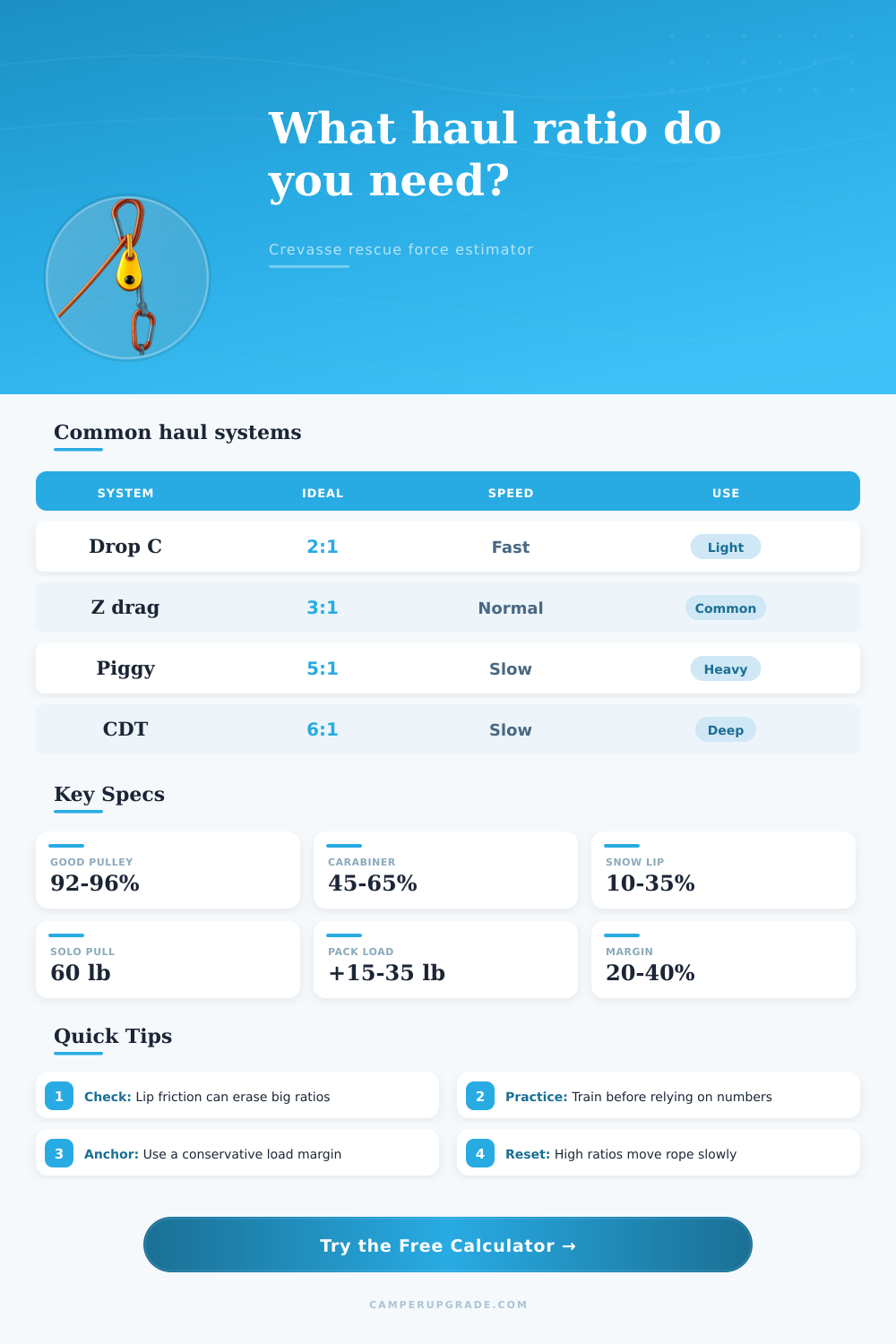
| Field system | Ideal mechanical advantage | Haul strand travel for 10 ft lift | Typical tradeoff |
|---|---|---|---|
| Direct 1:1 hand haul | 1:1 | 10 ft | Fast movement, very high pull demand. |
| Drop loop or C assist | 2:1 | 20 ft | Simple assistance, limited advantage if edge drag is high. |
| Z drag / simple 3:1 | 3:1 | 30 ft | Common compact system with manageable resets. |
| 5:1 piggyback on Z | 5:1 | 50 ft | Lower pull demand but more rope handling. |
| 6:1 compound / Canadian drop | 6:1 | 60 ft | Powerful for heavy loads, slower and more complex. |
| 9:1 training rig | 9:1 | 90 ft | Very low pull force but resets are frequent. |
| Component or condition | Planning range | Calculator use | Field meaning |
|---|---|---|---|
| Oval or HMS carabiner as pulley | 45-65% | Pulley efficiency | Large loss from rope sliding over metal. |
| Small pulley | 82-90% | Pulley efficiency | Good compact glacier kit option. |
| Sealed rescue pulley | 92-96% | Pulley efficiency | Best force transfer and smoother resets. |
| Friction hitch progress capture | 70-85% | Capture efficiency | Grip, ice, dressing, and cord choice matter. |
| Sharp snow lip | 20-50% loss | Lip friction | Edge protection or excavation changes the math. |
| Load profile | Imperial estimate | Metric estimate | Use in calculator |
|---|---|---|---|
| Small climber, pack removed | 130-160 lb | 59-73 kg | Practice, low load teams. |
| Average climber with harness layers | 170-210 lb | 77-95 kg | Common planning value. |
| Large climber or wet winter kit | 220-260 lb | 100-118 kg | Use higher safety margin. |
| Victim plus pack/skis attached | 250-310 lb | 113-141 kg | Expect more edge and reset work. |
| Two-person rescue load practice | 330-420 lb | 150-191 kg | Training only with expert supervision. |
| Hauler stance | Sustainable pull | Short burst pull | Planning note |
|---|---|---|---|
| Kneeling, poor snow platform | 35-55 lb | 60-80 lb | Use a conservative margin and expect fatigue. |
| Standing, braced feet | 55-85 lb | 90-130 lb | Good default for a practiced team. |
| Two haulers in line | 110-160 lb | 180-250 lb | Coordination and rope handling become limiting. |
| Mechanical ascender haul team | 70-100 lb each | 120-160 lb each | Better grip, but anchor and lip loads still rule. |
Seconds after your partner tumbles down a crevasse, you have to evaluate both rope dynamics and anchor stability. The window for panic is small; the time for action, not so much. While most guides knows the best mechanical advantage of their hauling system by memory, few appreciate how field conditions erode that advantage. What should of been a theoretically 6:1 system may only function as a 3:1 after the rope skates along an oval carabiner (not a pulley) or sinks it teeth into a sharp snow lip. This makes all the difference between a successful rescue and a failure. It is a fruitless failure that leaves the team spent.
This calculator on this page is a way to turn good ratios into practical force needs. It takes into account edge drag, pulley efficiency, and rope friction loss. Friction loss will be a factor in any glacial rescue situation. The tool also factors in weight of all that wet gear: heavy packs, ice-encrusted clothes, ropes. Because the victim may weigh twice as much with all that snow and gear as they do on dry land. And that has a lot to do with how much “resistance” they have. Plug in your suspended load weight and the tool calculates out the pull force per hauler to help you gauge whether your team can handle the lift or whether you’ll have to add some other to the line.
Why this rescue calculator is useful
For instance: A rounded crevasse lip allows for easier rope movement; a sharp lip functions as a brake. Enter that into the calculator, and it tells you how much of your pulling power is going to be lost to abrasion or melted snow. That’s why digging out the bottom of the crevasse before rigging isn’t only good practice, it’s also a mechanical need. It restores half the lost advantage of a high-ratio system, without the need for any additional complex pulley configuration.
The page has reference tables that put the numbers in context for hardware decisions. For example, specialized rescue pulleys is far more efficient than traditional carabiners. That’s why it makes sense to carry at least one good one in your glacier kit, even if it never gets used. The small increase in pack weight are balanced by the increased force you recover when needed. And then there’s those other drag coefficients introduced by progress capture devices like friction hitches. These keeps from slipping when reset but do eat up a bit of the haul energy. Knowing that balance allows you to choose where to adjust hitch tension vs. You can also add an additional hauler.
In compound systems, teams can be underestimating the amount of force their anchors is taking. When you add mechanical advantage to decrease the personal force required, total force applied to your primary anchor increases by equal measure. This maximum demand is what the tool calculates and it gives you something with which to compare strength of your anchor. If the calculated force comes close to exceeding the capacity of your C-pit or snow pit, consider reinforcing that anchor prior to pulling hard on it. Built-in safety factors in the calculator help accommodate bad footing around the rim and anchor fatigue.
The variables become instinctive, not arithmetic, after practice. Run through some drills on level ground with your training bags in hand to experience first-hand what various ratios equate to in terms of rope speed during rescue. The lower ratio systems will tax your initial strength and pace rapidly as they cover distance quickly per pulling cycle. The higher ratio systems take time and patience and will force you to reset more often, pushing the limits of both coordination and endurance. The calculator simulates this movement so you can get a sense for the rhythm beforehand without having to endure bitter winds aloft.
Preparedness is more important than improvisation in a rescue situation. The numbers need to be known ahead of time so there’s no dilly-dallying when time matter. The tool helps you estimate if the rig can support the load or if it needs more reinforcement. Instead, you’re free to concentrate on helping the victim while communicating with each other. Run through the math in practice so every team member knows what they can handle physically and from a gear standpoint. Then when the chips are down, all that’s left is executing and getting your partner home safe.