Cordelette Length Calculator
Estimate the cut length for a climbing cordelette from anchor span, master point drop, knot choice, tie-in style, cord material, diameter, tails, and reserve cord.
🧗Cordelette Anchor Presets
⚙Anchor Span, Knot, Tie-In, and Cord Inputs
This calculator estimates cord geometry only. Climbing anchors require trained judgment, rated equipment, sound placements, and partner checks.
📏Cord Material and Spec Grid
🧵Cord Material Notes
Nylon accessory cord
forgivingGood knot behavior and some stretch. Bulkier at 7 mm, but familiar for everyday anchors.
Aramid cord
compactHigh heat resistance and low stretch. Knots need careful dressing and inspection.
Dyneema blend cord
low stretchLight and strong by rating, but slippery bends and knots demand extra care.
Polyester static cord
stableModerate handling with lower water absorption. Check device and knot compatibility.
📊Cordelette Length Tables
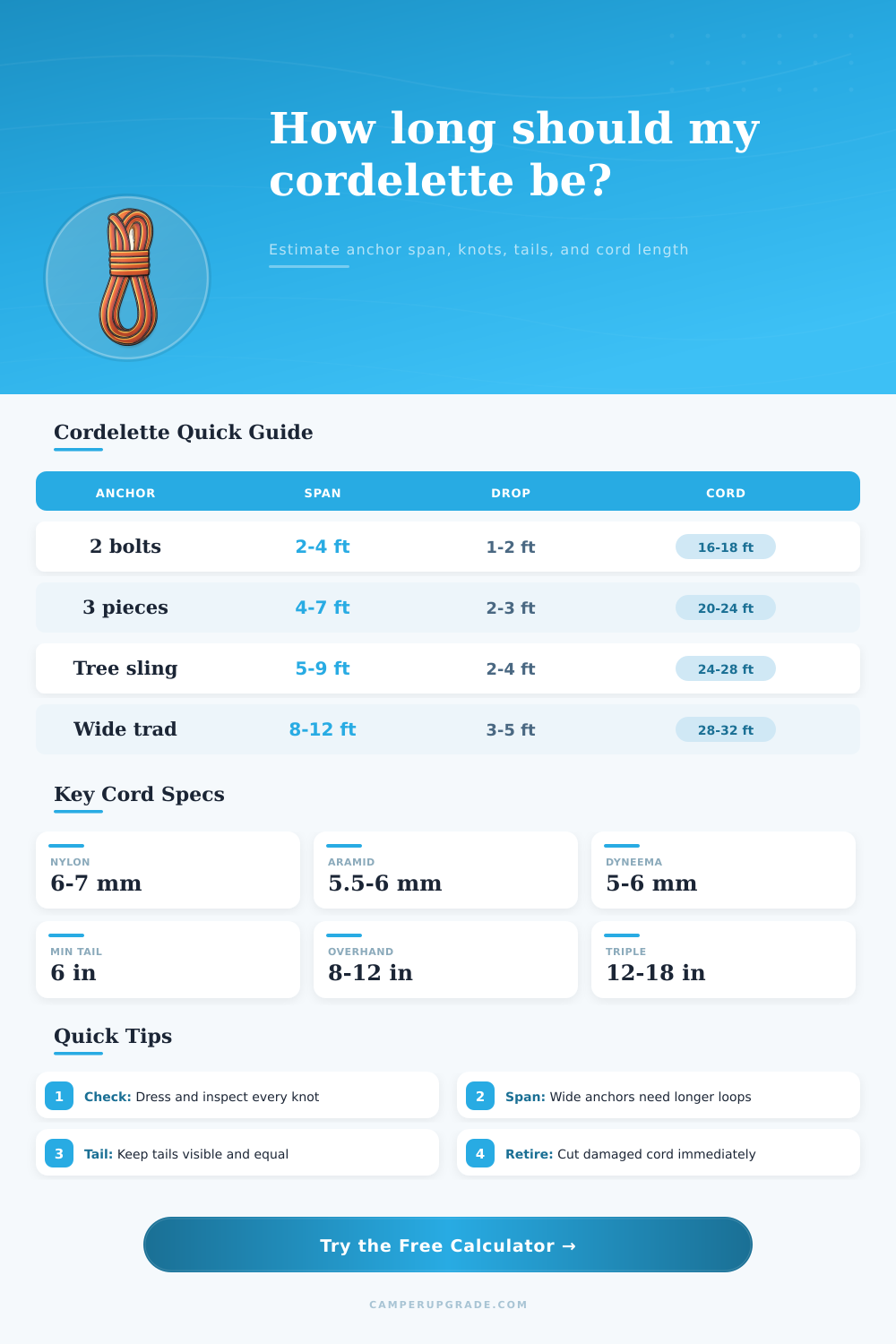
| Anchor type | Span | Drop | Cut length |
|---|---|---|---|
| Two close bolts | 2-4 ft | 1-2 ft | 14-18 ft |
| Compact 3-piece trad | 3-5 ft | 2-3 ft | 18-22 ft |
| Wide 3-piece trad | 6-9 ft | 2-4 ft | 24-28 ft |
| Tree or horn anchor | 6-10 ft | 2-4 ft | 26-32 ft |
| Four-point stance | 7-12 ft | 3-5 ft | 28-36 ft |
| Knot type | Allowance | Best use | Note |
|---|---|---|---|
| Double fisherman's | 16-24 in | Closed loop | Secure, compact bend |
| Flat overhand bend | 12-18 in | Retrievable cord | Needs long tails |
| Overhand master | 8-12 in | Cordelette master | Fast and bulky |
| Figure-eight master | 12-18 in | Training anchors | Easy to inspect |
| Triple fisherman's | 20-30 in | Small slick cord | Consumes more cord |
| Cut length | Approx loop | Compact reach | Wide reach |
|---|---|---|---|
| 16 ft | 7-7.5 ft | 2-bolt anchors | limited |
| 20 ft | 9-9.5 ft | 3-piece anchors | moderate |
| 24 ft | 11-11.5 ft | standard trad | good |
| 28 ft | 13-13.5 ft | large anchors | strong |
| 32 ft | 15-15.5 ft | rescue rigging | strong |
| Material | Diameter | Handling | Adjustment |
|---|---|---|---|
| Nylon | 6-7 mm | easy knots | standard |
| Aramid | 5.5-6 mm | stiff | +5% |
| Dyneema blend | 5-6 mm | slick | +8% |
| Polyester static | 6-7 mm | firm | +3% |
| Small cord | under 6 mm | tiny knots | +6 in tails |
💡Cordelette Calculation Tips
Calculating the correct length for a cordelette is an important task for a climber. If the cordelette is too short, it wont be able to reach the master point. Similarly, if the cordelette is too long, it can create excessive sag in the anchor system.
The cordelette should create a loop that allow for the equalization of the chosen anchor pieces, but it should not waste cord or create excess sag in the cordelette. Several variables will determine the length of the cordelette that is require to establish a secure anchor system. These variables includes the length of the span of the anchor system, the vertical drop distance, the type of knot that will be used, and the diameter of the cordelette.
How to Find the Right Cordelette Length
The geometric shape of the chosen anchor system will have an impact on the length of the cordelette that is required. For example, if two bolts are use in an anchor system, and those bolts are close together, less cordelette will be required than if three different anchor pieces are to be utilized. The length of the span between the anchor pieces is a critical measurement of the anchor system.
The length of the span of the anchor pieces and the vertical drop distance will determine the amount of cord that is require to create the loop. The vertical drop is the distance between the anchor pieces to the master point that will be used to lower the climber into the area that is to be climbed. The types of knots that are to be used in the cordelette can also impact the length of the cordelette that is required.
For instance, a double fisherman’s bend will require more cordelette than a flat overhand knot. Furthermore, the type of cord will also impact the amount of cordelette that are consumed by the knot. If the cordelette is made of a stiff material, it will consume more cord than if the cord is slickly.
Ensuring that the type of knot is chosen will allow the calculation of the cordelette to account for the amount of cord that the knot will consume. Additionally, the tails of the knots must also be accounted for. The tails of knots should be at least six or seven inches in length to ensure they dont roll underneath the load of the anchor system.
A calculator can be used to ensure that the length of the tails is build into the length of the cordelette that is to be cut. The material out of which the cordelette is made will also impact the length of the cordelette. For instance, nylon is an easy material to inspect for damage but will stretch and absorb water.
Aramid and Dyneema materials will not stretch and will withstand heat but may be less forgiving in the event that the cordelette is not tied with care. The diameter of the cordelette must also be accounted for in the equation. Thinner cordelette will require longer tails so that it is secure when tied.
The diameter of the cordelette must be accounted for in the calculation to ensure the amount of cord that are consumed by the knots is calculated correctly. The circumference of the object that the cordelette will be wrapped around will also impact the length of the cordelette. If the cordelette is to be wrapped around an object such as a tree, the circumference of that object will require that some of the length of the cordelette be consume by the circumference of that object.
Furthermore, the number of times that the cordelette will be wrapped around that object will also impact the required length of the cordelette. The average circumference of the object that the cordelette will be wrapped around can be measured. Furthermore, the number of times that the cordelette will be wrapped around that object can be determined.
This information can be accounted for in the calculation that determines the length of the cordelette. The evenness of the placement of the anchor pieces will also have some impact on the length of the cordelette. The placement of bolts that are offset from one another on overhang walls will require more cordelette to account for the difference between these two bolts.
Finally, it is also wise to include a percentage of reserve cord in the cordelette that is calculated. The reserve percentage of the cordelette will account for the difference between the length of the cordelette that is calculated and the length that is actualy use once the cordelette is dressed. A ten percent reserve in the length of the cordelette is commonly used.
Using a reserve percentage less than ten percent may cause the cordelette to be too short to effectively reach the master point when the cordelette is under load. Finally, the calculated length of the cordelette should be compared with the length of the cord that a climber has in their gear. Most cordelette cord comes in standard lengths.
A calculator can be used to determine the length of the cordelette that should be purchased to account for the length calculations. The length of the cordelette should be checked against the length of the cord that is already on a rack in the climber’s gear to ensure that it will not be cut to a length that is too short for other anchor points that can also be utilized in the future. The goal of calculating the length of the cordelette is to create a loop that will effectively reach the master point, allow for the even equalization of the anchors pieces, and allow for enough tail to the cordelette to inspect for damage.