Cooler R Value Calculator
Estimate a camping cooler's insulation R-value, U-factor, heat gain, and daily ice melt from wall thickness, foam type, cooler dimensions, gasket quality, and temperature difference.
🧊Cooler Construction Presets
⚙Cooler R-Value Inputs
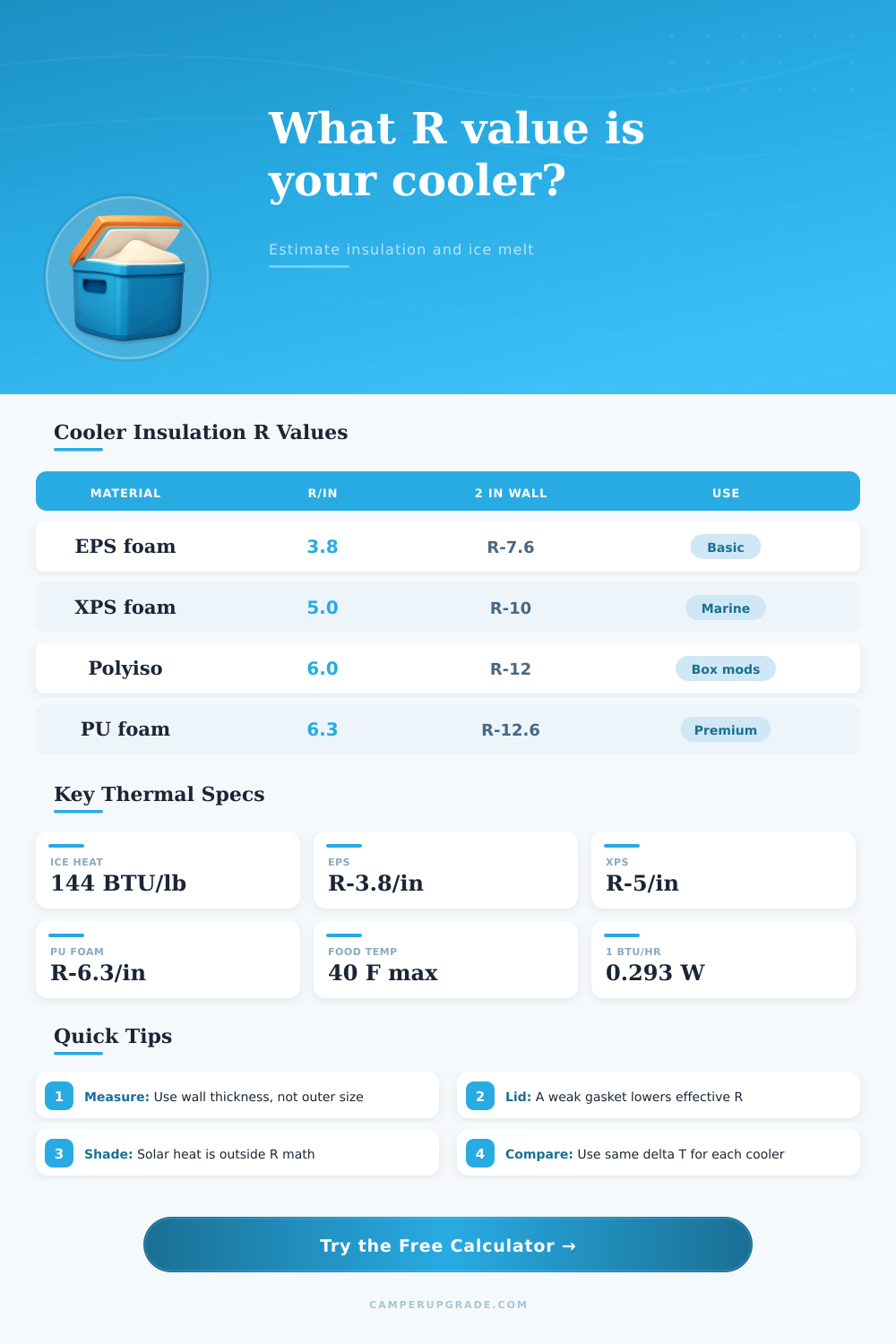
R-value is expressed in hr·ft²·°F/BTU. Heat gain is estimated with Q = area × delta T / effective R, then ice melt uses 144 BTU per pound of ice.
📊Estimated Material R-Value Grid
Fiberfill soft cooler
R-2.8/inFlexible batting used in many soft-sided lunch and grocery coolers.
EPS bead foam
R-3.8/inCommon low-cost molded foam; performance depends on density and fit.
Reflective air gap
R-4.0/inNeeds an air space; compressed foil layers perform much lower.
XPS board foam
R-5.0/inClosed-cell board foam often used in DIY cooler boxes and inserts.
Polyiso board
R-6.0/inHigh R per inch, but cold-temperature performance can drop somewhat.
PU cooler foam
R-6.3/inCommon in better hard coolers and rotomolded insulated chests.
Vacuum panel
R-25/inVery high performance if intact, protected, and not punctured.
Mixed unknown wall
R-4.5/inUse when the cooler material is unknown or varies across the shell.
📘R-Value And Insulation Reference Tables
| Insulation | R per inch | 2 in wall | Notes |
|---|---|---|---|
| Fiberfill batting | 2.5 to 3.2 | R-5 to R-6.4 | Soft coolers |
| EPS bead foam | 3.6 to 4.2 | R-7.2 to R-8.4 | Basic hard coolers |
| XPS foam board | 4.7 to 5.2 | R-9.4 to R-10.4 | DIY inserts |
| Polyiso board | 5.6 to 6.5 | R-11.2 to R-13 | High R panels |
| PU closed-cell foam | 5.8 to 6.8 | R-11.6 to R-13.6 | Premium coolers |
| Vacuum panel | 20 to 30 | R-40 to R-60 | Specialty panels |
| Wall thickness | EPS | XPS | PU foam |
|---|---|---|---|
| 0.75 in | R-2.9 | R-3.8 | R-4.7 |
| 1.00 in | R-3.8 | R-5.0 | R-6.3 |
| 1.50 in | R-5.7 | R-7.5 | R-9.5 |
| 2.00 in | R-7.6 | R-10.0 | R-12.6 |
| 2.50 in | R-9.5 | R-12.5 | R-15.8 |
| 3.00 in | R-11.4 | R-15.0 | R-18.9 |
| Cooler style | Typical wall | Effective R | Why it changes |
|---|---|---|---|
| Reflective bag | 0.25 to 0.5 in | R-1 to R-3 | Thin insulation, zipper leaks |
| Soft lunch cooler | 0.5 to 1 in | R-2 to R-5 | Fabric seams and lid gaps |
| Basic 48 qt hard cooler | 0.75 to 1.25 in | R-3 to R-7 | Thin lid and drain bridge |
| Marine hard cooler | 1.25 to 2 in | R-6 to R-11 | Better foam and UV lid |
| Rotomolded cooler | 1.75 to 3 in | R-9 to R-17 | Thick foam and gasket |
| Expedition chest | 2.5 to 3.5 in | R-14 to R-22 | Heavy shell, compression seal |
| Thermal term | Formula | US unit | Metric link |
|---|---|---|---|
| R-value | Thickness / k | hr ft² F / BTU | RSI = R × 0.176 |
| U-factor | 1 / R | BTU/hr ft² F | W/m²K = U × 5.678 |
| Heat gain | A × dT / R | BTU/hr | Watts = BTU/hr × 0.293 |
| Ice melt | BTU / 144 | lb ice | kg = lb × 0.454 |
| Delta T | Outside - inside | °F | °C diff = F diff / 1.8 |
| Surface area | 2LW + 2LH + 2WH | ft² | m² = ft² × 0.0929 |
📋Cooler Spec Comparison Grid
| Example cooler | Foam type | Wall | Adjusted R | Heat leak at 50°F dT |
|---|---|---|---|---|
| Reflective grocery bag | Air gap/fiber | 0.35 in | R-1.3 to R-2.4 | High, short day use |
| 18 qt soft lunch cooler | Fiberfill | 0.75 in | R-2.0 to R-3.8 | High, small surface |
| 48 qt basic hard cooler | EPS | 1.0 in | R-3.0 to R-5.5 | Moderate-high |
| 54 qt marine cooler | PU or EPS blend | 1.5 in | R-6.0 to R-9.5 | Moderate |
| 45 qt rotomolded chest | PU foam | 2.0 in | R-9.0 to R-13.5 | Lower |
| 75 qt expedition cooler | PU foam | 3.0 in | R-14 to R-20 | Low, large shell |
🛠Practical Cooler R-Value Notes
A cooler are a container that is used to keep the food and ice cold inside the cooler. However, a cooler may fail to keep the food cold if the individual dont understand the concept of thermal resistance. Thermal resistance is a measurement of the difficulty of heat move through a material.
If heat are able to move from the outside of the cooler to the inside of the cooler, the heat will melt the ice inside of the cooler. The R value is the measurement of the thermal resistance of the materials that are used in the cooler. The more higher the R value of a cooler material, the more thermal resistance the material possesses, which means that it will be better at resisting heat movement into the cooler.
How a Cooler Keeps Ice Cold
The insulation of a cooler is typically located in the foam core of the cooler. People add foam in the cooler between the walls of the cooler. There are different types of foam, each with different levels of thermal resistance.
For instance, a two inch wall of high-density polyurethane foam will have more thermal resistance than a two-inch wall of cheap bead foam. Thus, both the thickness of the walls of the cooler and the type of insulation have an impact on the R value of the cooler. Both of these variable must be considered when considering the thermal resistance of a cooler.
Another important part of a cooler is the lid of the cooler. The lid is one of the most important parts of the cooler, as heat will typically enter the cooler through this lid. The lid of budget coolers is typically thinner than the sides of the cooler.
A thin lid will have a lower R value than the thick sides of the cooler. Since heat rise, the cooler will typically have more heat enter through the lid. If the lid of the cooler has a low R value, it will allow heat to enter the cooler, which will melt the ice within that cooler.
Thus, the lid of the cooler is another part of the cooler that must be evaluated when considering the thermal resistance of that cooler. Another component of a cooler is the seal of the cooler. This component of the cooler prevents air from entering or leaving the cooler.
The cooler may have a high R value for its insulation, but if it does not have a good seal, heat will enter the cooler through the air. For example, someone may use rubber along the rim of the cooler to create a seal, but the plastic portions of the cooler may not seal as well. Air that enters the cooler will offset the benefits that the high R value of the cooler insulation may provide.
Thus, another important component of the cooler is that it have a good seal. Another consideration of coolers is the concept of thermal bridging. For instance, materials like plastic handles or metal drain plugs may disrupt the insulation of the cooler.
Plastic and metal materials typically have a higher rate of heat conduction than the insulation of the cooler. Thus, heat will travel more quickly through the handles or metal drain plugs of the cooler than it will through the cooler’s insulation. Any gap in the cooler that may allow for heat to bridge through the cooler will also reduce the thermal resistance of the cooler.
These gaps are referred to as thermal bridges, and they will reduce the total thermal resistance of the cooler. The cooler may also be exposed to various environment. For instance, a cooler may be placed in the shade or in direct sunlight.
If a person places the cooler in direct sunlight, that sunlight will add solar load to the cooler. The solar load will heat the cooler’s plastic shell. As the plastic shell of the cooler becomes hotter, more heat will be able to move into the cooler.
Thus, this environmental exposure to heat will affect the total thermal resistance of the cooler. These variables related to the environment of the cooler should be considered in the assessment of its total thermal resistance. If the cooler is melting ice, the cause of this event is the movement of heat into the cooler.
Each unit of heat that enters the cooler must be absorbed by the ice to melt it. By calculating how much heat the cooler gains in a given time period, such as over a period of twenty-four hours, an individual can calculate how much ice will be required to keep the food within the cooler cold. Thus, by calculating the amount of ice that will melt in a cooler, an individual can make a decision about the cooler that is required based off these calculation based upon math, not guesswork.
When choosing a cooler, an individual will have to make trade-offs between the size of the cooler and the thermal performance of the cooler. For instance, a large cooler with three inch walls may retain its ice for a longer period of time than a smaller cooler due to the high R value of the three-inch walls. However, the larger cooler will be more difficult to transport.
In contrast, a soft-sided cooler will be easier to transport, but will have a lower R value than a hard-sided cooler. Thus, if an individual understand these various variables that impact the thermal resistance of a cooler, they will be able to make a decision about which cooler best matches there need.