Cooler Ice Ratio Calculator
Estimate how many pounds of ice your camping cooler needs, how much food space remains, and whether your load fits safely for day trips, weekends, and hot base camps.
🏕Cooler Trip Presets
⚙Cooler Load Inputs
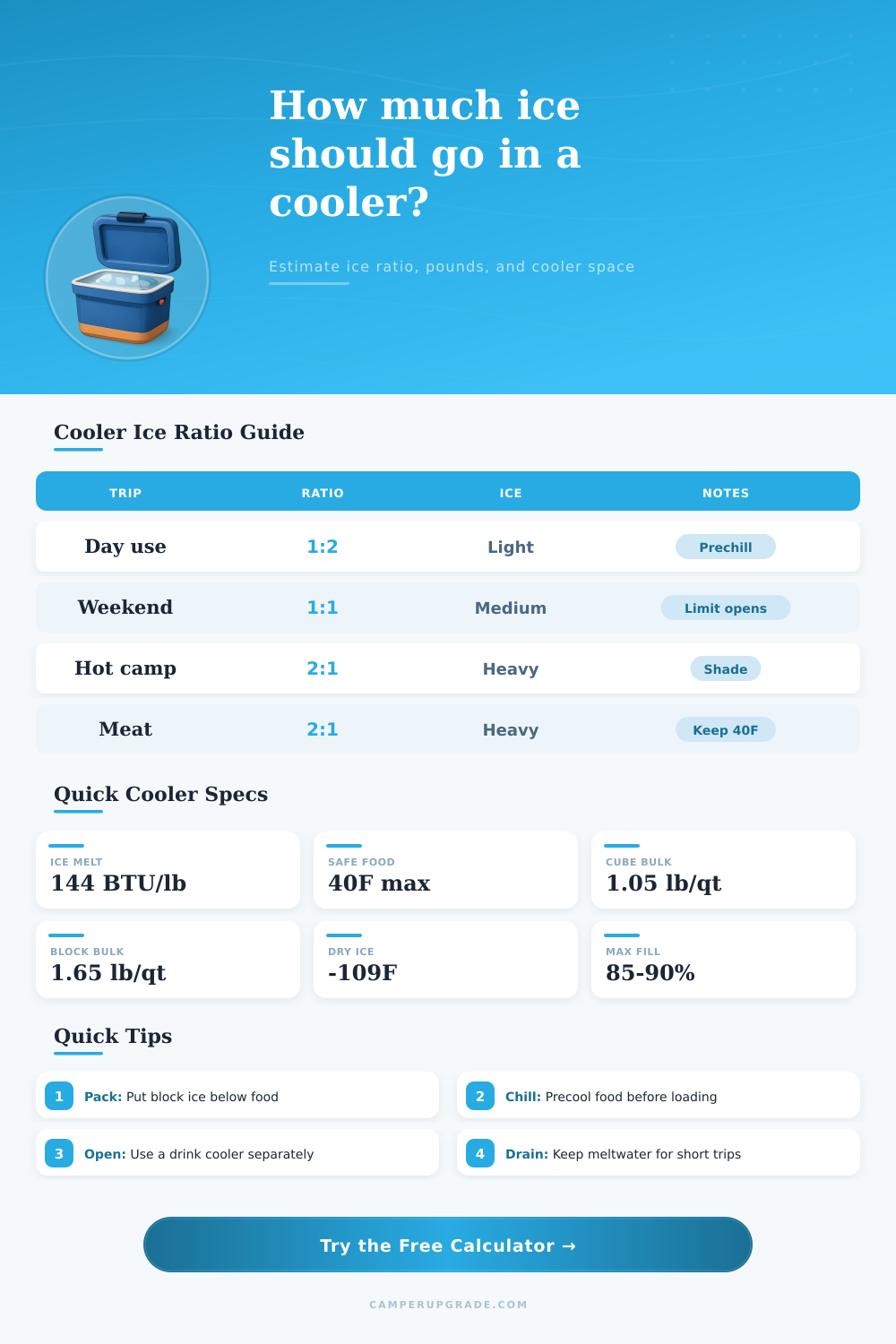
The calculator uses 144 BTU per pound of ice melted, food cooling load, estimated cooler heat gain, lid-opening heat, and packed ice bulk density.
🧊Cooler Load and Ice Spec Grid
📊Ice Ratio Reference Tables
| Camping Use | Ice:Food | Typical Hold | Best Ice |
|---|---|---|---|
| Lunch cooler or short trailhead stop | 1:2 | 6 to 10 hr | Cube or gel |
| Day-use drink cooler | 1:1 | 10 to 18 hr | Cube ice |
| Weekend mixed meal cooler | 1:1 to 1.5:1 | 36 to 60 hr | Block plus cube |
| Hot camp perishable food | 2:1 | 48 to 72 hr | Block below cube |
| Frozen food transport | 1:1 cold mass | 12 to 36 hr | Dry ice or gel |
| Cooler Size | Food Load | 1:1 Ice | 2:1 Ice |
|---|---|---|---|
| 25 qt personal | 10 qt | 10 qt / 11 lb | 20 qt / 21 lb |
| 45 qt weekend | 18 qt | 18 qt / 19 lb | 36 qt / 38 lb |
| 65 qt camp | 26 qt | 26 qt / 27 lb | 52 qt / 55 lb |
| 100 qt group | 40 qt | 40 qt / 42 lb | 80 qt / 84 lb |
| 150 qt fish | 60 qt | 60 qt / 63 lb | 120 qt / 126 lb |
| Ice Form | Bulk Density | Cooling Use | Ratio Note |
|---|---|---|---|
| Loose cube ice | 1.05 lb/qt | Fast contact cooling | Good for drinks |
| Block ice | 1.65 lb/qt | Slow melt reserve | Best at bottom |
| Crushed ice | 0.90 lb/qt | Rapid chilling | Melts faster |
| Block plus cube | 1.30 lb/qt | Balanced camping | Most flexible |
| Frozen gel packs | 1.70 lb/qt | Dry package cooling | Less contact |
| Dry ice | 1.60 lb/qt | Frozen cargo only | Vent cooler |
| Condition | Add Ice | Why | Example |
|---|---|---|---|
| Food starts at 70F | +15% to +30% | Food cooling load | Pantry drinks |
| Ambient above 90F | +20% to +35% | Heat leak rises | Desert camp |
| Opened 25+ times/day | +10% to +20% | Warm air exchange | Drink cooler |
| Soft cooler | +25% to +50% | Thin insulation | Picnic bag |
| Raw meat or fish | Use 2:1 | Safety margin | Hunt or fish trip |
🧭Practical Packing Notes
To pack a cooler effective, you need to understands how ice and heat interact within a cooler. A cooler is a container that is meant to maintain low temperatures within the cooler. However, coolers continuously loses cold air and gain heat from there environment.
If you dont manage the heat within a cooler, the ice within that cooler will melt at a rapid rate. The melting ice will heat the food in the cooler above 40 degrees Fahrenheit, which make the food unsafe to eat due to the potential growth of foodborne illness. The ratio of ice to food within a cooler is one of the first factor to consider in packing a cooler.
How to Pack a Cooler Safely
A one to one ratio of ice to food is the standard ratio to use for short trip with coolers. For trips that are longer or for warmer environments, a higher ratio of ice to food will be necessary to maintain the food at a safe temperature. In the hotter environments, the ice can provide sufficient cold to the food to prevent the growth of foodborne illnesses so a two to one ratio of ice to food is recommended.
Ice comes in different type, and each type melts at a different rate within a cooler. Cube ice is commonly used for coolers because it has a high surface area that allow it to provide quick chilling to other liquid in the cooler. However, the high surface area also allows cube ice to melt at a faster rate.
Block ice melts more slower than cube ice because of its thicker mass. You can use both type of ice within the cooler. For example, place block ice at the bottom of the cooler so that the food rest on the melted block ice and add cube ice into the cooler so that cold melted ice surrounds the food.
Another factor that will impact how much ice you need within the cooler is the construction of the cooler. Thin plastic coolers does not have the same insulation as rotomolded coolers. Therefore, a thin plastic cooler will lose cold air at a faster rate than a cooler with rotomold construction.
A rotomold cooler will have thick walls and an airtight seal to retain the cold temperatures within the cooler. Soft sided cooler bags have minimal insulation so a significant amount of ice will be required to keep the food cold within these coolers. Additionally, do not overfill the cooler.
If you pack too many food into the cooler, the ice will not be able to completely surround the food, and warm pockets will develop within the cooler wherein foodborne illnesses can grow. Another way to improve the efficiency of your cooler is to prechill the food that you will transport in the cooler. If you place room-temperature food into a cooler, the ice will have to use its thermal energy to cool the food.
If you use the cooler to cool warm food, the ice will melt quick and not remain in the cooler to keep the food cold. If you prechill the food and the cooler prior to adding the food, the ice will have fewer challenge to provide the necessary coldness to the food. This practice will allow the ice to last longer.
Cooler owners must also decide whether to drain the meltwater that form within the cooler from the melting ice. Because water is more efficient at transferring heat than air, leaving the meltwater in the cooler will help maintain the coldness of the remaining ice. However, if the trip on which you will use the cooler is long, you may need to drain the water so that the food do not float within the water.
By draining the water from the cooler, you are removing a mass of coldness from the cooler. Therefore, the removal of the coldness will cause the temperature within the cooler to rise. To pack a cooler effectively, you need to consider the ambient temperature, the insulation of the cooler, and the density of the food within the cooler.
By performing the calculation regarding the ratio of ice to food and the type of ice you use, you can ensure that the food maintains a temperature at or below 40 degrees Fahrenheit. If the calculations show that the food and ice will not last the trip in one cooler, bring a second cooler. With proper planning, you can ensure that the ice lasts for the entirety of the cooler trip while maintaining the foods safety to eat.