Cooler Ice Quantity Calculator
Estimate the ice quantity, melt load, cooler volume share, and expected cold days for camping coolers from food mass, drink volume, ambient temperature, openings, trip length, and cooler insulation.
🧊Cooler and Trip Presets
🧮Cooler Volume, Food, Weather, and Opening Inputs
This is a planning estimate for conventional water ice. Food safety still depends on thermometer readings, sealed food, clean meltwater handling, and actual cooler conditions.
⚙Ice and Cooler Spec Grid
📊Cooler Ice Reference Tables
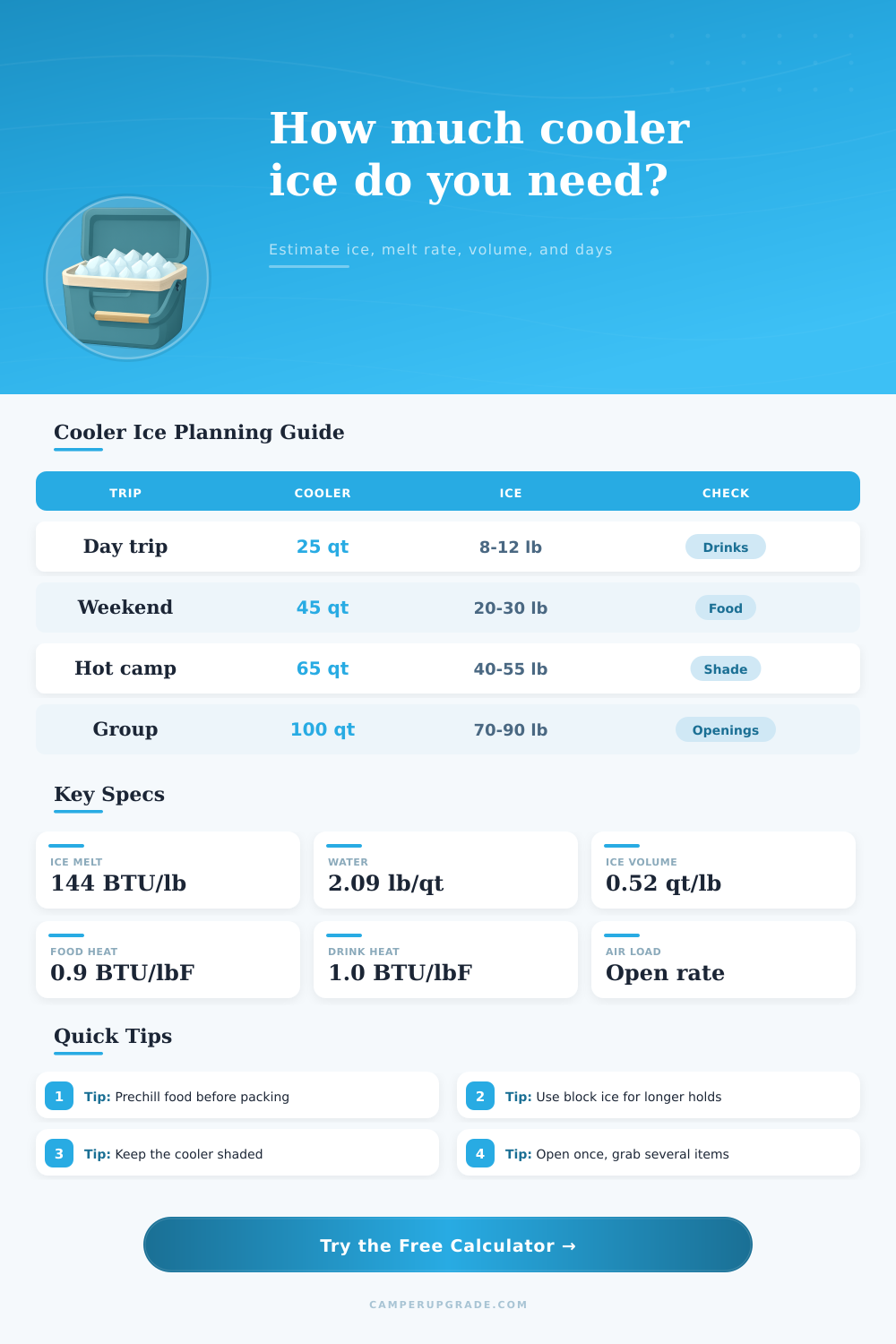
| Trip type | Cooler size | Typical ice | Main driver |
|---|---|---|---|
| Lunch or beach day | 20 to 30 qt | 8 to 15 lb | Drink chilling |
| Weekend food cooler | 40 to 55 qt | 20 to 35 lb | Food mass and openings |
| Hot weather camp | 55 to 75 qt | 40 to 60 lb | Ambient heat load |
| Group drink cooler | 70 to 120 qt | 50 to 100 lb | Openings per day |
| Overland food hold | 75 to 120 qt | 60 to 110 lb | Trip days and insulation |
| Formula | Calculation | Use | Planning note |
|---|---|---|---|
| Cooler volume | rated qt x 0.946 | Metric volume | Rated volume is before cargo |
| Food chilling | lb x 0.9 x temp drop | Initial BTU | Use zero if already colder |
| Drink chilling | qt x 2.09 x temp drop | Initial BTU | Water-like drinks |
| Ice melt | BTU / 144 | Ice pounds | Latent heat of fusion |
| Ice days | planned ice / daily melt | Trip coverage | Includes opening load |
| Opening pattern | Openings/day | Open time | Ice effect |
|---|---|---|---|
| Meal-only food cooler | 4 to 8 | 10 to 15 sec | Low air exchange |
| Shared camp cooler | 10 to 18 | 15 to 25 sec | Moderate melt add |
| Drink cooler | 25 to 50 | 8 to 15 sec | High lid load |
| Group event cooler | 50+ | 10 to 20 sec | Plan extra ice |
| Separated coolers | Lower food opens | Shorter | Better food hold |
| Ice type | Volume factor | Melt behavior | Best use |
|---|---|---|---|
| Cube ice | 0.52 qt/lb | Fast chill, faster melt | Drinks and gaps |
| Block ice | 0.50 qt/lb | Slower melt | Long food hold |
| Block plus cube | 0.51 qt/lb | Balanced | Weekend camping |
| Frozen bottles | 0.48 qt/lb | Contained meltwater | Clean food cooler |
| Kept meltwater | No extra volume | Maintains contact | Sealed foods |
💡Practical Cooler Ice Tips
Selecting an correct amount of ice for a cooler is a necesary step in keeping the food and drinks cold during the trip. Many peoples dont consider how much ice they will need for their cooler trips. When people goes on these trips without enough ice, their food and there drinks often become warm to the touch.
There are a few factor that will influence how much ice will last for the entire trip. One of the factors to consider is the amount of heat that will enter the cooler. The size of the cooler and the insulation will influence the amount of heat that enters the cooler.
How Much Ice Do You Need for a Cooler
The ambient temperature and the amount of exposure to the sun will contribute to the amount of heat that enters the cooler. The frequency of opening and closing the cooler will allow warm air to enter the cooler and cold air to exit the cooler. Based off these factors, it is possible to calculate the total amount of heat that will enter the cooler.
The amount of heat that will melt the ice can be divided by the amount of heat necessary to melt the ice to calculate the daily melt rate of the ice in the cooler. Another factor to consider is the temperature of the food and drinks. If the food and drinks are warm when they are placed in the cooler, the ice will melt to cool the food and drinks.
To avoid this problem, you can prechill the food and drinks before they are placed in the cooler. Another alternative is to prechill the cooler before the food and drinks are placed in the cooler. In both instances, the ice will last longer since the ice wont have to melt to cool the food and drinks.
The type of ice that is used also plays a role in how well the cooler will maintain the coldness of the food and drinks. Cube ice has a relatively large surface area, allowing it to quickly chill the food or drinks quickly. However, the large surface area of the cube ice will allow the ice to melt quick.
Block ice has a smaller surface area that will allow it to melt at a slower rate than cube ice. However, block ice can leave gap in the cooler. Frozen bottles can be used as a means of cooling the cooler and the food and drinks since the frozen bottles will melt the ice and keep the meltwater contained within the bottles.
The volume that the ice will occupy in the cooler is another consideration. Using a large amount of ice will take up the volume in the cooler that is available for the food and drinks. The percentage of the cooler that the ice takes up can be calculated to ensure that there is enough space for the food and drinks.
If the ice take up too much of the cooler volume, either a larger cooler can be used or the amount of food and drinks can be reduced. The frequency with which the cooler is opened is another consideration. If the cooler will be used to store drinks, it will be opened a greater number of times than a cooler that is used to store food only.
Based on this information, the cooler that is used for drinks will require more ice than the cooler that is only opened a few times. One way to manage this variable is to store the food and drinks in two cooler. Another solution is to use more ice in the cooler.
The way that the meltwater is managed in the cooler is another factor. If the meltwater is kept within the cooler, it will help keep the remaining ice cold. If the meltwater is drained from the cooler, the liquid will be removed from the cooler, but the thermal buffer that the meltwater provides will be removed from the cooler as well.
Depending on the preference of the individual, the meltwater can be kept in the cooler or drained from the cooler. The ice melt calculator will provide an estimation of the amount of ice that is necessary for the cooler. However, the amount of ice that melts can be impacted by a few additional factor.
Heat waves or placing the cooler in the sun can melt the ice at a faster rate than the calculator indicates. The temperature within the cooler can be checked with a thermometer to ensure the food and drinks are at a safe temperature. Enough ice should of been added to the cooler to ensure that the food is safe to eat and the drinks are cold.
However, the amount of ice that is added should not exceed the amount of space that the ice will take up in the cooler.