Compression Sack Size Calculator
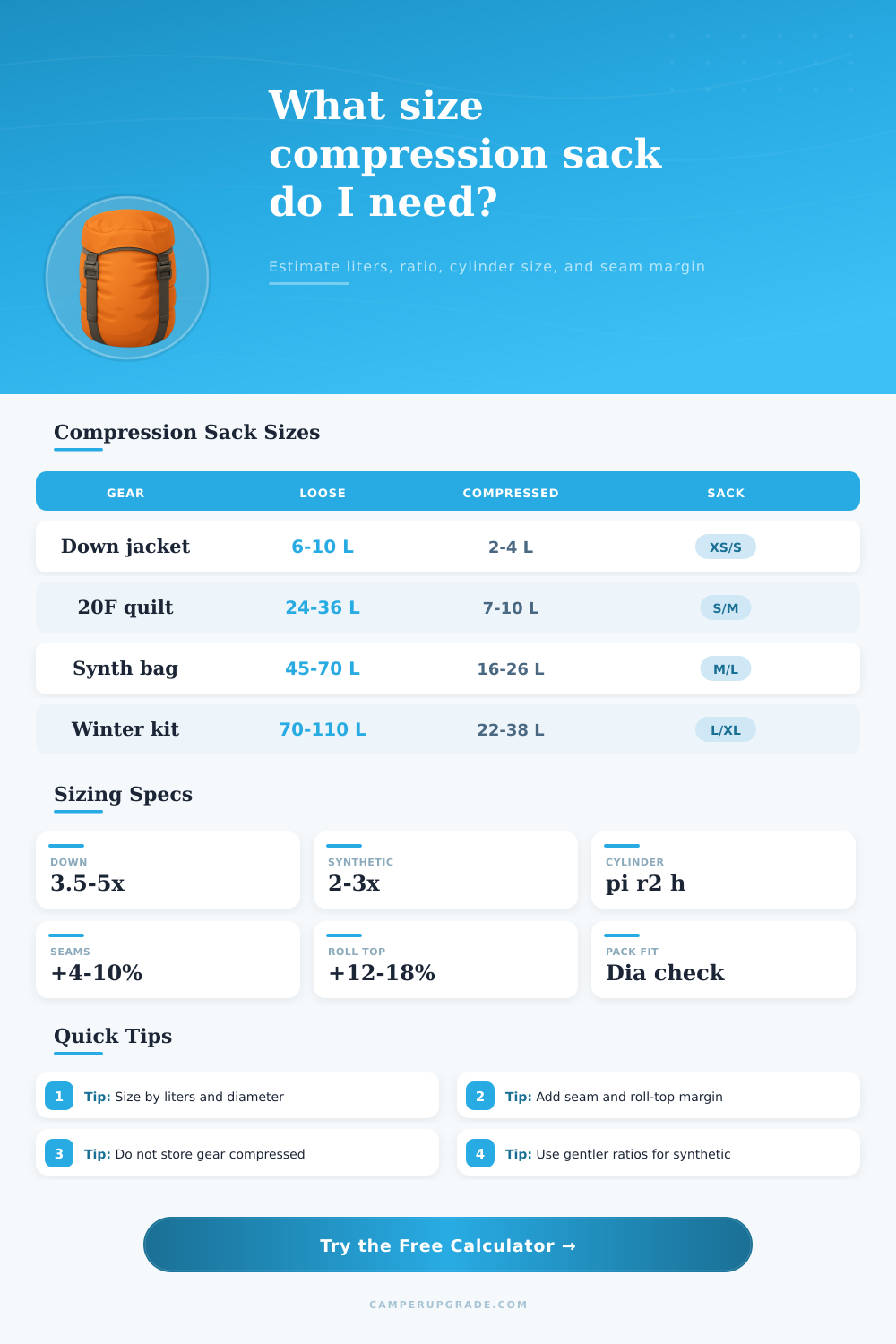
Estimate loose gear volume, realistic compression ratio, final packed liters, cylinder diameter and length, seam margin, and whether the sack will fit your pack opening.
🎒Gear Presets
📏Compression Sack Inputs
📊Compression Sack Spec Grid
📋Compression Reference Tables
| Gear Type | Normal Ratio | Short Max | Notes |
|---|---|---|---|
| Premium down | 4.0:1 to 5.0:1 | 6.0:1 | Best compression, protect from moisture |
| Standard down | 3.3:1 to 4.4:1 | 5.2:1 | Good backpacking balance |
| Light synthetic | 2.2:1 to 3.0:1 | 3.6:1 | Less fussy in damp weather |
| Heavy synthetic | 1.8:1 to 2.6:1 | 3.1:1 | Avoid hard long-term crushing |
| Fleece or wool | 1.6:1 to 2.2:1 | 2.6:1 | Bulky fibers rebound slowly |
| Sack Diameter | 12 in Body | 16 in Body | Typical Use |
|---|---|---|---|
| 5 in | 3.9 L | 5.1 L | Jacket, spare layers |
| 6 in | 5.6 L | 7.4 L | Quilt or compact down kit |
| 8 in | 9.9 L | 13.2 L | Three-season down bag |
| 10 in | 15.4 L | 20.6 L | Synthetic sleeping bag |
| 12 in | 22.2 L | 29.7 L | Winter or family bulk |
| Sack Style | Effective Volume | Margin | Best Fit |
|---|---|---|---|
| Simple stuff sack | 92% | 4% | Clothing and dry-weather bags |
| Strap compression | 96% | 8% | Sleeping bags and quilts |
| Roll-top dry bag | 88% | 16% | Boat trips and wet routes |
| Compression dry bag | 92% | 14% | Waterproof sleep system storage |
| Result | Meaning | Action | Trip Note |
|---|---|---|---|
| Loose | Ratio below target | Use smaller sack if desired | Lowest fabric stress |
| Balanced | Within normal ratio | Good planning size | Best for multi-day use |
| Firm | Above normal ratio | Use for travel only | Check synthetic rebound |
| Over-compressed | Beyond short max | Choose larger sack | Risk rises with damp gear |
💡Compression Sack Sizing Tips
In order to choose a compression sack, a persons must understand the volume of a persons gear. In order to choose a compression sack, a person also must account for how much of that gear will compress when place into the sack. Although it is tempting for a person to choose a compression sack based off the perceived size of the sack or based upon the size of the previous compression sack that a person owns, the perceived size of a sack isnt always accurate to the actual size of the sack.
Furthermore, if a person choose a sack that is too small for there gear, they will have difficulty packing there gear into the sack. In contrast, if a person chooses a sack that is too large for their gear, they will waste space in their backpack with that large sack. A person must understand the difference between the loose volume of a persons gear and the packed volume of that gear.
How to Choose the Right Compression Sack
Volumes often differ between the loose and packed gear; for instance, down gear will take up a large amount of volume when the insulation is loosened, but will take up less volume when the gear is packed into a sack. A calculator allow a person to determine the volume of their gear by accounting for the dimensions of each item and the type of fabric of each item. Furthermore, the calculator also accounts for the space that the seams, roll-tops, and small items will take up within the sack.
A person should also consider the type of fill that their gear contain. For instance, premium down will maintain its loft even when compressed, but synthetic fill may lose its loft if the insulation is compressed too much times. A person can use the calculator to choose a type of fill for their gear so that the compression ratio of their gear reflect the type of insulation that it contains.
Furthermore, the moisture levels of the gear will also affect how the fill reacts to compression, as wet fill will not regain its loft as quick than dry fill and the wet fill will be more likely to experience permanent flattening. Another factor to consider for a compression sack is the diameter of the sack. The diameter of the sack is often not discussed in the product descriptions for the sack.
For instance, a sack may be described as having a certain volume in liters, but it may be unusable if the diameter of the sack is too great for the opening of a persons backpack. The calculator will ensure that the diameter of the compression sack will fit within the backpack. A person must account for the volume that the components of a sack will consume.
For instance, the seams, end caps, and straps will consume some of the volume of the sack. These components does not factor into the advertised capacity of the sack. The calculator accounts for the volume of these components, as well as the possibility of imperfect packing of the items into the sack.
Thus, with this calculator, a person will also be able to determine if they have enough space within their pack to also include a liner and spare socks. A person should always release the compression of their gear as soon as they set up camp. Compressing insulation for long periods of time will shorten the life of that insulation.
This is especially true for synthetic insulation fill. The calculator allow a person to account for the number of days that the gear will be compressed within the sack. This ensures that a person does not compress there gear for too long.
Overall, compression sacks are tools that are used to account for the volume of a persons gear. However, they are not tools that a person should of used to permanently reshape that gear. If a person uses the real measurements of their gear to input into the calculator, the calculator will provide a reliable output regarding the correct type of compression sack for that persons gear.
By using the correct compression sack for a persons gear, they will save space within their backpack, and they will not experience the frustration of purchasing a compression sack that is too tight for their gear or more large than their gear.